What Are Polysaccharides?
Introduction
Polysaccharides represent complex carbohydrates consisting of extensive monosaccharide chains joined together through glycosidic bonds. The size of these molecules varies from small chains of a few sugar units up to massive structures of thousands and they serve essential biological functions. Polysaccharides exhibit complex structural features composed of various organizational layers which enable their multiple functional capabilities. The monosaccharide type and their linkage order along with glycosidic bond type (α or β) and branch placement form crucial elements at the primary level. Hydrogen bonds between the backbone create helices or sheets when polypeptides move to the secondary structure stage. The tertiary and quaternary structures of molecules result from non-covalent bonds between multiple molecules which lead to larger aggregates such as cellulose microfibrils. Cellulose achieves rigidity through its linear chains which are established by β-1,4-glycosidic bonds whereas starch develops branched structures because of α-1,4 and α-1,6 linkages. The distinct structural features of polysaccharides allow them to fulfill their various biological functions.
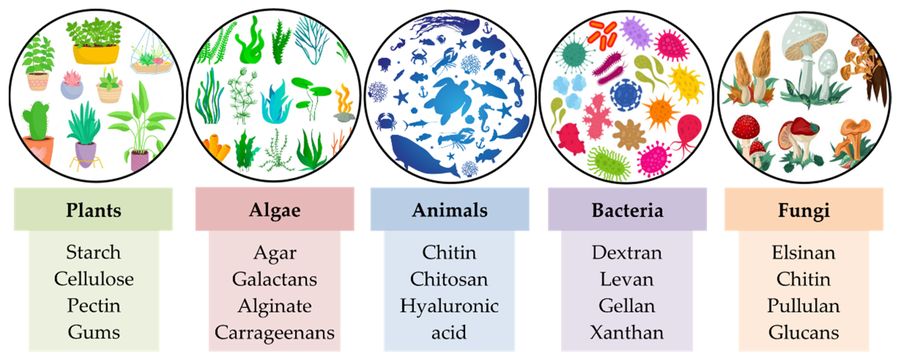 Fig.1 Polysaccharides found in nature.1
Starch vs. Non-Starch Polysaccharides
Starch is a well - known polysaccharide that plants use to store energy. It's made of glucose molecules arranged in two forms: amylose, which has linear chains, and amylopectin, which is branched. On the flip side, non - starch polysaccharides (NSPs) are found in plant cell walls. They include cellulose, hemicellulose, and pectin. NSPs are important for plant cell structure and are also dietary fibers.
|
Property
|
Starch
|
Non-Starch Polysaccharides (NSPs)
|
|
Monosaccharide Composition
|
Primarily glucose
|
Varies (e.g., glucose, xylose, arabinose)
|
|
Function
|
Energy storage
|
Structural support, dietary fiber
|
|
Solubility
|
Soluble in water
|
Generally insoluble (except pectin)
|
|
Glycosidic Bond Type
|
α - 1,4 and α - 1,6 glycosidic bonds
|
Mostly β - 1,4 bonds
|
Structural Polysaccharides vs. Storage Polysaccharides
Another way to categorize polysaccharides is by their function.
-
Storage Polysaccharides: These are all about storing energy. Starch in plants and glycogen in animals are the main ones.
-
Structural Polysaccharides: They give cells and organisms their shape and strength. Cellulose in plants and chitin in arthropods are great examples.
Examples of Common Polysaccharides
There are some well - known polysaccharides that you might have heard of.
-
Starch: The primary energy storage molecule in plants, made of glucose units.
-
Cellulose: A structural polysaccharide in plants, forming β-1,4-linked glucose chains.
-
Glycogen: The animal equivalent of starch, stored in liver and muscles.
Types of Polysaccharides
Polysaccharides are categorized by their monosaccharide composition and glycosidic bonds:
-
Homopolysaccharides: Single monosaccharide type (e.g., starch, cellulose).
-
Heteropolysaccharides: Multiple monosaccharides (e.g., hyaluronic acid, pectin).
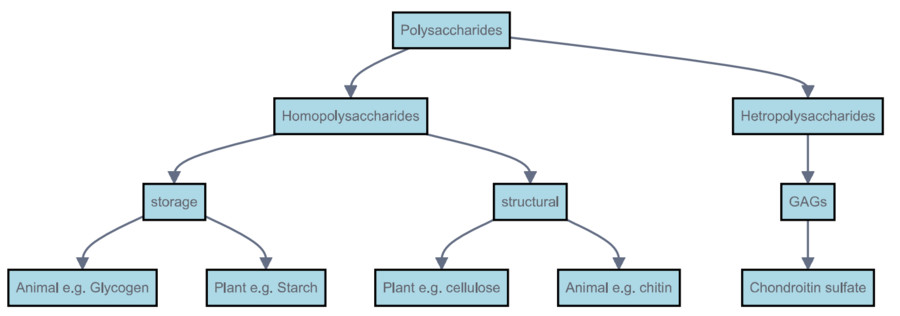 Fig.2 Polysaccharides classifications based on the type of monosaccharides.
Polysaccharides are made through enzymatic processes. Enzymes are like little workers that help monosaccharides stick together to form long chains with glycosidic bonds. This can happen inside or outside the cell, depending on the polysaccharide and the organism. Enzymatic modification is really important during this process. It decides how the polysaccharide is structured, whether it's branched, and what it can do. For example, the enzyme hyaluronan synthase makes hyaluronic acid, which is a key part of connective tissue. At Creative Biolabs, we're the go - to guys for polysaccharide synthesis! We've got a bunch of services that are customized to fit what researchers and industry folks need.
|
Service
|
Details
|
|
Custom Synthesis
|
We can design and make polysaccharides for all sorts of uses, whether it's for making drugs, in biotech, or other industries. Our team is great at coming up with solutions that are just right for your project.
|
|
Enzymatic Engineering
|
Our advanced enzymatic modification services can make polysaccharides even better. We can improve things like how well they dissolve, how stable they are, and how active they are biologically.
|
Check out our polysaccharide synthesis services to see how we can help your research with the latest and greatest solutions.
If you want to really understand what a polysaccharide can do, you need to look at its structure, how heavy it is (molecular weight), and what it's made of. There are lots of techniques for this, and each one gives you different information. At Creative Biolabs, we've got you covered with polysaccharide analysis! Our polysaccharide analysis services cover every part of characterizing polysaccharides.
|
Service
|
Details
|
|
Structural Elucidation
|
We use NMR, MS, and HPLC to figure out the detailed structure of polysaccharides.
|
|
Molecular Weight Characterization
|
We use GPC and other techniques to analyze how the molecular weight is distributed and how polydispersed the polysaccharide is. This helps you understand its properties better.
|
|
Functional Group Analysis
|
We can find and measure the functional groups that you might want to change chemically. This is really useful for modifying polysaccharides to do what you want them to.
|
New Chemical Modification Methods for Polysaccharides
Chemical modifications can really level up the properties and functions of polysaccharides. Here are some cool techniques:
-
Selenium Modification: Adding selenium groups to polysaccharides can make them better at fighting off free radicals and reduce the harm from heavy metals. It's like giving the polysaccharide a superpower!
-
Zinc Modification: Zinc chelation can make polysaccharides better at fighting cancer, like what we've seen with Lycium barbarum polysaccharides.
-
Alkylation: This modification makes polysaccharides dissolve better and work better as emulsifiers. It's great for using polysaccharides in food and cosmetics.
Click chemistry is also a really powerful tool. It can add specific functional groups to polysaccharides with high accuracy and efficiency. Dual group derivatization takes it a step further by adding two functional groups at once. This can make the polysaccharide even more bioactive or perfect for a specific use.
Polysaccharides serve vital functions within biological systems and find numerous applications across various industrial sectors. Creative Biolabs has developed extensive experience with polysaccharides during several years in the industry. Through our synthesis, analysis, and modification services researchers can fully utilize polysaccharides for their projects. Our expertise and resources enable us to assist you regardless of whether you work in pharmaceuticals or biotechnology or any other field. Contact Creative Biolabs for any support you require with your polysaccharide research. Our team stands ready to develop tailor-made solutions for your work on drug delivery systems or structural polysaccharides and their enzymatic modification. Our polysaccharide synthesis service or polysaccharide analysis service provide detailed information. We're ready to collaborate with you to advance your polysaccharide research projects.
Reference
-
Díaz-Montes, Elsa. "Polysaccharides: Sources, characteristics, properties, and their application in biodegradable films." Polysaccharides 3.3 (2022): 480-501. Distributed under Open Access license CC BY 4.0, without modification. https://doi.org/10.3390/polysaccharides3030029
Related Services
Resources
For Research Use Only.