Marine Oligosaccharides
Marine oligosaccharides (MAOs) are short-chain saccharides (typically 3–10 monosaccharide units derived from complex marine polysaccharides such as agar, carrageenan, ulvan, fucoidan, chitosan, and others. Their fine structure—degree of polymerization, linkage patterns, sulfation, branching—shapes their bioactivity. These molecules mediate microbial recognition, ion balance in algae, and defense mechanisms, and serve as biologically active compounds in marine ecosystems. From a biological perspective, marine oligosaccharides offer high solubility, improved bioavailability, and tunable functional properties, making them ideal for diverse biotechnological applications. As interest in functional oligosaccharides continues to grow, Creative Biolabs offers comprehensive custom oligosaccharide synthesis and oligosaccharide structural analysis services to support the development of high-purity marine oligosaccharides for research use.
Marine Oligosaccharides Sources
Most MAOs originate via hydrolysis or enzymatic degradation of seaweed polysaccharides:
-
Agar-oligosaccharides (AOS) and neoagaro-oligosaccharides from red algae (e.g. Gracilaria, Gelidium)
-
Carrageenan-oligosaccharides (κ, ι, λ types), distinguished by sulfation and repeating disaccharide units
-
Ulvan-oligosaccharides from green algae (Ulva genus), generated via ulvan lyase enzymes that cleave glucuronic-rhamnose backbones
-
Fuco-oligosaccharides, degraded low-molecular weight forms of fucoidan extracted from brown algae (e.g. Fucus vesiculosus, Laminaria)
-
Chitosan oligosaccharides (COS)—β-(1→4) D-glucosamine chains—from chitin deacetylation and enzymatic digestion
|
Polysaccharide source
|
Marine oligo types
|
Typical linkages & modifications
|
|
Agar / agarose
|
AOS / NeoAOS
|
α-/β-galactose, occasional sulfation
|
|
Carrageenan (κ, ι, λ)
|
CarrAOS
|
Sulfated galactose polymers
|
|
Ulvan (green algae)
|
Ulvan-oligos (UOs)
|
Rhamnose–glucuronic acid, sulfated
|
|
Fucoidan (brown algae)
|
Fuco-oligos
|
Fucose backbone ± galactose/xylan, sulfated
|
|
Chitin/chitosan (crustacea)
|
COS
|
β-(1→4)-linked glucosamine, acetyl derivatives
|
Marine Oligosaccharides Bioactivities & Mechanisms
Marine oligosaccharides display confirmed biological activities across several models:
-
Immunomodulation & anti-inflammatory: MAOs modulate cytokines (e.g. IL-1, TNF) to reduce inflammation in autoimmune and inflammatory models. Fuco-oligos reportedly suppress inflammatory mediator expression and support immune homeostasis.
-
Antioxidant & anti-aging: Agaro-oligos and carrageenan-oligos demonstrated scavenging activity against reactive oxygen species and photoprotective effects. Certain PACOs attenuated glutamate-induced neural cell death by reducing ROS and mitochondrial dysfunction.
-
Prebiotic & gut-microbiota modulation: Marine oligosaccharides act as prebiotics, promoting short-chain fatty acid production, enhancing Bifidobacterium populations, and regulating gut-lipid metabolism and glycemic control.
-
Metabolic regulation: Agar-oligos and fuco-oligos inhibit α-glucosidase, delaying carbohydrate digestion and blunting postprandial glucose surges.
-
Muscle and tissue effects: Recent work from showed 10–30 kDa agaro-oligosaccharides (from Rheinheimera sp.) significantly increased myotube diameter, hypertrophy rate, and expression of myosin heavy-chain genes in C2C12 cells—implying potential in muscle function modulation.
Creative Biolabs Platform & Services
At Creative Biolabs, we combine scientific rigor with CRO-grade workflow:
-
Source selection: Tailored algal species & microbial fermentation.
-
Hydrolysis control: Predictable DP via enzymatic or chemical processing.
-
Structural analysis: ESI-MS, MALDI-MS, HPLC, NMR, sulfation/acetylation mapping.
-
Bioactivity screening: In-vitro assays—antioxidant, anti-inflammatory, myotube assays, enzyme inhibition, SCFA in microbiota cultures.
-
Regulatory compliance: Quality control aligned with GRAS status for fucoidan derivatives, endotoxin assessment where needed.
Production Methods
Creative Biolabs and collaborators apply multi-tiered methods:
-
Physical hydrolysis: Controlled acid/alkaline treatment or heat-induced depolymerization offers scalability but risks random cleavage and variable DP.
-
Enzymatic hydrolysis: Specific carbohydrases like agarases, carrageenases, ulvan lyases tune degree of polymerization and preserve functional groups such as sulfates.
-
Chemical modification: N- or O-acetylation, sulfation, or per-acetylation to enhance biological potency. PACOs show superior neuroprotective effects in PC12 cell models compared to N-acetylated or native COS.
Analytical Characterization
We use high-strength analytical methods for glycan analysis:
Marine oligosaccharides fuse marine biodiversity with glyco-biotech innovation. Their compact size, defined structure, and functional versatility make them powerful ingredients in food, cosmetic, nutraceutical, and research sectors. Creative Biolabs delivers end-to-end solutions—from controlled enzymatic production and structural analysis to targeted bioactivity validation and regulatory support. We welcome inquiries for custom oligosaccharides synthesis and comprehensive oligosaccharides analysis, please contact us for more service details.
Published Data: Agaro-oligosaccharides from Marine Bacteria
In a 2024 study, researchers isolated a marine bacterium from seawater near Shimabara, Nagasaki, identified as Rheinheimera sp. (HY) via 16S rRNA sequencing, showing 93-94 % similarity to Rheinheimera sp. WMF-1. The bacterium produced crude agarase enzymes that preferentially hydrolyzed agarose over other polysaccharides, with optimal activity at pH 10 and 50 °C and specificity for α-galactosidic linkages. The hydrolytic products—agaro-oligosaccharides sized between 10–30 kDa—were applied to differentiated C2C12 myotubes at a concentration of 2 000 µg/mL. Compared to untreated controls, treated myotubes showed significantly increased hypertrophy rate and cell diameter, accompanied by upregulated expression of myosin heavy-chain genes (MyH3, MyH7, MyH4), as measured by RT-PCR. These results demonstrate that marine bacteria-derived agaro-oligosaccharides can enhance muscle mass at the cellular level and suggest their potential utility in functional food or nutraceutical development focused on muscle health
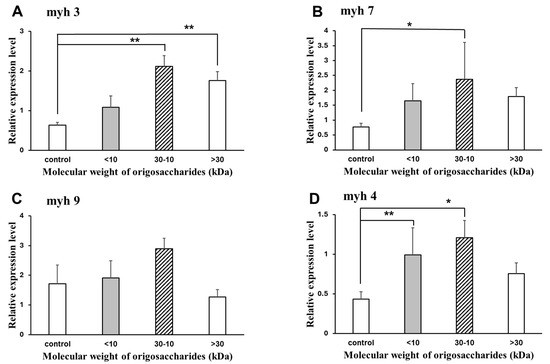 Fig.1 Agaro-oligosaccharide mixture enhances myosin heavy chain gene expression in C2C12 myotubes.1
Reference
-
Huang, Youshi, et al. "The Effects of Agaro-Oligosaccharides Produced by Marine Bacteria (Rheinheimera sp.(HY)) Possessing Agarose-Degrading Enzymes on Myotube Function." Marine Drugs 22.11 (2024): 515. Distributed under Open Access license CC BY 4.0, without modification. https://doi.org/10.3390/md22110515
Related Services
Resources
For Research Use Only.