Soybean Oligosaccharides
Soybean oligosaccharides (SBOSs), a group of water-soluble carbohydrates naturally found in soybeans, have gained increasing recognition as powerful non-digestible prebiotics. These unique oligosaccharides play a crucial role in shaping the gut microbiota and enhancing immune function, making them an essential component in the growing field of functional foods and microbiome-targeted therapies. At Creative Biolabs, we are proud to offer decades of glycomics expertise to support the development and application of plant-derived oligosaccharides, including SBOSs. We specialize in custom oligosaccharide synthesis solutions, where we provide tailored synthesis of various oligosaccharides based on your specific research or product needs. Additionally, our oligosaccharide profiling and analytical services provide comprehensive support in analyzing the structure, purity, and bioactivity of your oligosaccharide samples. From HPLC and mass spectrometry to microbiota fermentation assays, we offer a range of state-of-the-art technologies to ensure your oligosaccharides meet the highest standards.
Soybean Oligosaccharides Introduction
Soybean oligosaccharides are short-chain carbohydrates composed primarily of raffinose, stachyose, and sucrose units. They belong to the raffinose family of oligosaccharides (RFOs). The α-1,6 and α-1,2 glycosidic linkages in SBOSs resist hydrolysis by human digestive enzymes. Once they reach the colon, SBOSs serve as substrates for beneficial bacteria such as Bifidobacterium spp., Lactobacillus spp., Faecalibacterium prausnitzii. For soybean-derived oligosaccharides, high-performance liquid chromatography (HPLC) remains the gold standard, offering nanogram-level quantification with sub-microgram sensitivity, while tandem mass spectrometry and GC-MS unravel exact monosaccharide signatures and linkage patterns; high-speed LC further extends robustness to highly contaminated matrices. A critical caveat is that ethanolamine derivatization fails to detect sucrose, making arginine-based fluorescent tagging the preferred alternative for accurate profiling of raffinose–stachyose–sucrose mixtures in tofu wastewater.
Soybean Oligosaccharides Biological Functions and Health Benefits
Modulation of Gut Microbiota
Consistent in vivo evidence demonstrates that SBOS selectively elevate Bifidobacterium and Lactobacillus alongside butyrate-producers such as Faecalibacterium and Akkermansia, while suppressing pathogens including Clostridium perfringens and E. coli, thereby fostering a resilient, beneficial community.
Immune Regulation
SBOS enhance both mucosal and systemic immunity by:
-
Activating macrophage phagocytosis and antigen presentation.
-
Increasing mucosal IgA, serum IgG and balanced cytokine profiles (IL-2, IL-10, IFN-γ).
In rodent studies, SBOS supplementation elevated spleen and thymus indices and promoted coordinated humoral and cellular responses without overt inflammation.
Anti-inflammatory Effects
By fueling microbial synthesis of SCFAs—especially butyrate—SBOS attenuate colonic inflammation dose-dependently:
-
Reducing pro-inflammatory cytokines
-
Inhibiting nuclear factor-κB (NF-κB) activation
-
Promoting regulatory T-cell (Treg) differentiation
Analytical Characterization Techniques for Soybean Oligosaccharides
At Creative Biolabs, we employ cutting-edge analytical platforms to verify SBOS identity, purity, and bioactivity. These platforms ensure SBOS products meet precise compositional and biological standards.
-
HPAEC-PAD: Quantification of individual oligosaccharides
-
MALDI-TOF-MS: Mass spectrometry-based glycan profiling
-
NMR Spectroscopy: Structural verification
-
Microbiota Assays: In vitro fermentation profiling with human fecal microbiota
Soybean oligosaccharides represent a scientifically validated, naturally derived tool for microbiome modulation and immune health. Their non-digestible structure enables selective stimulation of beneficial gut microbes, while their fermentation products contribute to host homeostasis. Supported by decades of glycomics innovation and a robust analytical infrastructure, Creative Biolabs is your partner for advancing SBOS research into impactful applications across food, health, and therapeutics. Contact Us to discuss your SBOS-based formulation, screening, or biomodulation project.
Published Data
One study integrates two complementary HPLC-RI chromatograms that together provide a definitive compositional map of the soybean oligosaccharides (SBOS) recovered from tofu-processing wastewater. In panel (a), a cocktail of authentic standards—glucose, sucrose, raffinose and stachyose—was first separated on an Ultrahydrogel column train under isocratic aqueous conditions; the symmetrical peaks elute in ascending order of molecular size at 36.91, 35.03 and 33.87 min, respectively, establishing a precise retention-time dictionary. This calibration frame is immediately exploited in panel (b), where the same chromatographic platform was applied, without any parameter change, to the crude SBOS powder and to its three Sephadex G-15 sub-fractions (Z1, Z2 and Z3). Six discernible peaks appear in the crude extract; integration shows that stachyose (40.1%), raffinose (9.2%) and sucrose (23.4%) dominate, alongside minor saccharides, confirming that the waste stream is a genuine oligosaccharide resource. Subsequent fractionation enriches these species differentially: Z1 emerges as essentially pure stachyose (100%), Z2 contains a balanced ternary mixture of stachyose, raffinose and sucrose at 60%, 28%, 12%, while Z3 is inverted to a sucrose-majority blend (68%). The retention-time fidelity across both panels underlines the robustness of HPLC-RI for simultaneous qualitative identification and quantitative profiling, and sets the analytical groundwork for the ensuing fermentation and microbiota studies.
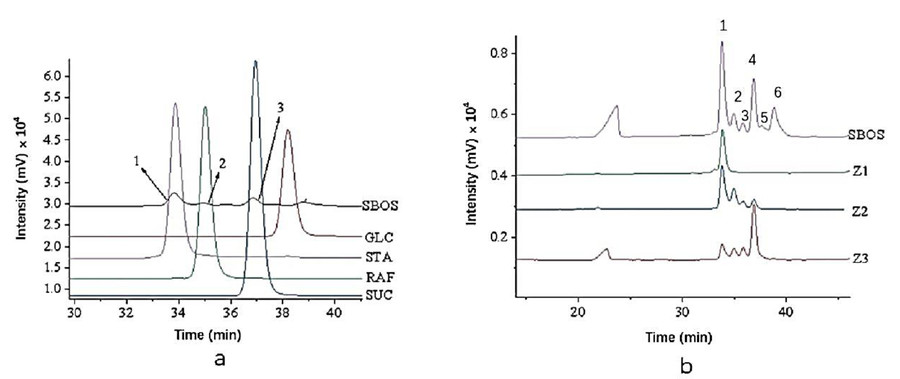 Fig.1 HPLC-RI fingerprints reveal oligosaccharide compositions of tofu-wastewater SBOS.1
Reference
-
Wang, Yuling, et al. "In vitro fermentability of soybean oligosaccharides from wastewater of tofu production." Polymers 14.9 (2022): 1704. Distributed under Open Access license CC BY 4.0, without modification. https://doi.org/10.3390/polym14091704
Related Services
Resources
For Research Use Only.