End-to-End Preclinical Services for CCL22-Targeted Cancer Vaccines
Creative Biolabs provides end-to-end preclinical development services for CCL22-based cancer therapy and immunomodulatory vaccines. The platform covers antigen discovery from the tumor microenvironment (TME), MHC-binding epitope prediction and validation, peptide synthesis, vaccine formulation, potency testing, in vivo efficacy evaluation, and translational support. This service is ideal for researchers developing therapeutic vaccines that re-shape the TME by targeting the CCL22 chemokine, for teams exploring anti-Treg strategies in solid tumors, and for programs that need preclinical evaluation of combination regimens with checkpoint inhibitors. Our scientists can deliver sample strategy, custom peptide design, multi-color flow cytometry panels, tumor-infiltrating lymphocyte (TIL) profiling, and integrated preclinical study packages aligned with your indication, mouse strain, and translational roadmap.
Why Target CCL22 to Re-Shape the Tumor Microenvironment?
A Central Chemokine of Treg Recruitment
CCL22 (also known as macrophage-derived chemokine, MDC) is a C-C motif chemokine secreted by tumor cells, tumor-associated macrophages, and dendritic cells. By engaging its receptor CCR4 on FOXP3+ regulatory T cells (Tregs), CCL22 acts as the dominant chemokine that drives Treg accumulation in many solid tumors. Preclinical evidence shows that disrupting the CCL22:CCR4 axis—either by eliminating CCL22-producing cells or by blocking CCR4 signaling—shifts the TME toward a pro-inflammatory state, increasing the CD8/Treg ratio and improving responsiveness to immune checkpoint inhibition.
Unlike receptor antagonists that risk systemic depletion of CCR4+ T cells, a CCL22-targeted vaccine trains the patient's own CD4+ and CD8+ T cells to recognize and kill CCL22-producing cells in the TME, offering a more selective, durable, and lower-risk path to immune modulation.
- Core Preclinical Challenges We Address:
- Selecting naturally processed CCL22 epitopes presented on MHC class I and II.
- Designing multi-epitope peptide pools that cover strain-specific MHC backgrounds (H2-Db, H2-Ld, HLA-A2).
- Quantifying CD8/Treg and M1/M2 ratios in tumor-infiltrating immune cells after vaccination.
- Evaluating synergy with anti-PD-1, anti-PD-L1, or anti-CTLA-4 agents in in vivo models.
Why CCL22-Targeted Vaccines Differ from Other Anti-Treg Strategies?
| Key Comparison | Direct CCR4 Blockade (e.g., Antibodies) | CCL22-Targeted Vaccines |
|---|---|---|
| Mechanism of Action | Antibody-dependent depletion of all CCR4+ cells, including peripheral effector T cells. | Selective T cell killing of CCL22-producing cells in the TME. |
| Selectivity | Broad; affects CCR4+ Tregs, Th2 cells, and some DC subsets. | Restricted to cells actively producing CCL22 in the tumor bed. |
| Durability of Response | Requires repeated dosing; effect wanes between cycles. | Memory T cell expansion enables long-term immune surveillance. |
| Combinability | Limited overlap with checkpoint blockade; risk of compounding irAEs. | Designed for synergy with anti-PD-1/PD-L1 and anti-CTLA-4. |
| Risk of Autoimmunity | Higher; FOXP3+ Treg depletion can trigger systemic autoimmunity. | Lower; effector lymphocytes outside the TME are not directly targeted. |
Modular Service Packages for CCL22-Targeted Vaccine Programs
Our preclinical services are organized into flexible modules that can be combined end-to-end or used individually. Every package is fully customizable—from peptide length and adjuvant selection to mouse model choice—to align with your tumor indication, target HLA/MHC background, and translational milestones.
Antigen Mapping & Epitope Design
Bioinformatic and experimental identification of naturally processed CCL22 epitopes presented by MHC molecules.
- Sequence Analysis: Full-length CCL22 mapping, including the signal peptide region critical for cross-presentation.
- MHC Binding Prediction: Algorithms applied to mouse (H2-Db, H2-Ld, H2-Kb) and human (HLA-A2, -A3, -B7) alleles.
- 20mer Library Design: Overlapping peptide libraries for T cell recall screening in vitro.
- Conservation Check: Cross-species comparison to select conserved immunogenic regions.
Peptide Synthesis & Formulation
High-purity peptide production with adjuvant screening for optimized immunogenicity.
- Custom Synthesis: Short (8–11mer) MHC-I and long (15–25mer) MHC-II peptides with verified purity ≥80%.
- Peptide Pooling: Multi-epitope pools for broad immune coverage.
- Adjuvant Screening: Montanide, poly-ICLC, and TLR agonist pairing for Th1 polarization.
- Quality Control: Mass spectrometry verification and endotoxin monitoring.
Vaccine Construct Engineering
Multi-format vaccine design to match your delivery route, dosing schedule, and target species.
- Synthetic Long Peptides: SLP constructs incorporating CD4+ and CD8+ epitopes.
- DC Loading: Ex vivo DC pulsing with CCL22 peptides for cell-based vaccines.
- mRNA Constructs: Codon-optimized mRNA encoding CCL22 epitopes for nucleic acid delivery.
- Viral Vectors: Lentiviral and adenoviral vector backbones for stable antigen expression.
Multi-Color Flow Cytometry Panels
Deep phenotypic profiling of vaccine-induced responses in spleen, lymph nodes, and tumor.
- T Cell Panels: CD4, CD8, FOXP3, CCR4, PD-1, TIM-3, and IFN-γ intracellular staining.
- Myeloid Panels: CD11b, F4/80, CD86 (M1), CD206 (M2) for macrophage polarization analysis.
- TIL Analysis: Tumor dissociation protocols optimized for syngeneic and humanized models.
- Reagent QC: Lot-to-lot antibody validation and viability dye controls.
In Vivo Efficacy Studies
Predefined endpoints for monotherapy and combination regimens across tumor models.
- Syngeneic Models: CT26 (colon), B16 (melanoma), 4T1 (breast).
- Humanized Models: NSG and BRG variants for human CCL22-specific T cell evaluation.
- Combination Arms: Anti-PD-1, anti-PD-L1, anti-CTLA-4 dosing schedule design.
- Readouts: Tumor growth, survival, TIL composition, cytokine profiling, TCR sequencing.
Data Package & Translational Support
Comprehensive preclinical documentation aligned with IND-enabling workflows.
- Mechanism Studies: CCL22 quantification in TME by ELISA and multiplexed cytokine assays.
- Repertoire Analysis: TCR β-chain sequencing of vaccine-expanded T cell clones.
- Documentation: Preclinical study reports suitable for IND or grant submission.
- Safety Readouts: Body weight, hematology, and histopathology screening.
Optimized Preclinical CCL22-Targeted Vaccine Development Workflow
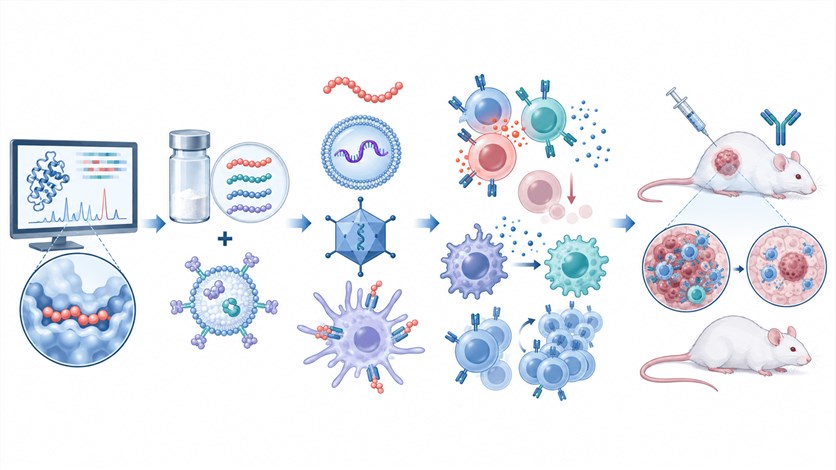
Phase 1 — CCL22 Antigen Mapping & Epitope Selection
We combine bioinformatic MHC binding analysis with experimental validation to identify naturally processed CCL22 epitopes. The signal peptide region, which is cleaved prior to secretion, is prioritized because it is efficiently loaded onto MHC class I and presented by tumor and antigen-presenting cells.
Enabling Technologies for CCL22 Vaccine Discovery
Why Choose Creative Biolabs?
Specialized in tumor-microenvironment antigens (TMAs) including chemokine- and cytokine-targeted vaccines, complementing checkpoint and neoantigen approaches.
From synthetic long peptides to mRNA and DC-pulsed formats, we deliver the construct that best fits your indication and preclinical timeline.
Beyond tumor volume, we quantify CD8/Treg and M1/M2 ratios, intratumoral chemokine levels, and TCR clonal expansion to capture the full immune signature.
Design support for anti-PD-1/PD-L1/CTLA-4 combination arms and biomarker-driven stratification within the same preclinical package.
Research Insight: Targeting the CCL22:CCR4 Axis to Re-Shape the TME
Key Findings from Preclinical & Translational Studies
Disrupting the CCL22:CCR4 axis has emerged as a focal strategy for converting "cold" tumors into inflamed, immune-permissive environments. By training the immune system to recognize and remove CCL22-producing cells, vaccine approaches can selectively suppress Treg recruitment without broadly depleting peripheral immune populations.
-
Selective TME Reprogramming: Vaccines targeting CCL22 preferentially decrease intratumoral CCL22 levels while sparing CCR4+ effector T cells in circulation. This translates into a higher CD8/Treg ratio and a measurable shift toward M1 macrophage polarization in tumor lesions.
-
Robust Immune Memory: CCL22-specific memory T cells persist after vaccination and respond rapidly upon re-exposure to CCL22-producing cells, providing durable protection against tumor recurrence in aggressive syngeneic models.
-
Synergy with Checkpoint Inhibitors: Combining CCL22-targeted vaccines with PD-1/PD-L1 blockade overcomes resistance by lowering local immunosuppression and increasing the proportion of IFN-γ-producing CD8+ TILs, improving tumor regression and survival outcomes.
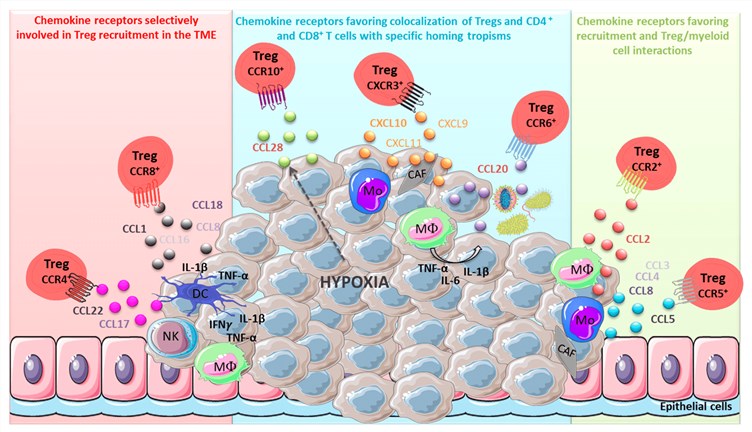
Fig.1 Chemokine/receptor axes for Treg recruitment and chemokine production in the TME.1.2