Preclinical Cancer Transcriptome Profiling Powered by the HARCS Platform
Creative Biolabs provides end-to-end preclinical HARCS platform-based cancer transcriptome assays, covering project design, RNA extraction from challenging FFPE and low-input samples, strand-specific library preparation, high-depth sequencing, alignment and quantification, differential expression analysis, alternative splicing profiling, fusion-transcript detection, miRNA and long non-coding RNA characterization, and downstream pathway and biomarker interpretation. This solution is suited to researchers who need to compare tumor vs. normal transcriptomes, identify expression-based biomarkers, profile immune-related signatures, discover non-coding RNA biomarkers, validate splicing events, or screen for actionable fusions. Our team delivers sample and study strategy consultation, customized wet-lab and bioinformatics workflows, transparent QC checkpoints, structured data deliverables, and integrated preclinical study packages tailored to your tumor indication, RNA input quality, and translational goals.
Why the Transcriptome Carries the Most Direct Disease Signal
Downstream of the Genome, Upstream of the Phenotype
The transcriptome is the most direct downstream molecule of genetic variation and the most immediate upstream driver of cellular phenotype. For cancer biomarker discovery, transcript-level screening offers a decisive advantage over mutation-only profiling: loss-of-function mutations occur at relatively low frequency between cancer patients, so a single variant rarely serves as a robust predictive biomarker. In contrast, quantitative comparison of transcriptomes between samples exposes subtle shifts in gene expression, isoform usage, and non-coding RNA activity that collectively describe how a tumor is actually behaving in vivo and in vitro.
Most archived cancer specimens are FFPE-fixed, where DNA tends to survive but RNA is heavily fragmented and chemically modified. A platform that can rescue transcriptome information from such samples unlocks the largest existing archive of cancer tissue and makes retrospective biomarker studies possible.
- Core Preclinical Challenges We Address:
- Recovering usable sequencing data from FFPE samples with degraded and partially modified RNA.
- Distinguishing tumor cell transcripts from stromal and immune-cell background in bulk data.
- Capturing mRNA, miRNA, and long non-coding RNA in a coordinated profiling run.
- Turning millions of expression measurements into a small set of biologically interpretable biomarkers.
How HARCS Cancer Transcriptome Differs from Generic RNA-seq?
| Key Comparison | Generic RNA-seq Workflow | HARCS Cancer Transcriptome Assay |
|---|---|---|
| FFPE Sample Compatibility | Variable; often needs re-extraction or rRNA depletion tweaks. | Optimized chemistry for fragmented FFPE RNA with built-in quality gating. |
| Coverage & Resolution | Standard gene-level counts; isoform signal often lost. | Deep coverage across mRNA, miRNA, and lncRNA with isoform-level resolution. |
| Fusion & Splicing Detection | Requires extra dedicated assays or pipelines. | Built-in fusion transcript and alternative splicing profiling from the same library. |
| Biomarker-Ready Output | Raw counts; interpretation left to the client. | Pathway, immune-signature, and candidate biomarker tables delivered with every project. |
End-to-End Cancer Transcriptome Service Packages
Our preclinical cancer transcriptome services are structured into flexible, modular packages. We understand that every project is unique; therefore, all modules can be fully customized—from RNA input requirements to bioinformatics depth—to align with your tumor indication, sample type, and downstream translational goals.
Project Design & Sample Strategy
Strategic planning and optimized sample processing to ensure high-quality starting material for transcriptome profiling.
- Indication Evaluation: Tumor indication review and feasibility based on sample availability.
- Customized Sampling: Processing protocols for FFPE, fresh-frozen tissue, plasma exosomes, and sorted cell populations.
- RNA QC Gating: DV200, RIN, and yield thresholds defined up-front for every sample class.
- Customized Path: Tailored timelines, sequencing depth targets, and risk mitigation strategies.
RNA Extraction & Library Preparation
High-recovery RNA purification and strand-specific library construction adapted to each sample type.
- Total RNA Recovery: Optimized extraction from low-input and FFPE-derived material.
- rRNA Depletion: Ribosomal RNA removal with broad species coverage for comprehensive profiling.
- Strand-Specific Libraries: Retain transcript orientation for accurate antisense and overlapping gene analysis.
- Quality Controls: Pre- and post-library Bioanalyzer traces and qPCR-based yield checks.
High-Depth Sequencing on HARCS
Deep, balanced sequencing runs optimized for differential expression and isoform detection.
- Depth Targeting: Configurable read depth (commonly 30M–100M paired reads) per sample.
- Read Length: Optimized for confident alignment across splice junctions.
- Batch Balancing: Multiplexing schemes designed to minimize lane and index bias.
- Run QC: Per-lane quality metrics with go/no-go checkpoints before data delivery.
Alignment, Quantification & DGE
Robust computational pipeline producing gene- and transcript-level measurements ready for biological interpretation.
- Splice-Aware Alignment: Reference-based alignment optimized for vertebrate and cancer model genomes.
- Quantification: Gene- and isoform-level counts with normalization across conditions.
- Differential Expression: Statistical ranking of up- and down-regulated genes with multiple-testing correction.
- Reproducibility: Containerized pipelines with version-pinned tools and traceable parameters.
Isoform, Fusion & Non-Coding RNA
Extended analyses that go beyond standard gene-level differential expression to capture cancer-specific RNA biology.
- Alternative Splicing: Isoform usage changes and event-level quantification across conditions.
- Fusion Transcripts: Candidate gene fusions with annotation and confidence scoring.
- miRNA & lncRNA: Coordinated small-RNA and long non-coding RNA profiling and differential analysis.
- Immune Signatures: Tumor microenvironment and immune-cell deconvolution scores per sample.
Interpretation & Reporting
Structured data packages and biological interpretation designed for translational research workflows.
- Pathway Analysis: Enrichment across curated cancer and immune-relevant pathways.
- Candidate Biomarkers: Ranked shortlist of expression-based biomarkers with supporting evidence.
- QC Report: Sample-, library-, and run-level quality summary with acceptance criteria.
- Data Package: Raw FASTQ, processed counts, tables, and an analysis notebook ready for downstream use.
Optimized Preclinical Cancer Transcriptome Profiling Workflow
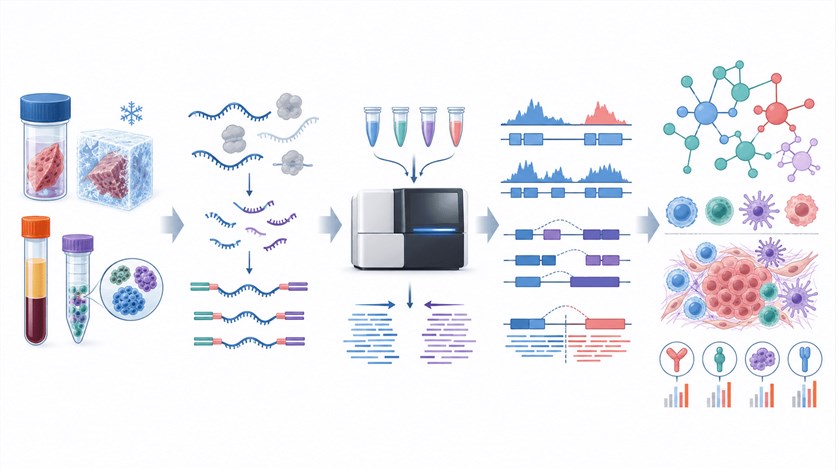
Phase 1 — Sample Intake & RNA Quality Gating
We accept FFPE, fresh-frozen tissue, plasma-derived RNA, and sorted cell populations. Each sample is logged, sectioned or aliquoted under standardized conditions, and gated on RNA integrity (e.g., DV200 for FFPE) before library construction. Samples that fall below the agreed threshold trigger a client-facing recommendation rather than silent failure.
Enabling Technologies Behind the HARCS Cancer Transcriptome Assay
Why Choose Creative Biolabs?
Years of experience in cancer RNA biology, with scientists who understand how RNA quality, library chemistry, and depth choices interact to shape the final answer.
A platform and protocol stack that opens up archived FFPE material, the largest and most clinically annotated source of human cancer tissue available.
From sequencing depth to bioinformatics focus, every step can be tailored to your tumor indication, sample type, and translational question.
Transparent QC checkpoints, version-pinned pipelines, and structured data deliverables that are ready to hand off to downstream preclinical teams.
Research Insight: Transcriptome-Based Cancer Biomarker Discovery
Key Findings from Preclinical & Comparative Studies
Quantitative transcriptome comparison has become a central strategy for finding cancer biomarkers that are robust across patient cohorts. The findings below summarize the patterns that make transcript-level screening attractive for preclinical cancer research.
-
FFPE Is No Longer a Hard Limit: Recent comparative studies show that, with appropriate library chemistry and depth, transcriptome profiling on small FFPE samples can approach the data quality obtained from fresh-frozen material, opening the door to large retrospective cancer cohorts.
-
High-Throughput Profiling Drives Biomarker Yield: When sequencing depth and replication are matched to the biological question, RNA-based screening consistently surfaces more candidate biomarkers per project than mutation-only panels, while keeping cost and turnaround compatible with preclinical timelines.
-
Beyond Gene Counts: Isoform usage, fusion transcripts, and non-coding RNA layers each carry independent biomarker information. Coordinated profiling of these layers from a single dataset multiplies the chance of finding a clinically meaningful candidate.
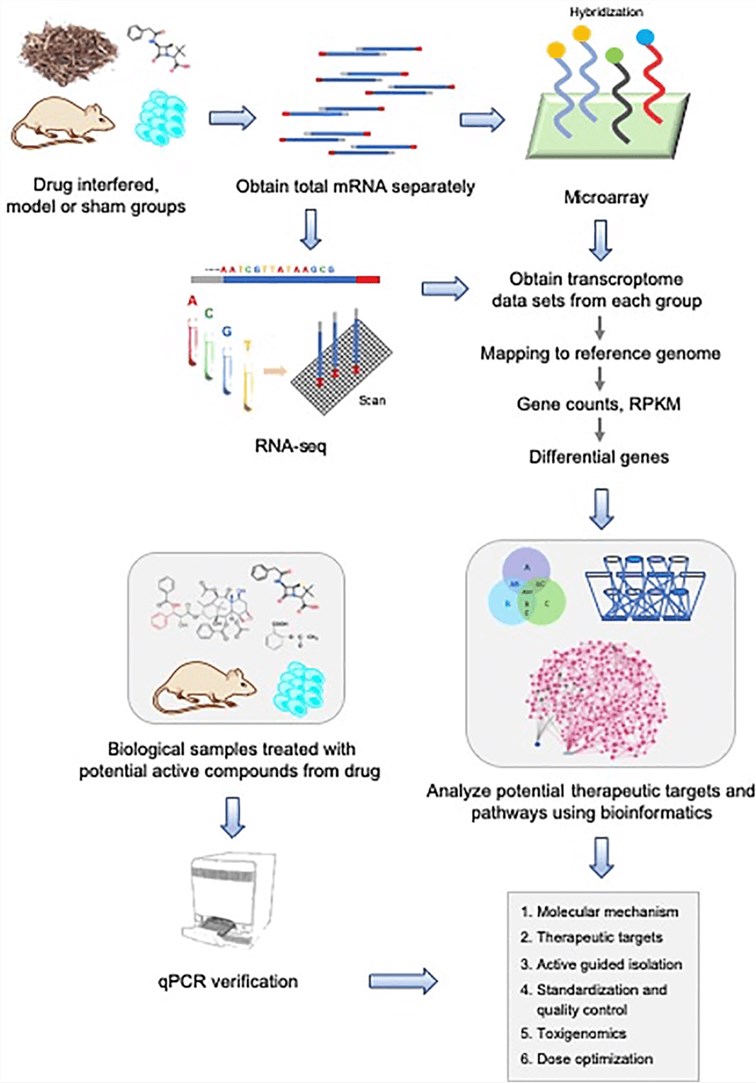
Fig.1 System-biology strategy for natural drug discovery based on transcriptome sequencing.1,2