Integrated Glycosylation Solutions for DNA Repair and GlycoRNA Profiling
Glycosylation is a key process where cells attach sugar molecules to proteins, RNAs, and DNAs. This changes how these molecules work, affecting everything from cell communication to disease. At Creative Biolabs, our glycosylation analysis services help researchers study these sugar modifications easily. We use simple, effective methods to explore how glycosylation impacts cells, whether you're looking at DNA repair, RNA function, or potential medical uses.
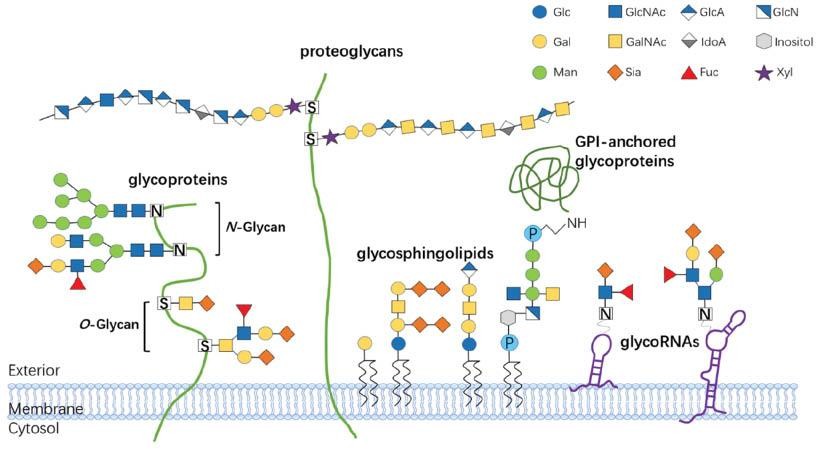 Fig.1 Major types of glycoconjugates (glycoRNA) on the cell membrane.1
Why Glycosylation Matters in Cells
In proteins: Sugars help proteins fold correctly, stay stable, and communicate with other cells (vital for immune responses). Our services include protein glycosylation profiling to identify these sugar markers and how they change in disease.
In RNA (glycoRNA): Sugars alter RNA stability, location, and protein-making ability, controlling gene expression. We offer GlycoRNA-seq and imaging tools to track these changes, even in live cells.
In DNA: DNA glycosylases repair damage and regulate genes. Our assays measure glycosylase activity and DNA repair efficiency, helping you uncover their role in genome health.
DNA Glycosylases
DNA glycosylases are enzymes that act as DNA "repair workers." Their main job is to find and remove damaged bases in the DNA, starting a repair process that keeps our genetic code accurate. But they do more than just repair:
UDG (Uracil-DNA Glycosylase): Removes uracil, a harmful base that forms when another base (cytosine) breaks down.
TDG (Thymine-DNA Glycosylase): Fixes mismatched bases that can cause mutations, and also helps adjust gene activity by modifying chromatin.
Other glycosylases, like MBD4 and SMUG1, repair DNA damaged by oxidation, ensuring cells can handle environmental stress.
RNA Glycosylation
GlycoRNA—RNA molecules with sugar tags—have recently grabbed attention. These sugars attach to a modified RNA base (ACP3U), changing how RNA interacts with proteins and moves around the cell. This affects processes like protein production and RNA recycling.
Imaging glycoRNA: New microscopy tools let us see where these sugar-tagged RNAs go in cells, helping us understand how they control gene expression and cell behavior in real time.
Tools to Study Glycosylation
At Creative Biolabs, we use straightforward, powerful techniques:
Mass Spectrometry (MS): The technique identifies attachment sites of sugars on RNAs or proteins and reveals the precise structure of these sugar molecules.
GlycoRNA-seq: GlycoRNA-seq operates like standard RNA sequencing but examines glycosylated RNAs for changes in sugar levels and functions.
Antibodies and Imaging: Special antibodies identify sugar-tagged molecules in cells or tissues while fluorescence techniques enable tracking of these molecules within live cells.
Interaction Studies: Using RNA Immunoprecipitation (RIP) techniques scientists can determine protein partners of glycoRNA and understand sugar's role in molecular interactions.
Gene Editing for DNA Glycosylases: We edit DNA glycosylase genes (e.g., UDG, TDG) to study their role in DNA repair.
Real-World Applications
Understanding glycosylation opens doors for new treatments:
Cancer: Targeting DNA glycosylases could weaken cancer cells' ability to repair DNA, making them more sensitive to therapy. Abnormal sugar patterns in cancer cells might also serve as early warning signs.
Immune Health: GlycoRNAs help control immune cell movement. Manipulating these sugars could treat autoimmune diseases or boost vaccine effectiveness.
Gene Therapy: Using DNA glycosylases for precise DNA repair might fix genetic mutations in inherited diseases. GlycoRNA-based therapies could adjust RNA function to treat disorders like Alzheimer's.
Why Choose Creative Biolabs?
Expertise Across Modalities: Our team integrates expert scientific understanding with technical expertise through DNA glycosylase activity assays and glycoRNA-seq.
Custom Solutions: We create customized workflows for both high-throughput screening or single-cell imaging based on your specific research needs.
End-to-End Support: We provide complete, ready-to-publish data that spans sample preparation through to bioinformatics including statistical analysis and functional annotation.
Innovation-Driven: Access to emerging techniques including super-resolution imaging for glycoRNA localization and multi-omics integration for systems-level insights keeps you ahead in scientific advancements.
Glycosylation may appear complex but it fundamentally describes the function alterations in cellular molecules caused by sugar attachments. Creative Biolabs provides straightforward tools for scientific exploration of molecular modifications for both research and therapeutic development. Ready to start? Reach out to us today to learn how our glycosylation analysis services will assist you in discovering the role of sugars in health and disease mechanisms. Let's make complex science simple together.
Published Data
Little is known about the biological roles of glycoRNAs because we lacked ways to visualize sugar-modified RNAs in cells. This study introduces a new method called ARPLA, which uses sialic acid aptamers and RNA in situ hybridization to see glycoRNAs with high sensitivity and precision in single cells. ARPLA works by only triggering a signal when both the sugar and RNA parts of glycoRNAs are recognized at the same time. This starts a process called rolling circle amplification of complementary DNA, which creates a fluorescent signal through labeled oligonucleotides. Using ARPLA, researchers found that glycoRNAs gather on the cell surface, co-localize with lipid rafts, and move through the cell via SNARE-protein mediated exocytosis. In breast cancer cells, more surface glycoRNAs correlated with less tumor malignancy and reduced metastasis. Studies of monocyte-endothelial cell interactions suggested glycoRNAs might help cells communicate during immune responses. This method finally lets us "see" glycoRNAs in action, opening doors to understand their roles in health and disease.
References
-
Li, Xiuling, et al. "Glycan-RNA: a new class of non-coding RNA." BIO Integration 3.3 (2022): 124. Distributed under Open Access license CC BY 4.0, without modification. https://dx.doi.org/10.15212/bioi-2021-0032
-
Jacobs, Angelika L., and Primo Schär. "DNA glycosylases: in DNA repair and beyond." Chromosoma 121 (2012): 1-20. https://doi.org/10.1007/s00412-011-0347-4
-
Ma, Yuan, et al. "Spatial imaging of glycoRNA in single cells with ARPLA." Nature biotechnology 42.4 (2024): 608-616. https://doi.org/10.1038/s41587-023-01801-z
Resources
For Research Use Only.