Pectic Oligosaccharides
Introduction to Pectic Oligosaccharides
Pectic oligosaccharides (POS) are short-chain fragments derived from pectin, a complex polysaccharide found in the cell walls of plants, particularly in fruits. Pectin is primarily composed of galacturonic acid, arabinose, rhamnose, and galactose, making up the backbone and side chains of the molecule. The structure of pectic oligosaccharides is closely linked to the degree of polymerization (DP) and the presence of specific side groups such as methyl esters and acetyl groups, which influence their bioactivity and functionality. These oligosaccharides are typically generated by enzymatic degradation of pectin and consist of galacturonic acid residues linked by α-(1→4) glycosidic bonds. The most common types of pectic oligosaccharides include homogalacturonans and rhamnogalacturonans, depending on the structure of the original pectin. At Creative Biolabs, we offer custom oligosaccharide synthesis solutions to meet the specific structural needs of plant-derived oligosaccharides for research. Additionally, our oligosaccharide analysis services ensure precise characterization and functional profiling of your oligosaccharides to support their use in diverse fields.
Biological Activities of Pectic Oligosaccharides
Pectic oligosaccharides have been shown to possess numerous beneficial biological activities, including antioxidant, anti-inflammatory, antimicrobial, and prebiotic effects. These properties make them valuable not only in traditional industries but also in cutting-edge biomedical and therapeutic applications.
|
Biological Activity
|
Mechanism
|
Example Application
|
|
Prebiotic
|
Promotes growth of beneficial gut microbiota
|
Gut health, digestion, immunity
|
|
Antioxidant
|
Scavenges free radicals, reduces oxidative stress
|
Chronic diseases, aging
|
|
Antimicrobial
|
Inhibits microbial cell wall integrity
|
Infection prevention, antibiotic resistance
|
|
Anti-inflammatory
|
Reduces pro-inflammatory cytokine production
|
Inflammatory disorders (e.g., IBD, RA)
|
POS Applications in Agriculture, Food Industry, and Medicine
Pectic oligosaccharides (POS) are highly versatile and find numerous applications across agriculture, food industries, and medicine. Their unique bioactive properties make them valuable tools for improving plant health, enhancing food quality, and even treating certain diseases. Here are some key areas where POS are proving beneficial:
Agriculture: Promoting Growth and Disease Resistance
In agriculture, pectic oligosaccharides are used to stimulate plant growth and enhance resistance to diseases. These oligosaccharides work as natural elicitors, activating plant defense mechanisms. As a result, crops grow stronger and are better able to withstand environmental stressors. They are commonly used as biostimulants to boost crop yields, offering a sustainable alternative to chemical treatments.
Food Industry: Improving Digestive Health
In the food industry, pectic oligosaccharides are valued for their prebiotic effects. They help support the growth of beneficial bacteria, such as bifidobacteria and lactobacilli, in the gut. This leads to improved digestion and better immune function. By promoting a healthy gut microbiome, POS contribute to overall gastrointestinal health and well-being.
Food Preservation: Naturally Extending Shelf Life
Pectic oligosaccharides also play a role in food preservation. Due to their antimicrobial properties, they can inhibit the growth of spoilage-causing microorganisms. This helps extend the shelf life of fresh produce, processed foods, and beverages, all without the need for artificial preservatives. POS offer a natural and clean-label solution that meets growing consumer demand for healthier food options.
Cancer Therapy: Targeting Tumor Growth
Pectic oligosaccharides have shown potential in cancer therapy. Research suggests that POS can help slow tumor growth, reduce blood vessel formation in tumors, and even trigger cancer cell death. These properties make POS valuable in targeted therapies for cancers like colorectal and breast cancer. As part of cancer treatment, they could offer new ways to complement or improve existing therapies.
Immune Modulation: Boosting the Immune System
Pectic oligosaccharides are known for their immune-modulating effects. They can activate immune cells, such as macrophages, and increase the production of cytokines and antibodies. This makes POS promising for improving immune responses, especially in treating autoimmune diseases. Additionally, they could enhance the effectiveness of vaccines by stimulating a stronger immune reaction.
Wound Healing: Accelerating Tissue Repair
Pectic oligosaccharides also promote wound healing. They help stimulate the production of collagen and encourage the growth of new skin cells. This accelerates tissue repair, especially in chronic wounds like diabetic ulcers or pressure sores. POS-based treatments are proving helpful in healing wounds that are difficult to treat with traditional methods.
Pectic oligosaccharides represent a versatile group of biomolecules with a wide array of applications in food, agriculture, and medicine. Their unique biological activities, including prebiotic, antioxidant, antimicrobial, and anti-inflammatory effects, make them valuable tools in both therapeutic and industrial settings. Ongoing research and development in enzymatic production, genetic engineering, and functionalization are poised to unlock even more potential for pectic oligosaccharides in the future. At Creative Biolabs, our custom oligosaccharide synthesis solutions and oligosaccharide analysis services ensure that we can deliver precise, high-quality oligosaccharides tailored to your research or industrial needs. Our expertise and advanced technologies will help you harness the full potential of pectic oligosaccharides for a variety of applications. Contact us for more service details!
Published Data
A rigorous analytical workflow was established to fully characterize the mango pectic oligosaccharides (MPOS). Low-methoxyl pectin was first extracted from Thai 'Chok Anan' mango peel using either microwave-assisted or conventional hot-acid protocols; the purified polysaccharide was then subjected to controlled enzymatic depolymerisation at 45–50 °C, pH 4.5, for 2–6 h to yield a heterogeneous MPOS pool. The hydrolysate was clarified by centrifugation and microfiltration, followed by two-stage membrane processing—discontinuous diafiltration and concentration on regenerated-cellulose ultrafiltration membranes (1–3 kDa MWCO)—to remove monosaccharides, proteins and residual enzyme. Size-based refinement was achieved via low-pressure gel-permeation chromatography on a Toyopearl HW-40S column (XK 26/70, 0.1 M NH₄OAc, 0.5 mL min⁻¹), collecting fractions with DP 2–10 for downstream analyses. Molecular-weight distributions were determined by high-performance size-exclusion chromatography coupled to multi-angle laser-light scattering and refractive-index detection (HPSEC-MALLS-RI). Monosaccharide composition was quantified with high-performance anion-exchange chromatography–pulsed amperometric detection (HPAEC-PAD) after TFA hydrolysis. Structural details—degree of polymerisation, methyl-esterification pattern and glycosidic linkages—were elucidated through matrix-assisted laser desorption/ionisation time-of-flight mass spectrometry (MALDI-TOF-MS) and electrospray ionisation ion-trap tandem MS (ESI-IT-MS/MS) in negative-ion mode. One- and two-dimensional NMR experiments (¹H, ¹³C, HSQC, HMBC) confirmed the α-1,4-linked galacturonan backbone interspersed with rhamnogalacturonan-I regions. Capillary electrophoresis with laser-induced fluorescence (CE-LIF) of 2-aminobenzamide-labelled oligosaccharides provided high-resolution profiling of reducing-end structures. Finally, prebiotic functionality was assessed in anaerobic batch cultures (37 °C, 72 h) using Lactobacillus reuteri and Bifidobacterium animalis; viable counts (CFU mL⁻¹) and SCFAs (GC-FID) were analysed and correlated with molecular descriptors by principal-component analysis.
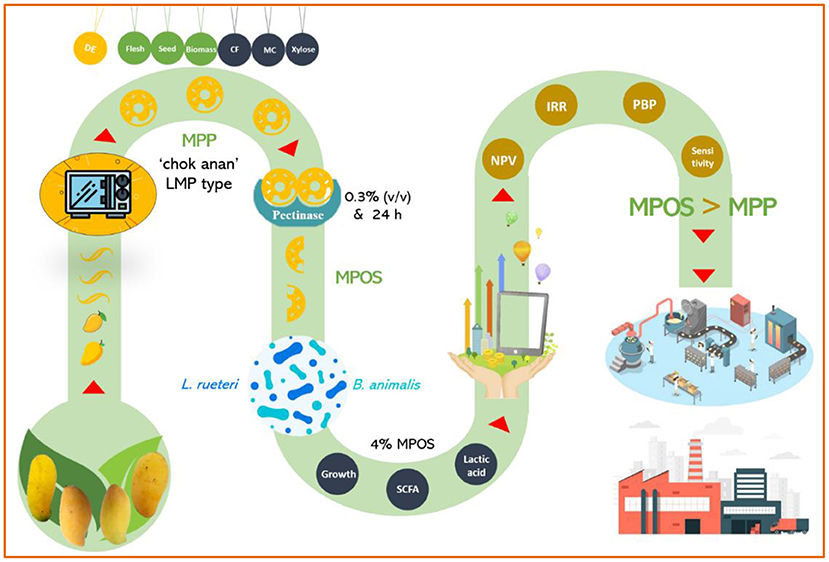 Fig.1 The schematic of the green biorefinery route from mango peel waste to value-added pectic oligosaccharides.1
Reference
-
Wongkaew, Malaiporn, et al. "Mango pectic oligosaccharides: a novel prebiotic for functional food." Frontiers in Nutrition 9 (2022): 798543. Distributed under Open Access license CC BY 4.0, without modification. https://doi.org/10.3389/fnut.2022.798543
Related Services
Resources
For Research Use Only.