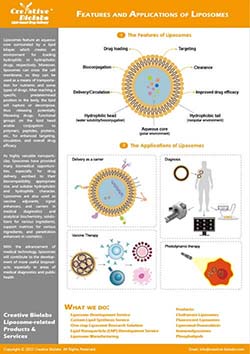
In the pursuit of precision medicine, the ability to control when and where a therapeutic agent is released is a paramount challenge. While traditional soft-matter nanoscale assemblies have been instrumental in improving drug delivery, their simplistic architecture often limits their functionality to single-stage release. Nanoscale multi-stage drug delivery emerges as a transformative solution, offering a sophisticated platform for orchestrating complex, time-dependent, and site-specific drug release. Creative Biolabs provides specialized expertise in developing these advanced lipid-based drug delivery systems, enabling our clients to pioneer next-generation therapies.
The field of drug delivery is evolving beyond the constraints of traditional lipid carriers, which typically release their entire payload in a single, uncontrolled event. Today's therapeutic paradigms, however, call for more intelligent solutions—such as the timed, sequential administration of drugs or their release in response to a specific biological trigger. Our multi-stage delivery platforms are designed to answer this call, enabling the programmed, sequential release of multiple agents. This represents a significant leap forward for combination therapies, allowing for the staggered delivery of therapeutics to maximize treatment efficacy and reduce adverse side effects.
To achieve the complex functionality of multi-stage delivery, carriers must be engineered with a more sophisticated architecture. Researchers are moving beyond simple, single-compartment vesicles to create structures with multiple, nested compartments. This requires advanced manufacturing techniques, such as microfluidics, which allow for precise control over particle formation, and conjugation chemistry, which enables the functionalization and assembly of distinct lipid bilayers. These techniques are critical for building carriers where form and function are intricately linked, allowing for a new level of control over therapeutic outcomes. This approach provides the foundational principles for the experimental research explored below.
Recent scientific literature, such as a study published in Nature Chemistry, highlights innovative strategies to create nanoscale multi-stage delivery systems. These experiments demonstrate how novel engineering techniques are being used to synthesize carriers with a sophisticated, multi-compartment design, paving the way for programmed drug release.
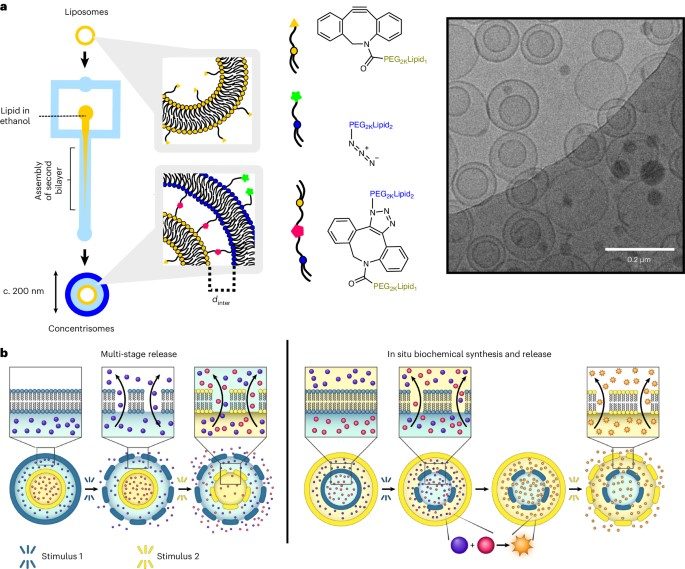 Fig. 1 Engineered liposomes.1
The study details an engineering strategy that combines microfluidics and conjugation chemistry. This approach allows for the controlled, high-throughput synthesis of complex, multi-compartment liposomes, which they term "concentrisomes" Experimental data, likely presented through techniques such as transmission electron microscopy (TEM) and dynamic light scattering (DLS), would provide visual confirmation of the nested, two-compartment structure and demonstrate the narrow size distribution of the particles, a critical indicator of reproducibility and quality.
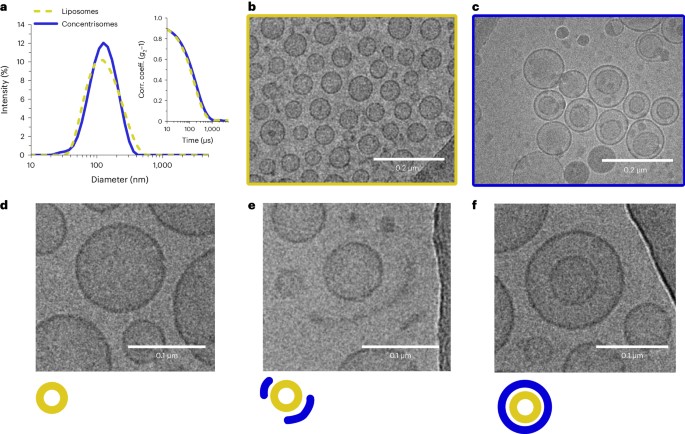 Fig. 2 Characterization of the concentrisomes.1
A key finding is the ability to program the sequential release of two distinct payloads. This is achieved by tuning the composition of each nested bilayer to respond to different stimuli. The data shown in release kinetics curves, illustrating a clear, staggered release profile for the two encapsulated cargos. This demonstrates a significant advance over traditional systems and provides a compelling proof of concept for multi-stage delivery.
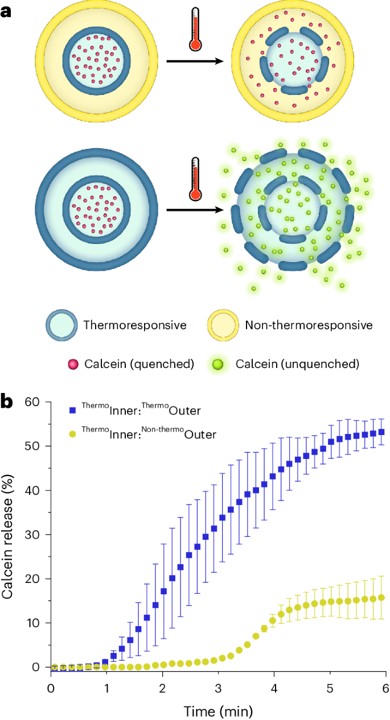 Fig. 3 The controlled release effect of engineered liposomes.1
A key finding is the ability to program the sequential release of two distinct payloads. An advanced fluorescent assay was used to demonstrate this capability. Researchers encapsulated two different dyes, methylene blue and calcein, in the outer and inner compartments, respectively. By engineering the outer bilayer with DPPC (a lipid with a lower transition temperature) and the inner bilayer with DSPC (a lipid with a higher transition temperature), they were able to achieve sequential release.
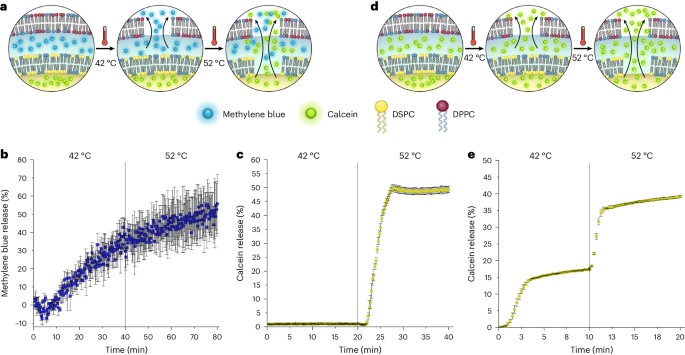 Fig. 4 The step-by-step release of the payload.1
The innovative research on concentrisomes showcases a major leap forward in drug delivery, proving that complex, multi-stage release is not only possible but can be precisely engineered. These advancements open the door for a new generation of therapies with enhanced efficacy and safety. Creative Biolabs has the expertise and resources to help you transition these sophisticated research concepts into practical applications. Our team is ready to assist with the synthesis, characterization, and validation of multi-stage delivery systems. Contact us today to discuss how we can support your project.
Creative Biolabs offers a comprehensive suite of specialized services to help our clients overcome the complexities of nanoscale multi-stage drug delivery.
| Services/Products | Description | Inquiry |
|---|---|---|
| Microfluidic-based LNP/Liposome Preparation | We customize the synthesis of microfluidic chips to enable the precise and scalable production of LNPs and liposomes. | Inquiry |
| Comprehensive Characterization of Nanodelivery Systems | Our services include detailed analysis using techniques like DLS, Cryo-TEM, and in vitro release assays to ensure system integrity and performance. | Inquiry |
| Encapsulation of Fluorescent Dyes | We assist in the encapsulation of fluorescent dyes such as Calcein, and Rhodamine, helping you achieve visualization and quantitative analysis of your delivery system's performance. | Inquiry |
| Development of Multi-Stage Delivery Systems | We can prepare advanced systems, such as incorporating liposomes into hydrogels or creating multilamellar liposomes, for more complex delivery profiles. | Inquiry |
| Synthesis and Evaluation of Stimuli-Responsive Delivery Systems | Our team designs and evaluates delivery systems that respond to specific triggers, such as temperature, pH, or enzymes, for targeted release. | Inquiry |
| Fluorescent Dyes | A range of fluorescent dyes, including Calcein, for visualizing and analyzing encapsulation and release kinetics in your delivery system. | Inquiry |
| Widespread Lipids | High-purity lipids and phospholipids to meet your diverse needs in preparing advanced lipid-based delivery systems. | Inquiry |
Reference
 For Research Use Only. Not For Clinical Use
Supports
Online Inquiry

Creative Biolabs is a world-leading liposome provider with extensive experience in liposome preparation, custom formulation development, and characterization.

© 2026 Creative Biolabs. All rights reserved.