Blood Group Oligosaccharides
The ABO blood group system depends on specialized carbohydrate structures called blood group oligosaccharides which attach to the surfaces of red blood cells. Oligosaccharides composed of three to twenty monosaccharide units joined by glycosidic bonds act beyond determining blood types by serving as essential messengers for immune recognition and cellular signaling as well as pathogen interaction. The growing focus on glycan-mediated processes in both immunology and transfusion science makes the exploration of blood group oligosaccharide complexity increasingly essential. Our team at Creative Biolabs specializes in custom oligosaccharide synthesis and oligosaccharide analysis services which provide essential tools for research into blood group oligosaccharides. Our services provide tailored support for scientific research in blood compatibility studies immune system research and pathogen interactions. We provide advanced glycan analysis technologies to deliver top quality data and results for your research projects.
Structural Overview of ABO Blood Group Antigens
ABO blood group antigens consist of specific terminal oligosaccharide structures that develop from a shared precursor known as the H antigen. The A and B antigens develop when specialized glycosyltransferases add distinct sugars to the base structure.
|
Blood Group
|
Antigen Structure
|
|
O
|
H antigen: Fuc-α1,2-Gal-β1,3-GlcNAc
|
|
A
|
A antigen: Fuc-α1,2-Gal-β1,3-(GalNAc)
|
|
B
|
B antigen: Fuc-α1,2-Gal-β1,3-(Gal)
|
|
AB
|
A & B antigens: Fuc-α1,2-Gal-β1,3-(GalNAc) and Fuc-α1,2-Gal-β1,3-(Gal)
|
Enzymatic Regulation: Oligosaccharide Protein Transferases
A series of glycosyltransferase enzymes precisely control the biosynthesis and expression of blood group oligosaccharides through the directed addition of specific monosaccharide units to precursor substrates. The antigenic properties of blood groups emerge from enzymatic processes which affect transfusion matching capabilities as well as determine susceptibility to infections and immunological reactions.
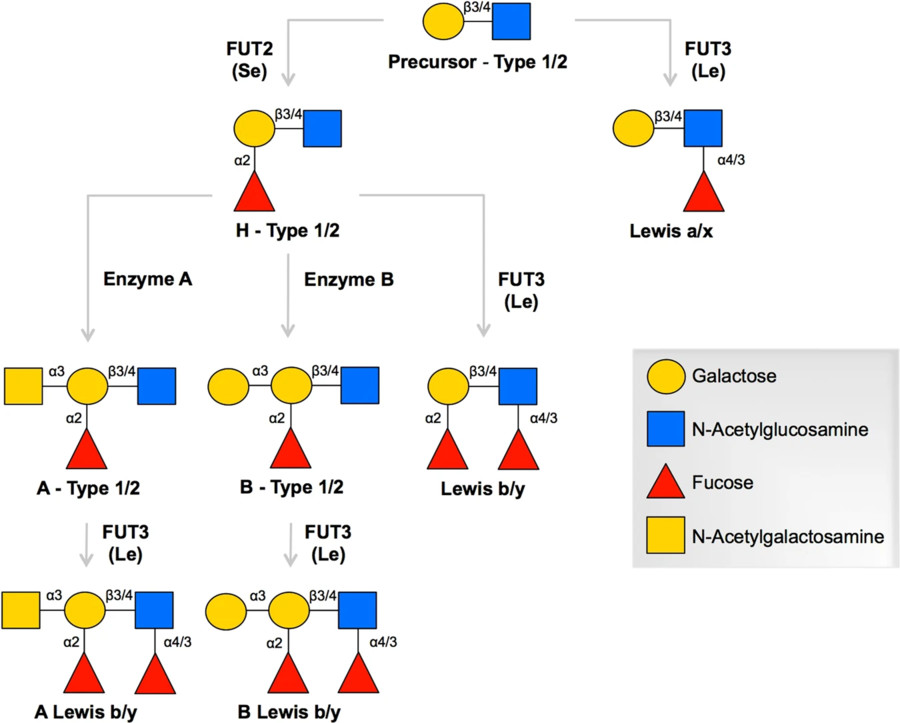 Fig.1 The biosynthetic pathway for histo-blood group antigens (HBGAs).1
Fucosyltransferases Drive the Production of ABO Blood Group and Lewis Antigens
Fucosyltransferases play a crucial role in synthesizing fucosylated oligosaccharides which include the extensively studied ABO and Lewis blood group antigens. Both fucosyltransferase 1 (FUT1) in blood-forming tissues and fucosyltransferase 2 (FUT2) in epithelial and mucosal cells work together to create the H antigen which constitutes the base structure of the ABO system. The enzymes FUT1 and FUT2 attach fucose residues to precursor oligosaccharide chains to create the H antigen which serves as a base for further modification into A and B antigens.
The Lewis antigen system resembles ABO antigens structurally and derives from the enzyme fucosyltransferase 3 (FUT3) which is produced by the Lewis (Le) gene. FUT3 transforms type I oligosaccharide chains to generate Lewis a (Lea) while working together with FUT2 to create Lewis b (Leb) antigens. People express different Lewis phenotypes because their bodies either produce functional FUT3 and FUT2 enzymes or do not.
Glycosyltransferases and ABO Blood Group Determination
The specific glycosyltransferases that the ABO gene locus encodes determine the ABO blood group. The enzyme α-1,3-N-acetylgalactosaminyltransferase produced by the A allele attaches N-acetylgalactosamine to the H antigen to create the A antigen. The B allele produces α-1,3-galactosyltransferase which adds galactose to the H antigen thereby generating the B antigen. The O allele produces an inactive enzyme because of a frameshift mutation which prevents modification of the H antigen.
Role of Sialyltransferases in Sialylated Oligosaccharide Biosynthesis
Sialyltransferases attach sialic acid residues to oligosaccharide chains to form sialylated oligosaccharides. The modifications serve vital functions in enabling cell-cell interactions while facilitating immune recognition and pathogen binding. The sialyl-Lewis X antigen results from sequential enzyme actions of sialyltransferases and fucosyltransferases which significantly influences leukocyte adhesion in inflammatory responses.
Clinical Implications of Glycosyltransferase Variations
The expression of blood group antigens can be modified by glycosyltransferase enzyme variations or deficiencies which affects transfusion compatibility and disease susceptibility. People who have the Bombay phenotype exhibit nonfunctional FUT1 and FUT2 enzymes which eliminates H, A, and B antigens on their red blood cells requiring blood transfusions from donors who share this rare phenotype. The activity of various glycosyltransferases determines glycoprotein oligosaccharide expression patterns which in turn influence host-pathogen interactions. Human susceptibility to diseases like cholera and malaria varies depending on their expression of blood group antigens.
Our Blood Group Oligosaccharide Services
Creative Biolabs recognizes the intricate biological nature of blood group oligosaccharides which requires research tools that offer precision and control especially for their sialylation, fucosylation and branching patterns. Our new cell line glycoengineering platform provides scientists researching glycan structure-function relationships with the ability to customize glycosylation profiles in living cells. Our cell-based glycoengineering services deliver precise control of glycan expression which enables research into sialylated oligosaccharides like sialyl-Lewis X for leukocyte adhesion studies and fucosylated structures for ABO and Lewis antigen synthesis. Creative Biolabs provides specialized services for oligosaccharide research to facilitate investigations into blood group oligosaccharides.
Clinical Implications of Blood Group Oligosaccharides
Blood group oligosaccharides affect human health and disease processes beyond their role in determining transfusion compatibility.
Blood Transfusion Safety
Precise glycan characterization is essential because accurate antigen identification helps to avoid deadly hemolytic reactions during blood transfusions.
Disease Association
Cancer growth along with cardiovascular disease risk and vulnerability to infections demonstrate correlation with abnormal glycosylation patterns. Some malignancies show a loss of A/B antigen expression as one of their characteristics.
Therapeutic Targeting
The sialylated and fucosylated molecules such as sialyl-Lewis X provide viable targets for drug development that can control inflammatory responses or stop cancer metastasis. Employing glycoengineering techniques for antibodies and cell therapies introduces a new approach to precision medicine.
These oligosaccharides from blood groups function beyond mere biochemical markers to serve as essential controllers of immune response and therapeutic effectiveness. These glycan structures maintain their importance in glycobiology and medical research because they range from complex biosynthesis processes to their roles in transfusion safety and disease mechanisms. Creative Biolabs provides sophisticated glycan analysis capabilities and custom synthesis options designed to advance your research into blood group antigens. Our expert teams and innovative platforms provide essential support to those characterizing antigens developing glycan-based therapies or conducting in-depth glycosylation profiling. Expand your research capabilities through our specialized oligosaccharides services. Creative Biolabs is committed to provide you with a partnered scientific team dedicated to support your success beyond just service delivery! Contact us now!
Reference
-
Barbé, Laure, et al. "Histo-blood group antigen-binding specificities of human rotaviruses are associated with gastroenteritis but not with in vitro infection." Scientific reports 8.1 (2018): 12961. Distributed under Open Access license CC BY 4.0, without modification. https://doi.org/10.1038/s41598-018-31005-4
Related Services
Resources
For Research Use Only.