
Glycosylated Liposomes: Balancing Receptor-Mediated Uptake and Immune Recognition
Design strategies for glycan-decorated liposomes that improve receptor-mediated uptake while minimizing nonspecific binding, immune clearance, and formulation tradeoffs.
Strategic Guidelines for Glycosylated Liposome Development
Decision 01
Glycan choice must follow receptor biology, not chemistry convenience.
Decision 02
Ligand density and accessibility must be optimized together.
Decision 03
Increased cell association is not equivalent to productive delivery.
Decision 04
Immune recognition should be evaluated under serum conditions.
Navigating the Glycan "Sugar Code" in Drug Delivery
Glycosylated liposomes represent a sophisticated intersection of synthetic chemistry and glycobiology. By decorating the lipid surface with carbohydrate motifs—such as mannose, galactose, or sialylated structures—researchers aim to exploit the specific recognition between glycans and endogenous lectins. Unlike traditional pegylated liposomes that rely primarily on the EPR effect, glycosylated variants leverage active, receptor-mediated processes.
For formulation and CMC scientists, the challenge is not just "adding a ligand," but managing the dual impact of these glycans on both therapeutic efficacy and the immunological profile. Carbohydrate-lectin interactions are characterized by high collective avidity arising from low individual affinity. Consequently, spatial arrangement, density, and orientation on the liposomal surface are the primary variables for development. When engineered correctly, these particles may reshape, rather than eliminate, protein adsorption and the downstream biological identity of the carrier in vivo.
To transition from a biological concept to a viable product, developers must address common bottlenecks: balancing ligand density against steric shielding, ensuring batch-to-batch consistency of the glycan-lipid conjugate, and distinguishing productive receptor-mediated uptake from nonspecific binding or phagocytic clearance.
Hardcore Pain Points for Developers
-
Accessibility tradeoff: Ensuring the glycan is exposed beyond the PEG stealth layer without compromising colloidal stability.
-
Process consistency: Controlling ligand distribution and density during scale-up (injection vs. post-insertion).
-
Productive vs. Mere uptake: Validating that the receptor interaction leads to endosomal escape and cytosolic payload function.
CMC & Formulation Constraints
For formulation scientists, glycosylation introduces significant complexity to the lipidic landscape. Success hinges on the precision of the surface chemistry and the robustness of the characterization.
Batch Consistency & Stability
The introduction of glycan-lipid conjugates can alter critical quality attributes (CQAs). High ligand density might impact the packing parameter of the lipid bilayer, leading to shifts in particle size, PDI, and encapsulation efficiency. CMC teams must monitor:
- Conjugate Purity: Residual catalysts or unreacted glycan precursors can affect the safety profile.
- Surface Presentation: Ensuring the "business end" of the carbohydrate is not buried within the PEG brush.
- Storage Risk: Desorption of post-inserted ligands or hydrolysis of the glycan-linker bond during long-term storage.
Receptor Engagement Mechanisms
| Ligand Motif | Targeted Receptor | Context-Dependent Relevance |
|---|---|---|
| D-Mannose | MR (CD206) | APC/Macrophage-facing programs |
| Galactose/GalNAc | ASGPR | Best-studied hepatocyte-directed system |
| Glucose-related | GLUT1 / Transporters | Explored for metabolically active tissues; BBB relevance is model-dependent |
| Sialic Acid | Siglecs | Immune modulation and tolerance induction |
The "Productive Uptake" vs. "Mere Binding" Distinction
High cell association alone is not sufficient for therapeutic success. Developers should distinguish between surface binding, true receptor-mediated internalization, and cytosolic payload release under serum-relevant conditions. Pattern Recognition Receptors (PRRs) evolved to identify carbohydrate signatures on pathogens; thus, a targeted liposome might be "taken up" via scavenger pathways that lead to rapid degradation rather than functional delivery.
In ex vivo assays, researchers often observe impressive targeting ratios that disappear in vivo. This is often due to the competition from endogenous ligands or the formation of a protein corona that masks the glycan. A successful design requires Targeted Liposome Development Services that integrate competitive inhibition studies using serum or specific lectin blockers.
Et al., the oriented presentation of ligands—achieved through site-specific glycoengineering—is often the deciding factor in whether a particle enters a productive endocytic pathway or is sequestered by the spleen.
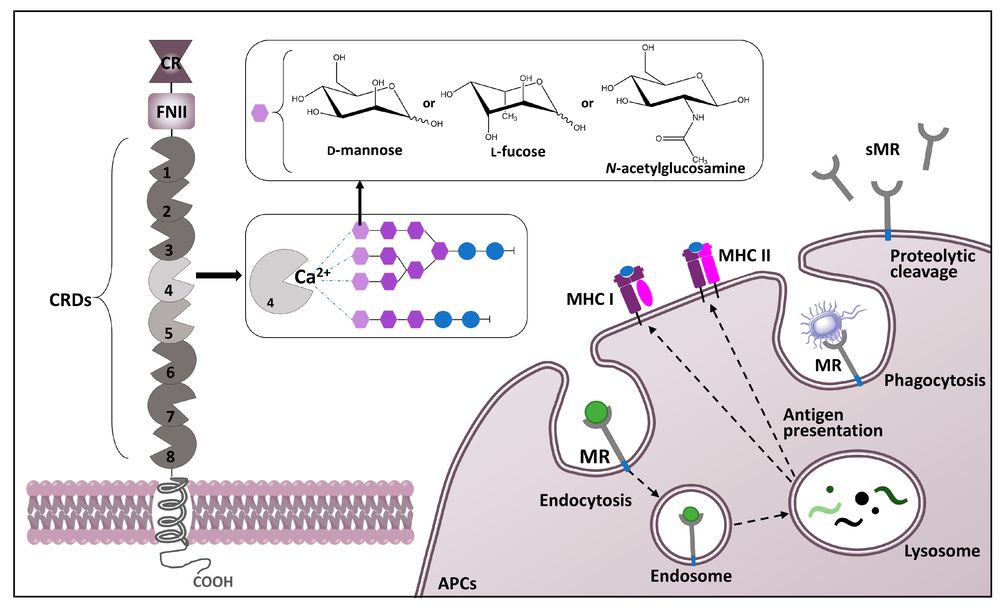
Fig.1 Structure of the mannose receptor (MR) and the overview of its cellular functions. 1,2
Preclinical & CMC Development Checklist
| Development Question | Why it matters | Recommended Readout |
|---|---|---|
| Is the receptor biologically relevant? | Avoid decorative targeting in the wrong model. | Receptor expression, competition assay. |
| Is the glycan exposed beyond PEG? | Prevent false-negative results. | Lectin binding, surface accessibility assays. |
| Is internalization productive? | Avoid mistaking binding for delivery. | Payload function (e.g., GFP/Luc reporter). |
| Does density increase clearance? | Balance targeting efficacy and PK. | Complement activation, macrophage uptake. |
Preclinical translation requires rigorous Formulation Safety Evaluation. Developers must assess Complement Activation-Related Pseudoallergy (CARPA) and cytokine release profiles, as glycosylated surfaces can trigger the lectin pathway of the complement system.
Representative Glycan Design Scenarios
Different motifs present distinct biodistribution and immune profiles. Mannose highlights the tradeoff, but other motifs are equally context-critical.
Scenario A: Mannose (MR-Directed)
Prototype for targeting and immune-recognition tradeoffs.
Mannose ligands facilitate efficient trafficking into the endo-lysosomal pathway for mRNA vaccines. However, a commonly explored starting range is low single-digit to ~10 mol%, followed by optimization against colloidal stability and serum protein binding. High density may inadvertently lead to sequestering by Mannose-Binding Lectin (MBL).
Scenario B: Galactose/GalNAc (ASGPR-Directed)
The benchmark for hepatocyte-directed delivery.
Galactose motifs allow for exceptionally specific capture by hepatocytes. For liposomal carriers, the "cluster glycoside effect" (multivalency) is leveraged through glycolipid clusters to increase avidity to the nM range, necessary for overcoming flow conditions in liver sinusoids.
Frequently Asked Questions
1. Paurević, Marija, Martina Šrajer Gajdošik, and Rosana Ribić. "Mannose ligands for mannose receptor targeting." International journal of molecular sciences 25.3 (2024): 1370. https://doi.org/10.3390/ijms25031370
2. Under Open Access license CC BY 4.0, without modification.
Online Inquiry
This site is protected by reCAPTCHA and the Google Privacy Policy and Terms of Service apply.