
Gene Therapy for Alpha-1 Antitrypsin Deficiency
Introduction to Gene Therapy for Alpha-1 Antitrypsin Deficiency
Gene therapy for alpha-1 antitrypsin deficiency (AATD) investigates how pathogenic SERPINA1 variants might be addressed through functional gene expression, transcript control, or genetic correction. Because AATD can combine loss of pulmonary antiprotease protection with toxic protein accumulation in hepatocytes, liver-directed gene therapy research must consider lung and liver objectives separately. This resource reviews disease biology, genetic strategies, delivery choices, model selection, and translational evidence without treating investigational approaches as established therapies. For research teams exploring genetic strategies for AATD, Creative Biolabs can support vector design, liver-targeted delivery planning, SERPINA1 correction model development, and analytical evaluation to connect molecular design with interpretable preclinical evidence.
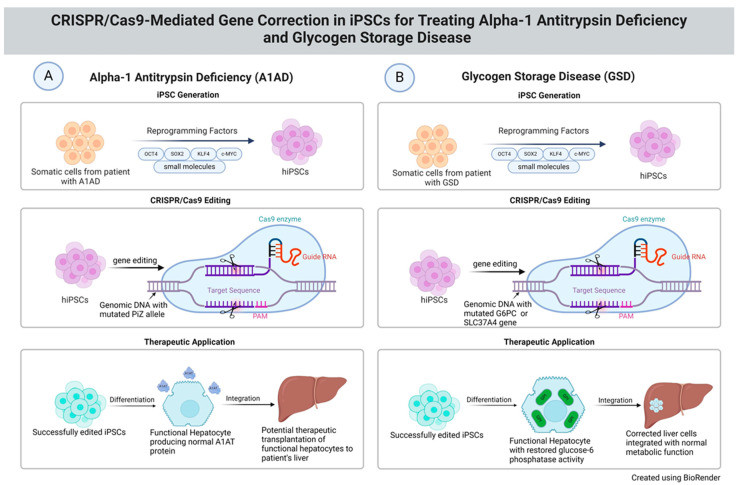 Figure 1. CRISPR-Cas9-mediated correction of patient-derived iPSCs followed by hepatocyte differentiation as a research path for alpha-1 antitrypsin deficiency.1,3
Why Gene Therapy Matters for Alpha-1 Antitrypsin Deficiency?
Current management can reduce exposure-related risk, monitor organ injury, and replace circulating AAT in selected patients, but it does not correct SERPINA1 or directly remove hepatocyte polymer burden. Genetic strategies are therefore being explored as potentially durable ways to restore functional AAT, reduce mutant protein production, or repair the disease-causing sequence. The most appropriate approach depends on whether the primary research goal is pulmonary protection, hepatic rescue, or a combined profile.
- Gene addition seeks durable production of functional AAT from liver, muscle, or another transduced tissue.
- Silencing-replacement combines reduction of mutant transcripts with expression of a functional replacement sequence.
- Genome editing aims to correct, disrupt, or bypass a pathogenic SERPINA1 allele, but remains dependent on efficient delivery and rigorous genomic safety assessment.
The SERPINA1 Defect Connects Liver Production to Lung Protection
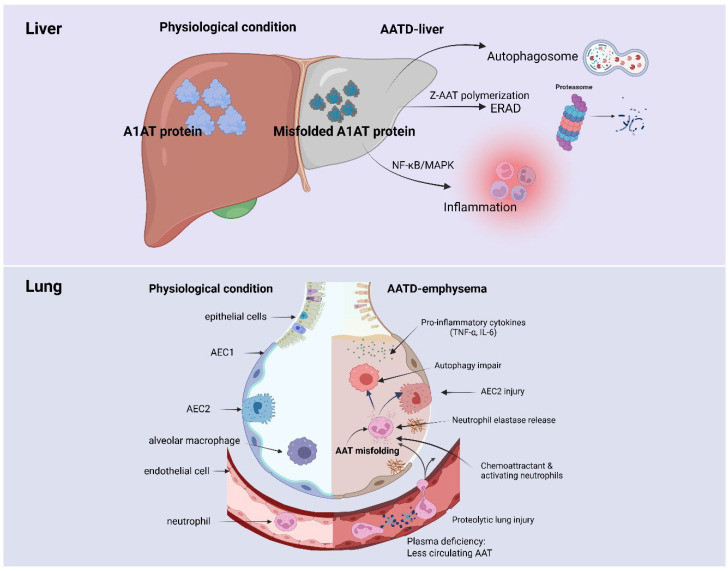 Figure 2. Pathophysiological mechanisms of AATD-associated liver and lung injury, including hepatic Z-AAT accumulation and pulmonary protease-antiprotease imbalance.2,3
AATD has two connected but biologically distinct disease components:
- Pulmonary loss of function - insufficient circulating AAT permits excessive neutrophil elastase activity and progressive tissue damage.
- Hepatic toxic gain of function - misfolded Z-AAT can polymerize within hepatocytes and contribute to cellular stress, fibrosis, and liver disease.
Liver Production and Pulmonary Protection
SERPINA1 is expressed mainly in hepatocytes, which secrete AAT into the circulation. Functional AAT reaches the lung and restrains neutrophil elastase during inflammation. A genetic strategy intended to protect the lung must therefore produce enough correctly folded, secreted, and active protein, not merely detectable transgene expression. Liver-directed production is biologically attractive, although extrahepatic expression may also be studied when secretion and durability are adequate.
Z-AAT Polymer Accumulation in Hepatocytes
The Z variant, p.Glu342Lys, promotes AAT misfolding and polymer retention in hepatocytes. This creates a hepatic toxic gain of function while reducing the circulating protein available for lung protection. Gene addition may address the deficiency component, but liver-focused programs may also need to lower mutant Z-AAT or correct SERPINA1. Relevant readouts include intracellular polymers, secretion, stress responses, cell viability, and functional antiprotease activity.
What a Genetic Therapy Must Accomplish?
The phrase gene therapy for AATD covers several product concepts. The most direct is AAV-mediated gene addition, which introduces a functional SERPINA1 coding sequence into a durable cell population that can secrete AAT. Other programs suppress mutant transcripts, replace their function, or correct the pathogenic allele. Platform selection should begin with the intended benefit - pulmonary protection, hepatic rescue, or both - rather than with a preferred vector.
| Strategy | Primary objective | Potential advantage | Central limitation | Current position |
|---|---|---|---|---|
| Gene addition | Provide a functional SERPINA1 expression cassette without changing the endogenous locus. | Conceptually direct; compatible with nonintegrating AAV platforms; can turn liver or muscle into a protein depot. | Does not inherently stop mutant Z-AAT synthesis; expression must reach a protective and durable level. | Clinical and preclinical experience |
| Mutant transcript silencing | Reduce synthesis of pathogenic AAT, particularly to relieve hepatocyte proteotoxicity. | Addresses the toxic gain of function and can be designed for allele-selective or broad knockdown. | May worsen systemic deficiency unless paired with functional replacement; repeat dosing may be needed for RNA medicines. | Clinical development of RNA-targeting concepts; gene-delivered silencing remains investigational |
| Targeted gene correction | Repair a pathogenic SERPINA1 sequence through nuclease editing, base editing, prime editing, or template-directed repair. | Preserves endogenous regulation and could correct both loss and toxic gain of function. | Requires efficient hepatocyte delivery, high on-target correction, low off-target activity, and control of editing by-products. | Preclinical and translational research |
| Corrected cell therapy | Edit patient-derived stem cells or hepatocyte progenitors, validate them ex vivo, and generate functional hepatocyte-like cells. | Allows extensive characterization before administration and supports patient-specific disease modeling. | Engraftment, maturation, scale, genomic integrity, tumorigenicity, and durable liver repopulation remain major barriers. | Research-stage development |
Genome Editing and Targeted SERPINA1 Correction
Gene-editing vector design must match the intended DNA change with the delivery window and target-cell biology. CRISPR nucleases, base editors, and prime editors create different on-target products and by-product profiles. A potentially durable correction is valuable only when enough relevant hepatocytes are edited and off-target changes, large rearrangements, and prolonged editor exposure remain acceptably controlled.
Delivery Choices Determine Which Biological Problem Is Addressed
Delivery determines the treated cell, exposure duration, repeat-dosing options, and safety profile. AAV can support durable expression in relatively stable tissues, but capsid immunity, dose, biodistribution, and limited redosing must be considered. The selected route should match the intended pulmonary, hepatic, or combined therapeutic goal.
Lipid nanoparticles can deliver nucleic-acid payloads to the liver without permanent vector persistence and may suit transient editing or silencing. Their performance depends on cell targeting, payload stability, innate immune activation, and whether repeat administration is feasible. Ex vivo delivery offers tighter product control but requires a practical cell source and engraftment strategy.
Disease Models and Translational Readouts
A focused translational package should connect molecular change with functional rescue:
- Confirm delivery or editing with vector-genome, biodistribution, and allele-resolved sequencing assays.
- Distinguish therapeutic AAT from endogenous mutant protein and verify neutrophil elastase inhibitory activity.
- Measure hepatic polymer burden, cellular stress, pulmonary exposure, immune responses, and off-target effects according to the selected strategy.
No single model reproduces the complete AATD phenotype. Disease modeling and gene editing can combine patient-derived cells with isogenic corrected controls to separate mutation-specific effects from background variation. Primary hepatocytes improve physiological relevance, while iPSC-derived hepatocyte-like cells, spheroids, and organoids support longer studies of AAT secretion, polymer accumulation, cellular stress, and treatment response.
Translation: Durability, Safety, and Meaningful Benefit
Durable expression is necessary but not sufficient. Viral vector analysis should connect identity, titer, purity, and potency with transduction, functional AAT output, and safety readouts. Editing programs additionally need sensitive assessment of on-target heterogeneity, off-target changes, structural variants, and the persistence or clearance of editing components.
As of June 2026, AATD genetic therapies remain investigational. Development programs should separate proof of delivery from proof of biological benefit and define whether success means higher functional serum AAT, lower hepatic Z-AAT burden, improved lung protection, or a combined outcome. Long-term monitoring must address durability, immunity, biodistribution, genotoxicity, and organ-specific safety.
Overview of What Creative Biolabs Can Provide
AATD programs require coordination among disease biology, vector engineering, hepatocyte targeting, molecular correction, and analytical development. Creative Biolabs supports research-stage projects that investigate functional AAT expression, liver-directed delivery, SERPINA1 correction, disease-relevant models, and vector quality. The following related capabilities were selected from the GT website link inventory because they directly match the technical decisions discussed on this page.
| Research Need | Related Creative Biolabs Support | How It Connects to AATD Research |
|---|---|---|
| Designing a functional SERPINA1 expression cassette | AAV Vector Design for Gene Therapy | Supports capsid, promoter, coding-sequence, and regulatory-element decisions for sustained functional AAT expression. |
| Exploring hepatocyte-directed expression | Liver Directed Gene Therapy | Connects the natural hepatic source of AAT with liver tropism, secretion, systemic exposure, and organ-specific safety. |
| Establishing a gene-addition strategy | AAV Design for Gene Addition | Supports research concepts that introduce functional SERPINA1 without directly changing the endogenous locus. |
| Building genotype-defined disease models | Disease Modeling related Gene Editing Service | Enables mutant and isogenic corrected systems for evaluating AAT secretion, polymer burden, stress, and rescue. |
| Connecting vector quality with biological activity | Viral Vector Analysis | Provides identity, titer, purity, potency, and safety measurements for interpretable preclinical experiments. |
Creative Biolabs can help translate an AATD research hypothesis into a defined vector, editing, disease-model, and analytical workflow. Contact us today to discuss the biological objective, target compartment, and evidence package required for your project.
Frequently Asked Questions
Q: Why is alpha-1 antitrypsin deficiency both a lung and liver disease?
A: The lung disease mainly reflects loss of circulating functional AAT, which leaves neutrophil elastase insufficiently controlled. The liver disease is a toxic gain-of-function process in which misfolded variants, especially Z-AAT, polymerize and accumulate in hepatocytes. A therapy that only raises circulating AAT may not remove the intracellular liver burden.
Q: Is there an approved gene therapy for AATD?
A: No AATD gene therapy was approved as of June 2026. Clinical studies have evaluated AAV-mediated gene transfer, and a phase 1 study of intravenous AAV8hAAT(AVL) is listed as recruiting, but these products remain investigational.
Q: Why might gene addition be insufficient for patients with liver disease?
A: Gene addition can create a new source of functional AAT, but it does not automatically stop expression of the mutant endogenous SERPINA1 allele. Z-AAT may therefore continue to accumulate in hepatocytes. Silencing-replacement or gene-correction strategies are intended to address this limitation.
Q: What is the difference between gene editing and silencing-replacement?
A: Gene editing changes genomic DNA to correct, disrupt, or insert sequence. Silencing-replacement usually leaves the endogenous DNA unchanged, suppresses mutant RNA, and supplies a functional replacement sequence that escapes the silencer. Editing may provide a permanent correction, whereas silencing-replacement can offer modular control but requires coordinated expression of two functions.
Q: Which models are most useful for developing AATD genetic therapies?
A: A combination is usually needed. Patient-derived iPSC hepatocytes and isogenic corrected lines support mechanism and editing studies; primary hepatocytes and three-dimensional liver models improve physiological relevance; AAT-null and Z-AAT animal models test lung protection, hepatic polymer biology, biodistribution, immunity, and long-term safety.
Q: What measurements indicate that a therapy is working?
A: Key measurements include vector delivery or editing efficiency, the amount and identity of therapeutic AAT, neutrophil elastase inhibitory activity, pulmonary target exposure, and reduction of intracellular Z-AAT polymers or liver stress. Safety testing must also assess immunity, organ toxicity, biodistribution, and off-target genomic changes when editing is used.
References
- Walsh C, Jin S. Induced Pluripotent Stem Cells and CRISPR-Cas9 Innovations for Treating Alpha-1 Antitrypsin Deficiency and Glycogen Storage Diseases. Cells. 2024;13(12):1052. https://doi.org/10.3390/cells13121052
- Yang SR, Kim HR. Next-Generation Regenerative Therapies for Alpha-1 Antitrypsin Deficiency: Molecular Pathogenesis to Clinical Translation. International Journal of Molecular Sciences. 2025;26(17):8504. https://doi.org/10.3390/ijms26178504.
- Distributed under Open Access license https://creativecommons.org/licenses/by/4.0/, without modification.
