
Tissue-Targeted Delivery Strategy
Successful tissue-targeted delivery depends on matching the therapeutic payload, carrier, targeting mechanism, and administration route to the biology of the intended tissue. Effective strategies combine passive distribution, ligand–receptor recognition, tissue-selective vectors, or local administration to improve target-cell exposure while limiting off-target uptake and systemic toxicity. Candidate systems should be evaluated for biodistribution, cellular internalization, endosomal escape, functional payload release, dose response, and safety.
Introduction
Tissue-targeted delivery strategies aim to direct genetic payloads to therapeutically relevant cells while limiting off-target exposure. Creative Biolabs explains how targeting approaches, delivery platforms, and functional validation can be integrated into an effective development strategy. Creative Biolabs supports these programs through its tissue- and cell-specific AAV targeting service, covering vector engineering, targeting optimization, and analytical evaluation.
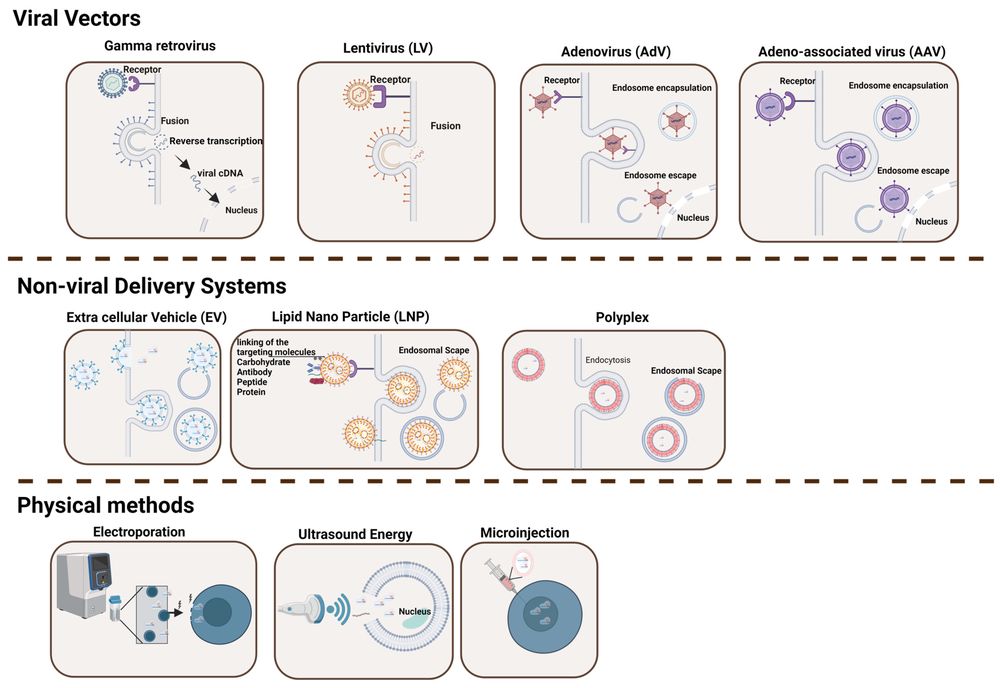 Figure 1. Delivery Systems for Gene Editing Components.1
Define the Target Beyond an Organ Name
| Target Definition | Question to Resolve | Design Consequence | Evidence Needed |
|---|---|---|---|
| Anatomical compartment | Is the target vascular, epithelial, stromal, parenchymal, or behind a specialized barrier? | Sets route, particle size, residence time, and barrier-crossing requirements. | Regional exposure plus compartment-resolved histology |
| Disease-driving cell | Which cell type must receive and process the payload? | Determines receptor, capsid, lipid, ligand, and promoter choices. | Cell-sorted or single-cell payload and expression data |
| Therapeutic threshold | How many cells and how much activity per cell are sufficient? | Prevents maximizing uptake when modest functional correction is enough. | Dose-response linked to a disease-relevant function |
| Duration and redosing | Is transient expression acceptable, or is long-lived correction required? | Changes modality, vector, immunity, integration, and repeat-dose strategy. | Longitudinal expression, function, and immune monitoring |
| Avoidance tissues | Where would payload expression create toxicity or confound interpretation? | Creates explicit detargeting criteria and safety readouts. | Biodistribution, off-target expression, pathology, and recovery |
Four Layers of Tissue Selectivity
Anatomical targeting controls first contact
Route, dose volume, infusion rate, device, and formulation determine the first tissues exposed. Intrathecal, intravitreal, intramuscular, intratumoral, inhaled, and vascular routes create different concentration fields even when the same vector is used. Anatomical targeting should therefore be treated as a distribution experiment, not as proof of cellular specificity.
Transductional targeting governs binding and entry
The vehicle surface determines interactions with extracellular matrix, serum proteins, receptors, and uptake pathways. For viral vectors, natural tropism, capsid engineering, peptide insertion, chimeric capsids, and library selection can shift which cells bind, internalize, traffic, and uncoat the vector. For nanoparticles, lipid composition, charge, size, morphology, protein corona, and attached ligands influence organ accumulation and cellular uptake.
Transcriptional targeting restricts where payload becomes active
A vehicle can enter several cell types while a promoter, enhancer, microRNA target site, or regulatory switch limits functional expression. Tissue-selective promoters may reduce consequences of off-target entry, and disease-responsive elements can restrict expression to a physiological state. Promoter-driven targeting is especially valuable when perfect transductional specificity is unrealistic.
Intracellular targeting decides whether cargo reaches its site of action
Endosomal escape enhancers, nuclear localization signals, organelle-targeting peptides, and release-cleavable linkers are functional targeting layers. These features should be evaluated with assays that distinguish surface association, internalization, productive release, molecular action, and cell function rather than relying on total tissue fluorescence.
Match the Platform to Target Biology
| Platform Lever | Best-Answered Targeting Question | Main Strength | Key Boundary |
|---|---|---|---|
| AAV capsid or peptide display | Can receptor interaction and post-entry processing be shifted toward a tissue or cell? | Large capsid diversity and in vivo selection options | Species translation, immunity, payload capacity, and redosing |
| Lentiviral envelope or ligand retargeting | Can stable gene transfer be focused on a defined cell population? | Integration and efficient ex vivo HSPC modification | Insertional risk, envelope biology, and in vivo exposure control |
| LNP composition or surface ligand | Can RNA cargo be redirected or enriched outside default clearance patterns? | Modular chemistry, transient expression, and scalable formulation | Protein corona, endosomal escape, innate sensing, and repeat dosing |
| Tissue-selective regulatory cassette | Can expression be restricted after broader physical delivery? | Adds functional specificity without requiring perfect entry specificity | Promoter leak, silencing, disease-state and species dependence |
| Local route or device | Can a concentration field be created around an accessible target? | High regional exposure with potentially lower total dose | Leakage, uneven coverage, procedure burden, and limited reach |
Build a Targeting Cascade
- Define the causal cell and therapeutic threshold, including whether cross-correction or secreted protein permits indirect benefit.
- Choose a route that creates plausible access to the compartment before optimizing a receptor interaction that the vehicle may never encounter.
- Screen the vehicle surface or formulation for productive cell entry, not merely binding, tissue fluorescence, or total recovered nucleic acid.
- Add transcriptional or post-transcriptional restriction when physical selectivity is incomplete and off-target expression has meaningful consequences.
- Optimize intracellular release and payload action in the same target cells used to judge uptake so trafficking failures are not hidden by bulk assays.
- Challenge the combined design at relevant dose, disease state, sex, age, immunity, and repeat-exposure conditions before claiming a targeting advantage.
Measure Selectivity, Not Signal Alone
Reporting high signal in the target tissue is incomplete without the administered dose, total recovered material, cell-type distribution, off-target tissues, and functional threshold. Reporter proteins can differ from therapeutic cargos in expression, secretion, stability, and detectability. Viral vector analysis is most informative when analytical endpoints are planned around the hypothesized targeting cascade.
- Quantify absolute target exposure and target-to-off-target ratios; a better ratio caused by loss of target signal is not an improvement.
- Resolve major tissue cell types by sorting, spatial methods, histology, or single-cell assays, and include recovery controls for fragile populations.
- Distinguish association, internalization, productive expression, editing, protein activity, and functional rescue as separate steps.
- Measure vector or cargo in clearance organs, gonads when relevant, blood, excreta, and injection-adjacent tissues according to the product and route.
- Use time courses because early distribution, peak expression, persistence, and clearance can identify different liabilities.
Failure Modes and Rescue Experiments
When a targeted system fails, increasing dose can hide the failed layer and amplify off-target exposure. A useful rescue experiment compares the smallest number of variables needed to localize the bottleneck. Receptor abundance should be paired with accessibility and internalization; tissue accumulation should be paired with cell identity; expression should be paired with functional payload activity. Apparent success also needs stress testing because inflammation, fibrosis, tumor heterogeneity, age, or prior treatment can change the target landscape.
| Observed Pattern | Likely Bottleneck | Discriminating Experiment | Potential Redesign |
|---|---|---|---|
| Target-organ accumulation but wrong cell type | Passive trapping, protein corona, or nonproductive receptor uptake | Cell-sorted cargo, receptor blockade, and spatial colocalization | Change surface chemistry, ligand, capsid, or route |
| Cell entry without molecular action | Endosomal trapping, uncoating, nuclear access, or cargo damage | Trafficking markers plus intact-cargo and proximal-action assays | Add release, escape, localization, or stability features |
| Good rodent targeting but weak human-cell activity | Species-specific receptor, promoter, immunity, or intracellular processing | Human primary cells, organoids, tissue explants, and cross-species receptor tests | Select in human systems or use conserved target biology |
| High target signal with off-target toxicity | Dose spillover, promoter leak, immune activation, or toxic payload threshold | Dose deconvolution, expression mapping, cytokines, and pathology | Add detargeting, lower dose, alter route, or use transient cargo |
| Loss after storage or administration | Aggregation, ligand shedding, capsid damage, or adsorption | Pre/post-device comparability and functional targeting assay | Change formulation, container, device, or conjugation chemistry |
Translation Across Species and Dose
Targeting is one of the least portable properties of a delivery system. Receptor sequence, abundance, glycosylation, vascular anatomy, immune history, tissue turnover, and promoter activity vary across species. A capsid selected in mice may not reproduce its hierarchy in nonhuman primates or human tissue, and a ligand validated in healthy cells may fail in inflamed or fibrotic disease. Dose can also change selectivity by saturating receptors, clearance pathways, or intracellular processing. Translation therefore requires a chain of models that answers mechanism, human relevance, whole-body distribution, and safety rather than one universal efficacy model.
- Use receptor and promoter conservation data to predict which targeting layer is most likely to translate.
- Include human primary cells or tissue models early enough to influence design, while recognizing that they cannot reproduce systemic distribution.
- Compare matched dose levels and administration conditions across species; avoid normalizing only by body weight when anatomy or compartment volume matters.
- Plan nonclinical biodistribution around expected peak and persistence windows, target and off-target tissues, and the assay sensitivity needed for decisions.
- Treat immune responses as modifiers of distribution and redosing, not merely as a separate safety endpoint.
Selection Guide: What to Optimize First
The first optimization should address the layer with the largest uncertainty and the greatest effect on feasibility. If the target compartment is inaccessible, route and anatomy dominate. If several cells receive the vehicle but only one should express the payload, regulatory restriction may be more efficient than further surface engineering. If entry is adequate but action is absent, intracellular release deserves priority. If all layers work only at an excessive dose, platform efficiency and tolerability become the decision. A good tissue-targeted program records the targeting hypothesis, comparator, denominator, success threshold, avoidance tissues, and next experiment before screening begins.
- Start with route when the target is compartmentalized or a procedure can create a large exposure advantage.
- Start with vehicle tropism when systemic access is required and target-cell entry is the dominant biological bottleneck.
- Start with expression control when off-target entry is unavoidable but functional expression can be restricted safely.
- Start with intracellular trafficking when uptake assays are positive but proximal molecular action remains weak.
- Stop or change platform when selectivity depends on a nonconserved receptor, an impractical dose, or a targeting feature that cannot be manufactured reproducibly.
Frequently Asked Questions
Q: What is the difference between tissue targeting and cell targeting?
A: Tissue targeting enriches delivery in an anatomical organ or compartment. Cell targeting resolves which cell populations within that tissue bind, internalize, express, or respond to the payload. A program may achieve one without the other.
Q: Does local administration guarantee tissue-specific delivery?
A: No. Local dosing changes first contact and may increase regional concentration, but drainage, vascular uptake, tissue pressure, and immune-cell transport can distribute the vehicle beyond the intended site.
Q: Can a tissue-specific promoter compensate for broad biodistribution?
A: It can restrict functional expression after broad entry, but it does not remove vector genomes or cargo from off-target tissues. Biodistribution, promoter leak, silencing, and disease-state dependence still require measurement.
Q: Why can AAV tropism differ between animal species?
A: Capsid receptors, vascular barriers, immune history, intracellular processing, and promoter activity vary across species. A capsid selected in one model may therefore show a different cell hierarchy in another.
Q: What is the most useful metric for targeted delivery?
A: No single metric is sufficient. Use absolute target exposure, target-to-off-target ratios, cell-resolved productive delivery, molecular action, functional rescue, and toxicity together, with a defined denominator and time point.
Q: When should a targeting ligand be abandoned?
A: Reconsider it when the receptor is inaccessible, poorly internalizing, absent in disease tissue, nonconserved across models, or when conjugation reduces stability, manufacturing consistency, or payload function more than it improves selectivity.
Overview of What Creative Biolabs Can Provide
Creative Biolabs can support research-stage targeting programs by connecting vector surface engineering, tissue-selective expression control, comparator design, and analytical evaluation to a defined target-cell hypothesis. The services below were selected from the Services branch of the supplied GT link inventory and address different layers of tissue selectivity.
| Research Need | Related Creative Biolabs Support | How It Connects to the Current Resource Topic |
|---|---|---|
| Develop a tissue- or cell-selective AAV strategy | Tissue/Cell Specific Targeting Advanced Adeno-Associated Virus Vector Service | Combines transductional and transcriptional approaches around a defined target population and avoidance tissues. |
| Modify AAV capsid tropism | AAV Capsid Modification | Supports capsid engineering when receptor interaction, entry, or immune recognition limits target-cell exposure. |
| Insert a targeting peptide into an AAV capsid | Peptide Insertion for Cell Surface Targeting of Advanced AAVs Vector | Tests whether displayed peptide motifs can redirect cell interaction while preserving vector assembly and function. |
| Evaluate rational capsid mutations | Rational Design-Based Capsid Amino-acid Mutation | Links capsid structure-function hypotheses to defined transduction and selectivity comparisons. |
| Restrict AAV expression with a specific promoter | Specific Promoter Driven Targeting of AAV Vector | Adds transcriptional control when physical delivery is broader than the desired functional expression pattern. |
| Retarget a lentiviral vector with a ligand | Ligand-retargeted Lentiviral Vector Service | Supports receptor-focused lentiviral entry strategies for selected cell populations. |
| Regulate lentiviral expression by tissue | Tissue-specific Promoter-Regulated Lentiviral Vectors Service | Uses tissue-selective regulatory elements to limit where an integrated cassette becomes active. |
| Analyze viral vector quality and activity | Viral Vector Analysis | Connects identity, titer, purity, safety, and potency attributes to targeting performance and comparability. |
To discuss a target-cell hypothesis, targeting layer, comparator panel, or translational model plan, contact us today to connect with our scientific team.
Reference
- Taghdiri M, Mussolino C. Viral and non-viral systems to deliver gene therapeutics to clinical targets. International journal of molecular sciences, 2024, 25(13): 7333. https://doi.org/10.3390/ijms25137333
