
Mulligan Lentiviral Vector
Introduction
"Mulligan lentiviral vector" is not a universally standardized vector class, commercial format, or fixed plasmid set. The phrase is best understood in relation to foundational lentiviral gene-delivery research that included Richard C. Mulligan, particularly the 1996 demonstration by Naldini, Blömer, Gallay, Ory, Mulligan, Gage, Verma, and Trono that an HIV-1-derived vector could mediate stable gene transfer in non-dividing cells in vivo. Modern lentiviral vector systems descend from this broader technical lineage but contain many subsequent safety and performance improvements. A scientifically accurate page should therefore distinguish historical attribution from a defined present-day product specification.
Historical Context: Stable Transduction of Non-Dividing Cells
Earlier oncoretroviral vectors were most efficient in dividing cells because nuclear-envelope breakdown facilitated access of the preintegration complex. Lentiviruses evolved mechanisms that support nuclear entry in many non-dividing cells. The landmark 1996 work used an HIV-1-derived system to demonstrate stable transduction in brain, muscle, liver, and retina, helping establish the practical importance of lentiviral nuclear import for gene delivery.
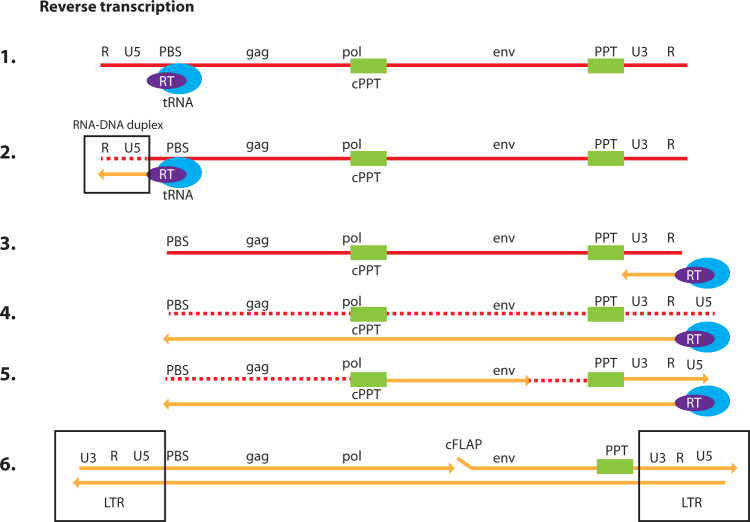 Figure 1. Reverse-transcription steps that convert the HIV single-stranded RNA genome into double-stranded DNA before nuclear entry and integration.1,3
The historical contribution was a proof of principle, not the endpoint of vector development. Early systems retained more viral components and were evaluated under a different safety and manufacturing framework than modern vectors. Subsequent work separated helper functions, removed accessory genes, introduced self-inactivating long terminal repeats, improved pseudotyping, optimized transfer cassettes, and developed integration-deficient variants.
Reconstructing an Early Lentiviral System
| Required Detail | Why It Matters | What to Record |
|---|---|---|
| Primary publication | Defines the exact experimental system and claims | Citation, supplementary methods, construct names |
| Transfer vector | Determines payload and cis-acting elements | Backbone, LTRs, packaging signal, promoter, transgene |
| Packaging components | Determine proteins and biosafety configuration | Plasmids, viral genes, split design, ratios |
| Envelope | Controls entry and tropism | Glycoprotein, target receptor, production effect |
| Production method | Changes titer and particle quality | Cell line, transfection, harvest, purification |
| Assay system | Defines reported performance | Target cell, titer method, dose, duration, endpoint |
Modern Lentiviral Architecture Is More Modular
Contemporary systems commonly divide vector functions among a transfer construct, packaging components, and an envelope plasmid. Later-generation packaging designs reduce the viral genes supplied in trans and separate functions across additional plasmids. Self-inactivating transfer vectors reduce promoter activity from the integrated long terminal repeats, while an internal promoter controls the payload.
The envelope can be changed through pseudotyping, and the internal cassette may use constitutive, tissue-specific, inducible, or microRNA-regulated expression. Integration-deficient systems alter integrase or attachment sequences to reduce stable insertion. These choices mean there is no single modern vector that can be inferred from the Mulligan name; each project needs a target-specific architecture.
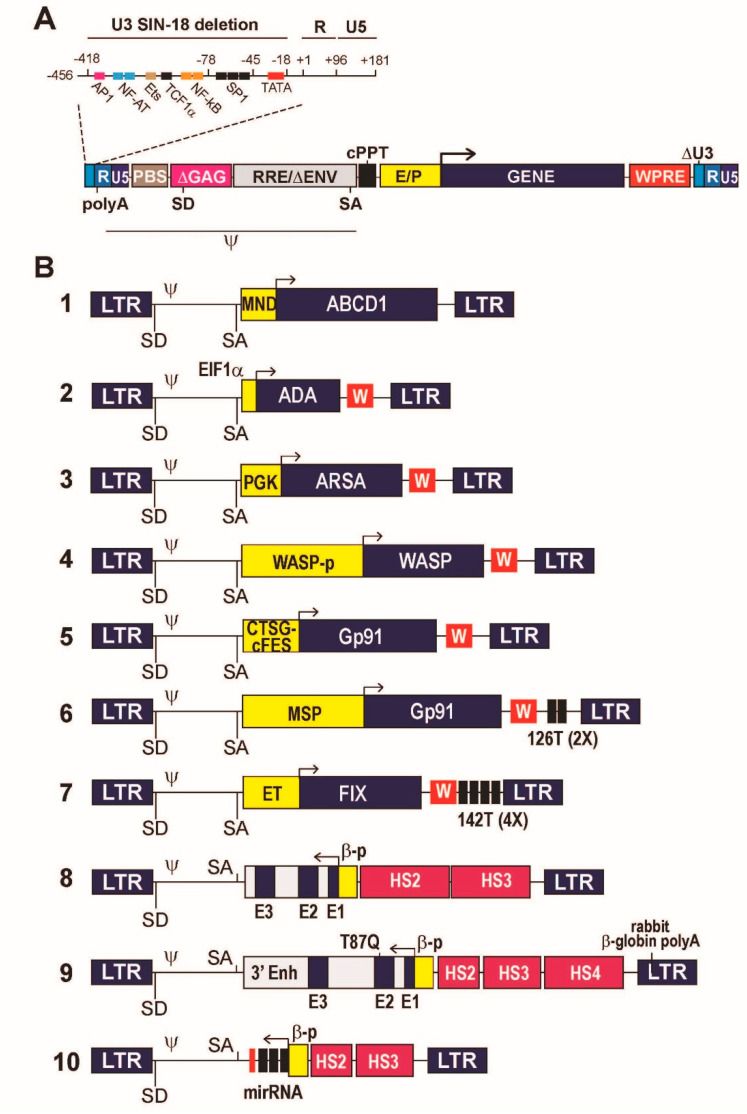 Figure 2. Prototype self-inactivating HIV-1-derived lentiviral vector and examples of disease-specific expression cassettes used in clinical gene therapy.2,3
From Foundational Vector to Current Safety Features
| Development Stage | Typical Technical Direction | Reason for the Change |
|---|---|---|
| Early proof-of-principle | Demonstrate stable transfer to non-dividing cells | Establish feasibility and tissue access |
| Split packaging systems | Separate essential functions among plasmids | Reduce recombination and replication competence |
| Accessory-gene reduction | Remove nonessential viral genes | Simplify vector and improve biosafety |
| Self-inactivating LTRs | Disable LTR promoter activity after integration | Reduce unwanted transcriptional activation |
| Targeted regulation | Engineered envelopes and internal regulatory elements | Improve specificity and expression control |
| Integration-deficient vectors | Reduce integrase-mediated insertion | Support transient delivery or editing applications |
Mulligan Lentiviral Vector Reconstruction Is Useful
Reconstructing an early vector can be valuable for method comparison, mechanism studies, validation of published findings, or teaching the evolution of gene delivery. It may also reveal which later modifications improved titer, expression, or safety. However, a historical construct is rarely the default choice for a new therapeutic or translational program.
A comparison should use matched payloads and target cells, then measure functional titer, expression durability, cell viability, vector copy number, integration profile, and replication safety. Differences should be attributed to defined architecture rather than the historical label. A modern self-inactivating vector may behave differently because of promoter, envelope, packaging, and process changes simultaneously.
Selection Guide: Choosing a Modern Equivalent for Application
- For stable ex vivo gene addition, prioritize target-cell transduction, copy-number control, and preservation of cell function.
- For transient delivery or genome editing, consider an integration-deficient system and measure residual integration.
- For restricted expression, select a tissue-specific promoter or microRNA-regulated cassette.
- For difficult primary cells, evaluate envelope glycoproteins using functional titer in the actual target.
- For multi-gene expression, optimize cassette order, linker or 2A elements, and total genome size.
A modern project may use regulated lentiviral integration and expression or other design controls that did not define the early historical system. The appropriate equivalent is selected from the biological requirement, not from author attribution.
Integration, Expression, and Clonal Risk of Mulligan Lentiviral Vectors
Why Integration Requires Deliberate Risk Control
Integrating lentiviral vectors insert a provirus into the host genome, enabling durable expression through cell division. The same feature creates context-dependent risks because an insertion can influence nearby genes or contribute to expansion of a modified clone.
- Vector architecture - self-inactivating LTRs and internal regulatory elements shape transcriptional activity after integration.
- Promoter and enhancer activity - strong or broadly active elements may influence adjacent genomic regions.
- Target-cell biology - stemness, proliferative capacity, and disease background affect the consequence of an insertion.
- Vector copy and integration pattern - higher copy numbers and particular integration sites can increase clonal concern.
- Transgene function and cell expansion - a biologically active payload or strong selective pressure may favor certain modified cells.
Evidence Needed for a Modern Safety Assessment
Safety should be demonstrated for the exact construct, production process, target cell, and application. Effective transduction by a historical vector does not establish that it meets current expectations.
- Replication-competent lentivirus testing matched to the vector generation and production system.
- Vector copy number measurement interpreted together with expression, viability, and cell phenotype.
- Integration-site and clonality analysis when the cell type, exposure, or development stage makes these assessments relevant.
- Genomic stability, long-term observation, and functional monitoring of the modified cell population.
Production and Analytical Comparability of Mulligan Lentiviral Vectors
A fair comparison between an early construct and a modern lentiviral vector requires matched production and testing. Otherwise, process differences may be mistaken for improvements or defects in vector architecture.
01 Standardize production inputs: producer cells, plasmid ratios, culture conditions, and harvest timing.
02 Normalize downstream handling: nuclease treatment, concentration, purification, formulation, freeze-thaw history, and storage.
03 Test matched target cells at comparable functional doses and under the same transduction conditions.
04 Relate expression to vector copy number, cell viability, phenotype, and the intended biological function.
A Practical Selection and Documentation Workflow
Clarify whether "Mulligan lentiviral vector" refers to a publication, plasmid, laboratory protocol, or general historical concept.
Obtain the exact sequence, map, repository identifier, and production method before attempting reconstruction.
Identify which historical features are required for the research question and which should be replaced by modern safety elements.
Build a side-by-side design table covering LTRs, packaging, envelope, promoter, payload, integration, and assay method.
Test historical and modern constructs under matched production, target-cell, dose, and endpoint conditions.
Overview of What Creative Biolabs Can Provide
A project involving a historically described lentiviral system should begin with source reconstruction, followed by a documented comparison with modern vector options. Creative Biolabs can support sequence-defined design, modernization, production, and analytical evaluation without treating an ambiguous historical label as a fixed specification.
| Research Need | Related Creative Biolabs Support | How It Connects to Mulligan Lentiviral Vector Research |
|---|---|---|
| Historical-to-modern redesign | Lentiviral Vector Development Service | Supports translation of a defined historical construct into a documented modern architecture. |
| Architecture optimization | Lentiviral Vector Optimization Service | Enables comparison of cassette, envelope, titer, expression, and stability variables. |
| Expression regulation | Lentiviral Vector Design for Regulated Integration and Expression | Adds modern control over integration-dependent expression. |
| Reduced-integration alternative | Integration-Deficient Lentiviral Vector Service | Provides an option when transient delivery is more suitable than stable insertion. |
| Inducible expression | Inducible Vector Systems Design for Lentiviral Vector | Supports controlled expression not inherent to an ambiguous historical vector name. |
| Matched vector production | Custom Lentiviral Vector Production Service | Provides material for controlled historical-versus-modern comparisons. |
| Functional titer | Lentiviral Vectors Titration Service | Supports comparable dose assignment across reconstructed and modern vectors. |
Contact us today to discuss a research objective, model, delivery challenge, or tailored development plan.
Frequently Asked Questions
Q: Is Mulligan lentiviral vector a recognized vector type?
A: Not as a single standardized category. The phrase is better treated as an informal historical reference unless an exact publication or construct is provided.
Q: Which publication is commonly associated with this context?
A: A foundational 1996 Science paper by Naldini and colleagues, including Richard C. Mulligan, demonstrated stable HIV-1-derived gene transfer in non-dividing cells in vivo.
Q: Can an early vector be used directly in a modern project?
A: It may be reconstructed for research, but current projects usually require updated safety architecture, defined sequences, modern production controls, and application-specific testing.
Q: What information is needed to reproduce a historical vector?
A: The primary publication, plasmid map or sequence, packaging components, envelope, promoter, transgene, production method, and assay definitions are needed.
Q: How do modern vectors differ from early systems?
A: Modern vectors commonly use more separated packaging functions, fewer viral genes, self-inactivating LTRs, engineered envelopes, internal regulatory elements, and improved analytical controls.
Q: Why should the historical label not be used as a build specification?
A: The label does not uniquely define the plasmids, sequence, generation, envelope, payload, or process, so it cannot support reproducible construction by itself.
References
- Milone MC, O'Doherty U. Clinical use of lentiviral vectors. Leukemia. 2018;32:1529-1541. https://doi.org/10.1038/s41375-018-0106-0.
- Poletti V, Mavilio F. Designing Lentiviral Vectors for Gene Therapy of Genetic Diseases. Viruses. 2021;13(8):1526. 10.3390/v13081526
- Distributed under Open Access license CC BY 4.0, without modification.
