
Lentiviral Vector Overview
Lentiviral Vector Introduction
Lentiviral vectors are enveloped retrovirus-derived delivery systems designed to transfer genetic cargo into dividing and non-dividing cells. Their capacity for stable integration, broad pseudotyping options, and ex vivo compatibility has made them important in cell engineering, disease modeling, gene addition, and several therapeutic workflows. A modern lentiviral vector development program is not defined by the transfer plasmid alone: envelope glycoprotein, packaging system, regulatory elements, integration profile, producer process, and target-cell biology collectively determine performance and risk.
Vector Architecture Separates Delivery from Replication
1. Multi-Component System
A lentiviral vector system distributes viral functions across multiple plasmids:
| Component | Function | Key Contents |
|---|---|---|
| Transfer Construct | Carries the therapeutic or experimental gene | Expression cassette between LTR-derived elements; packaging & reverse transcription sequences |
| Packaging Plasmids | Provide core machinery | Structural and enzymatic proteins |
| Envelope Plasmid | Determines viral tropism | Surface glycoprotein |
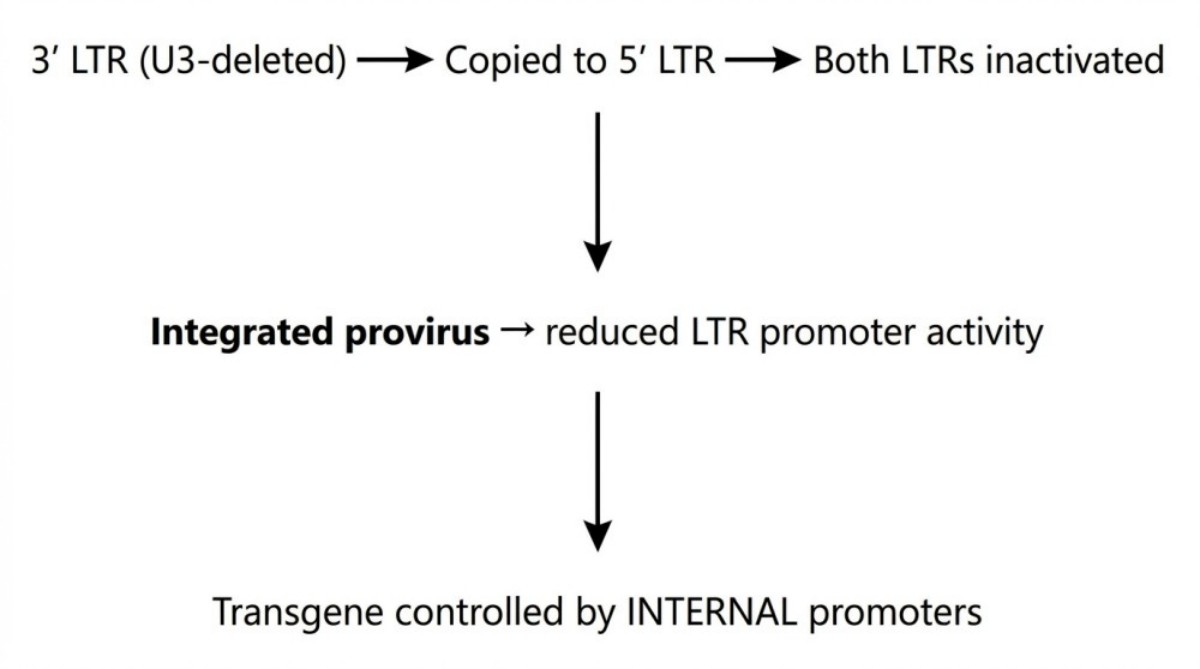
2. Self-Inactivating (SIN) Vector Design
Self-inactivating vectors contain a deletion in the U3 region of the 3' LTR.
During reverse transcription:
3. Design Principles
| ☑ Do | ⚠ Watch Out |
|---|---|
| Add elements to improve RNA processing | Every sequence must have a defined purpose |
| Enhance nuclear export | / |
| Optimize expression levels | / |
| Include chromatin insulators | / |
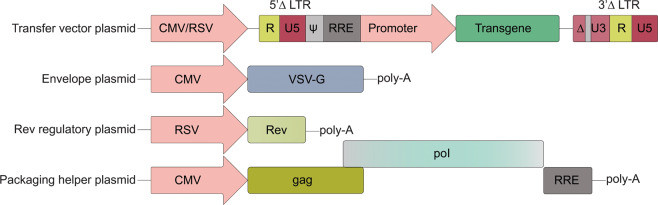 Figure 1. Four-plasmid organization of a third-generation lentiviral vector system, including the transfer, envelope, Rev, and packaging helper plasmids.1,3
Key Design Variables and Their Tradeoffs
| Design Variable | Primary Function | Potential Benefit | Common Tradeoff |
|---|---|---|---|
| Envelope | Cell entry and tropism | Broader or retargeted transduction | Stability, toxicity, receptor dependence |
| Internal promoter | Controls transgene expression | Strength or tissue specificity | Silencing, off-target expression, enhancer activity |
| Transgene cassette | Delivers functional payload | Single or multi-gene function | Size reduces titer and stability |
| Integration design | Stable or integration-deficient delivery | Durability or reduced insertion risk | Different expression persistence |
| Regulatory elements | RNA processing and expression control | Higher or more consistent output | Added complexity and recombination risk |
Lentiviral Vector Pseudotyping Expands and Redirects Tropism
Pseudotyping replaces the native lentiviral envelope with a heterologous glycoprotein. VSV-G is widely used because it supports broad tropism, particle stability, and concentration, but it is not optimal for every target. Glycoprotein optimization can improve entry into a chosen cell population, reduce off-target transduction, or adapt vector stability to a manufacturing process. Envelope selection should consider receptor abundance on the true target, activation state, toxicity, complement sensitivity, concentration method, and compatibility with serum-free processing. Tropism measured in an immortalized cell line may not predict primary-cell transduction.
Integrating and Integration-Deficient Lentiviral Vectors
Conventional lentiviral vectors use functional integrase to establish a stable provirus. Integration-deficient lentiviral vectors contain integrase or attachment-site changes that greatly reduce integration, leaving predominantly episomal DNA. They can be useful for transient expression, delivery of genome-editing components, or non-dividing targets where episomes persist long enough for the intended effect.
Integration-deficient does not mean integration-free. Residual integration must be measured with an assay suited to the application. Integration-deficient lentiviral vector design also requires attention to episomal expression, target-cell division, payload, and dose. A system selected to reduce insertion risk may require more particles or produce shorter expression.
Lentiviral Vectors Applications
- Stable gene addition in hematopoietic stem and progenitor cells, immune cells, and other ex vivo products.
- Generation of constitutive, inducible, reporter, overexpression, or knockdown cell lines.
- Delivery of shRNA, CRISPR components, receptors, metabolic pathways, or reprogramming factors.
- Disease modeling through stable introduction of pathogenic or corrective sequences.
- Transient delivery with integration-deficient vectors where permanent insertion is unnecessary.
Lentiviral Vectors Manufacturing
Most lentiviral vectors are produced by transient transfection of packaging cells, followed by harvest, clarification, concentration, purification, formulation, and storage. Stable producer lines may improve consistency at scale but require substantial development. Upstream parameters influence particle assembly and envelope incorporation; downstream operations can reduce recovery or infectivity through shear, aggregation, adsorption, or loss of envelope function.
Physical particle measurements, reverse-transcriptase activity, p24 antigen, genome-containing particles, and functional transduction answer different questions. A high particle count with low functional titer can indicate damaged particles, poor envelope activity, defective genomes, or an unsuitable titration cell. The release strategy should use assays linked to the intended target or supported by a justified reference system.
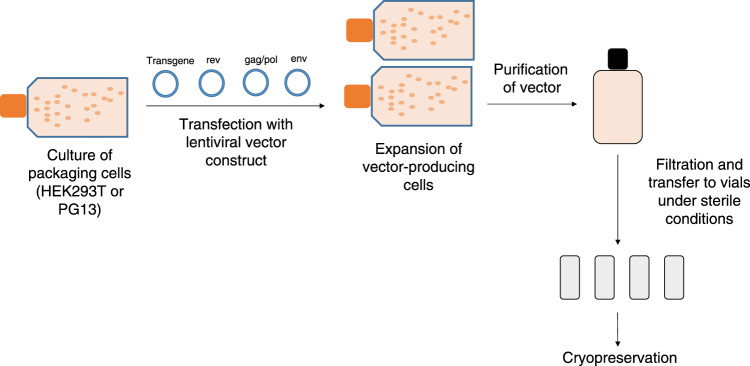 Figure 2. Overview of large-scale lentiviral vector manufacturing from packaging-cell culture and plasmid transfection through purification, sterile filling, and cryopreservation.2,3
Lentiviral Transduction
For ex vivo products, lentiviral transduction is one stage of the cell-manufacturing process rather than an isolated vector assay. Upstream and downstream conditions can change receptor availability, cell-cycle state, vector uptake, viability, differentiation, and vector copy number.
Variables That Shape Transduction Performance
- Starting material and collection - donor variability, cell composition, and handling affect baseline fitness.
- Activation and culture - media, cytokines, cell density, and activation state alter receptor expression and permissiveness.
- Vector exposure - functional dose, exposure time, mixing, enhancers, temperature, and washout influence uptake and recovery.
- Expansion and harvest - culture duration and selection pressure can change phenotype, copy-number distribution, and clonal representation.
Optimize for the Final Cell Product
A condition that maximizes short-term expression may reduce stem-cell fitness or alter the phenotype required in the final product. Process development should therefore map functional dose and transduction efficiency against cell recovery, vector copy distribution, differentiation, and final biological function.
- Define target-cell quality attributes before optimizing transduction efficiency.
- Test vector and cell-process variables in the intended culture format, including closed or automated systems.
- Control residual vector and transduction enhancers according to the downstream workflow.
- When either process changes, evaluate molecular modification and cell performance together for comparability.
Safety Assessment Focuses on Replication and Integration of Lentiviral Vectors
Replication and Product-Quality Controls
Replication-competent lentivirus testing addresses recombination events that could restore a spreading virus. The assay should match the vector generation, envelope, production system, sample type, and amplification strategy.
- Residual plasmid and host-cell DNA
- Host-cell proteins, nuclease, and other process reagents
- Endotoxin, sterility-related attributes, and adventitious agents
- Vector identity, purity, and residual replication-related risk
Integration and Clonal-Risk Controls
Insertional risk is evaluated through vector design, target-cell biology, vector copy number, integration-site analysis, clonal monitoring, and long-term observation. Self-inactivating architecture and internal promoters improve the profile relative to earlier gamma-retroviral designs, but they do not eliminate risk.
The required evidence should be proportional to use: a research reagent, a preclinical vector, and a vector used to manufacture a clinical cell product do not carry the same analytical or follow-up expectations.
Selection Guide for Lentiviral Vector Projects
- Define whether expression must persist through cell division or whether transient delivery is sufficient.
- Select the target cell and envelope using primary-cell receptor biology and process constraints.
- Choose promoter strength and specificity based on the required expression range and off-target risk.
- Minimize cassette size and complexity while retaining essential regulatory functions.
- Set vector copy, functional titer, potency, purity, replication-safety, and stability specifications before scale-up.
Interpreting Titer, MOI, and Vector Copy Number
These three measurements are related, but they describe different parts of the transduction process. Reporting them together with the assay method and target-cell context prevents misleading comparisons.
Functional Titer
Functional titer measures successful transduction in a defined cell and assay. The same preparation can produce different titers in HEK293 cells, primary T cells, and hematopoietic progenitors because receptor abundance and intracellular permissiveness differ.
Multiplicity of Infection
MOI is calculated from the selected titer and the number of target cells; it is not an intrinsic property of the vector. MOI should therefore be reported with the titration cell, assay endpoint, and exposure conditions. Enhancers, activation, cell density, exposure time, and washout can all change the observed efficiency.
Vector Copy Number
VCN measures integrated or total vector sequences per cell depending on assay design and sampling time. It should be interpreted with viability, expression, clonality, and function rather than used as a stand-alone measure of product quality.
Avoid Average-Only Interpretation
An average VCN can conceal a mixed population containing untransduced cells and a smaller high-copy fraction. Distribution-level measurements or clonal analysis may be needed when safety depends on limiting highly modified cells.
Overview of What Creative Biolabs Can Provide
Lentiviral vector performance emerges from coordinated envelope, cassette, integration, production, and analytical choices. Creative Biolabs can support complete development or focused optimization based on the target cell and intended function.
| Research Need | Related Creative Biolabs Support | How It Connects to Lentiviral Vector Research |
|---|---|---|
| Core vector development | Lentiviral Vector Development Service | Supports transfer-vector, packaging, envelope, and application planning. |
| Vector optimization | Lentiviral Vector Optimization Service | Addresses titer, expression, stability, tropism, and process performance. |
| Envelope selection | Glycoprotein Optimization of Lentiviral Vector | Supports pseudotype evaluation for target-cell entry and particle stability. |
| Targeted entry | Ligand-retargeted Lentiviral Vector Service | Enables investigation of receptor-directed transduction. |
| Expression specificity | Tissue-specific Promoter-Regulated Lentiviral Vectors Service | Connects internal promoter choice to tissue-restricted expression. |
| Reduced integration | Integration-Deficient Lentiviral Vector Service | Supports transient or editing-focused delivery with reduced integration. |
| Custom production | Custom Lentiviral Vector Production Service | Provides vector material for research and development studies. |
| Titer and safety testing | Lentiviral Vectors Titration Service | Supports functional dose assignment and vector characterization. |
Contact us today to discuss a research objective, model, delivery challenge, or tailored development plan.
Frequently Asked Questions
Q: Can lentiviral vectors transduce non-dividing cells?
A: Yes. Lentiviral preintegration complexes can enter the nucleus of many non-dividing cells, although efficiency still depends on cell type and envelope.
Q: Do all lentiviral vectors integrate?
A: Conventional vectors are designed to integrate. Integration-deficient vectors greatly reduce integration but can retain residual integration and usually provide less durable expression in dividing cells.
Q: What is pseudotyping?
A: Pseudotyping replaces the vector envelope glycoprotein to change cell entry, tropism, stability, or manufacturing characteristics.
Q: Why is functional titer different from particle count?
A: Particle assays count physical components, while functional titer measures successful transduction in a defined cell and assay. Damaged or inactive particles can increase particle count without increasing function.
Q: What does self-inactivating mean?
A: A deletion in the long terminal repeat reduces promoter activity from the integrated vector ends, so expression is driven mainly by an internal promoter.
Q: What are the main safety concerns?
A: Key concerns include replication-competent virus, insertional effects, excessive vector copy number, off-target transduction, impurities, and target-cell changes caused by the transgene or process.
References
- Bulcha JT, Wang Y, Ma H, Tai PWL, Gao G. Viral vector platforms within the gene therapy landscape. Signal Transduction and Targeted Therapy. 2021;6:53. https://doi.org/10.1038/s41392-021-00487-6.
- Milone MC, O'Doherty U. Clinical use of lentiviral vectors. Leukemia. 2018;32:1529-1541. https://doi.org/10.1038/s41375-018-0106-0.
- Distributed under Open Access license CC BY 4.0, without modification.
