Monosaccharide & Blood Types
Blood typing is a fundamental aspect of transfusion medicine and immunohematology, with its significance extending into genetics, forensic science, and organ transplantation. Monosaccharides are the building blocks of oligosaccharides, which, when attached to proteins or lipids, form antigenic determinants on red blood cells. The ABO blood group system relies on these structural differences in terminal sugar residues to classify blood types. The key enzymes involved in this differentiation are glycosyltransferases, which catalyze the addition of specific sugars to the precursor H antigen.
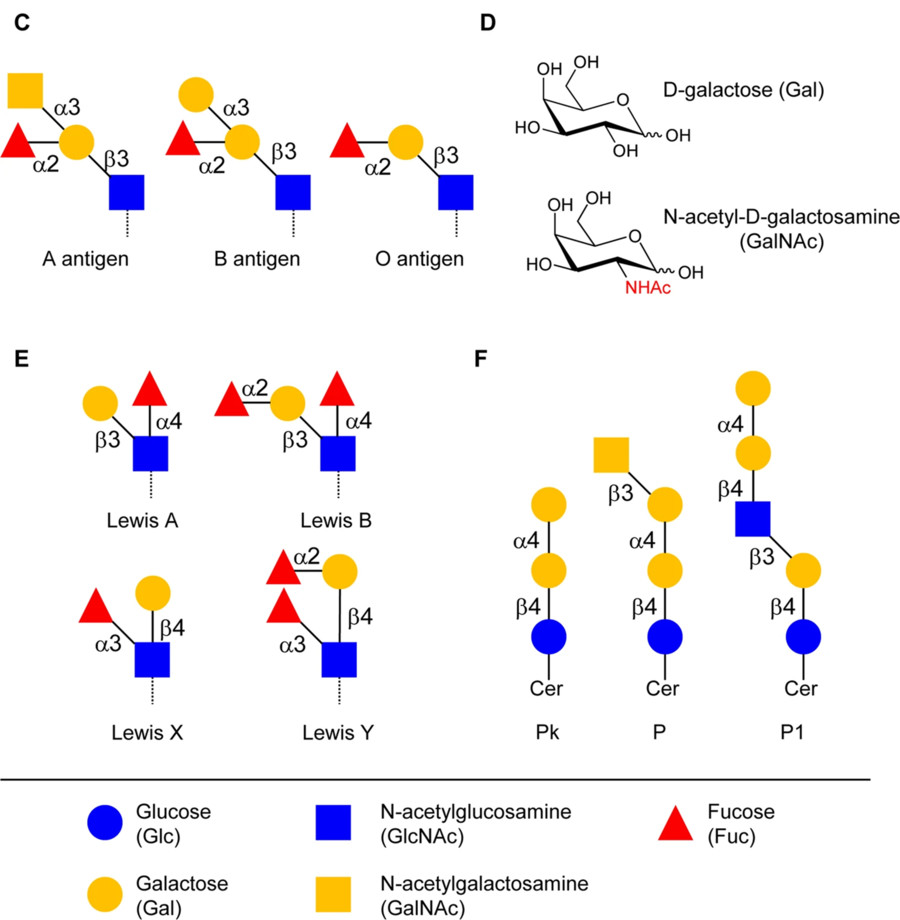 Fig.1 The schematic of several glycan structures (three blood type antigens).1
Monosaccharide in Blood Types
Monosaccharides have extensive applications in transfusion medicine, disease research, vaccine development, and synthetic biology. The ABO blood group system is determined by carbohydrate antigens found on red blood cells, shaped by specific glycosyltransferases. Type A carries N-acetylgalactosamine (GalNAc), Type B has D-galactose, while Type O retains only the H antigen, which acts as a precursor. Meanwhile, the Rh system is based on the RhD protein, defining whether someone is Rh-positive or negative, which is especially important in transfusions and pregnancy. Blood antigens fall into two main categories: Lewis antigens (Lea, Leb) and H antigen. Lewis antigens (Lea, Leb), which are fucose-containing glycolipids. Lewis antigens are not permanently fixed to red blood cells; instead, they are synthesized in secretory tissues and absorbed onto the cell membrane from plasma. They play key roles in immune recognition, inflammation, and microbial interactions. For example, some pathogens, such as Helicobacter pylori, exploit Lewis antigens as adhesion sites, influencing susceptibility to infections. H antigen, which forms the foundation of the ABO system, and its structure is as follows:
-
Fucose (Fuc) linked to galactose through an α1-2 bond
-
Galactose linked to N-acetylglucosamine (GlcNAc)
-
N-acetylglucosamine (GlcNAc) linked to another galactose
-
The terminal sugar determines the specific blood type
The enzyme fucosyltransferase (FUT1) is responsible for adding fucose to this precursor, forming the fundamental H antigen. Individuals with blood type O retain this structure unmodified, whereas individuals with blood types A or B have additional modifications.
ABO Blood Group System
|
Blood Type
|
Terminal Sugar
|
Enzyme Responsible
|
Monosaccharide Present
|
Transfusion Compatibility
|
|
O
|
No additional sugar
|
None
|
Fucose, Galactose, GlcNAc
|
Universal donor
|
|
A
|
N-acetylgalactosamine (GalNAc)
|
A-transferase
|
Fucose, Galactose, GlcNAc, GalNAc
|
Compatible with A, AB
|
|
B
|
Galactose
|
B-transferase
|
Fucose, Galactose, GlcNAc, Gal
|
Compatible with B, AB
|
|
AB
|
Both GalNAc and Gal
|
A and B transferases
|
Fucose, Galactose, GlcNAc, GalNAc, Gal
|
Universal recipient
|
Blood type O is often called the "universal donor" for red blood cells because it lacks additional antigenic determinants that would trigger an immune response. Conversely, AB individuals, who possess both modifications, are considered "universal recipients" since their immune system does not produce anti-A or anti-B antibodies.
Applications of Monosaccharides in Blood Type Studies
Research on monosaccharides has led to advanced blood type testing methods and transfusion compatibility assessment. At Creative Biolabs, we specialize in developing high-quality blood group antigens, including ABO and Rh systems, to support your immunohematology research needs.
-
Development of monosaccharide-fluorescent probes (e.g., GalNAc-PAA-fluor, Gal-PAA-fluor) enhances the detection of A/B antigens.
-
H trisaccharide probes improve O blood type identification sensitivity.
-
Chemically synthesized monosaccharide-based glycoproteins mimic natural blood antigens.
-
Used in antibody absorption assays, reducing transfusion-related reactions.
Recent Research Progress in Monosaccharides
Recent advancements of carbohydrate chain in glycobiology, synthetic biology, and immunology have expanded the applications of monosaccharides beyond traditional blood typing.
Monosaccharides and Disease Susceptibility
Monosaccharide research has revealed correlations between blood type glycans and susceptibility to infectious diseases and metabolic disorders.
-
O Blood Type individuals are more susceptible to norovirus and Plasmodium spp. (malaria) due to H antigen binding.
-
SARS-CoV-2 shows a higher affinity for A blood type antigens, enhancing viral adhesion.
-
ABO gene polymorphisms influence glycosyltransferase activity, impacting insulin sensitivity in B blood type individuals.
-
Non-enzymatic glycosylation (AGEs) affects RBC membrane proteins in diabetes, altering blood type antigen stability.
|
Blood Type
|
Infection Risk
|
Metabolic Risk
|
|
O
|
Higher risk of Norovirus, Malaria
|
Lower cardiovascular risk
|
|
A
|
Higher susceptibility to SARS-CoV-2
|
Increased thrombotic risk
|
|
B
|
Lower risk of some infections
|
Reduced insulin sensitivity
|
|
AB
|
Mixed susceptibility
|
Higher cholesterol levels
|
Vaccine and Antibody Engineering
Monosaccharide structures serve as immune epitopes, driving innovations in carbohydrate-based vaccine design and monosaccharide-specific antibody development.
-
Influenza Hemagglutinin (HA) glycosylation patterns (mannose-rich epitopes) are key vaccine targets.
-
Synthetic H trisaccharides mimic pathogen glycans, enabling broad-spectrum antiviral vaccine development.
-
Monoclonal antibodies (mAbs) against A/B antigens can be used in therapeutic blood filtration.
-
Engineered glyco-antibodies enhance targeted drug delivery. We offer therapeutic antibody glycoengineering services to facilitate your glyco-antibody development.
Synthetic Biology and Personalized Medicine
Monosaccharide research has revolutionized blood engineering, organ transplantation, and glycan-based diagnostics.
-
Gene-editing of glycosyltransferases can convert A/B RBCs to universal O-type.
-
Enzyme-mediated glycan removal (e.g., GalNAc & Gal cleavage) produces universal donor blood.
-
Monosaccharide metabolic profiling predicts chemotherapy response.
-
AI-driven glycan design platforms (e.g., Auto-CHO software) accelerate blood antigen mimic development.
How Monosaccharides Facilitate Blood Type Research
How Monosaccharides Facilitate Blood Type Research
Monosaccharides are integral to understanding and manipulating blood type antigens, leading to breakthroughs in transfusion medicine and therapeutic interventions. At Creative Biolabs, we offer monosaccharide analysis services to support precise characterization of blood type-related glycans.
Blood Type Antigen Biosynthesis
Monosaccharides are the structural determinants of ABO and Lewis antigens, making their biosynthesis and enzymatic regulation key research areas. There are several techniques for studying blood group glycans:
-
Isotope-labeled monosaccharides trace antigen biosynthesis in live cells.
-
Glycosidase digestion assays (e.g., fucosidase, galactosidase) define antigen structure.
-
Thin layer chromatography (TLC) for Carbohydrate Analysis at Creative Biolabs offers an advanced approach to analyze and differentiate key glycan structures in blood group antigens.
Improving Blood Type Testing and Artificial Blood Development
Monosaccharide research has enabled innovative techniques for high-accuracy blood typing and synthetic blood advancements:
-
Monosaccharide-based glycan microarrays detect weak antigenic variations.
-
Lectin-based sensors recognize monosaccharide-binding proteins, a service offered in our lectin microarray platform.
-
Synthetic O-type RBCs using monosaccharide modification for universal donor blood.
-
Development of monosaccharide-based blood substitutes for emergencies.
To support blood antigen research, our high-performance anion-exchange chromatography (HPAEC-PAD) provides high-resolution profiling of glycans involved in blood typing.
Organ Transplantation and Monosaccharide Compatibility
Blood type glycans extend beyond RBCs, influencing organ transplantation success and immune responses.
Monosaccharides play a pivotal role in blood type determination by influencing the biochemical properties of erythrocyte surface antigens. The ABO blood group system is primarily defined by the presence of GalNAc and Gal, which dictate antigenic specificity and compatibility. Advancements in glycobiology and molecular genetics continue to enhance our understanding of blood group antigens, paving the way for improved transfusion medicine and personalized therapeutic strategies. By leveraging the intricate biochemistry of monosaccharides and glycosyltransferases, scientists and medical professionals can ensure safer blood transfusions, enhance disease diagnostics, and explore potential applications in regenerative medicine and immunotherapy. At Creative Biolabs, we provide cutting-edge glycan synthesis, carbohydrate analysis and engineering solutions to advance blood type research, transfusion safety, and organ transplantation success.
FAQs
Q: What is the relationship between blood types and carbohydrates?
A: Blood types are determined by specific carbohydrate antigens on red blood cells. These antigens are built from different monosaccharides, which help the immune system recognize self from non-self, making them essential for transfusion compatibility and disease susceptibility.
Q: What monosaccharide is present in blood group antigen structures?
A: Blood group antigens are made up of key sugars like fucose (Fuc) in the H antigen, N-acetylgalactosamine (GalNAc) in A antigen, and D-galactose (Gal) in B antigen. These small differences define a person's blood type and impact immune responses.
Reference
-
Kappler, Katharina, and Thierry Hennet. "Emergence and significance of carbohydrate-specific antibodies." Genes & Immunity 21.4 (2020): 224-239. Distributed under Open Access license CC BY 4.0, the graph was cropped to keep only part C/D/E/F. https://doi.org/10.1038/s41435-020-0105-9
Related Services
Resources
For Research Use Only.