Carbohydrate Chains in Lipid Metabolism & Membrane Fluidity
Carbohydrate chains orchestrate critical biological processes ranging from lipid metabolism to cellular communication. These intricate sugar polymers, often overshadowed by their protein counterparts, have shaped our understanding of membrane biology through decades of painstaking research. Early pioneers like Albert Neuberger, who first characterized glycoproteins in the 1950s, faced formidable challenges in isolating these hydrophilic structures using rudimentary chromatography techniques. Their perseverance laid the groundwork for modern glycobiology, revealing how these "sugar codes" govern membrane stability, flexibility, and function in both glycolipids and glycoproteins.
Why Carbohydrate Chains Matter in Lipid Systems
The story of carbohydrate chain research reads like a biochemical detective novel. When Swedish biochemist Gunnar Blix discovered sialic acids in the 1930s, he couldn't have anticipated their future role in lipid raft formation. Today, we understand these chains as molecular multitaskers: they serve as cellular ID cards in immune recognition (e.g., ABO blood group antigens), act as metabolic gatekeepers in lipoprotein regulation, and even function as emergency repair crews during membrane damage. Their structural complexity initially baffled researchers. Conventional mass spectrometry struggled with branched oligosaccharides until the 1980s advent of MALDI-TOF, which finally allowed precise sequencing. This technological leap revealed how membrane-bound glycans influence:
-
Signal transduction – Ganglioside GM1's carbohydrate moiety, for instance, modulates insulin receptor clustering
-
Lipid trafficking – Heparan sulfate proteoglycans guide LDL particle internalization
-
Membrane repair – Glycocalyx components facilitate vesicle fusion during wound healing
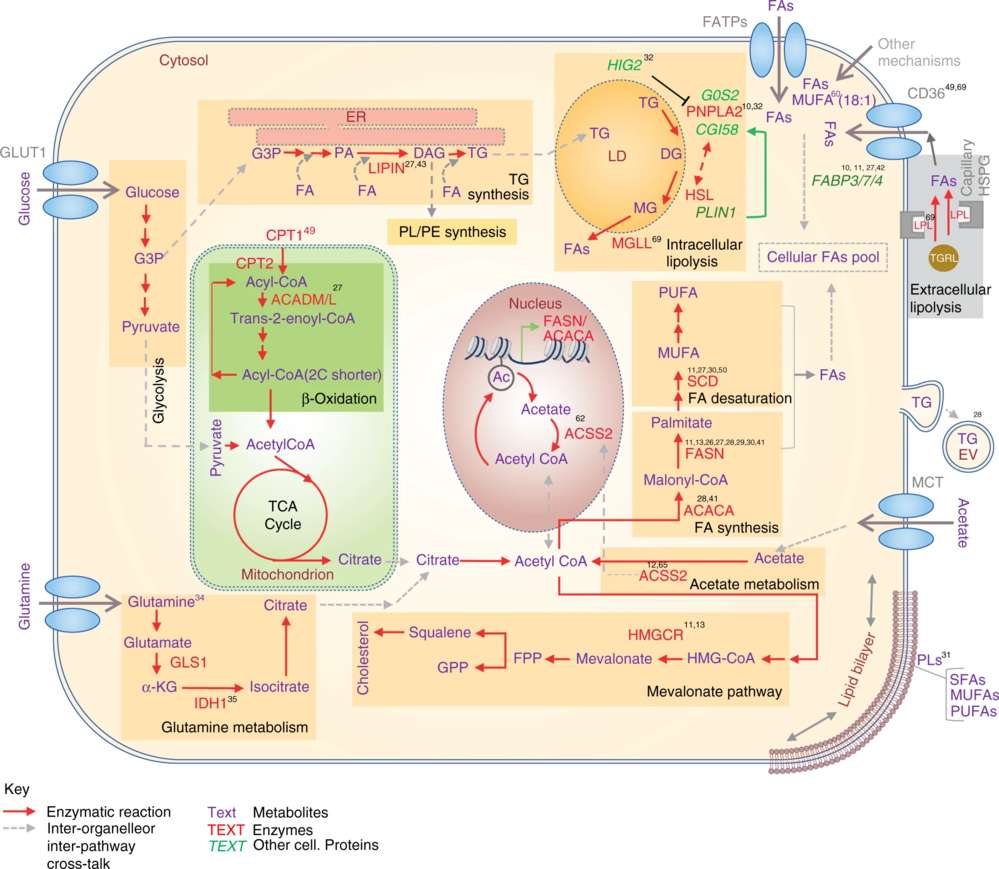 Fig.1 Major lipid metabolism pathways.1
The clinical implications are profound. When researchers linked O-GlcNAc modifications to diabetic insulin resistance, it revolutionized our view of metabolic disease pathogenesis. Similarly, obesity research now scrutinizes how chondroitin sulfate glycosylation impacts adipocyte lipid storage.
|
Creative Biolabs' Service
|
Service Overview
|
|
Carbohydrate Analysis Services
|
Comprehensive carbohydrate analysis to study carbohydrate chains in lipid systems and their role in metabolic processes.
|
|
Glycan Profiling Service
|
Detailed profiling of glycan structures to understand their roles in cellular processes and lipid regulation.
|
|
Custom Chondroitin Sulfate Synthesis Service
|
Custom synthesis of chondroitin sulfate to study its role in lipid systems and cellular interactions in the extracellular matrix.
|
Carbohydrate Chains in Metabolism, Membranes, and ECM
At Creative Biolabs, we've witnessed firsthand how cryo-EM has transformed glycobiology. One recent study employed single-particle analysis to visualize how sialylated lipids modulate LDL receptor binding—a breakthrough that took six months of iterative freezing and pattern recognition. By combining advanced mass spectrometry with AI-driven molecular dynamics simulations, we're now mapping glycan-lipid interaction hotspots that could yield next-gen antidiabetics.
Sugar-Coated Fluidity: Membranes in Motion
This sugar-mediated flexibility isn't just academic—it's survival. Polar fish prevent membrane crystallisation in freezing waters by producing antifreeze glycoproteins (AFGPs), which are the most potent known inhibitors of ice recrystallisation and inhibit the growth of ice crystals in fish body fluids, effectively helping Antarctic fish adapt to the cold environment. The fluid mosaic model gains new dimensions when we consider carbohydrate influences. One study demonstrated how:
-
Phospholipid tail dynamics are constrained by adjacent glycophosphatidylinositol (GPI) anchors
-
Membrane viscosity adapts to thermal stress via rapid glycan sulfation
-
Lipid raft assembly depends on galactose-lectin interactions during T-cell activation
Metabolic Regulation: From Storage to Signaling
Carbohydrate chains are vital in metabolism, influencing a variety of metabolic processes:
-
Lipoprotein lipase activation requires N-glycosylation at Asn-43
-
Ceramide glucosylation determines lipid droplet biogenesis rates
-
Hepatic VLDL secretion falters when GalNAc transferases are inhibited
|
Creative Biolabs' Service
|
Service Overview
|
|
Glycosylation Site Mapping Service
|
Mapping glycosylation sites to understand their roles in lipid storage and metabolic signaling.
|
|
Glycan Sequencing Service
|
Sequencing of carbohydrate chains to uncover their specific roles in metabolic processes and signaling pathways.
|
|
Glycoprotein Quantification Service
|
Quantification of glycoproteins involved in metabolic regulation, providing insights into their role in lipid metabolism.
|
ECM: Where Sugars Weave Cellular Narratives
The extracellular matrix's glycans tell a story of dynamic reciprocity. Recent ECM studies reveal how:
-
Chondroitin sulfate length dictates fibroblast migration speed
-
Keratan sulfate sulfation patterns guide stem cell differentiation
-
Decorin glycosylation prevents TGF-β overactivation in fibrotic tissues
|
Creative Biolabs' Service
|
Service Overview
|
|
Glycosaminoglycan Microarray
|
Profiling of glycosaminoglycans to study their role in ECM dynamics and cellular interactions.
|
|
Heparin Sulfate Microarray
|
Analysis of heparin sulfate in the ECM and its role in guiding cellular migration and differentiation.
|
How Our Services Support Breakthroughs in This Field
At Creative Biolabs, we offer cutting-edge services that support research into carbohydrate chains and their role in lipid metabolism. Our expertise in using advanced technologies like cryo-EM and mass spectrometry allows us to assist researchers in investigating lipid-carbohydrate dynamics in unprecedented detail. Whether you are exploring the carbohydrate chains in the cell membrane or studying the function of carbohydrate chains in the extracellular matrix, we provide the tools and knowledge necessary to drive innovation in your research. We offer end-to-end solutions for glycan analysis, including custom assays for lipid raft isolation and glycomics profiling. Partner with us to explore how carbohydrate chains drive metabolic health or membrane innovation. For more information, explore our research solutions and contact us to discuss how we can support your specific research needs.
Reference
-
Munir, Rimsha, et al. "Lipid metabolism in cancer cells under metabolic stress." British journal of cancer 120.12 (2019): 1090-1098. Distributed under Open Access license CC BY 4.0, without modification. https://doi.org/10.1038/s41416-019-0451-4
Related Services
Resources
For Research Use Only.