Custom Taxusin Production Service
Professional Biosynthetic Solutions for Advanced Phytochemical Research.
Taxusin is a significant diterpenoid within the taxane family, acting as a critical non-oxygenated model for studying complex phytochemical structures. However, the structural complexity and low natural abundance of these compounds in Taxus species have necessitated the development of advanced production methodologies. Creative Biolabs provides a specialized custom taxusin production service that Leverages Biocatalysis. Specifically, we examine the production process using Hydroxymandelonitrile Glucosyltransferase (HMG-GT) as the primary enzyme catalyst and 4-hydroxymandelonitrile as the foundational substrate. This approach offers a sustainable, high-purity alternative to traditional extraction and complex total chemical synthesis.
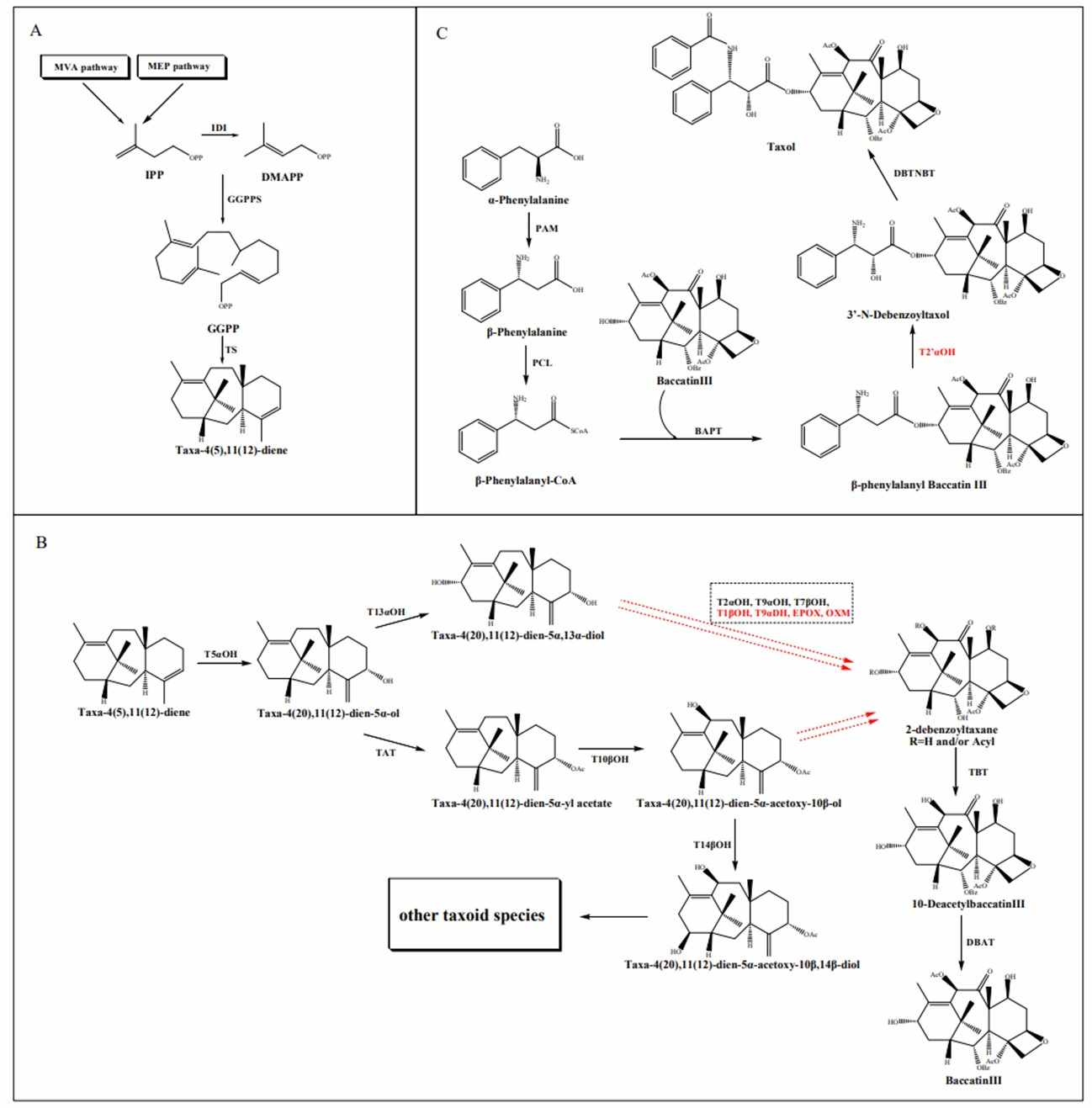 Fig.1 The biosynthetic pathway of Taxol.1
Technical Overview: The Biocatalytic Pathway
The Enzyme: HMG-GT
HMG-GT is a member of the Glycosyltransferase Family. Its natural role is to stabilize labile cyanohydrins by attaching a glucose moiety. In this custom service, the enzyme is utilized for its high regiospecificity and efficiency in converting aromatic nitriles into stable glycosides, which can then be further processed into the taxusin framework.
The Substrate: 4-Hydroxymandelonitrile
Also known as p-hydroxymandelonitrile, this substrate is a chiral cyanohydrin. In the presence of UDP-glucose and HMG-GT, it is transformed into its stabilized glucoside form. This step is crucial for maintaining the structural integrity of the aromatic ring and the chiral center during the subsequent steps of taxusin assembly.
Ready to Start? - Get Your Personalized Quote
Detailed Taxusin Production Process
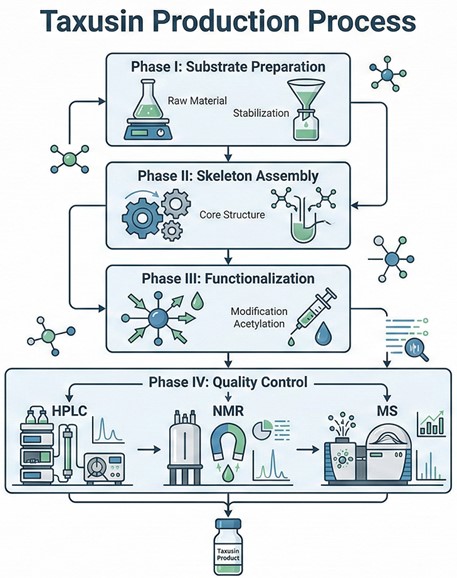
The production of taxusin via this custom service follows a multi-phase workflow designed to maximize yield and ensure product purity.
The process begins with the synthesis of 4-hydroxymandelonitrile. Since cyanohydrins are inherently unstable, they are subjected to the HMG-GT-catalyzed reaction.
-
Reaction conditions: The reaction occurs in an aqueous-organic biphasic system to manage the solubility of the aromatic substrate while maintaining enzyme stability.
-
Enzymatic step: HMG-GT transfers a glucose molecule from UDP-glucose to the hydroxyl group of the 4-hydroxymandelonitrile, forming a stable intermediate.
Using the stabilized aromatic intermediate, the taxane tricyclic core (A, B, and C rings) is constructed.
-
Cyclization: The intermediate is coupled with a cyclohexene-derived fragment. A Lewis acid-mediated cyclization is employed to form the B-ring.
-
Stereochemical control: The chirality provided by the initial 4-hydroxymandelonitrile substrate guides the orientation of the taxane skeleton, ensuring the correct configuration at the C9 and C10 positions.
Taxusin is characterized by its four acetyl groups. After the skeleton is formed:
-
Hydroxylation: Specific hydroxyl groups are introduced at the C5, C9, C10, and C13 positions through site-selective oxidation.
-
Tetra-acetylation: The resulting tetra-alcohol is treated with acetic anhydride in the presence of a catalyst to convert all four hydroxyl sites into acetates, yielding the final taxusin molecule.
To maintain the highest standards, the custom service integrates rigorous analytical checkpoints:
-
High-Performance Liquid Chromatography (HPLC): Used to monitor the conversion rate of the 4-hydroxymandelonitrile substrate and the purity of the final product.
-
NMR Spectroscopy: NMR is employed to confirm the stereochemical integrity of the taxane rings and the success of the tetra-acetylation.
-
Mass Spectrometry: Verification of the molecular weight and fragmentation patterns consistent with pure taxusin.
Key Features of the Custom Production Service
High Regiospecificity of the Catalyst
The use of HMG-GT ensures that the glucosylation happens exclusively at the cyanohydrin hydroxyl group. This eliminates the formation of unwanted side-isomers that are common in traditional chemical glycosylation, thereby simplifying the downstream purification process.
Optimized Substrate Utilization
By using 4-hydroxymandelonitrile, the service bypasses the need for more expensive or toxic precursors. The process is designed for high atom economy, where the substrate's aromatic structure is efficiently incorporated into the final taxane framework.

Scalable Bioreactor Integration
We utilize stirred-tank batch reactors with automated pH and temperature controls. By optimizing the aqueous-to-organic phase ratio, we achieve high-throughput synthesis of the stabilized intermediates.
Sustainability and Environmental Compliance
Biocatalysis is a hallmark of "Green Chemistry." This service significantly reduces the reliance on heavy metal catalysts and hazardous organic solvents. The enzymatic steps operate at mild temperatures, drastically lowering the energy footprint compared to high-temperature chemical synthesis.
Application
-
Intermediates: Taxusin is a crucial starting material for the synthesis of paclitaxel and its analogues. By custom-producing high-purity taxusin, research institutions can utilize its tricyclic skeleton to introduce necessary functional groups through chemical means, thereby achieving the semi-synthesis of complex anticancer drugs.
-
Pharmacokinetics and metabolism analysis: In the drug screening stage, custom-produced taxusin and its metabolites are used as standard controls. This helps researchers analyze the metabolic pathways, clearance rates, and potential toxicity of taxane drugs in vivo, providing crucial data for new drug applications.
-
Agricultural chemistry: As a secondary metabolite of the Taxus genus, taxusin possesses natural insect and disease resistance properties. In agricultural science, custom-produced taxusin is used to study plant chemical defense mechanisms or as a basic structure for developing highly efficient, low-toxicity, and environmentally friendly natural pesticides.
Explore Our Solutions - Request Your Quote Today
FAQs
Q: How does Creative Biolabs ensure the absolute structural identity and stereochemical purity of the produced taxusin?
A: We employ a rigorous analytical suite to verify every batch. This includes high-resolution mass spectrometry (MS) for molecular weight confirmation and advanced nuclear magnetic resonance (NMR) spectroscopy to map the carbon-hydrogen framework. This multi-tiered approach ensures that the final product is structurally identical to the target phytochemical and free from isomeric impurities.
Q: Is it possible to customize the taxane core with specific functional groups or isotope labels?
A: Yes. Our platform is highly modular. We can introduce specific modifications such as hydroxylation, acetylation, or glycosylation at various positions on the diterpene core. Furthermore, we offer custom isotope labeling to support metabolic flux analysis and other specialized tracking studies in laboratory research.
Q: What are the typical yield ranges and minimum order quantities for a custom production project?
A: We cater to a variety of research needs, ranging from small-scale milligram quantities for initial structural screening to larger multi-gram batches for comprehensive laboratory investigations. Because each project is custom-engineered, we do not enforce a rigid minimum order quantity. We provide a tiered pricing structure based on the desired scale and purity requirements.
Customer Review
Reliable Purity and Resolution for High-Sensitivity Assays
"Creative Biolabs provided an enzymatically synthesized batch with a purity profile exceeding 95%. This level of precision eliminated background interference in our high-sensitivity assays, allowing for much more accurate kinetic profiling of taxane-tubulin interactions."- Dr. Alen*** R.
Seamless Scalability and Enzymatic Integrity
"Creative Biolabs' use of HMG-GT as a biocatalyst ensured that even as we scaled up, the regioselectivity and stereochemical orientation of the taxusin remained flawless. Their robust enzymatic platform bypassed the degradation issues common in traditional chemical synthesis."- Prof. Sara* L.
In-Depth Structural Characterization Support
"Creative Biolabs not only delivered the high-purity taxusin but also provided comprehensive analysis data that served as a reference standard for our entire project. Their deep understanding of diterpene chemistry makes them an essential partner for any complex phytochemical research initiative."- Sci. Marc** H.
Contact Information
The custom taxusin production service represents the cutting edge of biosynthetic engineering. By marrying the precision of HMG-GT with a robust chemical assembly strategy, Creative Biolabs provides a reliable source of taxusin for researchers worldwide. This detailed production process ensures that every batch meets the stringent requirements for purity, stereochemical accuracy, and sustainability. For technical inquiries or to request a formal quote, please contact our project managers directly.
Reference
-
Wang, Tao et al. "Recent Research Progress in Taxol Biosynthetic Pathway and Acylation Reactions Mediated by Taxus Acyltransferases." Molecules (Basel, Switzerland) vol. 26,10 2855. 12 May. 2021. Distributed under an Open Access license CC BY 4.0, without modification. https://doi.org/10.3390/molecules26102855
For Research Use Only.
Related Services