Custom (20S)-Ginsenoside Rb1 Production Service
Introduction to (20S)-Ginsenoside Rb1
(20S)-Ginsenoside Rb1 is one of the most prominent protopanaxadiol (PPD)-type saponins found in the genus Panax. Characterized by its specific dammarane-type structure, it features four glucose moieties attached to the aglycone core at the C-3 and C-20 positions. While naturally occurring, the traditional extraction of high-purity Rb1 from raw ginseng roots is often hindered by low yield, seasonal variability, and the presence of structurally similar co-formulants. To address the growing demand for high-purity saponins in biochemical research and high-end industrial applications, custom production services have shifted toward advanced biotransformation. Our custom (20S)-ginsenoside Rb1 production service at Creative Biolabs helps you obtain high-purity (20S)-ginsenoside Rb1 through Advanced Enzymatic Biocatalysis and high-throughput screening platforms. This service ensures your projects move forward with reliable, high-concentration compounds tailored to your specific research or manufacturing needs.
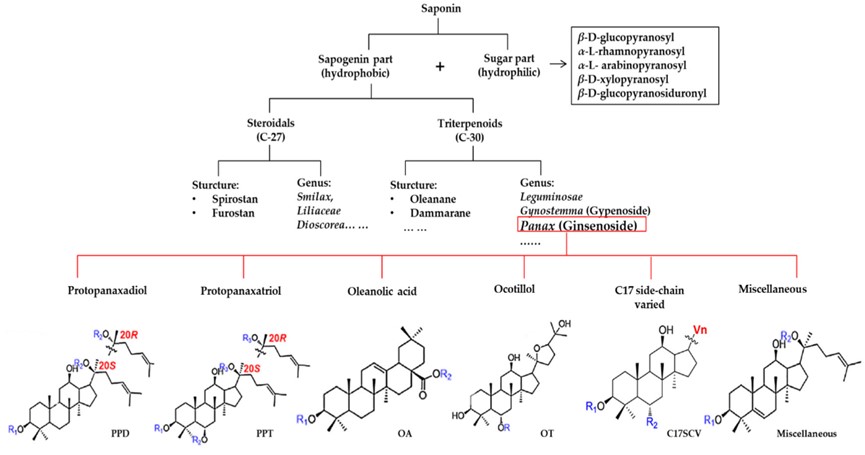 Fig.1 Various structural types of ginsenosides.1,3
Secure Your Research Success - Contact Our Experts
Technical Mechanism: Enzymatic Glucosylation
The core of this custom production service lies in the precise enzymatic conversion of ginsenoside Rd into Rb1. Unlike chemical synthesis, which often lacks stereoselectivity and requires harsh reagents, enzymatic biotransformation offers high specificity and environmentally friendly conditions.
The substrate: (20S)-ginseng root extract Rd
Ginsenoside Rd serves as the direct precursor in this biosynthetic pathway. The substrate must meet strict purity profiles to ensure that the final Rb1 product is free from isomeric impurities or residual ginsenosides of different classes.
This enzyme belongs to the family of UDP-glycosyltransferases (UGTs). It specifically recognizes the C-20 hydroxyl group of the Rd molecule and catalyzes the transfer of a glucosyl group from a sugar donor (typically UDP-glucose) to form the beta-1,6-glycosidic bond required to produce Rb1.
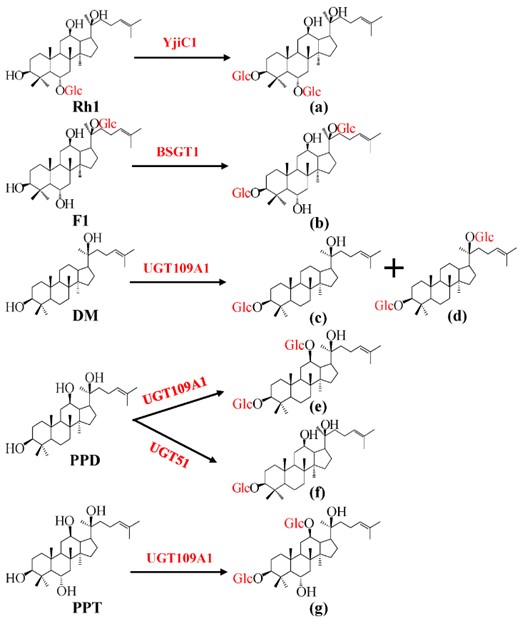 Fig.2 Microbial-derived UGTs for the glycosylation of ginsenosides.2,3
Detailed (20S)-Ginsenoside Rb1 Production Service
The production process is a multi-stage operation designed to maximize yield while maintaining the structural integrity of the (20S) isomer.
We select a specific glucosyltransferase and substrate (20S)-Rd as the starting materials for the reaction.
The substrate is dissolved in a buffered aqueous system. The glucosyltransferase is introduced along with the necessary sugar donors and cofactors. The reaction is closely monitored.
Once the conversion of Rd to Rb1 reaches the desired threshold, the reaction is terminated. The mixture undergoes primary separation, often involving centrifugal filtration or macroporous resin adsorption, to remove the enzyme, unreacted sugar donors, and water-soluble byproducts.
The crude Rb1 extract is subjected to preparative high-performance liquid chromatography (Prep-HPLC). This step is critical for separating (20S)-Rb1 from any trace amounts of unreacted Rd or minor side products.
The purified solution is concentrated and subjected to lyophilization. This process preserves the biological activity and stability of the saponin. Every batch undergoes rigorous QC testing, including NMR spectroscopy for structural verification and LC-MS for purity and mass identification.
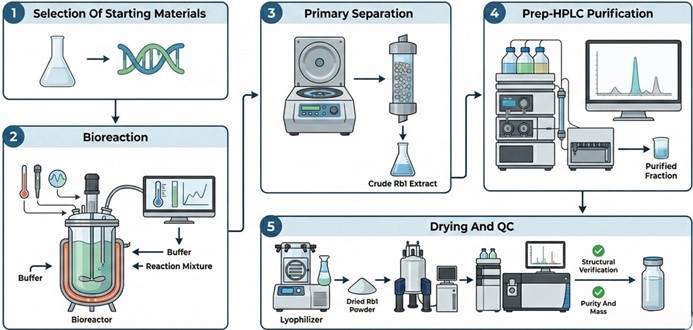 Fig.3 Production process of (20S)-ginsenoside Rb1.
Why Provide This Service?

Overcoming Natural Limitations
Natural extraction often yields a mixture of ginsenosides that are difficult to separate. Custom enzymatic synthesis provides a "cleaner" starting point, significantly reducing the complexity of the final purification.

Sustainability
Enzymatic methods are more sustainable than large-scale botanical extraction, which requires significant land use and results in large amounts of plant waste.

Consistency and Scalability
Industrial and academic partners require a reliable supply chain. By utilizing controlled bioreactors and recombinant enzymes, custom services can provide identical batches of Rb1 regardless of the season or geographical origin of the ginseng root extract.
Application
-
Disease research: Rb1 is a natural immunomodulator. It is applied in research on chronic inflammatory diseases such as rheumatoid arthritis by inhibiting the production of pro-inflammatory cytokines.
-
Dietary supplements: With increasing health awareness, custom-produced Rb1 is widely added to supplementary products such as anti-fatigue drinks and energy capsules. Its high purity ensures the stability of these products in improving endurance and relieving stress.
-
Standard testing: High-quality custom-produced Rb1 is an essential tool in life science research. It is often used as a standard for analysis and comparison, or in basic research to explore the metabolic kinetics and signaling pathway interactions of saponins in vivo.
Review Your Options with Us- Inquire Now
Published Data
The article provides a comprehensive overview of how different manufacturing strategies influence the chemical composition of ginseng. Since the therapeutic properties of Panax species are primarily attributed to their ginsenoside content, the researchers explore how physical, chemical, and biological methods can be used to convert naturally occurring major ginsenosides into more potent minor versions or novel derivatives. The following figure focuses on the complex biological pathways of transformation. On one hand, it details the deglycosylation process, where sugar groups attached to the triterpene backbone at the C-3, C-6, or C-20 positions are systematically removed through hydrolysis to produce simpler molecules. Conversely, the figure portrays the constructive process of glycosylation. In this phase, glycosyltransferases are employed to bind new glucose units or activated saccharides to the sapogenin core. By manipulating these biological routes, scientists can synthesize rare ginsenosides that are otherwise scarce in nature. This targeted modification is essential for expanding the chemical library of ginseng and improving the overall efficacy and bioavailability of its active components for pharmaceutical and cosmetic applications.
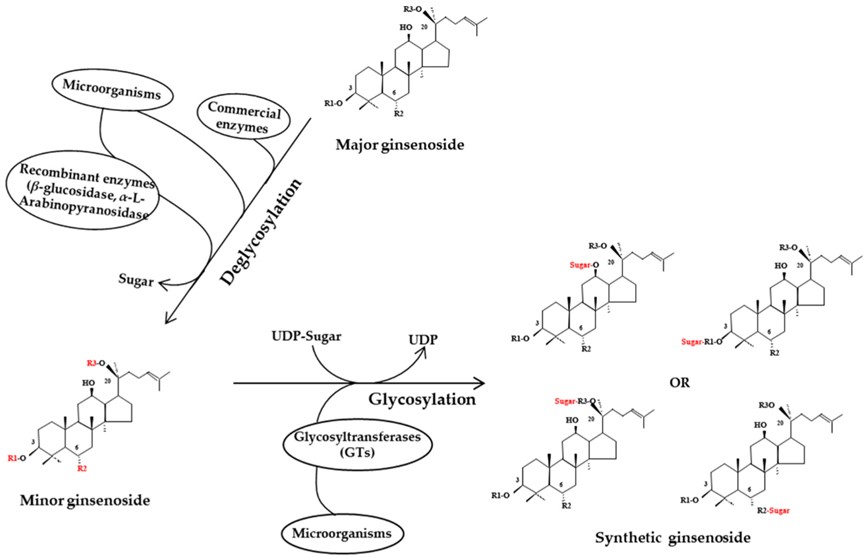 Fig.4 The transformation pathways of ginsenosides during bioprocessing.1,3
FAQs
Q: How does your enzymatic Rb1 compare to "natural" Rb1 extracted from ginseng roots?
A: Chemically and biologically, they are identical molecules. However, our enzymatic Rb1 is typically purer and free from the botanical contaminants that can interfere with sensitive biological assays or cause allergic reactions.
Q: Is the UDP-glucose donor included in the production cost?
A: Yes, our service is all-inclusive. We manage the entire enzymatic system, including the regeneration of sugar donors, so there are no hidden costs for the client.
Q: Can you produce other rare ginsenosides using this same platform?
A: Yes, our biocatalysis platform is versatile. We have a library of enzymes capable of producing a wide range of ginsenosides such as Rg3 and Rh2.
Customer Review
Reliable Scaling
"Using Creative Biolabs' custom (20S)-ginsenoside Rb1 in our research facilitated a seamless transition from lab-scale testing to pilot manufacturing. Their enzymatic process is far superior to traditional ethanol extracts."- Manager, M***l R.
Expert Technical Support
"Using Creative Biolabs' custom (20S)-ginsenoside Rb1 in our research allowed us to definitively map metabolic pathways without interference from other ginsenosides. Their team provided exceptional support for our formulation needs."- Project Director, E***a W.
How to Contact Us
Creative Biolabs provides a premier custom (20S)-ginsenoside Rb1 production service that integrates advanced biocatalysis with industrial-scale manufacturing. Our commitment to high purity, batch consistency, and green chemistry makes us the ideal partner for your next breakthrough in ginsenoside research. For more information about our production capacities or to request a formal project evaluation, please reach out to our team of specialists. We are ready to help you accelerate your research with precision.
References
-
Piao, Xiang Min et al. "Diversity of Ginsenoside Profiles Produced by Various Processing Technologies." Molecules (Basel, Switzerland) vol. 25,19 4390. 24 Sep. 2020, https://doi.org/10.3390/molecules25194390
-
Yang, Jin-Ling et al. "Progress on the Studies of the Key Enzymes of Ginsenoside Biosynthesis." Molecules (Basel, Switzerland) vol. 23,3 589. 6 Mar. 2018, https://doi.org/10.3390/molecules23030589
-
Distributed under an Open Access license CC BY 4.0, without modification.
For Research Use Only.
Related Services