Custom Hydroquinone O-β-D-Glucopyranoside (Arbutin) Production Service
Precision Biosynthesis: Accelerating Your Path to High-Purity Phenolic Glycosides!
Hydroquinone O-β-D-glucopyranoside, commonly known as Arbutin, is a premium bioactive compound widely utilized in the cosmeceutical and pharmaceutical industries. Recognized primarily for its potent tyrosinase-inhibiting properties, it serves as a gold-standard skin-lightening agent. Creative Biolab offers a comprehensive strategic partnership for the synthesis of complex phenolic glycosides. Our service is designed to bridge the gap between initial molecular discovery and industrial-scale manufacturing. We provide a turnkey solution that addresses the inherent instability and low solubility of hydroquinone by transforming it into its stable, bioavailable O-β-D-glucopyranoside form. Our custom production service utilizes an advanced biotechnological approach, leveraging Enzymatic Biotransformation to ensure the highest yield, purity, and environmental sustainability.
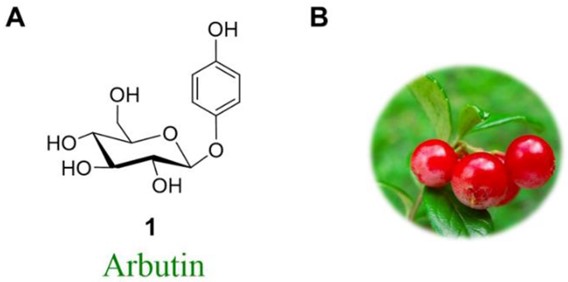 Fig.1 The structure and sources of arbutin.1,3
The core of our production service lies in the deployment of highly specific HQGT. Unlike non-specific enzymes, HQGT belongs to the glycosyltransferase family, which facilitates the transfer of a glucosyl moiety from a donor molecule to the phenolic hydroxyl group of hydroquinone.
Key advantages of our enzymatic catalyst include:
-
Regioselectivity: The enzyme ensures that glycosylation occurs precisely at the oxygen atom of the hydroquinone, avoiding unwanted side reactions.
-
Stereospecificity: The process yields exclusively the β-anomer, which is biologically active, whereas chemical methods often produce a mixture of α- and β-forms.
-
Mild reaction conditions: Operating at near-neutral pH and ambient temperatures, the enzymatic route preserves the structural integrity of the substrate and product.
Find Your Perfect Solution - Inquire Now
Professional Arbutin Production Service
The production process utilizes hydroquinone as the primary acceptor substrate. Because hydroquinone can be inhibitory to biological systems at high concentrations, our service employs a sophisticated substrate-feeding strategy to maintain optimal concentrations throughout the reaction.
The reaction mechanism follows a precise glucosyl transfer:

Our service is structured into three critical phases, ensuring that every batch of arbutin meets specific client requirements for concentration and purity.
-
Starting Material Selection
We select an enzyme with thermal stability and tolerance to high concentrations of hydroquinone substrate as the biocatalyst. This ensures that the biocatalyst can withstand the harsh industrial conditions of a large-scale bioreactor.
Biotransformation and Process Control
Bioconversion is carried out in a stirred tank bioreactor. This stage includes:
-
Real-time monitoring: Constant tracking of dissolved oxygen, pH, and temperature to maintain the enzyme's peak catalytic activity.
-
Fed-batch strategy: To prevent the toxicity associated with free hydroquinone, we implement a controlled feeding profile, ensuring that the substrate is consumed as soon as it is introduced.
-
Solubility management: We utilize specialized buffers or cosolvents to improve the solubility of hydroquinone without denaturing the HQGT enzyme.
-
Downstream Processing and Purification
After the biotransformation is complete, the mixture undergoes steps such as centrifugation, chromatographic separation, and crystallization to produce crude arbutin.
-
Quality Control and Analytical Characterization
The final stage involves a comprehensive suite of analytical tests to validate the product's identity and purity.
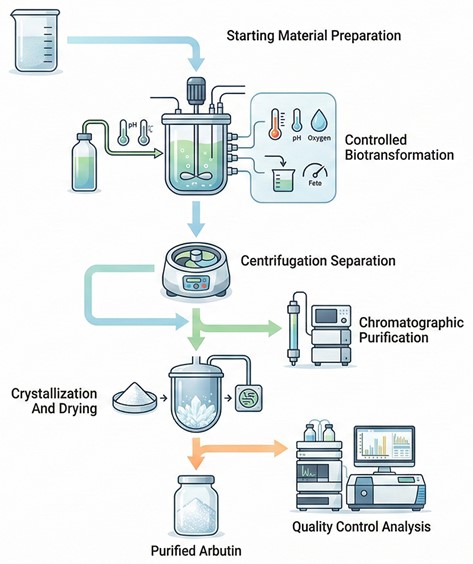 Fig.2 Detailed production process of arbutin.
Application
-
Skin Whitening & Brightening: Arbutin reduces melanin deposition at its source by inhibiting tyrosinase activity in the skin, blocking the synthesis of dopa. It is commonly used to lighten freckles, sunspots, and post-inflammatory hyperpigmentation.
-
Food Preservation: Due to its good stability, arbutin is used as a natural antioxidant in the food industry. It has potential applications in preventing oil oxidation, maintaining the color of meat products, and extending shelf life.
-
Textile & Material Chemistry: In the development of functional fibers, arbutin is integrated into fabric finishing agents, giving clothing UV protection and antibacterial properties, and even enabling slow release to the skin through microencapsulation technology.
Take the Next Step - Request a Free Consultation
Published Data
This literature review explores the evolving landscape of arbutin production, emphasizing the shift from traditional industrial methods toward sustainable, bio-based alternatives. Arbutin, a hydroquinone-derived glucoside, is primarily sought after in the cosmetic and pharmaceutical sectors due to its potent ability to inhibit tyrosinase and melanin formation. The following figure shows the four dominant production frameworks of arbutin: botanical extraction, chemical synthesis, enzymatic biotransformation, and microbial fermentation. This visual summary effectively contrasts conventional extraction with modern synthetic biology techniques aimed at high-efficiency, eco-friendly manufacturing.
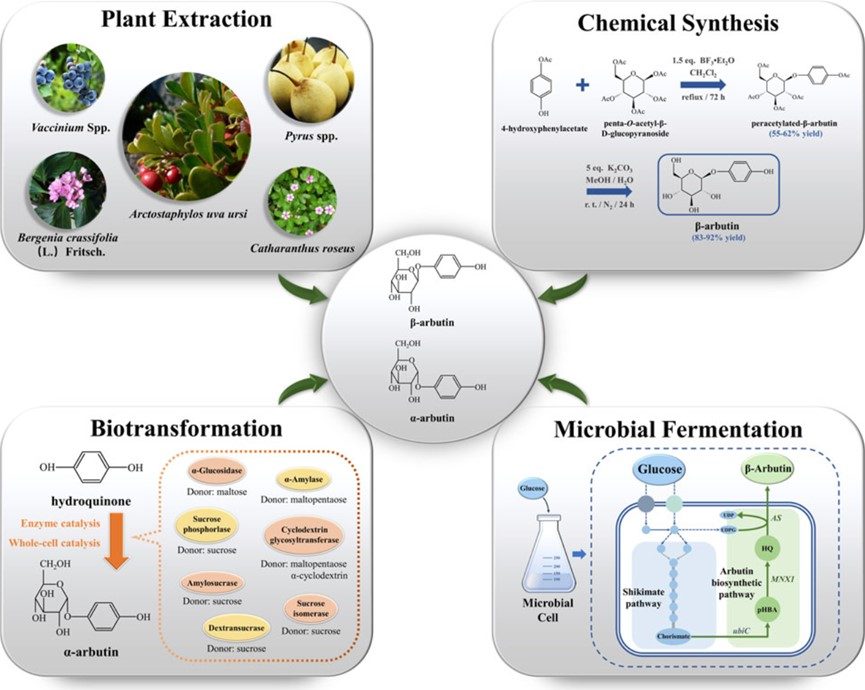 Fig.3 Production scheme for arbutin.2,3
FAQs
Q1: What is the advantage of O-β-D-Glucopyranoside over raw hydroquinone?
A1: Hydroquinone is effective but can be cytotoxic and unstable. The glucopyranoside form acts as a stabilized reservoir that releases hydroquinone slowly, reducing irritation and increasing the therapeutic index.
Q2: How do you ensure the product is free from enzyme contaminants?
A2: We employ high-capacity protein-removal steps, including ultrafiltration and specialized resins, ensuring that no residual glucosyltransferase remains in your final sample.
Q3: Is your service compatible with other phenolic substrates?
A3: Absolutely. Our Glycosyltransferase library is versatile and can be adapted for a wide range of phenolic compounds, including resveratrol and flavonoids.
Customer Review
Exceptional Isomeric Purity
"Using Creative Biolab's custom arbutin production in our research has significantly improved the reproducibility of our skin-cell assays. The total absence of α-isomer artifacts allowed us to pinpoint the exact mechanism of ligand-receptor binding."- Dr. Al***n K.
Proprietary Enzyme Advantage
"Using Creative Biolabs' custom arbutin production in our research has significantly improved the yield of our rare phenolic derivatives. The specificity of their glucosyltransferase is unmatched in the current market."- Prof. H***y M.
How to Partner with Us
Creative Biolabs' custom arbutin production service bridges the gap between complex biochemical synthesis and industrial-scale availability. By focusing on the synergy between HQGT efficiency and rigorous downstream purification, we provide a sustainable, high-purity source of arbutin tailored to the evolving needs of the global market. We encourage you to contact us directly for additional information and a thorough discussion of your specific requirements.
References
-
Zhou, Hangyu et al. "Chemical and Biocatalytic Routes to Arbutin." Molecules (Basel, Switzerland) vol. 24,18 3303. 11 Sep. 2019, https://doi.org/10.3390/molecules24183303
-
Xu, Ke-Xin et al. "Recent Progress on Feasible Strategies for Arbutin Production." Frontiers in Bioengineering and Biotechnology vol. 10, 914280. 9 May. 2022, https://doi.org/10.3389/fbioe.2022.914280
-
Distributed under an Open Access license CC BY 4.0, without modification.
For Research Use Only.
Related Services