
mRNA Delivery Systems
Effective mRNA delivery requires more than protecting the payload from degradation; the system must also reach the intended tissue, enter target cells, escape endosomes, and release functional mRNA into the cytoplasm. Lipid nanoparticles are the most established option, while polymeric carriers, peptides, extracellular vesicles, and other platforms may offer advantages for specific tissues or administration routes. The optimal system depends on payload properties, target-cell biology, expression duration, safety, manufacturability, and dosing requirements.
Introduction
mRNA therapy uses synthetic messenger RNA to instruct cells to produce therapeutic proteins, offering a flexible and non-integrating strategy for vaccines, protein replacement, immunotherapy, and gene regulation. Creative Biolabs compares major carriers, administration routes, biological barriers, analytical methods, and system-selection strategies. Creative Biolabs provides delivery systems development for gene therapy, supporting carrier screening, formulation, characterization, and functional validation for mRNA programs.
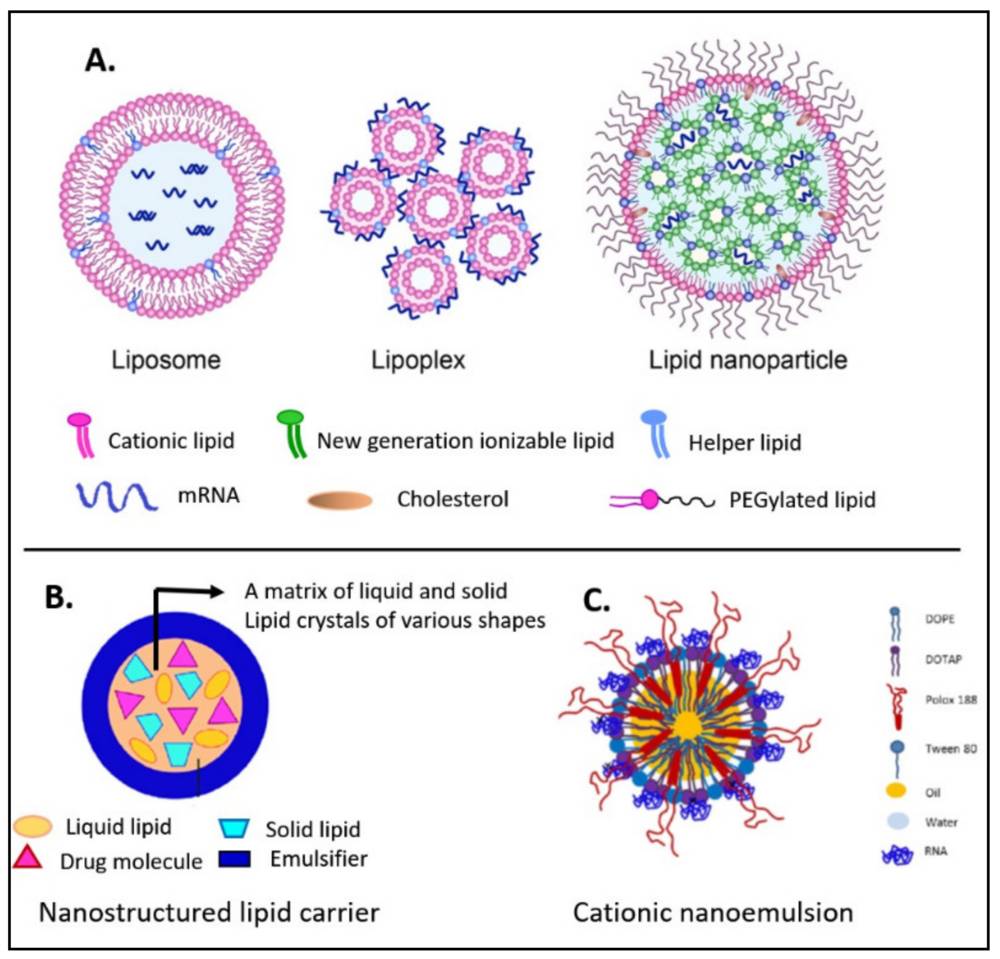 Figure 1. Key lipid nanocarriers of mRNA: (A) liposome, lipoplex, and lipid nanoparticle; (B) nanostructured lipid carrier; (C) cationic nanoemulsion.1
Lipid Nanoparticle Delivery
Core LNP Architecture
Lipid nanoparticles (LNPs) are the most clinically validated mRNA delivery platform. A typical LNP contains an ionizable lipid, a helper phospholipid, cholesterol, and a polyethylene glycol (PEG)-lipid. During formulation at acidic pH, the ionizable lipid becomes positively charged and complexes with mRNA. Each component influences multiple attributes. The ionizable lipid affects encapsulation, potency, biodistribution, biodegradation, and inflammatory signaling. Helper lipids and cholesterol influence particle structure and membrane fusion. PEG-lipids control particle size and aggregation during manufacturing, but their content and shedding rate can reduce cell interaction or contribute to anti-PEG responses. The liposome and cationic lipid framework provides useful background, although modern ionizable LNPs are not equivalent to permanently cationic liposomes.
Route-Dependent LNP Behavior
LNP performance is strongly route-dependent. Intravenous administration often produces substantial liver exposure because circulating particles acquire a protein corona and interact with hepatic cells. Intramuscular injection creates a local depot and immune-cell exposure appropriate for vaccination. Inhaled or nebulized LNPs must resist aggregation and loss of encapsulation under aerosol stress. Local intratumoral or organ-directed administration can reduce systemic dose but introduces distribution heterogeneity.
Mechanistic Evaluation
mRNA-LNP development should therefore connect composition to a mechanistic readout. Encapsulation efficiency and small particle size are not sufficient if endosomal escape is poor. Potency should be tested in the intended cell type, with measurements of uptake, cytosolic release, protein expression, cytokines, and viability. Empty LNP controls help distinguish lipid effects from mRNA effects, while a naked-mRNA control shows the contribution of the carrier.
Polymeric and Hybrid Nanocarriers
Polyplex Design Space
Cationic and ionizable polymers can condense mRNA into polyplexes through electrostatic interactions. Common design families include polyethyleneimine-like materials, poly(beta-amino esters), chitosan derivatives, dendrimers, and biodegradable copolymers. Polymer chemistry offers broad control over molecular weight, branching, charge density, degradability, ligand attachment, and release. The cationic polymer design space is therefore attractive when LNP biodistribution or formulation constraints are not suitable.
Hybrid Systems
Hybrid systems combine lipids with polymers, peptides, or inorganic components to separate functions. A polymeric core may condense mRNA while a lipid shell improves colloidal stability and cell interaction. Endosomolytic peptides can be incorporated to promote escape, and targeting ligands can be displayed on the surface. Hybrid complexity can improve performance but adds manufacturing variables and analytical burden. Every additional component should have a defined purpose and measurable contribution.
Extracellular Vesicles, Peptides, and Protein-Based Carriers
Table 1. Comparison of Major mRNA Delivery Platforms
| Platform | Main Strength | Primary Limitation | Best-Fit Research Context |
|---|---|---|---|
| Ionizable lipid nanoparticles | Strong clinical precedent, high encapsulation, scalable mixing | Liver-biased systemic distribution, reactogenicity, repeat-dose concerns | Vaccines, liver-directed delivery, expanding extrahepatic programs |
| Cationic or ionizable polymers | Large chemical design space and degradability options | Charge-related toxicity and batch-sensitive assembly | Local delivery, ex vivo studies, tissue-specific screening |
| Dendrimers | Defined branching and multivalent functionalization | Complex synthesis and potential accumulation | Targeted or hybrid delivery research |
| Extracellular vesicles | Biological membrane and potential cell-interaction advantages | Heterogeneity, loading, scale-up, product definition | Specialized targeting and exploratory delivery |
| Peptide/protein carriers | Modular targeting and endosomal functions | Serum stability and immunogenicity | Local delivery or hybrid systems |
| Physical methods | Direct cytosolic access without persistent carrier | Procedure dependence, tissue injury, limited in vivo reach | Ex vivo cell engineering and localized research |
Physical and Local Delivery Methods
Electroporation for Ex Vivo Delivery
Physical methods bypass some carrier barriers by transiently disrupting cell membranes. Electroporation is widely used ex vivo to deliver mRNA into immune cells, stem cells, and other primary cells. It can provide rapid cytosolic access without a persistent carrier, but voltage, pulse duration, buffer, cell density, and mRNA dose can affect viability, activation, and differentiation. Recovery conditions should be optimized together with expression.
Specialized Physical Methods
Microinjection, hydrodynamic injection, sonoporation, photoporation, and mechanical deformation have specialized roles. Microinjection gives direct single-cell control but is low throughput. Hydrodynamic injection is powerful in animal liver research but is not a general clinical method. Sonoporation and photoporation can localize membrane disruption, yet reproducibility and tissue injury require careful evaluation. Local administration into tumors, skin, muscle, eye, or accessible organs can also reduce the need for systemic targeting.
Combining Physical and Carrier-Based Approaches
Physical and carrier-based methods are not mutually exclusive. Electroporation can be used for ex vivo cell engineering, while an LNP or polymer formulation is developed for in vivo delivery of the same coding sequence. The correct comparison should include cell phenotype, functional outcome, process throughput, and scalability rather than expression percentage alone.
Route-Dependent System Selection
Each administration route imposes unique barriers: IV (blood proteins, shear, filtration), IM/SC (local retention, immune recruitment), inhalation (aerosol stability, airway barriers), intrathecal (CSF distribution, limited parenchymal access), and oral (acid, enzymes, mucus, epithelium).
Targeting ligands enhance cell uptake only after particles reach the tissue; high density may alter size, stability, or immunogenicity. Biodistribution is primarily governed by physicochemical properties, protein corona, route, and disease physiology—so targeting claims require cell-resolved data, not just bulk-organ fluorescence. Repeated dosing introduces additional complexity: anti-PEG antibodies, complement activation, carrier accumulation, and adaptive immunity can alter outcomes. Biodegradable materials may help, but their degradation kinetics must be characterized. Chronic-use systems should be tested with multiple doses from the outset.
Table 2. Route-to-System Decision Matrix
| Route | Dominant Barrier | Useful System Features | Key Readout |
|---|---|---|---|
| Intravenous | Protein corona, clearance, off-target organs | Neutral surface at physiological pH, biodegradability, targeting after tissue access | Cell-resolved biodistribution and systemic cytokines |
| Intramuscular | Local dispersion and immune-cell interaction | Stable depot, appropriate innate activation, robust antigen expression | Local expression, draining-node response, reactogenicity |
| Inhaled | Mucus, surfactant, aerosol stress, macrophages | Nebulization stability, mucus penetration, lung-cell potency | Post-nebulization particle integrity and lung-cell expression |
| Intratumoral | Heterogeneous tumor matrix and leakage | Local retention, immune modulation, tolerable repeated injection | Spatial expression and tumor/normal tissue exposure |
| Ex vivo electroporation | Membrane damage and cell-state disruption | Optimized pulse and recovery, carrier-free delivery | Viability, phenotype, expression, and function |
Critical Characterization and Biological Readouts
An mRNA delivery system is a combined product: RNA quality, carrier composition, particle attributes, and biological potency are interdependent. RNA identity should include sequence, cap status, poly(A) distribution, integrity, residual DNA, double-stranded RNA, and concentration. Particle characterization should include size, polydispersity, surface properties, encapsulation, morphology, component content, free RNA, and stability under intended handling conditions.
Biological assays should follow the exposure pathway. Uptake measurements alone can overestimate productive delivery because endosomal sequestration produces a strong intracellular signal without translation. Cytosolic release, protein output, onset, duration, cell viability, inflammatory markers, and functional potency should be measured in the intended cell type. In animals, biodistribution should distinguish carrier, mRNA, and encoded protein where possible because they can have different kinetics.
Process comparability is essential. Changes in mixing, flow rate, raw material lot, mRNA concentration, buffer, filtration, freezing, or thawing can change particle structure and potency. A quality-by-design approach identifies critical material attributes and process parameters before scale-up. The success of mRNA in gene therapy clinical development depends on linking these analytical attributes to a mechanism-relevant potency assay.
Table 3. Minimum Development Readouts for mRNA Carriers
| Layer | Representative Tests | Why It Matters |
|---|---|---|
| RNA quality | Identity, integrity, cap, poly(A), dsRNA, residual DNA | Defines payload competence before formulation |
| Particle quality | Size, polydispersity, encapsulation, composition, morphology | Defines reproducibility and stability |
| Productive delivery | Uptake, endosomal escape, cytosolic RNA, protein kinetics | Distinguishes internalization from usable delivery |
| Biological potency | Functional protein activity in relevant cells | Connects formulation to the intended mechanism |
| Safety | Viability, cytokines, complement, histopathology, repeat-dose effects | Defines the usable dose and route |
| Manufacturability | Mixing window, recovery, filtration, freeze-thaw, storage | Determines whether laboratory performance can translate |
How to Select an mRNA Delivery System
Selection begins with five questions: which cells must express the protein, what route is feasible, how long expression should last, whether the target tolerates inflammation, and whether dosing is single or repeated—these narrow the carrier design space far better than selecting the material with the highest reporter signal. In practice, start with formulation stability and encapsulation, then compare potency and viability in relevant cells; lead candidates advance to mechanistic uptake and endosomal-escape studies, followed by route-relevant animal biodistribution and functional assays. Test at more than one dose, since ranking can shift with toxicity or saturation, and include a reference formulation and negative controls to distinguish true improvement from assay drift. The final choice must balance potency, selectivity, safety, manufacturability, and storage—a slightly less potent but robust system may outperform a highly potent one that requires unstable raw materials, a narrow mixing window, or impractical cold-chain logistics. The intended product profile, not a single transfection experiment, should drive selection.Define the target cell and the minimum fraction of cells that must express the payload.
- Select the administration route before optimizing carrier chemistry.
- Measure productive cytosolic delivery rather than uptake alone.
- Include manufacturability, storage, and repeat-dose requirements in lead ranking.
- Advance more than one mechanistically distinct formulation when the target tissue is difficult to reach.
Challenges and Next-Generation Directions
The major challenge remains extrahepatic, cell-selective delivery, with new lipids, polymers, ligands, barcoded screens, and machine learning expanding possibilities for lung, immune, tumor, spleen, and CNS targets, though species differences in protein corona, immunity, and receptor expression hinder translation. Future systems must improve endosomal escape, as current particles often enter cells but release only a small fraction of payload; direct escape and trafficking assays can reveal gains missed by bulk expression, while more stable dry or refrigerated formulations, PEG alternatives, and scalable continuous manufacturing could enhance accessibility and repeat dosing. The field is shifting from a one-size-fits-all LNP approach toward route-, tissue-, and application-specific delivery, with the strongest programs treating carrier, payload, manufacturing, and biological model as an integrated system.
Published Data
Case 1: Ionizable Lipid Nanoparticles for Placenta-Targeted In Vivo mRNA Delivery
This study demonstrates a rational tail-engineering strategy to enable placenta-specific mRNA delivery via ionizable lipid nanoparticles (LNPs). To overcome the standard ApoE-mediated hepatic clearance of intravenous LNPs, researchers synthesized a library of 14 ionizable lipids with systematically varied hydrophobic tail structures while fixing the amine headgroup. Through in vivo screening in pregnant mice, a lead formulation (P4) with a unique branched tail structure achieved robust selective mRNA expression (firefly luciferase and erythropoietin) in placental trophoblasts with minimal off-target liver signal. Mechanistic studies revealed that this tissue tropism was driven by tail-dependent protein corona formation and cell uptake preferences rather than classical transcytosis pathways. This case provides a valuable methodology for organ-targeted LNP design, proving that fine-tuning lipid hydrophobic tails can bypass liver uptake and extend mRNA therapeutics to extrahepatic organs like the placenta.
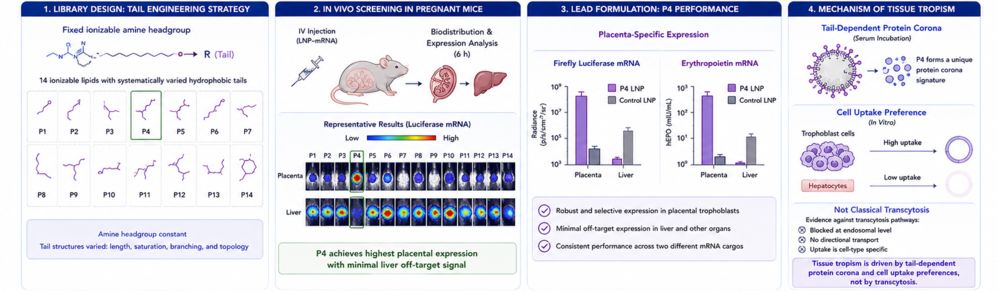 Figure 2. Ionizable lipid nanoparticles enable placenta-targeted mRNA delivery in vivo. Design strategy and functional validation of LNP formulations engineered for transplacental mRNA transport.
Frequently Asked Questions
Q: Why can't mRNA usually be administered as a naked molecule?
A: Naked mRNA is rapidly degraded, poorly crosses cell membranes, and can be cleared before reaching the cytosol. Local or physical methods can sometimes use unformulated mRNA, but most in vivo applications require a protective and uptake-promoting delivery system.
Q: Are lipid nanoparticles always the best mRNA carrier?
A: No. LNPs have the strongest clinical precedent, but route, target cell, repeated dosing, storage, and tolerability may favor polymers, vesicles, peptides, physical delivery, or hybrid systems.
Q: What is the main intracellular barrier after mRNA uptake?
A: Endosomal escape is often the dominant barrier. A cell may internalize a large amount of carrier while only a small fraction of mRNA reaches the cytosol and becomes available for translation.
Q: How should targeted mRNA delivery be demonstrated?
A: Targeting should be supported by cell-resolved biodistribution, cytosolic delivery, and functional protein expression in the intended population, together with assessment of off-target tissues. Bulk-organ fluorescence alone is insufficient.
Q: Can the same delivery system be used for every administration route?
A: Usually not without re-optimization. Blood, muscle, lung, cerebrospinal fluid, tumors, and ex vivo cell suspensions present different barriers and tolerability limits.
Q: Which controls are essential in an mRNA delivery study?
A: Useful controls include naked mRNA, empty carrier, noncoding or irrelevant mRNA, a reference formulation, untreated cells or animals, and where relevant the encoded protein itself. These controls separate carrier, RNA, and protein effects.
Overview of What Creative Biolabs Can Provide
Creative Biolabs can support mRNA delivery research across lipid, polymeric, dendrimer, nanoparticle, exosome, and organ-targeted systems. Projects can be organized around route-specific formulation, cell-type potency, carrier characterization, and comparative screening rather than a one-size-fits-all transfection endpoint.
| Research Need | Related Creative Biolabs Support | How It Connects to the Current Resource Topic |
|---|---|---|
| Clinically established nonviral delivery | Lipid Nanoparticle (LNP) | Supports formulation design for mRNA protection, particle assembly, uptake, and cytosolic delivery. |
| Organelle-directed delivery | Mitochondrial Targeting LNP | Addresses specialized lipid-based delivery when mitochondrial localization is part of the research objective. |
| Polyplex development | Development of Polyplexe as Gene Delivery System | Supports polymer-nucleic acid complex design and optimization for delivery applications. |
| Branched carrier design | Development of Dendrimer as Gene Delivery System | Provides a multivalent polymeric platform for tuning charge, loading, and functionalization. |
| Alternative nanoparticle screening | Custom Nanoparticles Service | Supports customized nanoparticle design when conventional LNP behavior is not suitable for the target application. |
| Polymer formulation development | Custom Polymers Service | Supports selection and optimization of polymeric materials for nucleic-acid complexation and release. |
| Biological carrier exploration | Custom Exosomes Service | Supports exosome-based delivery research for projects evaluating biologically derived carriers. |
Projects can be configured around the intended payload, expression window, target cell, route, and validation depth. Researchers may contact us today to discuss a fit-for-purpose study plan.
References
- Aldosari B N, Alfagih I M, Almurshedi A S. Lipid nanoparticles as delivery systems for RNA-based vaccines. Pharmaceutics, 2021, 13(2): 206. https://doi.org/10.3390/pharmaceutics13020206 Distributed under Open Access license CC BY 4.0, with modification.
- Swingle K L, Safford H C, Geisler H C, et al. Ionizable lipid nanoparticles for in vivo mRNA delivery to the placenta during pregnancy. Journal of the American Chemical Society, 2023, 145(8): 4691. 10.1021/jacs.2c12893
