
What Are Antisense Oligonucleotides?
The main advantages of antisense oligonucleotides (ASOs) include programmable gene regulation, reversible activity, and the ability to target disease mechanisms at the RNA level without permanently modifying genomic DNA, making them valuable for treating rare genetic, neuromuscular, neurodegenerative, metabolic, and other diseases driven by abnormal RNA or protein expression.
Introduction
Antisense oligonucleotides (ASOs) are synthetic, single-stranded nucleic acid polymers (typically 12–30 nucleotides) designed to sequence-specifically bind complementary target RNA to modulate gene expression through degradation, splicing correction, or steric blockade.
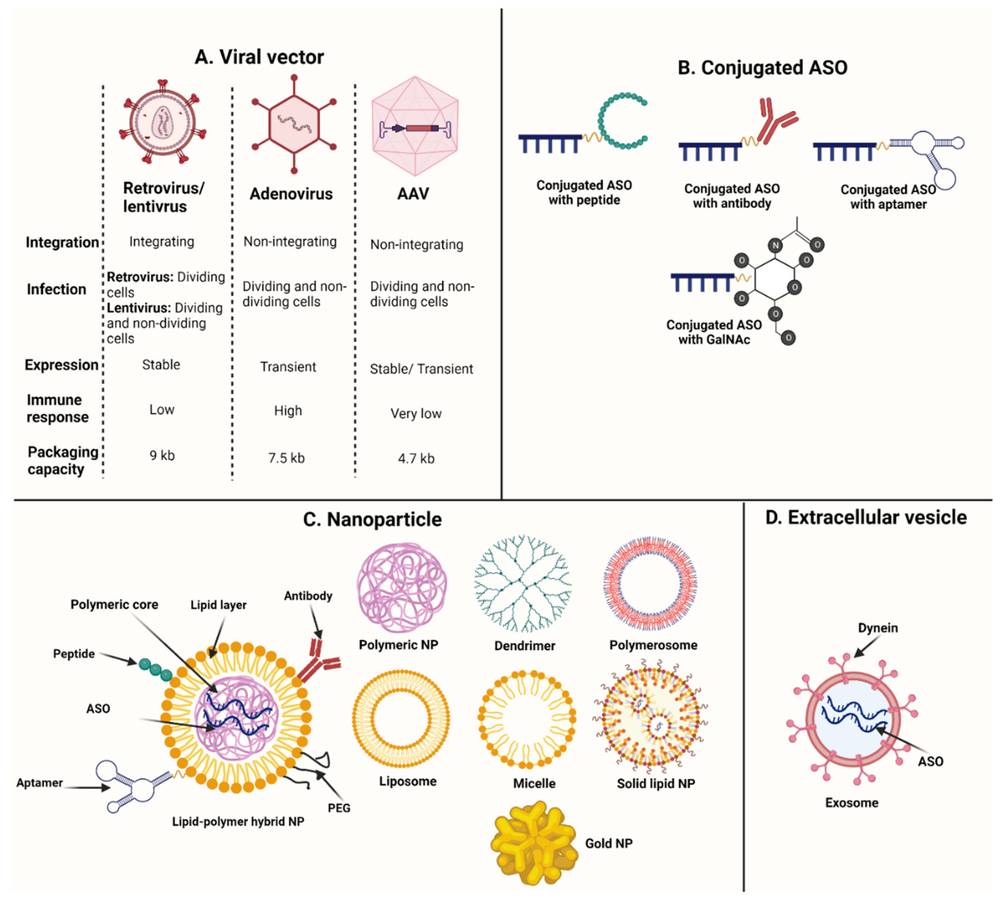 Figure 1. Antisense oligonucleotides can be delivered into the cells more efficiently using (A) viral vectors, (B) conjugated peptides, antibodies, and other ligands (e.g., aptamers and acetylgalactosamine (GaINAc)), (C) nanoparticles, or (D) extracellular vesicles.1
Mechanisms That Determine ASO Function
RNase H1-dependent RNA reduction
RNase H1 recognizes the RNA strand of an RNA-DNA heteroduplex and cleaves it. To use this pathway, an ASO normally includes a central DNA-like region that can support RNase H1 activity. Modified nucleotides at both ends protect the molecule and increase affinity, creating the widely used gapmer architecture. Cleavage fragments are processed by cellular RNA decay pathways, and the ASO can in principle bind another transcript. Activity may occur in both nucleus and cytoplasm, but productive concentration, target turnover, and local RNase H1 availability influence the observed response. Measuring target RNA reduction alone is not sufficient; protein change and a mechanism-relevant phenotype should follow with an appropriate temporal relationship.
Steric blocking and splice modulation
Fully modified or charge-neutral ASOs can occupy an RNA site without inducing cleavage. A splice-switching oligonucleotide can mask a splice site, branch point, silencer, enhancer, or cryptic regulatory element and thereby alter exon inclusion. Other steric-blocking designs may obstruct translation initiation, prevent binding of an RNA-binding protein, inhibit a microRNA, or interfere with a pathogenic repeat RNA. Here, preservation of the target transcript may be intentional. Chemistry must suppress RNase H1 recruitment, and the assay must directly resolve the expected RNA isoform or interaction. A total-RNA assay can miss a successful splice change, while apparent protein rescue without isoform confirmation may conceal an indirect response.
Transcript activation and RNA processing effects
Some ASO strategies increase rather than decrease productive gene expression. Masking a poison exon or an inhibitory upstream element can raise the abundance of a functional transcript. Blocking an RNA degradation motif or disrupting a regulatory non-coding RNA can also produce an activating outcome. These designs illustrate why "antisense" should not be equated with knockdown. The key question is which RNA-protein or RNA-processing event is being changed. Experimental plans should define the intended molecular intermediate, the predicted direction of protein change, and the phenotype expected if that mechanism is correct. This causal chain helps distinguish true sequence-directed pharmacology from stress responses or generic effects of transfection.
The Functional Anatomy of an ASO
Sequence and chemistry operate as one design system
An ASO candidate is a combined sequence-and-chemistry system. Sequence determines complementarity, potential cross-hybridization, GC content, self-structure, and overlap with RNA regulatory elements. Backbone, sugar, and base modifications tune nuclease resistance, protein binding, duplex stability, immune recognition, and mechanism compatibility. Length and modification pattern must be considered together: a short high-affinity sequence may discriminate single-nucleotide variants, but excessive affinity can stabilize partial matches; a longer sequence may gain specificity in theory yet encounter more structure or synthesis-related impurities. ASO design and synthesis is therefore an iterative process in which several candidates are screened rather than a single sequence being accepted from prediction alone.
Delivery determines whether binding can occur in cells
The same molecule must also travel through biological barriers. After administration, an ASO may bind plasma proteins, distribute into tissues, enter cells by endocytic routes, traffic through endosomes, and reach cytosol or nucleus. Only a fraction of cell-associated material may become pharmacologically available. Phosphorothioate-containing ASOs can show productive uptake without a carrier in some tissues, while the blood-brain barrier remains a major obstacle to systemic central nervous system exposure. Intrathecal delivery can distribute certain ASOs within the neuraxis, and receptor-targeting conjugates can improve uptake into selected cell types. Route and target tissue should therefore be chosen before extensive sequence optimization, not appended after potency screening.
| ASO design layer | Primary question | Representative evidence |
|---|---|---|
| Target biology | Does changing this RNA event address the disease mechanism? | Genetic evidence; patient RNA; rescue or phenocopy experiments |
| Sequence | Is the site accessible and sufficiently unique in the relevant transcriptome? | Candidate tiling; mismatch controls; transcriptome-wide alignment; structure-aware screening |
| Chemistry | Does the architecture support the intended mechanism and stability? | RNase H1 compatibility; melting behavior; nuclease challenge; protein-binding profile |
| Delivery | Can active ASO reach the correct cells and intracellular compartment? | Biodistribution; cell-type uptake; endosomal trafficking; nuclear or cytosolic exposure |
| Pharmacology | Does molecular engagement cause the predicted functional change? | RNA, isoform, protein, pathway, and phenotype time courses |
| Safety | Are effects sequence dependent, chemistry related, or procedure related? | Multiple controls; cytokines; viability; tissue pathology; clinical chemistry |
Antisense Oligonucleotide (ASO) Development
Antisense oligonucleotide development transforms a disease-relevant RNA mechanism into a sequence- and chemistry-defined candidate with measurable biological activity. The process integrates target selection, sequence and chemical optimization, synthesis, cellular screening, off-target assessment, delivery evaluation, and in vivo validation. Candidates should advance only when potency, specificity, tissue exposure, manufacturability, tolerability, and mechanism-linked functional outcomes converge in relevant models.
How ASOs Differ from Other Gene-Regulation Tools?
Selecting an ASO is easier when the research question is compared with realistic alternatives. Small molecules can be convenient and systemically available but require a druggable protein pocket and usually cannot repair a specific splicing event. siRNA is powerful for cytoplasmic mRNA reduction through RISC and can achieve catalytic turnover, yet it is not naturally suited to many nuclear pre-mRNA targets. CRISPR-based editing can create a durable DNA change, but durability increases the importance of genomic off-target assessment and may be unnecessary when reversible RNA modulation is preferred. ASOs occupy a useful middle ground: sequence-programmable, often compatible with nuclear RNA, chemically manufacturable, and adjustable by dose.
| Modality | Best-aligned research objective | Important limitation |
|---|---|---|
| ASO | Reduce RNA, redirect splicing, or block an RNA element with a single-stranded agent | Productive tissue and endosomal delivery remain context dependent; repeat dosing is common |
| siRNA | Reduce accessible cytoplasmic mRNA through RISC-mediated cleavage | Requires duplex delivery and RISC loading; nuclear splicing targets are less direct |
| Small molecule | Modulate a protein with a suitable binding site or pathway node | Many RNAs and disordered or scaffold proteins lack a tractable pocket |
| CRISPR editing | Create a durable genomic correction, disruption, or regulatory change | Delivery and irreversible on-target or off-target edits require extensive control |
| Gene addition | Supply a functional coding sequence when expression replacement is feasible | Vector capacity, expression control, immunity, and tissue targeting shape applicability |
Building Evidence from Sequence to Biological Effect
Discovery screening asks a mechanism-matched question
Candidate development should separate discovery screening from confirmation. Computational filtering can remove repetitive regions, common variants, unfavorable motifs, obvious self-complementarity, and close transcript matches, but it cannot predict all intracellular behavior. A tiled set is usually tested in a cell model that expresses the target and the relevant processing machinery. Primary screening should include concentration ranges and a time course rather than one high dose. The assay must match the mechanism: RT-qPCR for knockdown, junction-specific PCR or targeted sequencing for splice switching, and an interaction or translation assay for steric blockade. ASO in vitro screening should then be repeated with independent preparations and appropriate controls.
A five-step confirmation path
- Confirm the molecular diagnosis and define whether the desired outcome is transcript reduction, isoform correction, or occupancy of an RNA element.
- Screen multiple sequences under conditions that preserve target expression and biologically relevant uptake; use transfection-assisted and free-uptake results for different questions.
- Verify concentration-response and time-response relationships, then measure the downstream protein or functional consequence rather than relying on RNA alone.
- Use mismatch, scrambled, chemistry-matched, mock-treatment, and positive controls to separate hybridization-dependent activity from sequence-independent effects.
- Advance candidates into patient-relevant cells, organoids, or in vivo models with a route that reflects the intended tissue exposure.
Specificity has hybridization-dependent and chemistry-dependent layers
Specificity assessment has two layers. Hybridization-dependent off-targets arise when an ASO binds a partially matched RNA; gapmers may then induce RNase H1 cleavage. Hybridization-independent effects can result from chemistry, protein interactions, innate immune sensing, or excessive intracellular accumulation. Transcriptome analysis is useful but should be interpreted with sequence complementarity, dose, time, and cell health. Follow-up assays should confirm candidate off-target RNAs individually and ask whether their changes precede a general stress signature. Dedicated ASO off-target analysis is most informative when it compares several related sequences and chemistry-matched controls rather than judging one candidate in isolation.
Where ASO Strategies Fit Best?
Disease-modifying objectives
RNA reduction is a logical strategy when disease is driven by a toxic gain of function, excessive expression, a dominant negative product, or a non-coding RNA with validated pathogenic activity. Allele-selective designs may exploit a pathogenic variant or linked polymorphism, but single-nucleotide discrimination must be demonstrated at relevant exposure. Splice modulation is attractive when excluding a specific exon restores the reading frame, including a productive exon increases functional protein, or blocking a cryptic splice event restores normal processing. Steric blocking may suit repeat-associated RNA-protein interactions or microRNA inhibition. In every case, the target tissue must be accessible enough for the required magnitude and duration of modulation.
Target-validation objectives
ASOs also serve as research tools for rapid target validation. Because a sequence can often be redesigned faster than a small molecule, ASOs can test whether reducing a transcript changes a disease-relevant phenotype. However, a phenotype observed with only one oligonucleotide is weak evidence. At least two active, non-overlapping sequences should ideally produce concordant effects, inactive close analogues should not, and rescue by an ASO-resistant transcript can strengthen causality. For translational studies, route-matched in vivo studies of antisense therapeutics should connect exposure in the intended tissue with target engagement, protein modulation, functional readouts, tolerability, and recovery after dosing stops.
A Research-Oriented ASO Selection Guide
- Choose an RNase H1-active gapmer when the objective is durable reduction of an accessible nuclear or cytoplasmic RNA and the target tissue tolerates the selected chemistry.
- Choose a fully modified steric blocker when RNA cleavage would defeat the objective, as in splice correction, exon skipping, or masking a regulatory binding site.
- Prioritize route and cell type before optimizing potency; a nanomolar transfection result does not establish activity after free uptake or systemic administration.
- Use a conjugate or formulation only when it solves a defined delivery problem, and compare it with the unconjugated ASO at matched active-oligonucleotide exposure.
- Advance a portfolio, not a single sequence, until potency, specificity, manufacturability, and tolerability converge in a relevant model.
Published Data
Case 1: Presymptomatic Nusinersen Intervention Alters Natural History of Spinal Muscular Atrophy
This 2023 Muscle & Nerve update reports 5-year outcomes from the landmark NURTURE trial (NCT02386553), evaluating intrathecal nusinersen in 25 presymptomatic infants with spinal muscular atrophy (SMA). Nusinersen is a 2'-O-methoxyethyl (2'-MOE) and phosphorothioate-modified antisense oligonucleotide (ASO). It targets the ISS-N1 splicing silencer on SMN2 pre-mRNA to block hnRNP A1/A2, promoting exon 7 inclusion and drastically increasing functional full-length SMN protein. Initiating therapy prior to symptom onset achieved a 100% survival rate without permanent ventilation or safety discontinuation. Remarkably, all children with 3 SMN2 copies and 86.7% of those with 2 copies achieved independent walking—milestones unattainable in natural SMA type I/II progression—while 92% maintained normal swallowing function. This case provides definitive proof of principle for splice-switching ASO therapies, demonstrating that early presymptomatic intervention prevents irreversible motor neuron loss and fundamentally alters genetic disease trajectory.
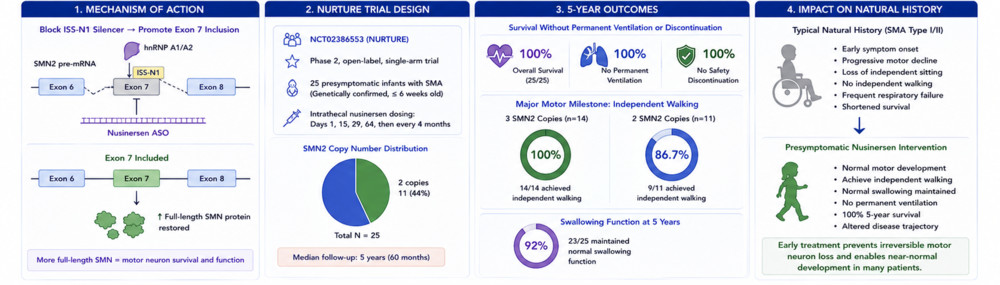 Figure 2. Presymptomatic nusinersen in SMA. Modification of natural history through early intervention.
Frequently Asked Questions
Q: Are antisense oligonucleotides made of DNA or RNA?
A: They may contain DNA-like, RNA-like, or non-natural nucleic acid building blocks. Many RNase H1-active ASOs use a DNA core flanked by modified sugars, while steric-blocking ASOs are often fully modified or use charge-neutral backbones.
Q: Do ASOs permanently change a gene?
A: Conventional ASOs act on RNA and do not intentionally edit genomic DNA. Their effects are generally reversible as the compound is cleared and new RNA is produced, although tissue retention and protein turnover can make pharmacology long lasting.
Q: What is the difference between an ASO and siRNA?
A: An ASO is usually a single strand that acts through RNase H1 or steric occupancy. siRNA is a duplex that is loaded into RISC, where the guide strand directs cleavage of complementary cytoplasmic RNA.
Q: Can an ASO increase protein expression?
A: Yes. A splice-switching ASO can promote a productive isoform, suppress a poison exon, or block an inhibitory RNA element. The direction of protein change depends on the targeted RNA-processing event.
Q: Why are several ASO sequences screened for one target?
A: RNA accessibility, protein occupancy, off-target complementarity, chemistry, and intracellular trafficking are difficult to predict completely. Testing a tiled sequence set reveals candidates that combine potency with specificity and tolerability.
Q: Which readout best proves that an ASO works?
A: No single readout is sufficient. Strong evidence links tissue or cellular exposure to the intended RNA change, the expected protein or pathway response, and a mechanism-relevant phenotype with appropriate sequence and chemistry controls.
Overview of What Creative Biolabs Can Provide
Creative Biolabs can support ASO research as a connected evidence chain, from target and sequence strategy through synthesis, cellular screening, delivery assessment, specificity analysis, and in vivo confirmation. The appropriate package depends on whether the project seeks RNA reduction, splice modulation, steric blockade, or delivery-enabled activity in a defined tissue.
| Research Need | Related Creative Biolabs Support | How It Connects to the Current Resource Topic |
|---|---|---|
| Integrated program design | One-Stop Antisense Oligonucleotide (ASO) Development Services | Connects target biology, sequence selection, chemistry, delivery, screening, and validation within one ASO development plan. |
| Candidate sequence and chemistry generation | Antisense Oligonucleotide (ASO) Design and Synthesis Service | Produces ASO candidates aligned with RNase H1, splice-switching, or steric-blocking mechanisms. |
| Cell-based activity ranking | Antisense Oligonucleotide (ASO) In Vitro Screening Service | Compares candidate potency, concentration response, time course, and mechanism-relevant readouts in vitro. |
| Delivery strategy evaluation | Antisense Oligonucleotide (ASO) Delivery Services | Examines formulation or conjugation options when productive exposure is the limiting step. |
| Specificity assessment | Antisense Oligonucleotide (ASO) Off-Target Detection and Analysis Service | Investigates sequence-dependent and broader transcriptomic effects to help prioritize candidates. |
| Route-matched translational validation | In Vivo Study Service for Antisense Therapeutics | Links exposure, target engagement, pharmacodynamics, phenotype, and tolerability in an in vivo setting. |
Projects can be scoped around target biology, mechanism, model, and decision-enabling readouts. Researchers may contact us today to discuss a fit-for-purpose ASO study plan.
References
- Amanat M, Nemeth C L, Fine A S, et al. Antisense oligonucleotide therapy for the nervous system: from bench to bedside with emphasis on pediatric neurology. Pharmaceutics, 2022, 14(11): 2389. https://doi.org/10.3390/pharmaceutics14112389 Distributed under Open Access license CC BY 4.0, with modification.
- Crawford T O, Swoboda K J, De Vivo D C, et al. Continued benefit of nusinersen initiated in the presymptomatic stage of spinal muscular atrophy: 5-year update of the NURTURE study. Muscle & nerve, 2023, 68(2): 157-170. https://doi.org/10.1002/mus.27853
