
Circular RNA Therapy
Circular RNA therapy offers sustained protein expression and enhanced RNA stability while avoiding permanent modification of genomic DNA. Its therapeutic potential spans vaccines, protein replacement, cancer immunotherapy, and regenerative medicine, but performance depends on efficient circularization, sequence optimization, product purity, tissue-specific delivery, and control of innate immune activation. Reliable development therefore requires coordinated evaluation of RNA integrity, translation efficiency, expression duration, biological activity, and safety.
Introduction
Circular RNA therapy is an emerging therapeutic approach that uses covalently closed RNA molecules to enable sustained protein expression or regulate gene activity. Creative Biolabs invites you to explore how circRNA design, synthesis, purification, delivery, analytical validation, and comparison with mRNA shape successful research programs. Through our custom circular RNA synthesis service, we help transform your construct concept into high-quality circRNA for expression, delivery, and functional studies.
Why Circular RNA Is Being Explored for Therapy
The main attraction of circular RNA is stability. A closed-loop RNA lacks free ends that are readily attacked by exonucleases, which can extend intracellular persistence compared with some linear RNAs. For therapeutic research, that persistence may support longer protein expression, reduced dosing frequency, or smaller RNA amounts, although these advantages depend on sequence design, purification, delivery system, innate immune activation, and the biology of the target tissue.
- Protein-expression circRNAs require translation initiation elements such as IRES or m6A-mediated initiation designs.
- Noncoding circRNA concepts may act through miRNA, protein, or RNA-binding interactions, but function is context-dependent.
- Manufacturing success depends on circularization efficiency and removal of linear RNA, dsRNA, and reaction by-products.
- Delivery remains a central challenge because circRNA size, charge, and structure still limit passive cellular entry.
circRNA Design
Synthetic circRNA design begins with a biological objective: encode a protein, present an antigen, modulate immunity, or study RNA regulation. From there, the sequence architecture must support circularization, translation, stability, and low unwanted immunogenicity. These requirements interact. A strong IRES may improve translation but enlarge the construct; homology arms may improve ligation but leave sequence scars; and purification conditions can change the immune profile of the final RNA.
| Design variable | Why it matters | Common research decision |
|---|---|---|
| Open reading frame | Defines the therapeutic or reporter protein | Optimize codon usage without disrupting circularization or translation control. |
| Translation initiation element | Enables cap-independent protein expression | Compare IRES or m6A-associated designs according to cell type and payload. |
| Spacer and homology arms | Support circularization efficiency and junction control | Balance ligation yield with minimal nonfunctional sequence burden. |
| Purification strategy | Removes linear RNA, dsRNA, and reaction components | Link analytical purity to innate immune and expression readouts. |
circRNA Synthesis Strategies
Synthetic circRNA can be produced through ligase-mediated circularization, ribozyme-assisted methods, permuted intron-exon systems, or other engineered routes. The best approach depends on RNA length, junction requirements, yield, scalability, and acceptable impurities. A practical circRNA synthesis strategy should therefore be selected with downstream expression and immune readouts in mind.
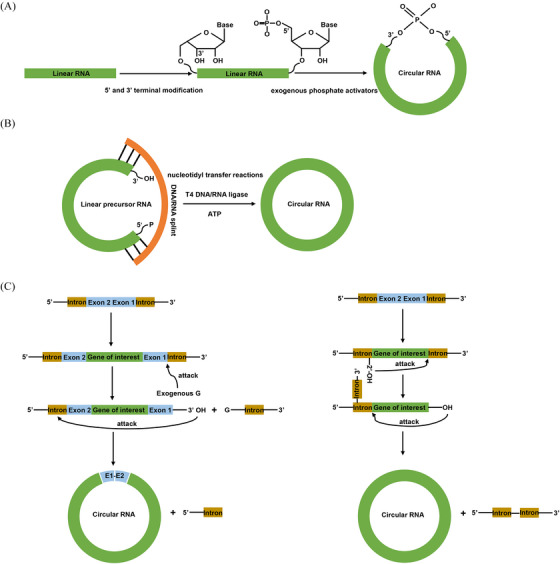 Figure 1. In vitro circRNA synthesis routes, including chemical synthesis, enzymatic ligation, and ribozyme-based circularization concepts.
| Synthesis route | Strength | Potential limitation | Best-fit research use |
|---|---|---|---|
| Enzymatic ligation | Direct control of linear precursor and ligation reaction | May need optimization for long RNA and junction purity | Small to medium constructs and method comparison studies |
| Ribozyme-assisted circularization | Can support self-splicing workflows | Residual intron or scar sequences may require careful design | Construct screening and scalable circularization exploration |
| Chemical or splint-assisted methods | Useful for defined junction control | Can be less practical for long therapeutic payloads | Short circRNA tools and mechanistic studies |
| Process-optimized IVT plus purification | Better connection to translational development | Requires analytical methods for linear and dsRNA impurities | Therapeutic candidate evaluation |
circRNA vs mRNA: How to Choose a Research Direction
circRNA and mRNA are often compared because both can encode proteins, but they are not interchangeable. mRNA is a mature translational platform with extensive delivery and manufacturing precedent, while circRNA may offer longer expression and distinctive immune behavior. The decision should be based on the desired duration of expression, payload size, target tissue, acceptable manufacturing complexity, and whether rapid translational benchmarking or long-lived expression is more important.
- Choose mRNA when short, controllable, transient expression and a mature formulation workflow are more important than extended intracellular persistence.
- Choose circRNA when longer expression is a central hypothesis and the program can support extra optimization of circularization, junction identity, and purity.
- Compare both formats when the same payload may benefit from different expression windows, immune profiles, or dose schedules.
- Do not assume circRNA is automatically less immunogenic or more potent; both claims require construct-specific and cell-specific validation.
Explore the Right circRNA Strategy for Your Project
A successful circRNA program requires more than selecting a circular RNA format. The construct must match the intended payload and expression goal, the circularization route must support efficient production, and analytical controls must confirm that the material is suitable for reliable evaluation. Creative Biolabs provides coordinated support across circRNA design, synthesis, purification, and analysis.
-
Considering circRNA for a new application?
Circular RNA Overview helps you assess whether circular topology aligns with your payload, expression goals, and research direction. -
Ready to build or optimize a construct?
Synthetic circRNA Design shows how sequence architecture, translation elements, junction design, and quality requirements can be tailored to your project. -
Need a practical production route?
circRNA Synthesis Strategies outlines circularization and analytical options that support reliable material generation, purification, and screening. -
Choosing between RNA platforms?
circRNA vs mRNA helps you weigh development maturity, manufacturing complexity, and desired expression duration before committing project resources.
Delivery Systems for circRNA
Delivery systems for circRNA frequently borrow from mRNA experience, especially lipid nanoparticles, but the RNA format can change encapsulation, stability, and expression kinetics. Researchers should measure not only total RNA delivery but also circular-to-linear ratio, junction integrity, protein output, duration, cytokine induction, and cell viability. In some programs, localization assays or in situ methods may help determine whether expression failure reflects delivery, release, translation, or RNA degradation.
A strong circRNA package often combines expression validation, circular RNA analysis, formulation screening, and functional assays. This helps separate the design problem from the delivery problem, which is essential before moving into disease-specific models.
Research Planning Notes for circRNA Programs
Define the purpose of using circRNA before optimizing the platform. Early studies should compare circular and linear constructs under matched sequence, delivery, and assay conditions to determine whether circRNA offers meaningful gains in expression duration, immune activity, or biological function. Readouts should also reflect the application; for example, antigen expression for vaccines or sustained, low-inflammatory protein production for replacement therapies.
Confirm circularity, purity, and delivery alongside performance. Junction-specific PCR, RNase R resistance, purity analysis, and expression kinetics can distinguish true circRNA activity from effects caused by linear RNA, dsRNA, or incomplete products. A stepwise assessment of formulation quality, uptake, intracellular release, expression, and function helps identify failure points. As candidates advance, reassess yield, junction accuracy, purification burden, and expression at the intended construct length and scale.
Frequently Asked Questions
Q: What makes circular RNA different from linear mRNA?
A: circRNA forms a covalently closed loop, whereas mRNA has 5' and 3' ends. This structural difference can improve resistance to exonucleases and change translation and immune behavior.
Q: Can circRNA encode proteins?
A: Yes. Engineered circRNA can encode proteins when it includes cap-independent translation elements, but expression depends on sequence architecture, cell type, purity, and delivery.
Q: Why is purification important for synthetic circRNA?
A: Purification removes linear RNA, dsRNA, enzymes, and reaction by-products that can reduce interpretability or trigger unwanted innate immune responses.
Q: Is circRNA always better than mRNA?
A: No. circRNA may offer durability advantages in some settings, while mRNA may be preferable when platform maturity, fast benchmarking, or transient expression is the priority.
Q: What readouts are useful in circRNA therapy research?
A: Useful readouts include circularization efficiency, junction sequence, circular-to-linear ratio, protein expression level and duration, innate immune activation, and functional activity.
Overview of What Creative Biolabs Can Provide
Creative Biolabs can help circRNA therapy researchers connect construct architecture, custom circular RNA synthesis, circularity analysis, localization detection, in vitro expression validation, and formulation studies. These links are drawn from the approved GT promotion Excel and focus on services that map directly to synthetic circRNA design and evaluation.
Because circRNA performance depends on circularization efficiency, purity, translation initiation, and delivery, the service pathway should not stop at synthesis. A practical program often combines circular RNA analysis with expression validation and LNP formulation studies so that low activity can be traced to design, quality, or delivery rather than guessed after the fact.
| Research Need | Related Creative Biolabs Support | How It Connects to the Current Resource Topic |
|---|---|---|
| Synthetic circRNA construct generation | Custom Circular RNAs Synthesis Service | Supports circular RNA production when junction design, payload sequence, and expression goals must be optimized. |
| Circularity, purity, and identity analysis | Circular RNA Analysis Services | Helps confirm whether the active material is truly circular and suitable for expression or functional studies. |
| Spatial localization of circRNA | In Situ Hybridization Detection Service for Circular RNAs | Supports studies that need cell- or tissue-level evidence of circRNA distribution. |
| Cell-based functional testing | Custom In Vitro Study Service for Synthetic Circular RNAs | Connects circRNA design to expression, activity, cell response, and model-specific readouts. |
| Protein-output validation | In Vitro Expression Validation Service for Synthetic Circular RNAs | Determines whether construct architecture and purification produce the intended expression profile. |
| Delivery formulation optimization | Custom LNP Formulation Service for Circular RNAs | Supports formulation development when circRNA uptake, release, and expression need improvement. |
Researchers can contact us today to discuss how these capabilities may be aligned with the current Resource topic, project stage, and experimental readout plan.
Reference
- Cai J, Qiu Z, Cho WCS, Liu Z. Synthetic circRNA therapeutics: innovations, strategies, and future horizons. MedComm. 2024;5(11):e720. 10.1002/mco2.720 Distributed under Open Access license CC BY 4.0, with modification.
