
Antisense Oligonucleotide (ASO) Therapy
ASO therapy can selectively modify disease-associated RNA by promoting transcript degradation, correcting pre-mRNA splicing, or blocking translation and harmful RNA interactions. Its effectiveness depends on precise sequence selection, chemical modification, target accessibility, tissue delivery, cellular uptake, and control of off-target or immune effects. Because each therapeutic mechanism requires a different oligonucleotide architecture and validation strategy, ASO candidates should be optimized through iterative design, screening, and functional testing.
Introduction
Antisense oligonucleotide (ASO) therapy is a therapeutic approach that uses short, sequence-specific nucleic acids to modify RNA processing or function. Creative Biolabs invites you to explore the essential mechanisms, chemical modifications, delivery strategies, synthesis methods, and evaluation considerations that shape successful ASO development. With our comprehensive one-stop ASO development services, we can support your program from initial design and synthesis through conjugation, delivery optimization, and functional validation.
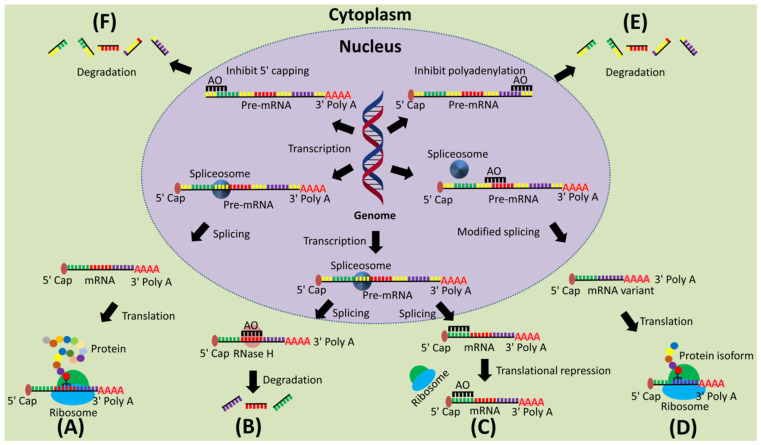 Figure 1. Mechanisms by which antisense oligonucleotides alter gene expression, including RNase H-mediated degradation, translational repression, splice modulation, and exon-skipping rescue.1
Why ASO Therapy Remains a Distinct RNA-Modulating Strategy
ASOs occupy a useful space between small molecules, protein biologics, and other nucleic acid modalities. They are not translated into proteins and do not require permanent genomic change. Instead, they act through hybridization with RNA, which makes target selection, mismatch tolerance, tissue exposure, and intracellular localization central to performance. This is why ASO therapy is often discussed in terms of mechanism-matched chemistry rather than as a single technology.
- A gapmer ASO is typically designed to bind a transcript and support RNase H-mediated degradation.
- A splice-switching ASO is usually optimized to occupy a pre-mRNA sequence without inducing cleavage.
- A steric-blocking ASO may interfere with translation, miRNA binding, or regulatory RNA interactions.
- A conjugated ASO can shift exposure toward a selected cell type, but the ligand must be matched to receptor biology.
How ASOs Regulate RNA
The core design decision is the desired RNA outcome. ASOs can reduce RNA abundance, change exon usage, mask regulatory elements, or modulate noncoding RNA function. A strong program therefore starts with transcript annotation and target accessibility rather than chemistry alone. Isoform context, disease mechanism, subcellular localization, and the tolerance for partial knockdown all influence whether degradation or modulation is the better research path.
| ASO mechanism | Primary RNA effect | Typical design implication | Useful research question |
|---|---|---|---|
| RNase H gapmer | Cleaves RNA in DNA/RNA duplexes | Requires a central DNA-like gap flanked by affinity-enhancing wings | Is transcript reduction the intended endpoint? |
| Splice switching | Promotes exon inclusion, exon skipping, or intron retention | Uses chemistries that support tight binding without RNase H recruitment | Can altered splicing restore a functional reading frame or reduce a toxic isoform? |
| Translation blocking | Prevents ribosome access or regulatory complex binding | Targets start sites or structured regulatory regions | Is protein reduction needed without lowering transcript abundance? |
| Noncoding RNA modulation | Interferes with lncRNA, circRNA, or miRNA-associated functions | Requires careful mapping of accessible and functional RNA domains | Which RNA interaction is disease-relevant enough to block? |
Chemical Modifications Shape Potency, Stability, and Safety
Native oligonucleotides are rapidly degraded and may not bind target RNA with sufficient affinity. Chemical modifications are used to improve nuclease resistance, pharmacokinetics, hybridization strength, tissue distribution, and tolerability. The same modification can solve one problem while creating another: high affinity may improve potency but narrow mismatch discrimination, and broad protein binding may improve exposure while increasing toxicity risk. The modification plan should therefore be connected to mechanism, route, target tissue, and assay design.
| Design layer | Common options | What it changes | Caution |
|---|---|---|---|
| Backbone | Phosphorothioate, phosphodiester, morpholino backbone | Nuclease resistance, protein binding, tissue retention | Protein interactions may contribute to class-specific toxicity. |
| Sugar | 2'-O-Me, 2'-MOE, LNA, cEt | Binding affinity, duplex stability, immune recognition | Very high affinity can reduce sequence-discrimination margins. |
| Architecture | Gapmer, mixmer, fully modified splice ASO | Determines whether cleavage or steric modulation is favored | Mechanism should be confirmed experimentally, not assumed from format alone. |
| Purity | Full-length product, truncations, depurination products | Interpretable pharmacology and safety readouts | Analytical methods must resolve closely related impurities. |
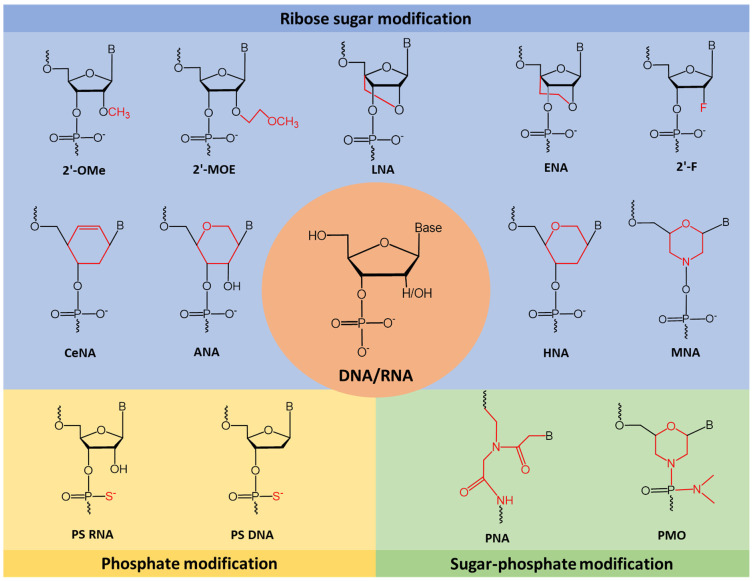 Figure 2. Representative chemically modified nucleotide analogues used in splice-modulating antisense oligonucleotides.1
Delivery and Conjugation Strategies
Delivery is the practical boundary of many ASO programs. Unconjugated phosphorothioate ASOs can distribute broadly after systemic administration, but receptor-mediated uptake, tissue barriers, and endosomal escape still influence active intracellular concentration. ASO conjugation strategies can improve the connection between chemistry and target tissue when the ligand, receptor, linker, and ASO format are chosen as one system.
- GalNAc conjugation is most relevant when hepatocyte uptake through ASGPR is central to the study.
- Peptide and antibody conjugates may be explored when cell-type selectivity or receptor biology is the key obstacle.
- Lipid or small-molecule conjugates can alter distribution and membrane association, but they require exposure and safety profiling.
- Encapsulation approaches may be useful when naked ASO exposure is insufficient or when formulation comparisons are part of the research question.
ASO Selection Guide for Research Planning
Selection should begin with the biological endpoint, not the preferred chemistry. If the objective is to reduce a disease-associated transcript, a gapmer design with transcript-accessibility screening and transcriptome-level specificity analysis is usually more informative than a splice-switching format. If the objective is to restore a reading frame or redirect exon usage, a steric-blocking ASO and isoform-resolved RT-PCR are more central. If the target is hepatocyte-expressed RNA, GalNAc-enabled uptake may be evaluated early; if tissue access is uncertain, naked, conjugated, and formulated designs can be compared in parallel.
- For knockdown studies, prioritize mRNA reduction, protein reduction, mismatch controls, and off-target transcript analysis.
- For splice modulation, prioritize isoform ratio, protein rescue, dose response, and durability of the corrected splice pattern.
- For delivery comparisons, prioritize uptake, endosomal release, functional activity, and cytotoxicity in the same model system.
Analytical Readouts and Translational Constraints
ASO activity is often easier to detect than to interpret. A reduction in RNA does not always translate into protein change, and a splice shift may need cell-type-specific context to become meaningful. Programs should combine molecular assays with functional endpoints, impurity profiling, cytokine or innate immune readouts, and concentration-response studies. Off-target analysis is especially important because short nucleic acids can tolerate partial complementarity, and chemical modifications can change both binding behavior and protein interactions.
Before moving from discovery to translational studies, researchers often combine in vitro potency testing, ASO off-target detection, delivery analysis, and manufacturability assessment. This integrated view helps distinguish a promising sequence from a developable ASO candidate.
Research Planning Notes for ASO Programs
A practical ASO research plan should separate four questions that are sometimes blended together: whether the RNA target is causally relevant, whether the chosen ASO mechanism can change that target, whether the chemistry provides enough intracellular exposure, and whether the observed effect is specific enough to justify deeper work. Separating these questions makes troubleshooting clearer. If RNA changes but protein does not, the issue may be protein stability or assay timing. If uptake is strong but activity is weak, the problem may be endosomal release, target accessibility, or incorrect mechanism selection.
Controls deserve early attention. Scrambled ASOs, mismatch controls, chemistry-matched negative controls, and positive controls for RNase H or splice switching help distinguish sequence-specific activity from chemistry-driven stress. For splice studies, isoform-level assays are essential because total transcript abundance may hide a meaningful splice change. For gapmers, both transcript and protein readouts are useful, especially when the protein has a long half-life or compensatory regulation.
Explore the Right ASO Approach for Your Project
The right ASO solution depends on your target, mechanism, delivery requirements, and project stage. Whether you are defining an initial strategy, optimizing chemistry, improving tissue exposure, or preparing candidates for screening, Creative Biolabs can connect these decisions within one coordinated development workflow. Explore the areas below to identify the support your program needs, and contact our team when you are ready to discuss a tailored ASO strategy.
- Starting a new ASO program? What Are Antisense Oligonucleotides? highlights the core considerations that can help you define a suitable mechanism and development direction.
- Need to balance potency, stability, and tolerability? ASO Chemical Modifications presents the chemistry options that can be tailored to your mechanism and performance goals.
- Facing tissue-targeting or cellular-uptake challenges? ASO Conjugation Strategies introduces ligand-enabled approaches that can be matched to your target tissue and delivery objectives.
- Ready to produce and evaluate candidates? Antisense Oligonucleotide Synthesis shows how controlled production and quality analysis support reliable screening and further development.
Frequently Asked Questions
Q: What is the main difference between RNase H ASOs and splice-switching ASOs?
A: RNase H ASOs are designed to degrade target RNA after duplex formation, whereas splice-switching ASOs usually block or expose splice regulatory elements without inducing cleavage.
Q: Why are chemical modifications necessary for ASO therapy research?
A: They improve nuclease resistance, affinity, pharmacokinetics, and tolerability, but they must be matched to mechanism because the wrong chemistry can reduce activity or increase risk.
Q: When is conjugation useful for an ASO program?
A: Conjugation is useful when tissue exposure or cell-type uptake is limiting and when the selected ligand has a biologically relevant receptor or uptake pathway.
Q: What assays are commonly used to evaluate ASO candidates?
A: Common assays include target RNA quantification, splice isoform analysis, protein measurement, cell viability, cytokine induction, uptake studies, and transcriptome-scale off-target profiling.
Q: Can ASOs permanently change DNA?
A: No. ASOs act primarily at the RNA level and generally do not edit genomic DNA, which is one reason they are considered a reversible RNA-modulating modality.
Overview of What Creative Biolabs Can Provide
Creative Biolabs can support ASO therapy research by connecting target-RNA analysis, ASO design and synthesis, chemistry selection, conjugation design, delivery evaluation, functional screening, and specificity analysis into one coherent workflow. For example, projects that begin with sequence selection may move into ASO conjugate development when tissue exposure becomes the limiting question, while programs that already have active candidates may need ASO off-target detection and analysis before broader translational evaluation.
| Research Need | Related Creative Biolabs Support | How It Connects to the Current Resource Topic |
|---|---|---|
| End-to-end ASO development planning | One-Stop Antisense Oligonucleotide (ASO) Development Services | Coordinates target selection, chemistry, screening, delivery, and analytical decisions for ASO therapy research. |
| Sequence design and modified ASO production | Antisense Oligonucleotide (ASO) Design and Synthesis Service | Supports candidate design when RNA accessibility, mechanism, and chemical modification must be matched. |
| Ligand-enabled tissue exposure | Antisense Oligonucleotide (ASO) Conjugate Development Services | Helps evaluate whether conjugation can improve uptake or tissue selectivity for the ASO concept. |
| Hepatocyte-oriented ASO delivery | GalNAc-Conjugated Antisense Oligonucleotide (ASO) Development Service | Connects ASO therapy concepts with receptor-mediated liver targeting when hepatocyte uptake is central. |
| Formulated ASO delivery comparison | Custom LNP based Antisense Oligonucleotide (ASO) Encapsulation Service | Supports comparison of encapsulated ASO delivery when naked or conjugated formats are insufficient. |
| Cell-based ASO activity screening | Antisense Oligonucleotide (ASO) In Vitro Screening Service | Ranks ASO candidates by functional activity, dose response, and model-specific readouts. |
| Specificity and safety-oriented analysis | Antisense Oligonucleotide (ASO) Off-Target Detection and Analysis Service | Adds transcript-level evidence for sequence specificity and candidate prioritization. |
Researchers can contact us today to discuss how these capabilities may be aligned with the current Resource topic, project stage, and experimental readout plan.
Reference
- Raguraman P, Balachandran A, Chen S, Diermeier SD. Antisense Oligonucleotide-Mediated Splice Switching: Potential Therapeutic Approach for Cancer Mitigation. Cancers. 2021;13(21):5555. https://doi.org/10.3390/cancers13215555. Distributed under Open Access license CC BY 4.0, with modification.
