
Synthetic circRNA Design
Effective synthetic circRNA design integrates sequence stability, circularization efficiency, translation performance, and immune compatibility from the outset. Key design decisions include selecting an appropriate circularization strategy, optimizing the coding sequence and regulatory elements, minimizing unwanted secondary structures and immunostimulatory motifs, and confirming junction accuracy, purity, and functional expression.
Introduction
Synthetic circRNA design converts a biological objective into a circular molecule whose topology, sequence, translation behavior, and delivery properties can be tested quantitatively. Unlike ordinary plasmid or linear mRNA design, the final product is shaped by both the payload and the method used to close the RNA. A rational program therefore connects control of therapeutic gene expression with circularization efficiency, product purity, innate immune compatibility, and application-specific potency. Creative Biolabs also provides a custom circular RNAs synthesis service, supporting sequence design, circularization strategy selection, RNA production, purification, and application-oriented validation.
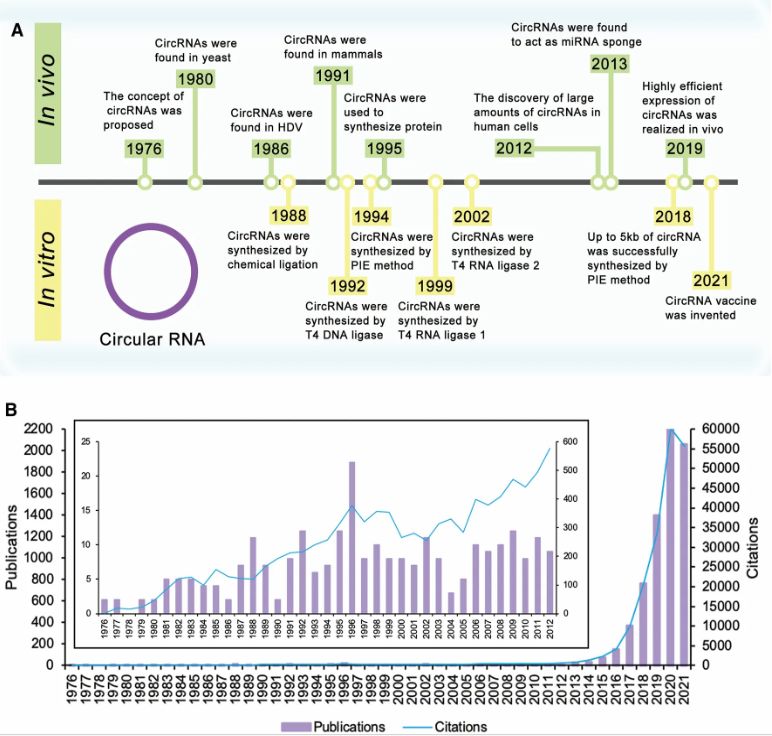 Figure 1. A Brief History of circRNAs.1
Why Synthetic circRNA Design Requires System-Level Engineering
1. A System, Not a Single Coding Sequence
- A synthetic circRNA behaves as an integrated system, not just a linear ORF.
- The ORF, translation-initiation region, spacer/UTR segments, circularization junction, residual intronic sequence, secondary structure, and formulation all interact with one another.
2. Trade-offs and Pitfalls
- A change that improves circularization may reduce translation efficiency.
- An IRES that works well in one cell type may be weak or inflammatory in another.
- A highly structured sequence may enhance stability but become difficult to manufacture or purify.
3. Start with a Defined Biological Goal
-
Before designing, clearly define:
- Target biological output
- Target cell type
- Duration of action
- Dose range
- Acceptable reversibility
4. Choose the Right Comparator
- For protein expression: Compare circRNA against a well-optimized linear mRNA under matched sequence, purification, dose, and delivery conditions.
- For regulatory applications: The comparator may be a linear RNA, expression plasmid, or loss-of-function reagent.
5. The Goal Is Not to Prove Universal Superiority
- The objective is not to prove that circular topology is universally better.
-
Rather, determine whether it solves a project-specific problem, such as:
- Short expression duration
- Need for repeated dosing
- RNA instability
- Insufficient local protein exposure
Core Sequence and Structural Architecture of Synthetic circRNA
Payload and coding sequence
For protein-producing circRNAs, the coding region should be evaluated for codon use, GC distribution, repetitive motifs, cryptic splice sites, internal complementarity, and unwanted open reading frames. Codon optimization can increase translation, but aggressive optimization may create stable structures, alter co-translational folding, or reduce sequence diversity needed for manufacturing. Signal peptides, transmembrane domains, secretion tags, and proteolytic processing sites must be selected according to the desired cellular compartment and protein form.
Non-coding modules
Non-coding segments influence ribosome recruitment, topology, stability, and interaction with innate sensors. Spacers can separate the circularization junction from translation elements, reduce junction-associated structural constraints, and support efficient ligation or self-splicing. Untranslated regions borrowed from linear mRNA do not necessarily behave identically in a circle because there is no conventional 5-prime-to-3-prime order. Each module should be justified by a measurable function rather than retained as inherited vector sequence.
| Design module | Primary objective | Failure mode to watch | Decision readout |
|---|---|---|---|
| Open reading frame | Produce the intended protein with correct localization and processing | Stable structure, cryptic ORFs, misfolding, or unintended peptides | Protein identity, activity, localization, and dose-response |
| Translation-initiation element | Recruit ribosomes without a 5-prime cap | Cell-type dependence, background from linear species, or innate sensing | Junction-dependent reporter output and orthogonal protein assay |
| Spacer / untranslated sequence | Support circularization and productive topology | Unnecessary length, secondary structure, or immunogenic remnant | Circularization yield, structure prediction, and expression comparison |
| Circularization junction | Close the RNA with minimal functional disruption | Scar sequence, nicked product, exonuclease sensitivity, or aberrant translation | Junction sequencing, integrity, and functional comparison |
| Purification-compatible features | Enable separation from linear and multimeric by-products | Co-migration or poor chromatographic resolution | HPLC/gel profile and impurity-linked activity |
Translation-Oriented Design
Initiation mechanisms
Because circRNAs lack a cap, translation requires cap-independent initiation. Viral or cellular internal ribosome entry sites can provide strong initiation, but performance is sequence- and cell-dependent. Short IRES-like motifs and N6-methyladenosine-associated initiation provide additional options, although predicted activity should be tested experimentally. Aptamer-based recruitment of initiation factors and engineered structured elements can further increase output. The best element is the one that performs in the intended cell under a relevant dose, not the one with the highest generic reporter signal.
Termination and rolling-circle translation
A conventional stop codon yields a defined protein, whereas removal of the stop codon can permit rolling-circle translation and repeated peptide units. Rolling-circle designs may amplify output or generate multimeric products, but they introduce processing, folding, aggregation, and quality-control questions. For most replacement proteins or secreted factors, a single defined product is easier to characterize. When rolling-circle translation is intended, the junction must preserve the reading frame and the resulting multimer must have a clear processing or functional rationale.
Circularization Interface and Precursor Design
For shorter or structurally cooperative RNAs, T4 ligase-based circularization may provide a direct route, sometimes using a DNA splint to bring ends together. Longer coding circles often use a group I intron self-splicing system or another engineered ribozyme architecture. The selection should account for RNA length, allowed scar sequence, circularization yield, purification burden, scale, and the sensitivity of the target cells to residual double-stranded or intronic material.
| Translation strategy | Potential strength | Main limitation | Best-fit question |
|---|---|---|---|
| Viral IRES | Often strong and well characterized | Length, cell dependence, and possible innate or regulatory concerns | Is robust protein output more important than minimal sequence? |
| Cellular IRES | May reduce reliance on viral elements | Variable activity and context dependence | Can endogenous initiation support the target tissue? |
| m6A-associated initiation | Compact and potentially tunable | Modification placement and reader availability affect output | Can a small initiation module provide adequate translation? |
| Short IRES-like motifs / structured elements | Sequence-efficient and compatible with screening | Activity can be difficult to predict from sequence alone | Which compact motifs perform across candidate payloads? |
| Rolling-circle translation | Repeated translation around the same template | Multimer processing, folding, and product heterogeneity | Is a repetitive peptide product biologically useful? |
Purity, Immunogenicity, and Delivery Fit
Innate immune behavior is not determined by circularity alone. Double-stranded RNA, uncircularized precursor, nicked circles, intron-derived fragments, 5-prime triphosphate-bearing species, and sequence-specific structures can activate RIG-I-like receptors, PKR, or Toll-like receptors. Purification and manufacturing history must therefore be treated as design variables. A candidate should be evaluated with matched linear and process controls, cytokine panels relevant to the target cells, and functional measurements that reveal whether immune activation suppresses translation or changes the desired phenotype.
Delivery can reorder candidate rankings. A large, highly structured circle may translate well after electroporation but encapsulate poorly or escape endosomes inefficiently. Lipid composition, particle size, RNA-to-lipid ratio, and tissue tropism should be optimized with the actual candidate rather than a generic reporter. Early circRNA delivery formulation studies help determine whether the chosen sequence and topology remain intact during formulation, storage, administration, and intracellular release.
Application-Specific Design Guide
Design priorities shift with the biological task. A vaccine antigen may benefit from sustained expression and innate immune tuning, whereas a potent cytokine may require lower expression and stronger tissue restriction. A genome-editing protein may need a bounded expression window to limit off-target activity. A replacement protein requires correct processing and sufficient duration, while a regulatory non-coding circle may not need translation at all. The design specification should state the required protein amount or regulatory effect, onset, duration, target tissue, tolerable inflammatory signal, and preferred route before sequence optimization begins.
| Application | Design priority | Risk to control | Minimum validation package |
|---|---|---|---|
| Protein replacement | Correct folding, secretion/localization, and durable output | Overexpression, ectopic exposure, or non-physiological processing | Protein identity, bioactivity, localization, duration, and dose-response |
| Vaccination | Antigen expression plus appropriate immune stimulation | Excess innate sensing, altered antigen processing, or weak tissue delivery | Antigen level, innate profile, humoral/cellular response, and durability |
| Genome-editing support | Adequate but time-bounded editor expression | Prolonged nuclease exposure and off-target editing | Editor kinetics, editing profile, cell viability, and off-target indicators |
| Local cytokine or antibody expression | Tissue-focused exposure and controlled potency | Systemic leakage, receptor overstimulation, or immune toxicity | Local/systemic protein, pathway activation, and safety markers |
| Non-coding regulatory circRNA | Specific interaction or pathway modulation | Stoichiometric insufficiency and unintended binding | Target engagement, rescue experiment, and transcriptome/proteome effects |
Design Validation
A Staged Validation Plan
| Stage | Action |
| 1 | Verify sequence & circular identity → junction sequencing, northern blotting, topology-sensitive assay |
| 2 | Quantify impurities → linear precursor, concatemers, dsRNA, process-related species |
| 3 | Compare activity → dose × time in the intended cell type |
| 4 | Measure off-target effects → viability, stress, innate immune markers |
| 5 | Connect to biology → mechanism-specific functional endpoint |
Essential Controls (Checklist Format)
✅ Matched linear RNA — same sequence in linear form
✅ Non-circularizable precursor — cannot form circle
✅ Inactive payload or start-codon control — no translation
✅ Junction-disrupting construct — required if claiming translation
✅ For secretion/membrane proteins: confirm mature protein form and biological activity (intracellular signal alone is insufficient)
✅ For regulatory circles: complement overexpression with junction-specific depletion and rescue
Published Data
Case 1: CircTADA2A Suppresses Colorectal Cancer Progression via the miR-374a-3p/KLF14 Axis
This study demonstrates the therapeutic potential of circRNA as a microRNA sponge in suppressing colorectal cancer (CRC). Researchers found that circTADA2A is significantly downregulated in CRC tissues and cell lines, correlating with poor clinical prognosis. Mechanistically, circTADA2A functions as a competitive endogenous RNA (ceRNA) by directly sponging miR-374a-3p. This interaction relieves the miR-374a-3p-mediated repression of KLF14, a key tumor-suppressive transcription factor. Consequentially, upregulated KLF14 suppresses CRC cell glycolysis and cell cycle progression while promoting apoptosis. Both in vitro and in vivo nude mouse xenograft experiments confirmed that overexpressing circTADA2A significantly impedes CRC cell proliferation, migration, invasion, and overall tumor growth. This case illustrates a complete strategy for validating tumor-suppressive circRNA sponge networks, establishing the circTADA2A/miR-374a-3p/KLF14 axis as a novel diagnostic biomarker and promising therapeutic target for CRC intervention.
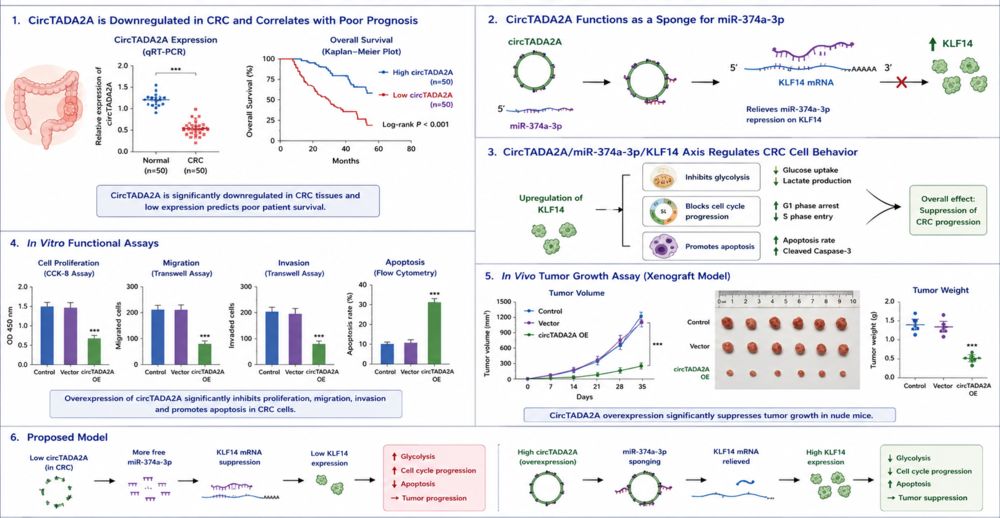 Figure 2. CircTADA2A Inhibits Colorectal Cancer Progression by Regulating the miR-374a-3p/KLF14 Signaling Axis.
Frequently Asked Questions
Q: What should be defined before designing a synthetic circRNA?
A: Define the intended function, target cell or tissue, required expression level, onset and duration, dose range, route, and acceptable reversibility. These specifications determine the appropriate translation and circularization architecture.
Q: Is the strongest IRES always the best choice?
A: No. IRES performance varies by sequence, payload, cell type, and stress state. A strong generic reporter signal may not translate to the intended tissue and can add length or unwanted regulatory properties.
Q: How much untranslated or spacer sequence should a circRNA contain?
A: Only enough to support circularization, productive structure, translation, and purification. Extra sequence can reduce yield, introduce immune-active structures, or complicate product characterization.
Q: Can codon optimization be used for circRNA payloads?
A: Yes, but it should be balanced against RNA structure, repetitive sequence, cryptic initiation, protein folding, and manufacturability. Protein activity is a more meaningful endpoint than expression alone.
Q: How can translation from linear by-products be excluded?
A: Use highly purified material, northern or topology-sensitive analysis, a non-circularizable precursor control, junction-disrupting constructs, and assays that connect the protein product specifically to the circular template.
Q: When should delivery be considered during design?
A: Delivery should be considered early. Sequence length, structure, charge density, and purity can change encapsulation, storage stability, endosomal escape, and tissue exposure, potentially reversing rankings obtained by direct transfection.
Overview of What Creative Biolabs Can Provide
Creative Biolabs can support synthetic circRNA programs by connecting sequence architecture, circularization route, production, analytical confirmation, expression testing, functional evaluation, and delivery formulation. Projects can be staged from small candidate panels through mechanism-focused cellular studies.
| Research Need | Related Creative Biolabs Support | How It Connects to the Current Resource Topic |
|---|---|---|
| Integrated synthetic circRNA planning | Circular RNAs (circRNAs) Services | Coordinates design, synthesis, analysis, functional testing, and delivery questions around the intended application. |
| Candidate synthesis | Custom Circular RNAs Synthesis Service | Generates custom molecules based on payload, circularization, scale, and study requirements. |
| Molecular quality assessment | Circular RNA Analysis Services | Evaluates circular identity and analytical attributes needed to interpret downstream performance. |
| Expression-focused screening | In Vitro Expression Validation Service for Synthetic Circular RNAs | Compares intracellular expression, persistence, and construct-dependent performance. |
| Mechanism-specific cellular testing | Custom In Vitro Study Service for Synthetic Circular RNAs | Links candidate design to functional activity, viability, and relevant pathway readouts. |
| Payload-specific LNP development | Custom LNP Formulation Service for Circular RNAs | Assesses how formulation variables affect encapsulation, delivery, stability, and biological response. |
Projects can be configured around the intended circRNA function, molecule format, model system, and validation depth. Researchers may contact us today to discuss a fit-for-purpose study plan.
References
- Chen X, Lu Y. Circular RNA: Biosynthesis in vitro. Frontiers in bioengineering and biotechnology, 2021, 9: 787881. https://doi.org/10.3389/fbioe.2021.787881 Distributed under Open Access license CC BY 4.0, with modification.
- Li Z, Yao H, Wang S, et al. CircTADA2A suppresses the progression of colorectal cancer via miR-374a-3p/KLF14 axis. Journal of Experimental & Clinical Cancer Research, 2020, 39(1): 160. https://doi.org/10.1186/s13046-020-01642-7
