


Custom Anti-Lewis B (LeB) Antibody Development for Blood Group & Host-Pathogen Studies
The Lewis B antigen is a critical histo-blood group antigen and Tumor-Associated Carbohydrate Antigen (TACA). Studying it demands tools of absolute precision. Standard, off-the-shelf Lewis antibodies often fail, lacking the specificity or affinity needed for conclusive data. At Creative Biolabs, we provide a comprehensive portfolio of solutions for researchers studying the Lewis B antigen (LeB). We offer both a wide selection of ready-to-use Anti-Lewis B (LeB) antibody products and a premier Custom Anti-Lewis B (LeB) Antibody Development service. We designed this service to solve the unique challenges of the LeB target, delivering high-affinity, specific anti-Lewis B antibody tools tailored precisely to your research needs. We also focus on custom services designed to address the challenges of other TACA targets (Custom Anti-TACA Antibody Development Service).
What is the Lewis B Antigen (LeB)?
The Lewis B antigen is a histo-blood group antigen. This means it is part of the complex system that determines blood types, but its role extends far beyond red blood cells. It is a key molecule in cell recognition and host-pathogen interactions. Unlike protein antigens, LeB is an oligosaccharide, meaning it is made of several sugar units linked together. Its specific structure is: α-L-Fucp-(1-2)-β-D-Galp-(1-3)-[α-L-Fucp-(1-4)]-D-GlcNAc-R.
- Fuc: Fucose
- Gal: Galactose
- GlcNAc: N-acetylglucosamine
- -R: The rest of the molecule it is attached to (a protein or a lipid)
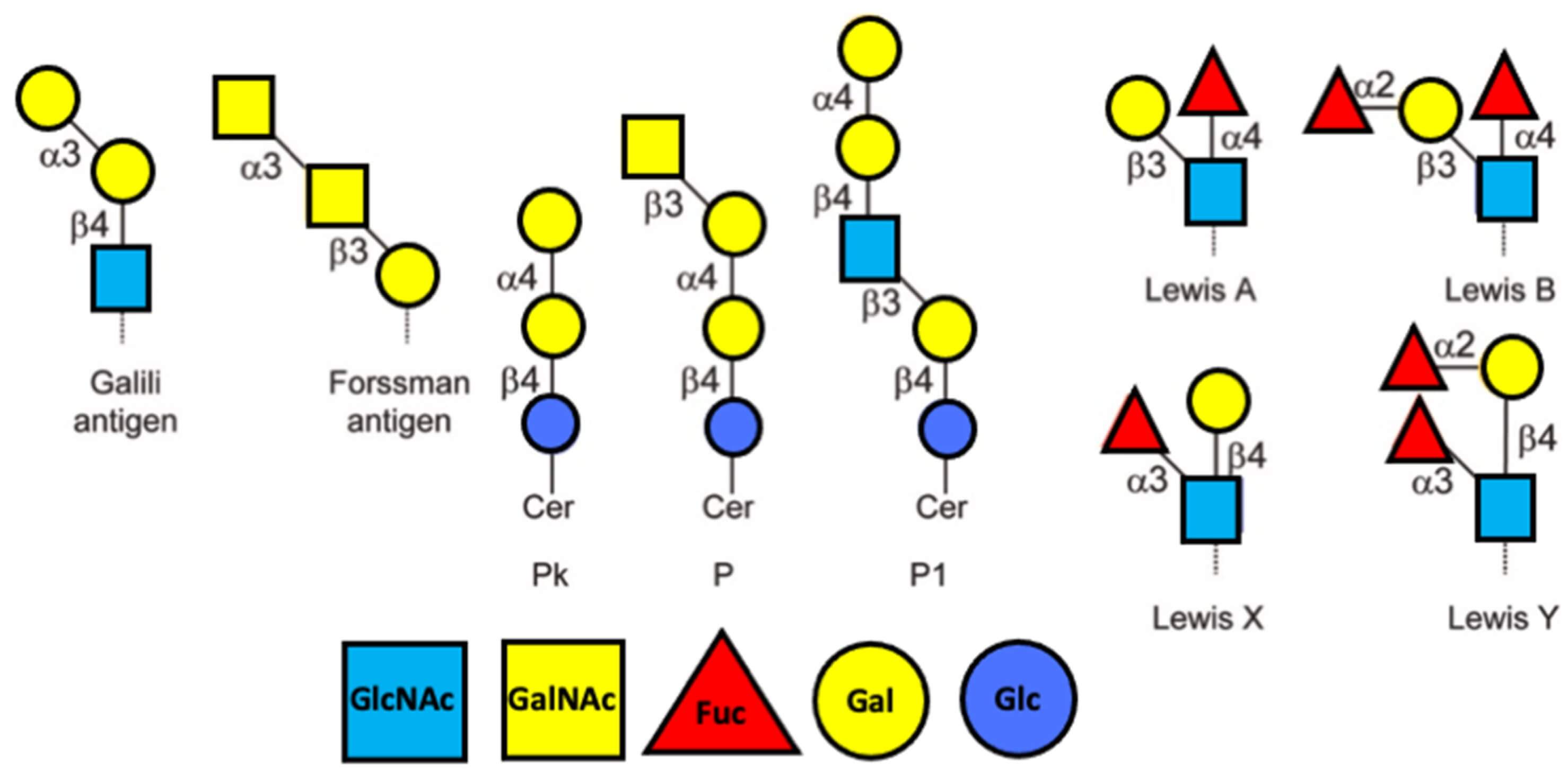 Fig.1 The structure of Lewis A, Lewis B, and ABH blood group antigens from a precursor.1
The defining feature of LeB is the presence of two fucose molecules, attached at different points. This specific structural arrangement is what our antibodies are designed to recognize.
Why Off-the-Shelf Antibodies Often Fail?
Given the challenges above, it is easy to see why generic, off-the-shelf anti-Lewis B antibody products are a common source of frustration for researchers.
Undocumented Specificity
Many commercial antibodies are not adequately tested against a full panel of related glycans. They may be sold as "anti-LeB" but have significant, undisclosed cross-reactivity with LeA or LeY. This leads to false positives and unreliable data.
Wrong Application
An antibody that works well for one application, such as ELISA, will often fail in another. An antibody that binds LeB in an ELISA tray (where it is purified and stuck to plastic) may not be able to recognize the native LeB antigen on a live cell surface in a flow cytometry experiment. An antibody for Western Blot is useless if it doesn't also work for Immunohistochemistry (IHC) on fixed tissues.
Wrong Format
Your research may require a specific format that isn't available. You might need a recombinant antibody for ultimate batch-to-batch consistency. You may need a smaller fragment, such as a scFv or Fab, for structural biology or to enhance tissue penetration. You might need a chimerized or humanized antibody for in vivo studies in mouse models.
Low Affinity or Sensitivity
Due to low immunogenicity, many available antibodies have weak binding (low affinity). This results in faint signals in IHC or flow cytometry, forcing you to use high concentrations, which in turn increases background noise and non-specific binding.
Our Service: A Complete Custom Antibody Solution
At Creative Biolabs, we overcome these challenges by managing every variable of the development process. We partner with you to create a novel anti-Lewis B antibody, designed, built, and validated for a single purpose: your specific research application.
Step 1: Strategy and Antigen Design
We start by discussing your goal. After communication, we then design the antigen that can meet your requirements. This is the most critical step for a carbohydrate target. We do not simply inject an animal with LeB. We design a highly specific immunogen to generate the exact response we want. We use synthetic, high-purity Lewis B antigen oligosaccharides. We then chemically conjugate (link) them to large, immunogenic carrier proteins. This "tricks" the immune system's T-cells into helping, resulting in a much stronger, higher-affinity antibody response. In some cases, we can immunize with cell lines that are known to express extremely high levels of native LeB on their surface.
Step 2: Antibody Generation
We offer multiple state-of-the-art platforms to generate your antibody.
- Hybridoma Development: The trusted, gold-standard method for creating robust monoclonal antibodies. We perform multiple immunization boosts and use advanced fusion protocols to make an extensive library of hybridoma clones.
- Phage Display Technology: A highly sophisticated in vitro alternative. We can build a vast library of antibody genes in phage. We then screen this library against the Lewis B antigen target. This method is ideal for anti-glycan antibodies (especially for recombinant Fab or scFv fragments) because it allows for adverse selection. We can first expose the library to LeA, LeY, and H-antigen to remove all the cross-reactive binders. We then take the remaining phage and screen them against LeB. The result is an antibody with unparalleled specificity.
Step 3: Validation
An antibody is only as good as its validation data. We find the correct clone, and then we prove it works.
- Primary Screening (ELISA): We screen thousands of clones for binding to the LeB-conjugate.
- Critical Specificity Screening: This is where we separate the bad from the good. Your top candidates are screened against a full panel of related glycans. We provide you with the data in a clear table.
- Application-Specific Validation: We then test the best clones in your intended application. We do not stop until we have a clone that works.
Step 4: Production, Purification, and Formatting
Once you have approved your perfect clone, we scale up.
- We can produce milligrams to grams of your antibody from hybridoma supernatant or our recombinant expression systems.
- All antibodies are purified to ensure they are ready for your experiments.
-
We provide the antibody in the format you need:
- Labeling (Biotin, FITC, and other fluorophores)
- Fragmentation (Fab, F(ab')2)
- Recombinant Formats (scFv, rAb)
- Isotype switching and chimerization
Ready-to-Use Anti-Lewis B Antibodies
For projects that require immediate reagents, Creative Biolabs also offers a portfolio of well-validated, ready-to-use Lewis antibodies. These products are ideal for initial screening or standard applications. You can explore our comprehensive catalog of pre-made anti-Lewis B antibody products, which are validated for various research applications. Below is a selection of our featured Anti-LeB products:
-
Host: MouseAntibody Isotype: IgG1Species Reactivity: HumanApplication: WB, ELISA, IHC, IHC-P
-
Host: MouseAntibody Isotype: IgG1Species Reactivity: HumanApplication: ELISA, IHC-P
-
Host: MouseAntibody Isotype: IgG1Species Reactivity: HumanApplication: IHC-P
-
Host: MouseAntibody Isotype: IgMSpecies Reactivity: HumanApplication: IHC-P
What You Can Achieve with Your Custom Antibody?
With a custom-developed, rigorously validated anti-Lewis B antibody, you can finally get clear, publishable answers to your research questions.
- You can definitively map LeB expression: Use your IHC-validated antibody to stain tissue arrays and determine, with confidence, the prevalence of LeB in different cancer types.
- You can quantify LeB-positive cells: Use your flow cytometry-validated antibody to accurately sort and analyze cell populations, such as identifying a sub-population of cancer stem cells that express LeB.
- You can prove functional mechanisms: Use your blocking-validated antibody to directly demonstrate that Lewis B antigen is the key receptor for the pathogen you study.
- You can develop new diagnostic tools: Your antibody can become the core reagent in a new diagnostic ELISA or IHC kit for detecting cancer or stratifying patients.
- You can create next-generation therapeutics: Your antibody can serve as the foundation for a pre-clinical ADC, a CAR-T construct, or a neutralizing antibody therapy.
Why Choose Creative Biolabs?
- Unmatched glycan expertise
- Absolute specificity (via counter-screening)
- Guaranteed application validation
- Flexible hybridoma & phage display platforms
- Transparent project management
- End-to-end solution (antigen to antibody)
Related Services
As a leader in glycan-targeted antibody engineering, Creative Biolabs provides a full suite of custom antibody development services for a wide range of Tumor-Associated Carbohydrate Antigens (TACAs) and histo-blood group antigens.
| Service | Description |
|---|---|
| Custom Anti-Tn Antibody Development | We develop particular antibodies against the Tn antigen, a simple TACA that is a crucial target for tumor biomarker discovery. |
| Custom Anti-sTn Antibody Development | This service focuses on creating custom antibodies targeting the Sialyl-Tn antigen, a key glycan in immuno-oncology research. |
| Custom Anti-T/sT Antibody Development | We provide specialized development of antibodies for T and Sialyl-T antigens, which are critical for studying cancer cell adhesion. |
| Custom Anti-sLeA (CA19-9) Antibody Development | This service creates high-affinity antibodies for Sialyl-Lewis A (CA19-9), the primary marker for pancreatic cancer research. |
| Custom Anti-sLeX Antibody Development | We develop high-specificity antibodies against Sialyl-Lewis X, an antigen essential for research on cancer metastasis. |
| Custom Anti-Lewis Y (LeY) Antibody Development | Our service generates antibodies targeting the Lewis Y antigen, a TACA heavily involved in tumor signaling pathways. |
The Lewis B antigen is too essential, and the challenge of studying it is too great, to rely on generic tools. Your research demands an antibody that is as specific as your hypothesis. We are experts in navigating the complexities of anti-carbohydrate antibody development. We partner with you to understand your scientific goal and then build the precise tool you need to achieve it. Contact our specialists today to discuss your project and design a custom anti-Lewis antibody.
Reference:
- Mironov, Alexander A., et al. "Mechanisms of Formation of Antibodies against Blood Group Antigens That Do Not Exist in the Body." International Journal of Molecular Sciences 24.20 (2023): 15044. Distributed under Open Access license CC BY 4.0, without modification. https://doi.org/10.3390/ijms242015044
Supports
- Glycosylation Influences Blood Type
- TACAs Overview
- Guide to Blood Group Antigens
- Comparing sLeA and sLeX Roles in Cancer
- CA19-9 as a Pancreatic Cancer Biomarker
- Lewis Antigen System Overview
- TACA-Targeted ADCs, CAR-Ts, and RICs