


Custom Anti-Lewis Y (LeY) Antibody Development for Tumor Signaling Pathway Research
Tumor-Associated Carbohydrate Antigens (TACAs) are complex sugar molecules found on the surface of cancer cells. They are active molecules that help tumors grow, survive, and resist treatment. Developing effective antibodies against these glycan targets is a highly specialized skill. Creative Biolabs is a world leader in this area. We provide a robust and comprehensive Custom Anti-TACA Antibody Development Service to support scientists everywhere. Within this critical group of molecules, one TACA is a significant focus: the Lewis Y antigen (LeY). This antigen is present in high amounts on many types of tumors and is a key player in cancer signaling. The Lewis Y antigen directly influences the signals that instruct a cell to divide, remain alive, and proliferate. To study these pathways, researchers need exact tools. Standard antibodies often fail to work effectively against complex carbohydrates. This is where our expert service provides a clear solution. We specialize in creating custom, high-affinity, and high-specificity anti-Lewis Y antibody reagents built from the start to meet your exact research goals.
What is the Lewis Y Antigen?
The Lewis Y antigen (LeY) is a complex carbohydrate structure, or glycan. Specifically, it is a difucosylated tetrasaccharide. It belongs to the Lewis blood group system, which also includes related structures like Lewis A (LeA), Lewis B (LeB), and Lewis X (LeX). These glycans are constructed by specialized enzymes known as glycosyltransferases. The structure of LeY is: Fucα1-2Galβ1-4[Fucα1-3]GlcNAcβ1-R. This complex structure is attached to either proteins (forming glycoproteins) or lipids (forming glycolipids) on the cell membrane and is highly expressed on the surface of various cancer cells, such as ovarian, breast, and gastric cancers, and is known to be involved in cell recognition, adhesion, and signal transduction processes.
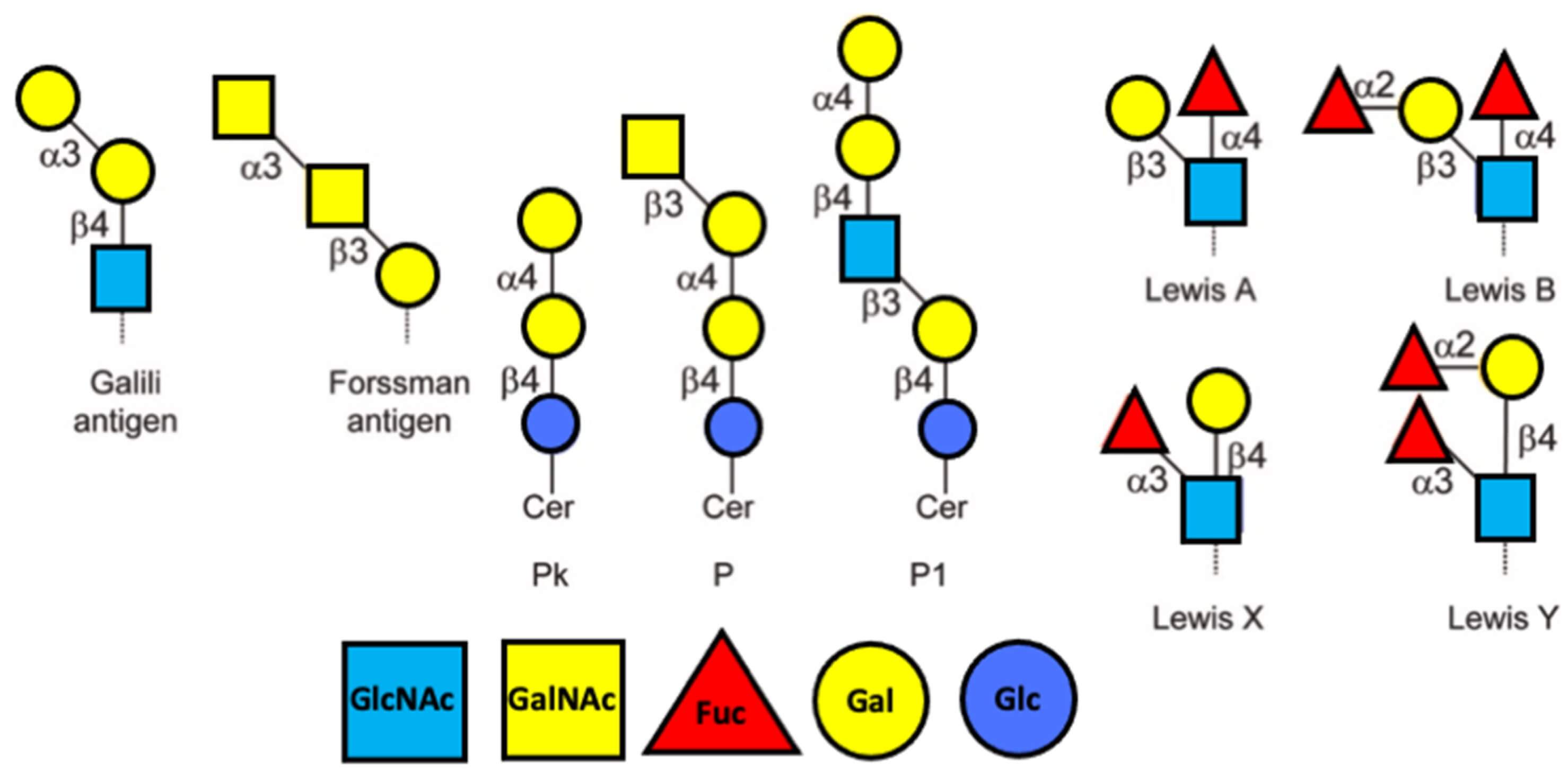 Fig.1 The structure of Lewis Y and other blood group antigens.1
Expression: Normal Tissue vs. Cancer
In healthy adult tissues, LeY expression is generally low. It is found on the surface of some red blood cells and specific epithelial cells, such as those lining the gastrointestinal and respiratory tracts. Its presence is tightly controlled. The situation changes dramatically in cancer. Many human cancers, particularly epithelial carcinomas, exhibit a significant increase in LeY expression. This overexpression is a common feature in:
- Breast cancer
- Non-small cell lung cancer (NSCLC)
- Colorectal cancer
- Ovarian cancer
- Pancreatic cancer
- Gastric cancer
- Prostate cancer
The high expression of the Lewis Y antigen on tumors, combined with its low expression in most vital normal tissues, makes it a desirable target for cancer research and therapeutic development.
LeY's Functional Role in Tumor Signaling Pathways
The high expression of LeY on tumors is a functionally significant phenomenon. Decades of research have demonstrated that LeY actively contributes to the development of established malignant phenotypes. It does this by physically interacting with and modifying the function of key cell surface receptors that regulate cell growth and survival. LeY acts as a functional modulator. When attached to specific proteins, it alters their signaling capacity. This modification often results in the constitutive activation of growth-promoting pathways, leading to uncontrolled proliferation and enhanced cell survival. The Lewis Y antigen, therefore, acts as a critical modulator of the cancer cell surface. It contributes to a specific cell surface glycan profile that amplifies or potentiates multiple oncogenic pathways simultaneously.
| Signaling Pathway | Key Proteins Modified by LeY | Resulting Cancer Phenotype |
|---|---|---|
| MAPK Pathway | EGFR, HER2 | Increased Cell Proliferation |
| PI3K/Akt Pathway | EGFR, HER2, Integrins | Increased Cell Survival, Anti-Apoptosis |
| Cell Adhesion & Motility | Integrins | Increased Migration, Invasion, Metastasis |
| Drug Resistance | EGFR | Resistance to RTK Inhibitor Drugs |
To dissect these pathways, researchers need a tool that can precisely identify LeY on specific proteins or block LeY's function in a live-cell assay. This is why a custom anti-Lewis Y antibody is essential.
Design Your Custom Anti-Lewis Y Antibody
Our Custom Solution: Precision-Engineered for Your Goal
Our custom anti-Lewis Y antibody development service is a collaborative process designed to deliver an antibody that is specifically tailored to your application. There are differences between off-the-shelf antibodies and our custom Ab products.
| Feature | Off-the-Shelf Antibody | Our Custom-Developed Antibody |
|---|---|---|
| Specificity | Often unknown or poorly defined. High risk of cross-reactivity with other glycans. | We screen against a comprehensive panel of related glycans (LeA, LeB, LeX, H-antigens) to ensure monospecificity. |
| Application | Validated for 1-2 typical applications (e.g., WB). Often fails in others (e.g., IHC, Flow). | We develop and validate antibodies for your specific assay (IHC, IF, Flow, Co-IP, ELISA, and Functional Assay). |
| Affinity | Variable and often uncharacterized. | Affinity optimized. We screen for high-affinity binders and provide you with complete characterization data. |
| Epitope | Unknown. | We can map the epitope and, for functional studies, specifically screen for antibodies that block a desired interaction. |
| Consistency | It can vary from batch to batch. | 100% Consistent. For recombinant antibodies, the sequence is defined, ensuring zero batch-to-batch variation forever. |
| Supply | The supplier reserves the right to discontinue this product at any time. | You own the sequence or the cell line. Your supply is secure. |
Our Custom Anti-Lewis Y Antibody Development Platform
We are experts in the discovery of anti-glycan antibodies. Our team combines deep knowledge of glycobiology with cutting-edge antibody engineering platforms. Our process is transparent, collaborative, and built for success.
Success starts with the immunogen. We work with you to understand your exact needs.
- Tell us about your goal: Do you need to block a function? Do you need to target LeY on a specific protein? Do you need IHC-grade sensitivity?
- We will design and synthesize the optimal LeY antigen for your project. This may be a synthetic LeY glycan conjugated to a carrier protein or a more complex cellular immunogen.
We employ two world-class platforms to generate a diverse pool of antibody candidates.
- Monoclonal Hybridoma: The classic, proven method for generating robust mouse and rat monoclonal antibodies, ideal for many research and diagnostic uses.
- Phage Display: A powerful in vitro technology. We screen vast libraries to find human or animal antibody fragments with the exact properties you need. This is the preferred platform for therapeutic development, as it produces recombinant, sequence-defined antibodies from day one.
This is our greatest strength. We do not just find binders; we find the right binders. All candidates undergo a rigorous screening cascade.
- Primary Screen (ELISA): Identify all clones that bind to the LeY antigen.
- Specificity Screen (Glycoarray Platform): This is critical. We test all positive hits against a panel of related glycans, including LeA, LeB, LeX, H-type 1, H-type 2, and others.
- Affinity Characterization: We measure the binding strength of your top candidates using SPR or BLI.
We deliver an antibody that is ready to use. We will validate the final, purified antibodies in the applications you requested.
- Western Blot (WB)
- Immunohistochemistry (IHC)
- Immunofluorescence (IF)
- Flow Cytometry
- Co-Immunoprecipitation (Co-IP)
- Functional Blocking Assays
We proceed with the scalable production of your validated antibody with the required formats. We deliver the final purified antibody, a comprehensive data report, and the hybridoma cell line or antibody sequence for a renewable supply.
Ready-to-Use Anti-Lewis Y (LeY) Products
We recognize that not every project requires a fully customized antibody. Sometimes, your research requires a high-quality, validated tool right now. For this reason, Creative Biolabs also offers a portfolio of excellent ready-to-use anti-Lewis Y antibody products. These reagents are in stock and validated for standard applications, allowing your experiments to start immediately. We invite you to explore our catalog of available anti-Lewis Y antibody products. These ready-to-use products are a fantastic option for many standard research projects. If you review this list and do not find the exact tool you need, our custom development team is here to help. We can design and develop a new antibody from scratch, tailored to meet your precise requirements.
-
Host: MouseAntibody Isotype: IgMSpecies Reactivity: HumanApplication: WB, FC, IHC-P
-
Host: MouseAntibody Isotype: IgG3Species Reactivity: HumanApplication: ELISA, FC, IHC, WB, TLC
-
Host: MouseAntibody Isotype: IgG1Species Reactivity: HumanApplication: ELISA, IHC-P
Related Services
As a leader in glycan-targeted antibody engineering, Creative Biolabs provides a full suite of custom antibody development services for a wide range of Tumor-Associated Carbohydrate Antigens (TACAs) and histo-blood group antigens.
| Service | Description |
|---|---|
| Custom Anti-Tn Antibody Development | We develop high-specificity antibodies against the Tn antigen. This simple TACA is a crucial target for the discovery of tumor biomarkers. |
| Custom Anti-sTn Antibody Development | This service focuses on creating custom antibodies targeting the Sialyl-Tn (sTn) antigen. sTn is a key glycan for immuno-oncology research. |
| Custom Anti-T/sT Antibody Development | We provide specialized development of antibodies for T and Sialyl-T antigens. These targets are critical for studying cancer cell adhesion. |
| Custom Anti-sLeA (CA19-9) Antibody Development | This service creates high-affinity antibodies for Sialyl-Lewis A (sLeA). This is the well-known CA19-9 marker, essential for pancreatic cancer research. |
| Custom Anti-sLeX Antibody Development | We develop high-specificity antibodies against Sialyl-Lewis X (sLeX). This antigen is a key player in cancer metastasis research. |
| Custom Anti-Lewis B (LeB) Antibody Development | Our service generates antibodies targeting the Lewis B (LeB) antigen. LeB is crucial for blood group studies and research on host-pathogen interactions. |
The Lewis Y antigen is one of the most critical and challenging targets in modern cancer research. Its role as a key modulator of oncogenic signaling pathways makes it a high-value target for investigation and drug development. To unlock the complex biology of LeY, a precise, reliable, and custom-built tool is necessary. Creative Biolabs is ready to partner with you. We will apply our expertise in glycobiology and antibody engineering to build the exact anti-Lewis Y antibody you need to achieve your breakthrough. Contact our scientific team today to discuss your project and discover how a custom antibody can accelerate your research into tumor signaling.
FAQs
How long does it take to develop a custom anti-LeY antibody?
A typical custom project timeline is about 4 to 6 months. This comprehensive process includes antigen design, immunization, screening, and final validation for your specific application. We will provide a detailed, personalized timeline for your project's precise goals.
Do I need to provide the LeY antigen myself?
No, you do not. Creative Biolabs has deep expertise in glycan chemistry. We will design, synthesize, and conjugate the optimal LeY immunogen for your project. We handle the entire process from antigen design to final antibody, ensuring the best possible immune response.
What do I need to provide to get started?
It's simple. You need to provide your research goals. We will schedule a technical consultation with our scientific team. They will discuss your specific needs (like the intended application, required specificity, or antibody format), and then we will prepare a formal project proposal for you.
What is the cost of a custom anti-LeY antibody project?
The cost varies based on the project's complexity, such as the screening strategy, validation requirements, and final deliverables. We provide a detailed, no-obligation quote after a technical consultation. Please contact our team to discuss your specific needs.
Reference:
- Mironov, Alexander A., et al. "Mechanisms of Formation of Antibodies against Blood Group Antigens That Do Not Exist in the Body." International Journal of Molecular Sciences 24.20 (2023): 15044. Distributed under Open Access license CC BY 4.0, without modification. https://doi.org/10.3390/ijms242015044
Supports
- TACAs Overview
- Guide to Blood Group Antigens
- Comparing sLeA and sLeX Roles in Cancer
- CA19-9 as a Pancreatic Cancer Biomarker
- Lewis Antigen System Overview
- TACA-Targeted ADCs, CAR-Ts, and RICs