


Name the protein and glycosylation site when context-specific recognition is required.
Custom Anti-Tn Antibody Development Service
Creative Biolabs develops anti-Tn antibodies for researchers who need to recognize the GalNAc-Ser/Thr epitope in a defined molecular context.
Service Overview
Although Tn is structurally simple, antibodies raised against it may bind the carrier, the peptide backbone, Blood Group A structures, or neighboring truncated O-glycans. We therefore build the antigen, screening panel, and biological validation around the particular Tn-bearing target and assay you plan to study. We offer researchers a comprehensive portfolio of custom anti-TACA antibody development services, including high-specificity anti-Tn (CD175) antibody products, enabling the creation of novel tools against this target.
Challenges in Developing Tn-Selective Antibodies
Tn is a small, self-like carbohydrate epitope with limited immunogenicity, and its presentation changes with the peptide sequence, glycosylation site, density, and carrier. The decisive question is often whether the antibody should recognize Tn broadly or only when displayed on a nominated glycopeptide such as a defined mucin segment. That choice determines the immunogen and the negative panel from the beginning.
Specify whether broad Tn detection across carriers is acceptable.
List T, sTn, blood group A, unglycosylated peptide, and unrelated GalNAc structures for exclusion.
Define the intended cell, tissue, array, or functional readout.
Tn glycopeptide selection treats GalNAc-O-Ser/Thr identity and Ser-versus-Thr placement as separate experimental variables. peptide-backbone sequence cannot be inferred from target-only epitope recognition when Tn epitope density is absent from the comparison panel. The glycopeptide design should also record unmodified peptide control, because an apparently strong clone may be recognizing presentation context rather than the intended carbohydrate surface. That glycan-versus-peptide distinction determines which antibodys remain interpretable after the assay format changes.
Our Anti-Tn Antibody Development Services
Our current Tn service page follows a collaborative four-phase route: strategic antigen design, antibody generation, positive/negative specificity screening, and application-focused validation. Creative Biolabs can discuss carrier conjugates or synthetic glycopeptides, hybridoma or display-based discovery, and a counter-screen that includes T, sTn, unmodified peptide, and Blood Group A where relevant to the requested recognition profile.
Tn Immunogen and Antibody Development
Tn immunogen design records GalNAc attachment to Ser or Thr, peptide sequence, glycosylation position, epitope density, carrier, and linker. Parallel unmodified and alternate-backbone controls help determine whether binding is glycan-dominant or peptide-context restricted.
Specificity and Biological-Context Validation
Candidates are assessed against T, sTn, sT, blood group A, unmodified peptide, and alternate Tn backbones as appropriate. Cell or tissue validation is used to test whether synthetic-glycopeptide selectivity survives a more complex biological presentation.
During antigen planning, T glycopeptide exclusion is intended to be varied deliberately instead of left as an uncontrolled property of the reagent. Parallel constructs help reveal whether sTn and sT comparators changes antibody ranking, while blood group A control identifies signal unrelated to the nominated epitope. These comparisons are especially useful before investing in downstream formatting, because reformatting cannot rescue a binder whose original specificity was defined by an incidental scaffold feature.
Defining the Tn Glycopeptide Context
A carrier conjugate can improve immunogenicity but may select antibodies that recognize the junction. A site-defined glycopeptide can preserve local context yet overfit to one backbone. Parallel target and alternate-backbone constructs help determine whether recognition is Tn-dependent, peptide-dependent, or genuinely junction specific.
The screening cascade is most informative when alternate Tn backbone is assessed alongside carrier-junction epitope recognition. One readout describes structural preference; the other tests whether the preference survives the valency, accessibility, and competing surfaces present in the intended model. Candidates that change rank between these settings are not automatically unsuitable, but the difference must be explained before a lead is selected for an application-specific study.
Counter-Screening Tn Against T, sTn, and Related Structures
| Control | Failure mode revealed |
|---|---|
| Unmodified peptide | Peptide-only recognition |
| T glycopeptide | Failure to distinguish core-1 extension |
| sTn glycopeptide | Tolerance of sialic-acid capping |
| Blood group A | Broad terminal GalNAc recognition |
| Alternate Tn backbone | Whether specificity is broad or peptide restricted |
Data interpretation distinguishes a measured epitope recognition profile from a universal property of the antibody. Evidence for array-to-sample translation is limited to the structures, concentrations, and presentation formats actually tested. Changes in density, matrix, or antibody format can alter apparent selectivity through avidity. Reporting these boundaries makes it easier to decide whether additional controls, a second assay geometry, or a different antibody is needed.
Our Development Workflow
Tn Context & Controls
The workflow starts with the Tn context rather than with a generic GalNAc reagent. We design the antigen and matched controls together, generate candidate antibodies, and retain only those that meet the agreed positive and negative screening pattern. Shortlisted clones then move into the customer's intended sample or assay, so peptide-context and biological accessibility are considered before final selection.
Unglycosylated Control
Use an unglycosylated version to remove peptide-only binders.
Related-Glycan Negatives
Apply T, sTn, and blood-group-related negatives during clone selection.
Secondary-Format Screening
Transfer screening to a second carrier or to cells before final ranking.
Workflow decisions are staged so that inexpensive structural questions precede more complex biological confirmation. glycan-dominant recognition can narrow the antibody set, whereas peptide-restricted recognition tests a different source of apparent selectivity. During each specificity check, positive and negative controls are interpreted together. A high target signal without a matched counter-target response does not establish specificity, and a negative result may reflect inaccessible antigen rather than absence of recognition.
Project Requirements and Deliverables
Project Input
Project Requirements
Project Output
Deliverables and Validation Scope
The agreed scope may provide antibody candidates, Tn-versus-related-structure screening results, and biological-context validation data. Interpretation states whether recognition is broad, backbone dependent, or limited to the tested presentation.
Project inputs should describe glycoengineered cells in enough detail to reproduce the intended antigen context and should identify how tissue accessibility will be evaluated. This information affects reagent choice, control construction, and the meaning of a negative result. If a customer sample is the final destination, its preparation history and expected target abundance are considered during planning rather than introduced only after purified-antigen screening is complete.
Research Applications
Map Tn-associated glycopeptides in tumor models.
Compare Tn with T and sTn after pathway perturbation.
Develop capture, imaging, or flow-cytometry research reagents.
Explore sequence-defined Tn binders in immunotoxin or cell-engagement models.
Preclinical activity in literature does not predict performance of a newly developed antibody.
For research applications, functional payload interpretation is evaluated as a separate question from antigen recognition. Binding may justify advancing a antibody, but it does not by itself demonstrate blocking, internalization, signaling, staining, or biological activity. Those endpoints require their own controls and model-specific acceptance logic. Maintaining this separation prevents a descriptive epitope recognition reagent from being overinterpreted as a functional antibody.
Published Data
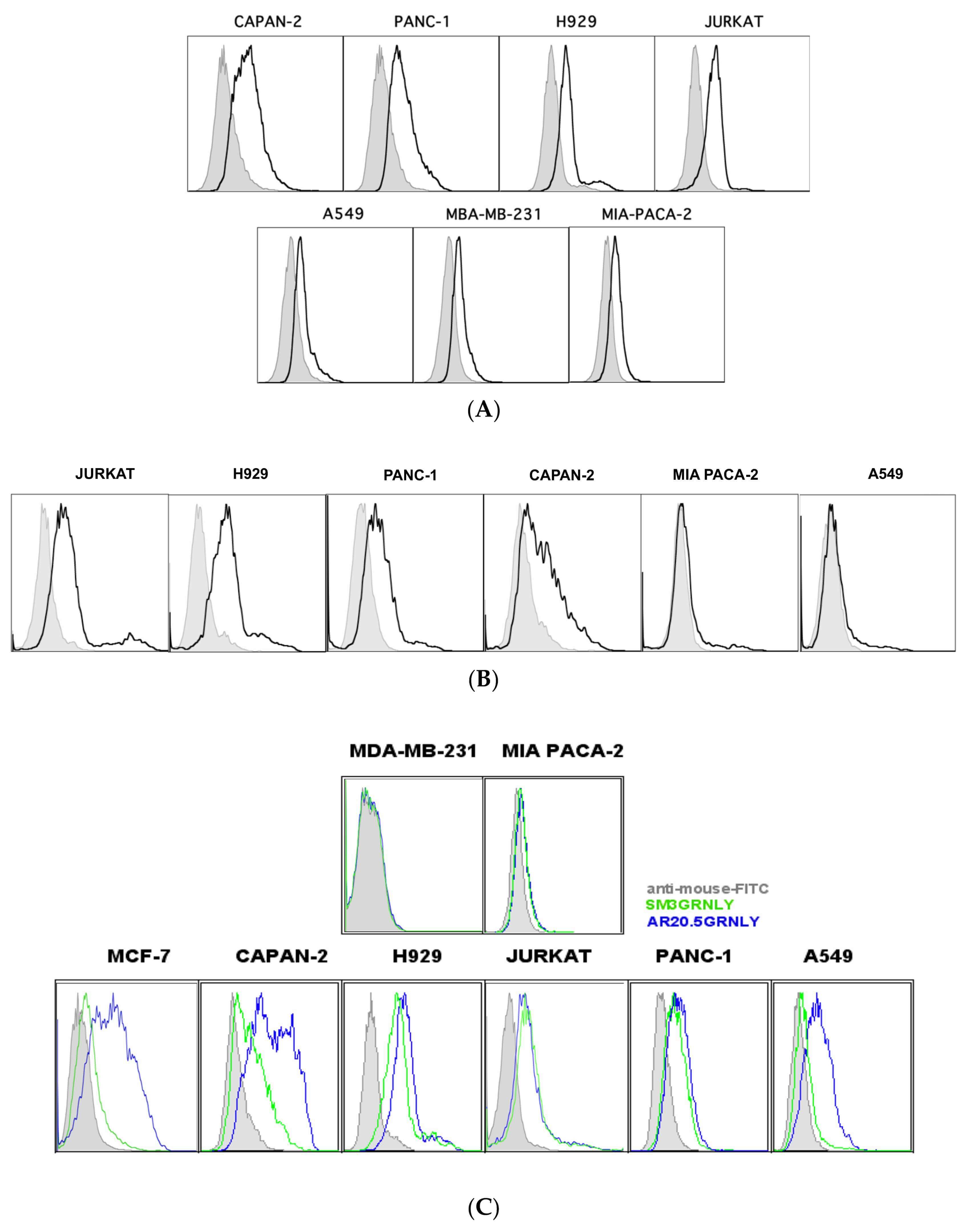
A recent preclinical study validates the Tn antigen as a premier target for antibody-based therapeutics. This study demonstrated this by constructing an immunotoxin, SM3GRNLY, which links an anti-Tn scFv (from the SM3 mAb) to the lytic protein granulysin. This anti-Tn immunotoxin retained its high affinity for the MUC1-Tn antigen, with a KD measured at 0.149 µM by Surface Plasmon Resonance (SPR). In cell-based assays using flow cytometry, the SM3GRNLY construct demonstrated highly specific binding. It successfully bound to the surface of known Tn-positive tumor cell lines (including CAPAN-2, PANC-1, H929, and Jurkat) while showing no binding to Tn-negative control cells (such as MDA-MB-231 and MIA-PACA-2). This targeted binding translated directly to enhanced function. The immunotoxin induced significantly more cell death in Tn-positive cells compared to granulysin alone. The most compelling results came from an in vivo xenograft model of human pancreatic cancer. Systemic treatment with SM3GRNLY reduced tumor volume by 42%, while granulysin alone had no therapeutic effect. Histological analysis confirmed the immunotoxin-induced apoptosis within the tumor tissue.
Start Your Anti-Tn Antibody Project
Tell us whether you need broad Tn recognition or sequence-specific glycopeptide recognition, and provide the target peptide, glycosylation site, carrier preference, counter-targets, sample type, final assay, and desired antibody format. Creative Biolabs can also review existing immunogens or antibodies before discussing a tailored Tn development and validation program.
Frequently Asked Questions
Should an anti-Tn antibody recognize GalNAc alone or a complete glycopeptide?
That depends on the research question. A broad reagent may
recognize Tn across several protein contexts, whereas a glycopeptide-selective antibody may require both
GalNAc and surrounding amino acids. Defining this preference before antigen design prevents a project from
selecting useful binders against the wrong molecular version of Tn.
Which negative controls are most useful for Tn antibody screening?
A practical panel often includes the corresponding unmodified
peptide, T-glycopeptide, sTn-glycopeptide, carrier-only material, and Blood Group A or other GalNAc-containing
structures when relevant. These controls test peptide, carrier, and neighboring-glycan recognition separately.
The exact panel should match the intended sample and the selectivity claim required.
Why are synthetic Tn glycopeptides useful as immunogens?
A synthetic glycopeptide can place Tn at a defined serine or
threonine within a known amino-acid sequence. This gives the immune system a reproducible molecular surface
and allows matched unmodified, T, or sTn peptides to be prepared for screening. It is especially valuable when
protein-context selectivity matters to the application.
Can an anti-Tn antibody selected by ELISA be used for tissue staining?
ELISA binding is an important early result, but tissue
staining introduces fixation, accessibility, glycan density, and background structures that are absent from a
coated plate. Candidates intended for IHC or IF should be evaluated directly in suitable positive and negative
materials. Enzymatic or genetic controls can strengthen interpretation when they are available.
Can Creative Biolabs evaluate an existing anti-Tn antibody?
An existing reagent can be reviewed for specificity,
cross-reactivity, and application fit within an agreed research scope. Useful inputs include antibody format,
sequence if available, immunogen history, prior assay data, and the intended sample. The evaluation plan can
then focus on the gaps most likely to affect the next experiment.
What should be submitted for a custom anti-Tn project discussion?
Please provide the Tn-bearing protein or peptide context,
glycosylation site, desired breadth of recognition, structures that must be excluded, available positive and
negative samples, final assay, and preferred antibody format. These details help determine whether the project
should prioritize glycan-wide recognition, peptide-context selectivity, or a deliberately defined
cross-reactive profile.
References
- Guerrero-Ochoa, Patricia, et al. "Preclinical Studies of Granulysin-Based Anti-MUC1-Tn Immunotoxins as a New Antitumoral Treatment." Biomedicines 10.6 (2022): 1223. Distributed under Open Access license CC BY 4.0, without modification. https://doi.org/10.3390/biomedicines10061223
Project Inquiry
For Research Use
Only.Not for clinical or diagnostic use.