


Anti-Glycolipid Antibody Overview: Unlocking the Potential of Glycolipids in Disease Research
Glycolipids, especially gangliosides, are structural components of cellular membranes. They are essential to signaling, immune response, and cell recognition. Their role in neurobiology and autoimmune diseases has opened up exciting avenues for discovery. At Creative Biolabs, we understand that studying glycolipids can be hard. Our custom glycolipid antibody development services can help your research at every step.
Glycolipids: The Membrane Players You Can't Ignore
Glycolipids are lipid molecules with carbohydrate groups attached, and their roles go far beyond simply keeping cell membranes intact. As crucial parts of cellular membranes, glycolipids, particularly gangliosides, play a critical role in how cells interact with their environment. These molecules help cells recognize and communicate with each other, and they act as essential markers for immune cells, allowing the immune system to differentiate between healthy and harmful cells.
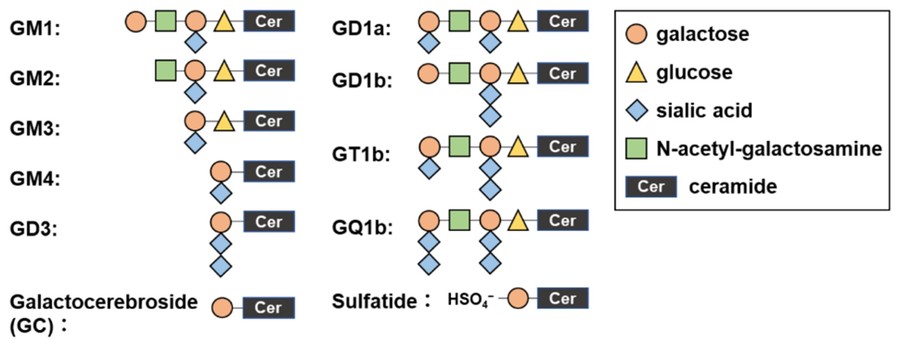 Fig.1 Representative glycolipids structures.1
Glycolipids consist of a ceramide (Cer) anchor and an outward-facing glycan headgroup built from galactose (Gal), glucose (Glc), N-acetyl-galactosamine (GalNAc), and one or more sialic acids; in ganglioside nomenclature, G denotes ganglioside, while M/D/T/Q indicate mono-, di-, tri-, or tetra-sialylation and the a/b suffix reflects linkage topology. Galactocerebroside (GC) is the neutral baseline (Gal–Cer), and Sulfatide is its sulfated, negatively charged derivative. Along the monosialyl branch, GM4 presents a compact, minimal headgroup, GM3 adds a lactose core (Gal–Glc) beneath the sialic acid, GM2 introduces GalNAc to expand the epitope, and GM1 further extends with Gal, creating richer binding geometries. Increasing sialylation yields the disialyl series GD3 (two sialic acids on a simplified core) and the topologically distinct GD1a and GD1b, whose different sialic-acid placements modulate exposure, flexibility, and antigenic surfaces. Greater negative charge and hydration culminate in GT1b (trisialylated) and GQ1b (tetrasialylated), which thicken the interfacial water layer and reshape membrane curvature. These precise compositional and spatial differences—from GC and Sulfatide through GM1/GM2/GM3/GM4 and on to GD3/GD1a/GD1b/GT1b/GQ1b—govern receptor engagement, immune recognition, and, critically, the selectivity landscape for anti-glycolipid and anti-ganglioside antibodies.
Why Researching Anti-Glycolipid Antibodies is Essential
You might be studying a wide array of topics, from autoimmune diseases like Guillain-Barré syndrome to neurodegenerative diseases or even cancer research. Whatever your focus, you'll find that anti-glycolipid antibodies are essential tools to unlock deeper insights. These antibodies are used to detect and study immune responses related to glycolipids in diseases that impact the peripheral and central nervous systems. For example, anti-ganglioside antibodies are often employed in research focusing on neurological diseases. Gangliosides, such as GM1, GM2, and GM3, are abundant in neuronal tissues and play a role in diseases like Multiple Sclerosis (MS) and Charcot-Marie-Tooth disease. In autoimmune studies, these antibodies can help identify aberrant immune responses targeting specific glycolipids, which in turn contributes to understanding the pathogenesis of these diseases. Researchers are also using anti-glycolipid antibodies to probe the role of glycolipids in cancer metastasis. Glycolipids like GD2 and GD3 are found in elevated amounts in certain tumors and are of great interest in immunotherapy research.
Anti-Glycolipid Antibodies Service Overview
At Creative Biolabs, we offer a comprehensive range of anti-glycolipid antibody services and anti-other glycolipid antibody solutions, as well as related products to support your research into anti-glycolipid antibodies and glycolipid-related studies. Our expertise in developing custom antibodies and providing specialized glycan analysis tools ensures that you can achieve precise and reliable results in your experiments.
| Target | Research Area/Applications | Services | Products |
|---|---|---|---|
| GM1 | Neurological diseases, Autoimmune research | Anti-GM1 Antibody Development | Anti-GM1 Antibody |
| GM2 | Neurodegenerative diseases, Cancer research | Anti-GM2 Antibody Development | Anti-GM2 Antibody |
| GM3 | Autoimmune diseases, Neurological research | Anti-GM3 Antibody Development | Anti-GM3 Antibody |
| GD1a | Peripheral neuropathies, Autoimmune disorders | Anti-GD1a Antibody Development | Anti-GD1a Antibody |
| GD1b | Guillain-Barré syndrome, Autoimmune research | Anti-GD1b Antibody Development | Anti-GD1b Antibody |
| GD2 | Cancer research, Immunotherapy | Anti-GD2 Antibody Development | Anti-GD2 Antibody |
| GD3 | Cancer, Neurological disorders, Immunology | Anti-GD3 Antibody Development | Anti-GD3 Antibody |
| GT1a | Autoimmune diseases, Nerve regeneration | Anti-GT1a Antibody Development | Anti-GT1a Antibody |
| GT1b | Neurological diseases, Immune response research | Anti-GT1b Antibody Development | Anti-GT1b Antibody |
| GQ1b | Autoimmune diseases, Neurological research | Anti-GQ1b Antibody Development | Anti-GQ1b Antibody |
| Sulfatide | Multiple sclerosis, Autoimmune research | Anti-Sulfatide Antibody Development | Anti-Sulfatide Antibody |
| Galactocerebroside | Demyelinating diseases, Immunology research | Anti-Galactocerebroside Antibody Development | Anti-Galactocerebroside Antibody |
| Globoside | Cancer research, Hematological disorders | Anti-Globoside Antibody Development | Anti-Globoside Antibody |
| Blood Group Antigens | Blood transfusion, Immunohematology, Organ transplantation research | Anti-Blood Group Antigens Antibody Development | Anti-Blood Group Antigens Antibody |
The Challenges: What Researchers Need to Know
When embarking on glycolipid-related research, you'll inevitably face several challenges.
- First and foremost, there is the complexity of glycolipid structures. These molecules come in various forms, each with different carbohydrate chains and lipid tails, meaning the antibody you need will depend on the exact glycolipid you're studying. Additionally, the heterogeneity of the glycolipid pool in tissues requires antibodies that can differentiate between similar glycolipids with subtle structural differences.
- Another challenge comes from model-specific differences. For instance, you may notice that certain antibodies behave differently in mouse models compared to human samples. This is where our custom antibody development services at Creative Biolabs shine—we tailor our antibodies to ensure they work effectively in the model you are using, whether it's EAE, MS, or a cancer model.
- You also need reliable assays to quantify anti-glycolipid antibodies. Many times, researchers use ELISA or Western blot to measure antibody titers, but setting up the right assay requires the right antigen and protocol, which can be a tedious and time-consuming process. At Creative Biolabs, we not only develop custom antibodies but also assist in optimizing assays for your specific needs.
How Creative Biolabs Can Help
We understand that when you're tackling the complexities of glycolipid immunology, you need more than just antibodies—you need a partner who can offer tailored solutions and scientific expertise. That's where we come in. Our anti-glycolipid antibody development services are designed with flexibility in mind. Whether you need antibodies for GM1, GM3, GD1a, or GD2, we work closely with you to ensure we develop the perfect antibody for your research needs. We can provide monoclonal or polyclonal antibodies that are finely tuned to your specific antigens, ensuring that you get precise, reproducible results.
For researchers studying autoimmune disorders, our anti-ganglioside antibody development services are particularly useful. Gangliosides like GM1 and GM3 are often targeted in Guillain-Barré syndrome and Fisher syndrome, and we can provide antibodies that help you track disease progression or immune responses in these conditions. In neurodegenerative disease research, understanding the role of gangliosides in diseases like Alzheimer's or Parkinson's requires specific antibodies that can identify changes in glycolipid composition in tissues. We can provide antibodies that help dissect these complex molecular pathways. Our custom antibody services also extend to more specialized glycolipids. For instance, GD2 and GD3 are frequently studied in neuroblastoma research, and our team can develop anti-GD2 antibodies that help track and target these glycolipids for immunotherapy studies.
Related Solutions You Might Find Useful
At Creative Biolabs, we offer an array of related services to complement your work with anti-glycolipid antibodies. These services can be critical in addressing common pain points, from validating your antibodies to optimizing your assays:
-
Glycosylation Analysis Services
Explore the full range of glycosylation analysis services, including glycolipid analysis, to ensure you're capturing all the relevant data for your research. Our glycan microarrays and mass spectrometry-based services offer detailed insights into the structure and function of glycolipids, helping you complement your antibody research with precise molecular data. -
Glycolipid Microarray
Study the interactions between glycolipids and other biomolecules using our glycolipid microarray services. This high-throughput technique allows you to profile glycolipid-antibody interactions, offering insights into how different glycolipids play a role in disease mechanisms. -
Antibody Engineering Services
If you need more than just a standard antibody, our antibody engineering services can help you create highly specific antibodies with enhanced properties. We specialize in humanization, affinity maturation, and other engineering techniques to ensure your antibodies perform at their best.
Understanding and developing anti-glycolipid antibodies is an essential step in exploring the roles these molecules play in neurological diseases, autoimmune disorders, and cancer research. At Creative Biolabs, we are committed to providing high-quality, customized antibodies and services to help you advance your research. Whether you are looking to study gangliosides like GM1, GM2, or GM3, or need antibodies targeting more specific glycolipids like GD2 or sulfatide, we have the tools and expertise to support your project. Explore our full range of services and products, and let us help you turn your research questions into discoveries. Get in touch with our team today.
Reference:
- Moriguchi, Kota, et al. "Anti-Glycolipid Antibody Examination in Five EAE Models and Theiler's Virus Model of Multiple Sclerosis: Detection of Anti-GM1, GM3, GM4, and Sulfatide Antibodies in Relapsing-Remitting EAE." International Journal of Molecular Sciences 24.16 (2023): 12937. Distributed under Open Access license CC BY 4.0, without modification. https://doi.org/10.3390/ijms241612937
Supports
- Glycolipid
- GM3 Antibody in Cancer Immunotherapy
- GM3 Ganglioside in Disease & Anti-GM3 Antibody Tools
- Engineering High-Affinity scFv for Next-Generation GD2-CAR-T Therapy