Creative Biolabs develops antibodies for researchers who need to distinguish the
Thomsen-Friedenreich T antigen from its sialylated sT form, or deliberately recognize both within a
defined study.
The two epitopes differ by a terminal sialic acid, but their accessibility also depends on the carrier
protein, glycosylation site, density, and surrounding glycocalyx. We design the project around the binding
profile your adhesion or glycosylation research actually requires.
We offer Anti-TACA
Antibody Development Service that includes a dedicated custom anti-T/sT antibody service to address this
challenge. We design and develop high-affinity, high-specificity antibodies that recognize only the T antigen
or only the sT antigen. These precision tools—your custom T antibody or sT antibody—are essential for
accurately studying cancer cell adhesion.
Challenges in Distinguishing T and Sialyl-T Epitopes
T and sT are closely connected products of mucin-type O-glycosylation, and a strong response to one synthetic antigen does not guarantee clean discrimination
on cells. Low immunogenicity, peptide-context recognition, and cross-reactivity with Tn or sTn can all
complicate clone selection. The project must therefore define whether sialylation should abolish binding, create
binding, or remain compatible with it.
Desired profile
Key comparison
T selective
Reject sT, Tn, sTn, and unmodified peptide
sT selective
Match sialic-acid linkage and reject unsialylated T
T/sT cross-reactive
Demonstrate intended breadth without extending to Tn/sTn
Backbone restricted
Compare the same glycans on alternate peptide sequences
Reciprocal T/sT selection treats core-1 glycopeptide identity
and sialic-acid linkage as separate experimental variables. T-versus-sT selectivity cannot be inferred from
target-only glycopeptide binding when Tn and sTn exclusions is absent from the comparison panel. The core-1
comparison plan should also record peptide-backbone dependence, because an apparently strong clone may be
recognizing presentation context rather than the intended carbohydrate surface. That sialylation-dependent
distinction determines which specificity tracks remain interpretable after the assay format changes.
Our Anti-T/sT Antibody Development Services
Our dedicated T/sT service page combines custom antigen design
with hybridoma or phage-display discovery, positive/negative glycopeptide screening, and validation in the
requested assay context. Creative Biolabs can support monoclonal or recombinant research formats and optional
labeling, while the screening strategy is customized to separate T, sT, Tn, sTn, and unmodified peptide
recognition as needed.
T/sT Immunogen and Antibody Development
Immunogen planning considers the exact core-1 structure, sialic-acid linkage, Ser/Thr attachment site,
peptide backbone, linker, carrier, and antigen density. These variables are documented before candidate
generation so the intended binding profile remains testable.
Specificity and Biological-Context Validation
Candidate evaluation separates target binding from peptide-only, carrier-driven, or density-dependent
recognition. Focused glycan panels are complemented by glycoprotein, cell, or tissue models when those
contexts are part of the intended application.
During antigen planning, O-glycan density has to be
varied deliberately instead of left as an uncontrolled property of the reagent. Parallel constructs help reveal
whether reciprocal counter-selection changes specificity track ranking, while glycoengineered cells identifies
signal unrelated to the nominated epitope. These comparisons are especially useful before investing in
downstream formatting, because reformatting cannot rescue a binder whose original specificity was defined by an
incidental scaffold feature.
Defining a T, sT, or Cross-Reactive Binding Profile
Defined glycopeptides preserve the O-glycan–peptide
junction; carrier conjugates provide immunogenic display; glycoproteins and cells supply native density. Using
one format for every stage can select presentation-specific binders, so immunogen and screening reagents should
be related but not identical.
The screening cascade is most informative when array-to-cell
translation is assessed alongside antibody valency. One readout describes structural preference; the other tests
whether the preference survives the valency, accessibility, and competing surfaces present in the intended
model. Candidates that change rank between these settings are not automatically unsuitable, but the difference
must be explained before a lead is selected for an application-specific study.
Counter-Screening Across Truncated O-Glycan Antigens
A focused array can resolve truncation and sialylation
patterns; engineered cells can test whether binding follows core-1 synthase or sialyltransferase status. Both
are needed because glycan density and membrane organization may change the apparent selectivity observed on
purified antigens.
Data interpretation distinguishes a measured glycopeptide
binding profile from a universal property of the antibody. Evidence for cross-reactive profile is limited to the
structures, concentrations, and presentation formats actually tested. Changes in density, matrix, or antibody
format can alter apparent selectivity through avidity. Reporting these boundaries makes it easier to decide
whether additional controls, a second assay geometry, or a different specificity track is needed.
Our Development Workflow
01
Recognition Profile
We first agree on the intended profile: T-selective, sT-selective, or defined cross-recognition.
Matched glycopeptides and controls are then incorporated into antigen preparation and screening,
allowing unwanted clones to be removed early. Selected candidates are compared across the truncated O-glycan panel and confirmed in the customer's intended cellular, tissue, or biochemical assay
before handoff.
02
Unglycosylated Control
Remove peptide-only binders with the unglycosylated backbone.
03
Reciprocal Counter-Screen
Apply reciprocal T/sT negatives and Tn/sTn controls.
04
Orthogonal / Cell Triage
Use an alternate carrier or solution competition before cell-based triage.
Workflow decisions are staged so that inexpensive structural
questions precede more complex biological confirmation. adhesion-model controls can narrow the specificity track
set, whereas tissue fixation tests a different source of apparent selectivity. Across the reciprocal screens,
positive and negative controls are interpreted together. A high target signal without a matched counter-target
response does not establish specificity, and a negative result may reflect inaccessible antigen rather than
absence of recognition.
Project Requirements and Deliverables
Project Input
Project Requirements
Exact T or sialyl-T glycopeptide structure and sialic-acid linkage
Peptide backbone, glycosylation site, and acceptable carrier formats
Required T/Tn/sT/sTn cross-reactivity or exclusion profile
Intended sample context, antibody format, and research assay
Project Output
Deliverables and Validation Scope
The agreed scope may include selected antibody candidates,
target and counter-target screening results, and application-context validation data. The final package is
defined around the requested recognition profile rather than an assumed universal T/sT reagent.
Project inputs should describe carrier and linker
glycopeptide binding in enough detail to reproduce the intended antigen context and should identify how
solution competition will be evaluated. This information affects reagent choice, control construction, and
the meaning of a negative result. If a customer sample is the final destination, its preparation history and
expected target abundance are considered during planning rather than introduced only after purified-antigen
screening is complete.
Research Applications
Compare T, sT, Tn, and sTn presentation in glycoengineered models.
Map truncated O-glycans in cells and tissues.
Investigate galectin- or selectin-associated adhesion hypotheses.
Develop structure-defined reagents for array, flow, imaging, or competition assays.
For research applications, functional interpretation is
evaluated as a separate question from antigen recognition. Binding may justify advancing a specificity track,
but it does not by itself demonstrate blocking, internalization, signaling, staining, or biological activity.
Those endpoints require their own controls and model-specific acceptance logic. Maintaining this separation
prevents a descriptive glycopeptide binding reagent from being overinterpreted as a functional antibody.
The final specificity track discussion integrates structural
data, orthogonal confirmation, and sample relevance rather than relying on a single highest signal. Trade-offs
among T-versus-sT selectivity, antibody valency, and tissue fixation are reviewed against the stated research
objective. This approach allows a narrowly selective binder and a deliberately broader binder to be evaluated on
their intended merits, provided that the recognition envelope and its limitations are documented clearly.
Published Data
Berois, Pittini, and Osinaga describe the Tn,
Thomsen-Friedenreich (TF/T), and sialyl-Tn antigens as simple mucin-type O-glycan tumor-associated
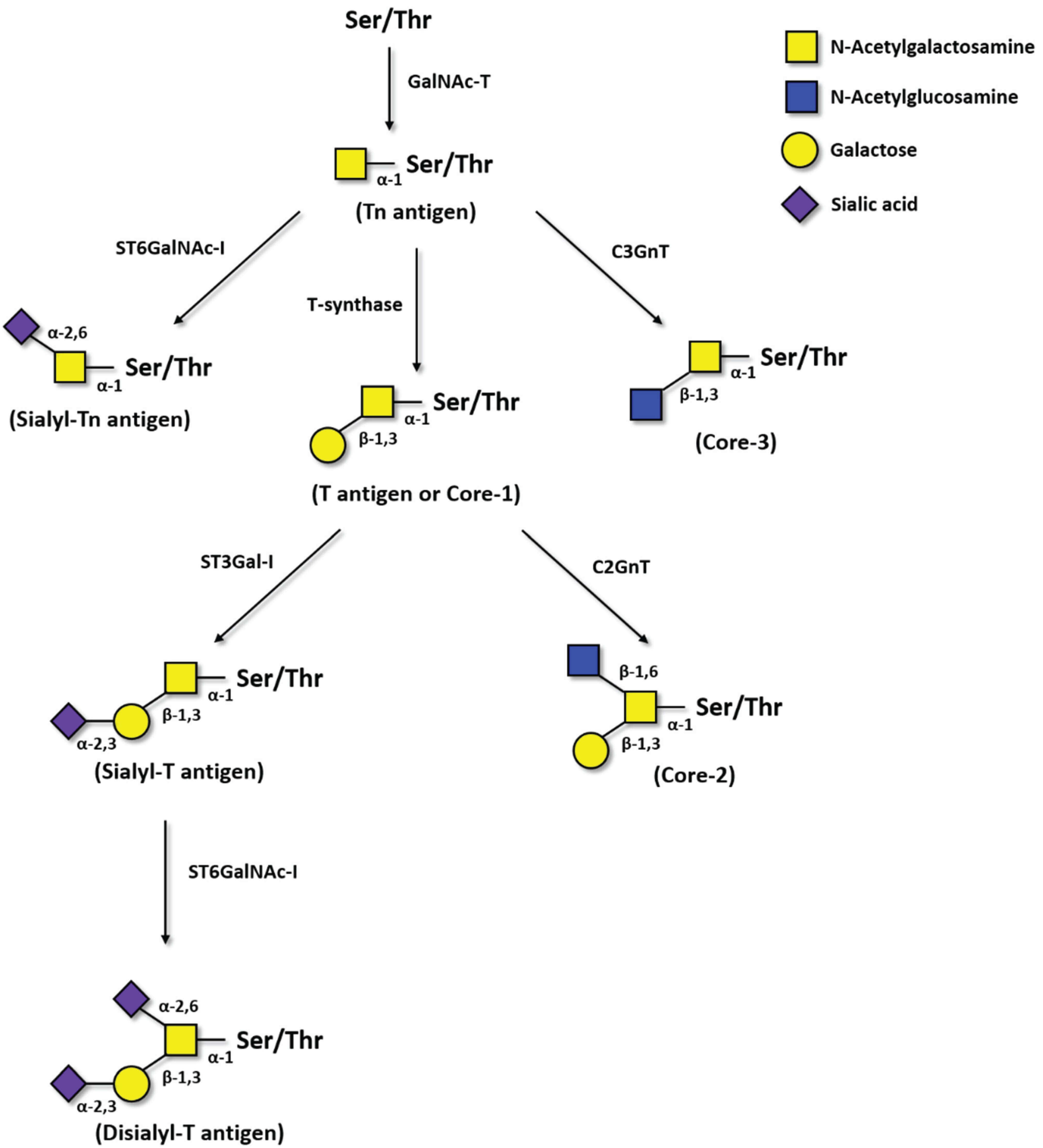
carbohydrate antigens. In mucin-type O-glycosylation, GalNAc is first attached to Ser/Thr to form
Tn; core 1 β3-galactosyltransferase (C1GalT1) can then add galactose to generate the core 1 disaccharide
Galβ1-3GalNAcα-O-Ser/Thr, the TF/T antigen. The review explains that aberrant glycosylation in cancer
produces truncated or otherwise altered glycan structures and can affect processes including cell-cell
adhesion, cell-matrix interaction, proliferation, invasion, and metastasis. It also notes that the
immunological definition of a glycan epitope can be more complex than its chemical structure because some
antibodies recognize carbohydrate together with peptide context. Together, these observations show that O-glycan structure and peptide context can both influence the definition of antibody-recognized
epitopes.
Fig.1 Simplified biosynthetic relationships among Tn, T, sTn, and sialyl-T antigens.1
Plan Your T/sT Antibody Program
Please share whether T, sT, or both are intended targets; the relevant peptide or protein context;
glycosylation sites; structures that must be excluded; available sample models; final assay; and preferred
antibody format. Creative Biolabs will use these parameters to discuss an antigen, screening, and validation
plan aligned with your research question.
Discuss Your T/sT
Antibody Project
Frequently Asked Questions
What is the practical difference between a T-selective and an sT-selective antibody?
A T-selective antibody should recognize the Galbeta1-3GalNAc
core while losing binding when the epitope is sialylated. An sT-selective antibody should require the added
sialic acid in the nominated linkage and context. Because peptide sequence and density can influence both
profiles, matched glycopeptides should be compared under the same assay conditions.
Can one antibody intentionally recognize both T and sT?
Yes, if a cross-reactive profile is scientifically useful and
is defined explicitly during screening. Such a reagent should still be tested against Tn, sTn, unmodified
peptide, and other relevant glycans so its recognition envelope is understood. Broad binding should be
documented as an intended property rather than mistaken for insufficient specificity.
Why must the peptide backbone be included in T/sT project planning?
T and sT are O-glycans attached to serine or
threonine on proteins, and some antibodies contact both the sugar and neighboring amino acids. Changing the
peptide can therefore change binding even when the glycan is identical. A matched peptide series helps
determine whether the desired reagent is glycan-focused or glycopeptide-context selective.
Which counter-targets are normally considered for T/sT screening?
The core panel generally considers T, sT, Tn, sTn, and the
corresponding unmodified peptide. Additional mucin glycopeptides, carrier controls, or related blood-group
structures may be introduced when relevant to the sample. The panel should be broad enough to answer the study
question without implying selectivity against structures that were never tested.
Can T/sT antibodies be validated in cell-adhesion research models?
They can be assessed in cell-based binding or adhesion-related
research when appropriate positive and comparison models are available. Binding qualification should precede
functional interpretation, because an antibody may recognize surface T or sT without altering adhesion.
Functional studies require their own controls, readouts, and model-specific acceptance criteria.
What information helps Creative Biolabs scope a T/sT antibody project?
Please provide the desired T-versus-sT recognition pattern,
glycopeptide or protein context, glycosylation site, counter-targets, biological model, final assay, and
preferred antibody format. Existing antigens or antibodies and any prior cross-reactivity data are also
useful. These inputs allow the screening cascade to reflect the actual adhesion or glycobiology question.
References
Berois, Nora, et al. "Targeting Tumor Glycans for Cancer Therapy: Successes, Limitations, and Perspectives." Cancers 14.3 (2022): 645. Distributed under Open Access license CC BY 4.0, without modification. https://doi.org/10.3390/cancers14030645
Project Inquiry
!For Research Use
Only.Not for clinical or diagnostic use.