


Custom Anti-GM3 Antibody Service for Cancer & Metastasis Studies
GM3 Background
Ganglioside GM3 has been termed as the "entry point" ganglioside. This is in no way an understatement. As the simplest of the ganglioside family with a single sialic acid linked to lactosylceramide, GM3 has several important functions, such as the organization of lipid rafts, modulation of receptor clustering, and tuning of signaling pathways that control cell proliferation, migration, and intercellular communication. In the context of cancer, one specific variant of GM3 is of particular interest to researchers: Neu5Gc-GM3 (NGcGM3). Humans cannot make Neu5Gc naturally, yet it can build up in tumors through dietary incorporation. In fact, it is nearly undetectable in healthy tissues, which makes NGcGM3 a particularly attractive cancer biomarker. Structural insights from the well-studied antibodies 14-F7 and chP3 reveal the depth of the pocket in which the Neu5Gc residue is "locked in", completely excluding Neu5Ac. This level of pocket-mediated recognition is part of what makes GM3 a strong target for cancer immunotherapy and metastasis studies, as well as biologically fascinating. At Creative Biolabs, we use these types of insights to design anti-ganglioside antibodies. With years of glycoimmunology and antibody engineering experience, our team is well-versed in custom antibody design against complex glycans such as GM3. We use antigen design techniques, multi-platform screening, and glycan array specificity mapping in the design process, in order to provide clients with the most specific antibodies possible. For biomarker validation studies, mechanistic analyses, preclinical cancer research, and more, our scientific team and technical support can help speed your research forward. We also provide ready-to-use anti-GM3 antibodies for your quick research.
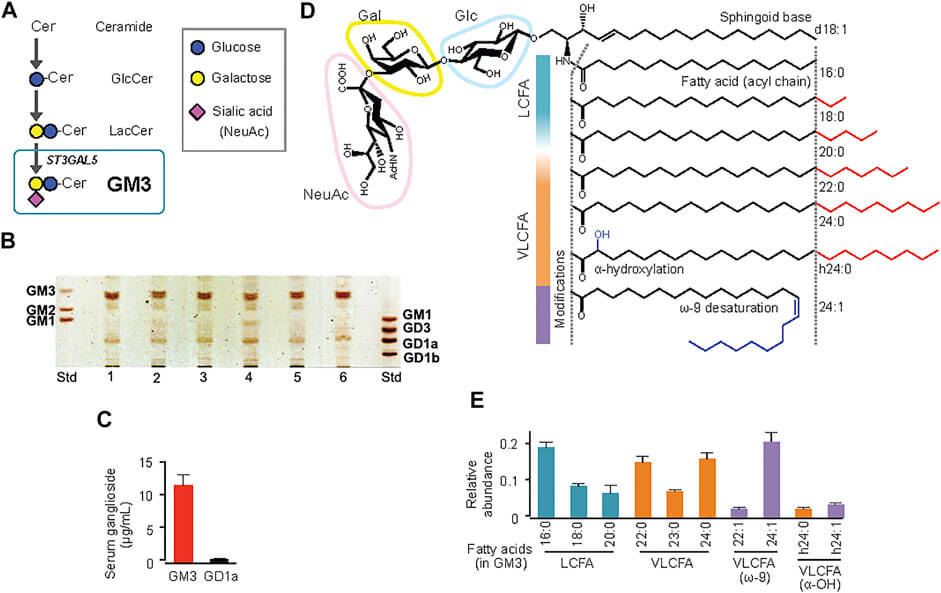 Fig.1 GM3 ganglioside species in serum showing acyl-chain structures.1
Custom Anti-GM3 Antibody Services at Creative Biolabs
We provide end-to-end custom antibody generation against GM3 and its clinically relevant variants (NGcGM3 and NA-GM3), across monoclonal, recombinant, and engineered formats. Programs are built for cancer biomarker discovery, mechanism interrogation, and translational assay development in cancer immunotherapy pipelines. Core modules include immunogen design (synthetic glycan–carrier and liposomal display), discovery by hybridoma/yeast or phage display, multi-tier specificity screening (glycan array, TLC-overlay, cell-based), affinity maturation and humanization, and RUO assay development (IHC/IF, ELISA, FC, SPR/BLI).
GM3 Services Highlights at a glance
- Epitope-focused antigen design delivers GM3 variants in optimized liposomal or carrier-conjugated formats, ensuring antibodies with maximum selectivity.
- Versatile antibody formats are available, including monoclonal, recombinant, and engineered types such as scFv, Fab, and full-length IgG1/IgG4, tailored for oncology-focused RUO studies.
- Integrated discovery platforms combine hybridoma and phage/yeast display technologies, capturing diverse clones with high affinity and specificity.
- Rigorous specificity profiling is performed using glycan arrays, TLC-overlay, and cell-based assays against structurally related gangliosides (GM1, GM2, GD2, GD3, asialo-GM1).
- Deep-pocket recognition strategies are applied, modeled after structural insights from 14-F7 and chP3 antibodies, to achieve precise Neu5Gc discrimination.
- Broad functional applications you can choose for cancer biomarker analysis and cancer immunotherapy research, such as ELISA, IHC/IF, flow cytometry, and SPR/BLI.
- Comprehensive deliverables include antibody sequences, expression vectors, stable cell pools, purified material, and detailed SOPs for seamless integration into client workflows.
What You Receive
- Antibody assets: hybridoma or recombinant clone; sequences; expression vectors; stable pools; small-scale purified RUO antibody.
- Validation package: antigen maps; glycan array graphs; cross-reactivity matrix; binding kinetics; cell-based validation; IHC/IF or FC protocols.
- Transfer docs: SOPs for assay setup; recommended controls; storage & handling.
Speak with our scientists
Ready-to-use anti-GM3 antibodies
Need immediate tools? Explore our ready-to-use anti-GM3 antibodies products and technical datasheets:
-
Mouse Anti-GM3 Monoclonal Antibody (CGYJ074)(CAT#: AGM-200YJ)Online InquiryHost: MouseAntibody Isotype: IgM, κSpecies Reactivity: HumanApplication: TLC-immunostaining, FC, ELISA, IHC
-
Mouse Anti-GM3 Monoclonal Antibody (CGYJ084)(CAT#: AGM-210YJ)Online InquiryHost: MouseSpecies Reactivity: HumanApplication: ELISA
-
Mouse Anti-GM3 Monoclonal Antibody (AGC-0425-QX487)(CAT#: AGC-0425-QX487)Online InquiryHost: MouseAntibody Isotype: IgG2a, κApplication: IHC, ELISA
-
Mouse Anti-GM3 Monoclonal Antibody (AGC-0425-QX493)(CAT#: AGC-0425-QX493)Online InquiryHost: MouseAntibody Isotype: IgG1, κApplication: IHC, WB, ELISA
-
Mouse Anti-GM3 Monoclonal Antibody (AGC-0425-QX500)(CAT#: AGC-0425-QX500)Online InquiryHost: MouseAntibody Isotype: IgG2aApplication: WB, ELISA
Why Choose Creative Biolabs
- Focused expertise. Several years dedicated to glycobiology and anti-ganglioside antibody programs.
- Precision at every step. From antigen design to glycan arrays, our workflow is built to guarantee specificity.
- Cancer-aligned. Services tailored for biomarker discovery and cancer immunotherapy research.
- Seamless support. End-to-end delivery—from concept to validated antibodies with full data packages.
Applications in Oncology
| Use case | Typical question | Recommended assay set |
|---|---|---|
| Tumor profiling | Is GM3/NGcGM3 enriched in this cohort? | IHC/IF with matched normal; array-based specificity; FC on dissociated cells |
| Metastasis studies | Does GM3 correlate with invasive phenotypes? | FC sorting + migration/invasion assays; co-localization with raft markers |
| Mechanism of signaling | Does GM3 alter RTK clustering? | Raft fractionation, co-IP under GM3 modulation |
| Biomarker qualification | Is NGcGM3 a robust readout for my model? | Tissue microarrays, orthogonal antibody clones, glycan array QC |
| Tool development | Can I track GM3-positive exosomes? | EV capture with GM3 antibody; nanoparticle FC and ELISA |
Popular Services You May Be Interested in
- Anti-GM1, Anti-GM2, Anti-GD2/GD3 Antibody Services
- Glycan Microarray Profiling
- Antibody Humanization & Engineering (maintain deep-pocket recognition)
Design a precision GM3 antibody with data that holds up in oncology labs. Share your target and model system—our team will return a tailored plan aligning immunogen chemistry, discovery route, and validation assays to your cancer immunotherapy and cancer biomarker goals. Contact us for further information.
FAQs
How do you ensure selectivity between NGcGM3 and NA-GM3?
We bias immunogens to expose the terminal Neu5Gc or Neu5Ac, then screen on both forms, use glycan arrays to separate binders, and confirm in cells and tissues. Structural literature shows a deep pocket in anti-NGcGM3 clones that disfavors Neu5Ac.
Will the antibody cross-react with GD3 or GM2?
We include ganglioside panels (GM1, GM2, GD3, GD2) and asialo controls in primary screens, followed by array-based mapping. Only clones passing pre-set cross-reactivity thresholds progress to engineering and validation.
Is Neu5Gc-GM3 really tumor-associated in humans?
Yes. Humans cannot produce Neu5Gc, but it can be incorporated from dietary sources. Elevated Neu5Gc-GM3 has been detected in several cancers, including breast cancer and melanoma, while remaining rare in healthy tissues—making it a valuable cancer biomarker.
Can GM3 antibodies be used for metastasis studies?
Absolutely. GM3 has been linked to tumor cell adhesion and invasion. By using antibodies to identify GM3-positive subpopulations, researchers can track how these cells migrate, invade, and contribute to metastatic behavior.
What kind of deliverables do I receive at the end of a project?
We provide more than just antibodies. Clients receive hybridoma or recombinant clones, validated sequences, purified antibody samples, and detailed SOPs covering ELISA, IHC, IF, or flow cytometry—making it easy to continue studies in-house.
Can the antibodies be humanized for translational research?
Yes. We routinely engineer and humanize promising clones while preserving the structural features that enable Neu5Gc-specific recognition. Deliverables include humanized IgG formats with validation data to support further research.
Reference:
- Inokuchi, Jin-ichi, and Hirotaka Kanoh. "Pathophysiological significance of GM3 ganglioside molecular species with a particular attention to the metabolic syndrome focusing on toll-like receptor 4 binding." Frontiers in Molecular Biosciences 9 (2022): 918346. Distributed under Open Access license CC BY 4.0, without modification. https://doi.org/10.3389/fmolb.2022.918346