
Controlling Particle Size Distribution and Stability in Magnetic Liposome Development
A formulation-focused guide to managing PDI increase, aggregation, sedimentation, payload leakage, and magnetic-response variability during magnetic nanoparticle co-loading.
The Challenges in Magnetic Liposome Development
Magnetic liposome development combines lipid vesicles with magnetic nanoparticles, typically iron oxide-based materials, to support magnetically guided delivery, imaging, hyperthermia-related applications, or theranostic formulation design.
For formulation scientists and nanomedicine R&D teams, however, the central challenge is not simply incorporating magnetic components into liposomes. The more difficult task is maintaining a controlled vesicle population after magnetic nanoparticles and therapeutic or imaging payloads are co-loaded.
From a development perspective, the path from conceptual design to scalable production is limited by several biophysical and process-related hurdles. The integration of inorganic nanomaterials with delicate, self-assembling lipid bilayers frequently introduces mechanical stress and alters surface energies.
When researchers attempt co-loading of therapeutic payloads—such as chemotherapeutics, nucleic acids, or diagnostic fluorophores—alongside these metallic cores, the formulations are often plagued by an increased polydispersity index (PDI), particle aggregation, rapid sedimentation, and premature drug leakage.
Impact of Magnetic Nanoparticles on Vesicle Dynamics
Magnetic nanoparticles can influence lipid packing, bilayer rigidity, phase behavior, and payload retention depending on their size, surface chemistry, and localization within the liposome.
Aqueous-core loading
Hydrophilic magnetic nanoparticles are generally retained in the aqueous core, where excessive loading may increase osmotic pressure and promote vesicle deformation. While this can shield magnetic components from the external medium, high concentrations may contribute to swelling, rupture, or payload instability.
Bilayer partitioning
Hydrophobic magnetic nanoparticles may partition into the lipid bilayer and alter membrane fluidity. This arrangement can preserve the aqueous core for water-soluble therapeutic payloads, but embedded solid cores may create localized rigidity within the fluid membrane.
Control coating, loading ratio, and lipid composition together.
Localized rigidity may alter the phase transition temperature (Tm) of the lipid mixture and introduce structural defects into the bilayer. These micro-structural changes may compromise the barrier function of the liposome, leading to increased payload leakage of the co-loaded active pharmaceutical ingredient (API) into the surrounding medium.
Resolving these dynamic instabilities is therefore a primary objective during early-stage formulation screening.
Longitudinal Particle-Size Tracking and Stability Evaluation
Distinguishing between a transiently stable dispersion and a robust, scalable formulation requires longitudinal monitoring rather than a single end-point particle-size measurement.
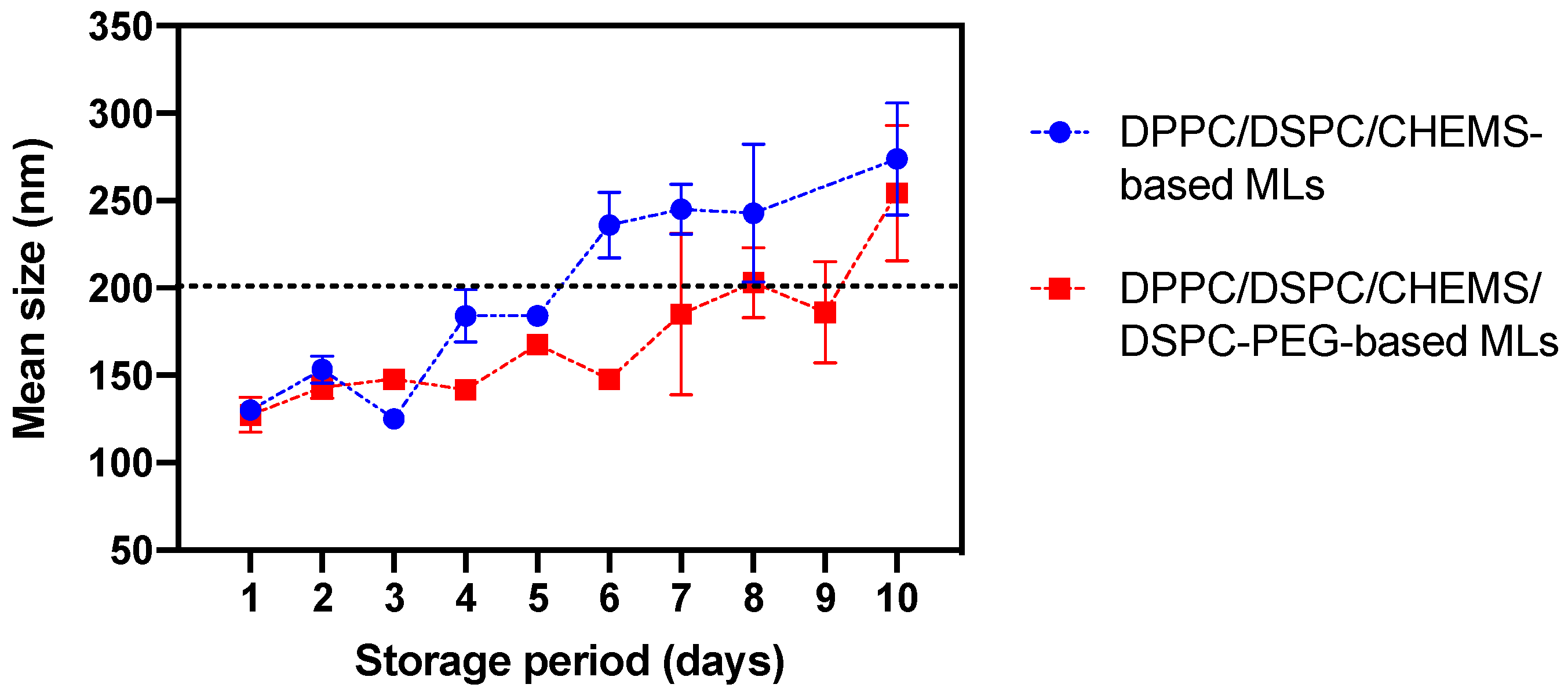
In magnetic liposome development, the integration of magnetic nanoparticles can alter vesicle size, surface charge, and the broader colloidal behavior of the system. Researchers must observe the formulation’s physical characteristics over designated storage periods and under relevant stress conditions.
As demonstrated by Cardoso et al., PEGylated lipids can play an important role in modulating aggregation kinetics. Non-stealth magnetoliposome formulations may exhibit an increase in mean hydrodynamic diameter when van der Waals interactions and magnetic dipole-dipole attractions overcome electrostatic or steric repulsion under certain formulation conditions.
Read size data with a full CQA panel
- Mean particle size and particle-size drift.
- PDI, zeta potential, and visual sedimentation.
- Magnetic separation behavior and magnetic responsiveness.
- Encapsulation efficiency and payload release data.
Conversely, stealth formulations bearing DSPC-PEG can exhibit a more stable size profile through steric hindrance. When size-tracking studies are combined with corresponding PDI, zeta potential, encapsulation efficiency, and payload release data, they provide a more complete matrix for determining whether a magnetic liposome formulation has entered a reproducible and stable development window.
To support researchers in acquiring this critical data, a professional formulation stability monitoring service can support accelerated aging tests, thermal stress evaluations, and release kinetics under controlled conditions.
Key Parameters for Formulation Locking
Establishing a control framework early in the development pipeline helps reduce the risk of late-stage formulation failures. Formulators must consistently track a specific set of Critical Quality Attributes (CQAs) to validate the success of their co-loading strategies.
Rather than applying universal numerical thresholds, magnetic liposome development should define project-specific acceptance criteria based on the intended application, administration route, payload type, and required magnetic function.
| Parameter | Development Focus | Why It Matters |
|---|---|---|
| Mean Particle Size | Define target size based on route of administration, payload type, and magnetic targeting requirements. | Influences circulation, tissue distribution, sedimentation risk, and magnetic-field responsiveness. |
| PDI | Maintain a low and stable PDI during storage and stress testing. | Rising PDI may indicate aggregation, vesicle fusion, nanoparticle redistribution, or formulation instability. |
| Zeta Potential | Interpret together with PEGylation, lipid composition, and steric stabilization. | Electrostatic repulsion can support colloidal stability, but PEGylated systems may remain stable even with near-neutral zeta potential. |
| Encapsulation Efficiency | Optimize separately for magnetic nanoparticles and therapeutic or imaging payloads. | Co-loading may reduce payload retention or alter release behavior. |
| Payload Leakage | Monitor release under storage and biologically relevant conditions. | Leakage indicates reduced bilayer integrity and may compromise dose consistency. |
| Magnetic Responsiveness | Evaluate magnetization, field response, and functional performance after formulation. | Confirms whether magnetic targeting, imaging, separation, or hyperthermia-related functionality is preserved. |
| Sedimentation / Redispersibility | Assess visual sedimentation and redispersion after storage. | Magnetic cores can increase density and promote settling even when mean particle size appears acceptable. |
How to Lock Particle Size Distribution and Stability During Development
A practical magnetic liposome development workflow should use staged formulation gates rather than relying on a single end-point characterization result.
Define the target product profile
Define the intended application, target particle-size range, acceptable PDI, desired magnetic response, payload-loading goal, and storage condition.
Screen lipid and nanoparticle chemistry
Screen lipid composition and magnetic nanoparticle surface chemistry together, because nanoparticle hydrophobicity, coating chemistry, and loading position can affect vesicle formation and bilayer integrity.
Control process parameters
Document lipid-to-nanoparticle ratio, hydration conditions, solvent exchange conditions, mixing rate, extrusion or sonication energy, temperature, and purification method.
Advance only through stability gates
Candidate formulations should pass gates for particle size drift, PDI increase, zeta potential shift, sedimentation, redispersibility, encapsulation efficiency, payload leakage, and magnetic responsiveness over defined storage intervals.
Why this staged approach matters
This staged approach helps identify a reproducible formulation window before scale-up. It also clarifies whether instability originates from nanoparticle dispersion, lipid composition, co-loading conditions, purification, storage stress, or biological exposure.
Engineering Strategies for Superior Formulation Control
To address high PDI, formulation instability, and inconsistent payload retention, development teams should evaluate both manufacturing conditions and formulation composition.
Microfluidic mixing
Microfluidic mixing can improve reproducibility by enabling controlled lipid self-assembly under defined flow conditions. Total flow rate, flow-rate ratio, lipid concentration, solvent composition, and nanoparticle-to-lipid ratio can be screened systematically to reduce size-distribution variability.
Surface engineering
Coatings such as oleic acid, citric acid, dextran, silica, PEG, or other functional layers can change nanoparticle hydrophobicity, surface charge, dispersibility, and compatibility with lipid membranes.
Lipid composition
Cholesterol and functionalized lipids can help modulate membrane fluidity, reduce bilayer permeability, and support payload retention when magnetic nanoparticles are incorporated.
Conventional techniques, such as thin-film hydration followed by probe sonication or mechanical extrusion, may yield variable results when applied to complex magnetic liposomes. High mechanical shear forces generated during extrusion can expel enclosed magnetic nanoparticles from lipid vesicles or lead to heterogeneous distribution of theranostic payloads across the liposome population.
However, downstream purification, solvent removal, and scale-up validation remain essential for confirming formulation robustness. To synthesize the ideal balance of structural lipids, functionalized lipids, and steric stabilizers, advanced liposome formulation optimization pipelines can apply Design of Experiments (DoE) frameworks to identify lipid ratios that accommodate magnetic nanoparticles without sacrificing payload integrity.
Biological Evaluation and Stability Confirmation
Accelerate Your Magnetic Liposome Development ServiceFor magnetic liposomes intended for biological evaluation, formulation stability must be confirmed beyond standard storage conditions. Serum proteins, ionic strength, dilution, and physiological temperature can alter surface properties, promote protein-corona formation, accelerate payload leakage, or reduce magnetic responsiveness.
Candidate formulations should be evaluated in biologically relevant media when appropriate, with attention to particle-size drift, PDI changes, aggregation, release behavior, and magnetic performance after exposure.
Frequently Asked Questions
Particle size distribution affects circulation behavior, tissue distribution, sedimentation risk, and magnetic-field responsiveness. A low and stable PDI indicates a more uniform vesicle population, which is important for reproducible loading, release, and biological performance. In magnetic liposome development, broad size distribution may also indicate nanoparticle aggregation or uneven magnetic material incorporation.
Magnetic nanoparticles may change lipid packing, membrane rigidity, or bilayer fluidity depending on their surface chemistry and location within the liposome. These effects can increase membrane permeability and promote payload leakage during storage or under physiological stress conditions.
Aggregation can be driven by magnetic dipole-dipole attraction, van der Waals forces, insufficient surface stabilization, or poor nanoparticle dispersion before liposome formation. Common mitigation strategies include nanoparticle surface coating, PEGylated or charged lipid incorporation, optimized lipid-to-nanoparticle ratio, controlled processing conditions, and stability testing under storage and dilution conditions.
Microfluidics is often preferred because it allows better control over mixing conditions, flow-rate ratio, lipid concentration, and nanoparticle-to-lipid ratio. This can improve reproducibility and reduce size variability compared with some conventional methods. However, extrusion, sonication, and microfluidics should all be evaluated based on the specific lipid composition, payload type, and scale-up requirements.
Yes. Our comprehensive development framework includes stability monitoring services. We track critical quality attributes such as particle size, PDI, zeta potential, encapsulation efficiency, payload leakage, and magnetic responsiveness over extended periods and under varying stress conditions to support a scalable development window.
Reference
- Cardoso, B. D., et al. "Magnetoliposomes with calcium-doped magnesium ferrites anchored in the lipid surface for enhanced DOX release." Nanomaterials 13.18 (2023): 2597. https://doi.org/10.3390/nano13182597
Image credit: Figure reproduced under the Creative Commons Attribution 4.0 International License (CC BY 4.0), without modification.
Online Inquiry
This site is protected by reCAPTCHA and the Google Privacy Policy and Terms of Service apply.