
Ultrasound-Responsive Liposome Development:
From Trigger Thresholds to Reproducible Release Validation
A practical guide for formulation scientists and drug delivery teams to define trigger thresholds, minimize premature leakage, preserve liposome integrity before activation, and validate reproducible release across batches in ultrasound-responsive liposome development.
Bridging the Gap: The Promise and Pain Points
In ultrasound-responsive liposome development, the key question is not simply whether a formulation can release drug after sonication. The real development challenge is whether the release can be activated within a defined acoustic window, remain minimal before ultrasound exposure, and be reproduced across independent batches. For pharmaceutical, biotech, and academic teams, this requires an integrated strategy that connects lipid composition, acoustic parameter mapping, structural characterization, and release kinetics validation.
Without clear trigger-threshold data, even a promising ultrasound-sensitive liposome may be difficult to advance into preclinical development. A formulation that releases too easily may show premature leakage during storage or circulation, while a formulation that is too stable may require ultrasound conditions that are impractical or unsafe. Therefore, successful development depends on balancing acoustic responsiveness with pre-trigger structural stability and generating repeatable data under calibrated ultrasound exposure conditions.
Partnering with experts can significantly accelerate your pipeline. Creative Biolabs offers comprehensive Ultrasound-Responsive Liposome Development services, guiding formulation scientists from initial lipid screening to rigorous in vitro and in vivo functional validation.
Ultrasound-Responsive Liposome Development Validation Workflow
A robust validation workflow should evaluate ultrasound-responsive liposomes from both formulation and acoustic perspectives. Instead of treating ultrasound exposure as a simple release trigger, development teams should define the formulation’s response profile across a controlled acoustic parameter space and compare triggered release with matched non-triggered controls.
1. Define Use Scenario
Clarify payload type, target tissue, intended ultrasound modality, and acceptable exposure conditions.
2. Screen Lipid Composition
Optimize phospholipid, cholesterol, PEG-lipid, and sonosensitive component ratios for stability and responsiveness.
3. Measure Baseline Leakage
Evaluate drug retention during storage, serum incubation, and 37°C exposure before ultrasound activation.
4. Map Trigger Thresholds
Generate release curves across frequency, intensity, pressure, duty cycle, PRF, and exposure time.
5. Confirm Reproducibility
Compare release profiles, particle attributes, and post-sonication integrity across independent batches.
Mechanisms of Acoustic Triggering
- Thermal Effects: Focused ultrasound can generate localized heating, which increases membrane permeability when thermosensitive lipid components approach their phase transition range. During development, this mechanism should be evaluated by correlating temperature rise, exposure time, and fractional drug release, rather than by reporting ultrasound exposure alone.
- Acoustic Cavitation: Stable or inertial cavitation can create mechanical stress that transiently disrupts the lipid bilayer and promotes payload release. Because cavitation behavior is highly dependent on acoustic pressure, frequency, gas nuclei, and sample geometry, validation should include controlled acoustic setup documentation and appropriate sham-exposure controls.
- Radiation Forces: Acoustic radiation forces may influence particle distribution, local accumulation, or tissue interaction before release. For preclinical studies, this effect should be distinguished from true triggered release by comparing ultrasound-exposed, non-exposed, and formulation-only controls.
Key Development Risks That Must Be Validated
Premature Leakage vs. Acoustic Sensitivity
High acoustic sensitivity is only useful when baseline leakage remains low under storage, serum, and physiological-temperature conditions. Development should therefore compare triggered release with matched non-triggered leakage to calculate an activation ratio.
Payload Retention and Release Efficiency
Different payloads, such as small molecules, proteins, nucleic acids, or imaging agents, may alter liposome stability and ultrasound response. Encapsulation efficiency should be evaluated together with retention, triggered release percentage, and post-release payload integrity.
Batch-to-Batch Consistency
Minor changes in size distribution, lamellarity, lipid composition, or residual solvent may shift the acoustic response profile. Reproducibility testing should compare independent batches under the same calibrated ultrasound conditions.
Establishing Trigger Thresholds in Ultrasound-Responsive Liposome Development
A common pitfall in ultrasound-responsive liposome development is treating ultrasound as a simple on/off trigger. In practice, release is usually governed by a threshold-dependent response. Below the activation window, the formulation may retain most of its payload; above that window, release may increase sharply, but excessive acoustic energy may compromise tissue safety, liposome integrity, or payload activity.
Critical FUS Parameters include:
- Acoustic Intensity (W/cm²): Dictates the magnitude of thermal heating and the probability of inertial cavitation.
- Frequency: Influences ultrasound penetration depth, cavitation behavior, and energy deposition.
- Peak Negative Pressure: A key parameter for evaluating cavitation-related release mechanisms.
- Pulse Repetition Frequency (PRF): Determines the cooling interval between acoustic bursts, allowing for fine-tuning of the thermal dose.
- Duty Cycle (%): The ratio of 'on' time to total time. Lower duty cycles promote mechanical disruption while minimizing bulk heating.
- Temperature Rise: Essential for distinguishing thermally driven release from mechanically induced release.
- Acoustic Field Uniformity: Should be assessed to reduce variability caused by sample position or standing waves.
- Exposure Time: The total duration of sonication required to achieve the desired fractional release.
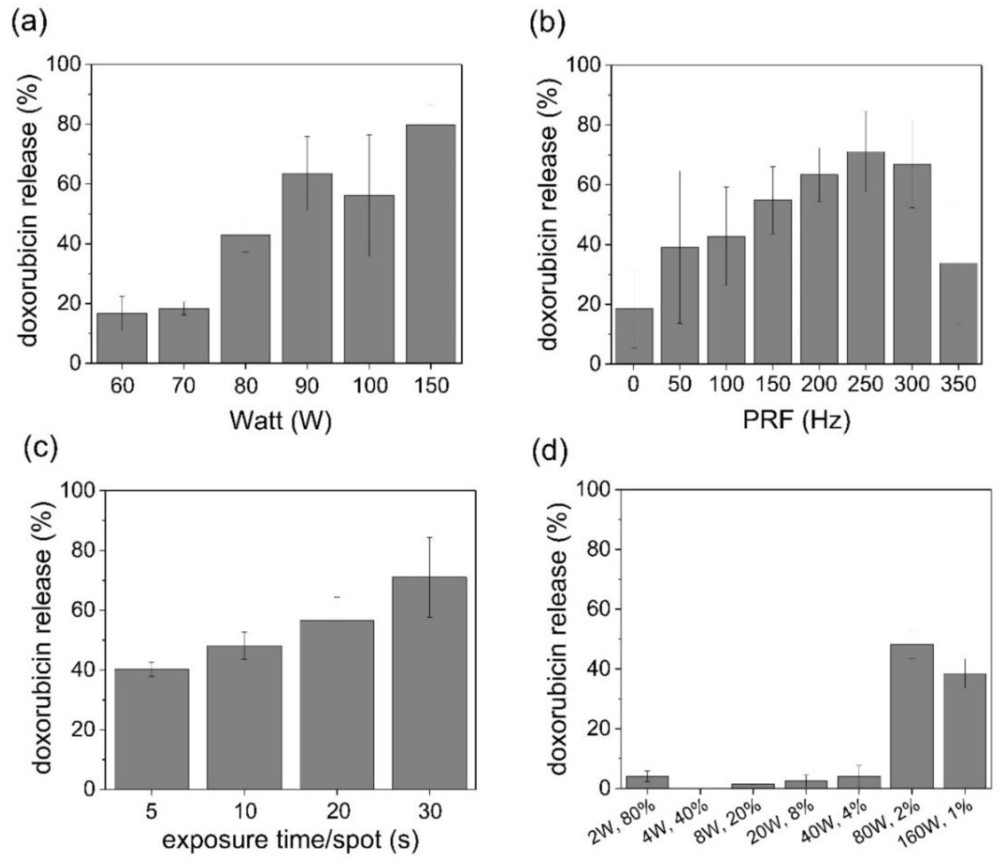
Parameter-dependent release profiling helps identify the acoustic window in which ultrasound-responsive liposomes show efficient drug release while maintaining low non-triggered leakage. Instead of relying on a single ultrasound setting, formulation teams should generate release curves across multiple combinations of intensity, duty cycle, pulse repetition frequency, and exposure time. This approach supports trigger-threshold definition, formulation comparison, and batch-to-batch reproducibility assessment.
Balancing Structural Stability, Baseline Leakage, and Triggered Release
The ultimate success of an ultrasound-responsive formulation hinges on its stealth and stability in vivo prior to reaching the target site. Formulations designed to be highly sensitive to acoustic disruption often suffer from poor shelf-life and high rates of premature drug leakage in serum environments. This is due to the inherent fluidity required in the lipid bilayer to respond to low-energy mechanical or thermal stimuli.
To combat this, formulation scientists utilize several advanced engineering strategies. Incorporating PEGylated lipids (e.g., DSPE-PEG2000) creates a steric hydration shell that not only prevents opsonization and reticuloendothelial system (RES) clearance but also acts as a dampening layer that stabilizes the membrane against minor physiological shear stresses. Furthermore, cholesterol content should be carefully optimized to regulate membrane fluidity and payload retention. While cholesterol can improve bilayer rigidity and reduce passive leakage, excessive cholesterol may dampen thermosensitive behavior or reduce ultrasound-triggered release efficiency. Therefore, cholesterol optimization should be treated as a formulation-specific design variable rather than a fixed target range.
Confirming this stability requires sophisticated analytical workflows. Rigorous Formulation Analysis & Characterization is essential to evaluate size distribution, zeta potential, lipid oxidation states, and serum stability profiles over time. High-performance liquid chromatography (HPLC) coupled with dynamic light scattering (DLS) is routinely employed to ensure that the liposomes retain both their structural integrity and their payload under simulated physiological conditions.
Key Stability Indicators
- Particle Size / PDI Project-defined range
- Baseline Leakage Low under matched controls
- Triggered / Baseline Ratio High activation contrast
- Post-Sonication Integrity No severe aggregation
- Payload Retention Stable before activation
Acceptance criteria should be defined according to payload type, intended route of administration, ultrasound modality, and development stage.
Validating Reproducibility and Release Kinetics
For CMC/analytical development teams, demonstrating lot-to-lot consistency is the most demanding aspect of ultrasound-responsive liposome scale-up. Because the release mechanism is a complex interplay of material science and applied physics, standard dissolution testing is insufficient.
| Analytical Goal | Key Metric | Validation Method | Control or Acceptance Focus |
|---|---|---|---|
| Baseline Stability | Spontaneous leakage at 37°C or in serum | HPLC / fluorescence / dialysis | No-ultrasound and sham-exposure controls |
| Acoustic Sensitivity | Minimum ultrasound setting required for target release | Acoustic dose-response assay | Triggered release vs. baseline leakage |
| Trigger Threshold Mapping | Release across parameter matrix | Calibrated transducer and hydrophone mapping | Defined acoustic activation window |
| Structural Integrity Post-US | Size, PDI, morphology, aggregation | DLS, cryo-EM, TEM, SEC | No unacceptable aggregation or payload degradation |
| Batch-to-Batch Consistency | Comparable release curves | Same ultrasound setup across independent lots | Lot-to-lot reproducibility |
| Payload Integrity | Drug or biologic activity after release | HPLC, LC-MS, bioassay, fluorescence assay | Released payload remains functional |
Reliable release validation requires a controlled acoustic exposure system. Standard laboratory ultrasonic cleaning baths are generally unsuitable for quantitative trigger-threshold studies because standing waves, uneven energy distribution, uncontrolled temperature rise, and variable sample positioning can introduce substantial variability. For reproducible data generation, the ultrasound setup should document transducer type, frequency, pressure or intensity, duty cycle, exposure time, sample geometry, temperature monitoring, and calibration method.
Learn more about our Formulation Stability Monitoring ServiceFrequently Asked Questions
The trigger threshold is defined by mapping drug release across a controlled acoustic parameter space, including frequency, intensity or pressure, duty cycle, pulse repetition frequency, and exposure time. A useful threshold should distinguish efficient ultrasound-triggered release from low baseline leakage under no-ultrasound or sham-exposure conditions.
Preventing leakage requires rigorous optimization of the lipid composition, primarily by adjusting the cholesterol content and the degree of PEGylation. While cholesterol improves bilayer rigidity and reduces permeability at 37°C, it must be carefully calibrated to avoid suppressing the liposome's responsiveness to thermal or mechanical triggers. Furthermore, confirming robust encapsulation involves strict in vitro serum stability assays, measuring drug retention over 24-48 hours using HPLC and dialysis methods to simulate systemic transit.
Reproducibility should be supported by comparable physicochemical attributes, baseline leakage profiles, trigger-threshold curves, and post-sonication integrity data across independent formulation batches. The same calibrated ultrasound setup and analytical methods should be used to reduce variability caused by acoustic field differences or sample positioning.
Creative Biolabs can support ultrasound-responsive liposome projects from formulation screening and characterization to in vitro release testing, stability monitoring, and preclinical study design support. Depending on project requirements, customized validation workflows can be developed to evaluate biodistribution, localized release, and therapeutic response under defined ultrasound conditions.
References
- Kim, Yoon-Seok, et al. "Ultrasound-responsive liposomes for targeted drug delivery combined with focused ultrasound." Pharmaceutics 14.7 (2022): 1314. https://doi.org/10.3390/pharmaceutics14071314
- Under Open Access license CC BY 4.0, without modification.
Online Inquiry
This site is protected by reCAPTCHA and the Google Privacy Policy and Terms of Service apply.