Liposome Characterization Service Guide
How to Choose the Right Liposome Characterization Service for Your Formulation
A practical resource for selecting DLS, NTA, zeta potential, encapsulation efficiency, and morphology analysis without overspending on tests that do not match your formulation stage.
Fast Selection Logic
- DLS/PDI: rapid size and uniformity screen
- Zeta potential: colloidal stability and surface charge
- NTA: particle-by-particle concentration and heterogeneity
- EE/DL: payload incorporation and loading efficiency
- TEM/Cryo-TEM: morphology confirmation for lead candidates
Start with the Formulation Question, Not the Assay List
A liposome characterization service should answer the next decision you need to make. During early screening, the priority is usually to compare batches quickly: are the particles within the target size range, is the distribution acceptable, and does the surface charge suggest reasonable colloidal stability? At this stage, DLS, PDI, and zeta potential can often provide enough information to remove weak candidates before paying for more detailed testing.
When a drug, nucleic acid, peptide, protein, or imaging agent has been incorporated, the question changes. The team must confirm encapsulation efficiency, drug loading, and the relationship between particle properties and payload performance. For this stage, the most economical approach is usually a combined physicochemical and loading package rather than isolated assays ordered one by one.
If you need a concise baseline panel, Creative Biolabs provides lipid-based basic characterization service options that can be used for rapid formulation screening before more expensive morphology or stability studies are added.
Cost and Time Rule of Thumb
Choose the smallest assay set that can support your next go/no-go decision:
- Screening: DLS/PDI + zeta potential
- Loaded candidates: add EE/DL and release testing
- Lead confirmation: add TEM or Cryo-TEM morphology
- Stability claims: add time-point monitoring under defined storage or stress conditions
What Each Liposome Characterization Method Tells You
DLS, NTA, zeta potential, encapsulation efficiency, and morphology are complementary. The best package is not the most comprehensive one; it is the one that reduces uncertainty at the lowest cost for your formulation stage.
| Method | Primary Output | Best Used For | When to Skip or Delay |
|---|---|---|---|
| DLS/PDI | Hydrodynamic size and population width | Fast batch comparison, screening, and aggregation risk | Do not rely on it alone for mixed or very heterogeneous samples |
| NTA | Particle-by-particle size profile and concentration | Heterogeneity checks, dilution behavior, and particle number estimates | Delay if DLS shows clean, early-stage trends and concentration is not needed |
| Zeta Potential | Apparent surface charge | Colloidal stability, ligand modification, and formulation comparison | Avoid overinterpreting it without buffer, pH, and ionic strength context |
| EE/DL | Encapsulation efficiency and drug loading | Drug-loaded liposomes, candidate ranking, and dose planning | Not essential for empty liposomes or blank excipient screens |
| TEM/Cryo-TEM | Morphology, lamellarity clues, and visible aggregation | Lead confirmation, publication support, and troubleshooting | Often unnecessary for every screening batch |
Choose the Most Efficient Package by Project Stage
Minimum Reliable Panel
Use DLS/PDI and zeta potential to compare particle size, distribution, and charge. This is the fastest route when many lipid ratios or process conditions must be screened.
Recommended: DLS + PDI + zeta potential
Payload-Aware Panel
Add encapsulation efficiency and drug loading when the payload is part of the decision. A formulation with ideal size but poor loading is usually not worth advancing.
Recommended: DLS + zeta + EE/DL + release profile
Decision-Ready Panel
Add NTA and morphology when you need stronger evidence for a lead formulation, especially before animal studies, manuscript preparation, tech transfer, or extended stability work.
Recommended: DLS + NTA + zeta + EE/DL + TEM
A Literature-Based Example of Assay Combination
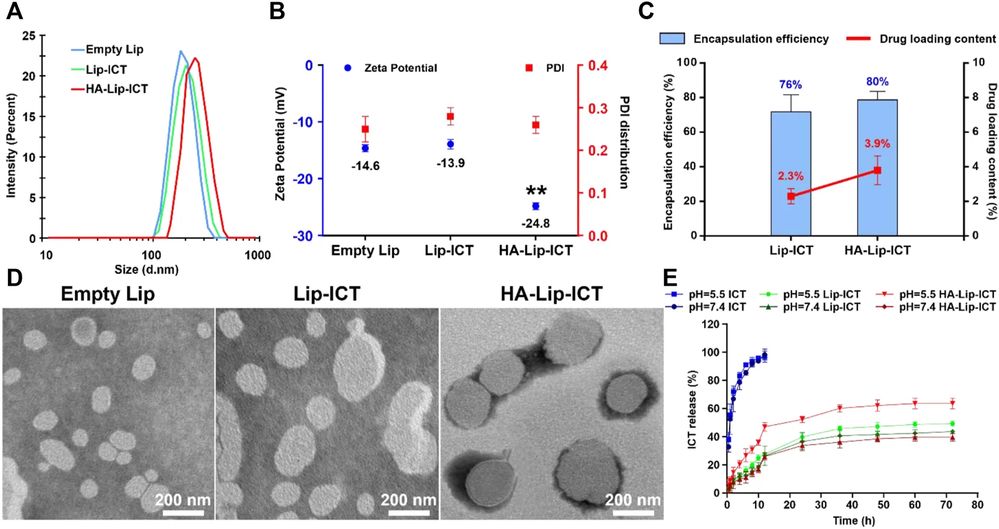
The referenced 2024 Frontiers in Pharmacology article on hyaluronic-acid-modified icaritin liposomes illustrates why assay combination matters. The study used hydrodynamic size distribution, zeta potential and PDI, encapsulation efficiency and drug loading, TEM morphology, and release profiling to connect formulation structure with payload incorporation and biological performance.
The key lesson for project managers is not to order every method automatically. For blank liposome optimization, DLS/PDI and zeta potential may be sufficient. For drug-loaded candidates, EE/DL becomes essential because it confirms whether the payload is incorporated at a useful level. For a final lead formulation, TEM adds visual evidence of morphology, while release testing helps interpret how the formulation may behave before in vitro, ex vivo, or in vivo evaluation.
If lipid ratios, surface modification, or structural composition are uncertain, Creative Biolabs also supports structure and composition analysis to help relate formulation design to measured performance.
A Practical Workflow for Faster Liposome Characterization
For most research teams, the economical path is staged characterization. First, eliminate unstable or off-size batches. Second, quantify payload loading. Third, confirm morphology and stability only for candidates that justify the additional time and cost.
When Speed Is the Priority
Choose a DLS/PDI and zeta potential panel when you are comparing preparation methods, extrusion settings, lipid ratios, hydration conditions, or buffer systems. This panel is suitable for formulation screening and short iteration cycles.
- Fast readout for size and batch uniformity
- Useful for formulation optimization and troubleshooting
- Lower cost than morphology-heavy packages
When Decision Confidence Is the Priority
Choose a broader package when the candidate is payload-loaded, surface-modified, intended for preclinical evaluation, or being used to support publication-quality data. Add NTA for particle concentration and TEM when visual morphology is needed.
- Stronger evidence for drug-loaded liposomes
- Better support for stability and release interpretation
- Useful before in vivo study design or lead selection
Need a customized assay combination?
Share your formulation stage, payload type, and decision goal. A tailored liposome characterization service package can help reduce repeat testing and turnaround time.
Frequently Asked Questions
For early screening, DLS/PDI plus zeta potential is usually the most cost-effective starting point. It provides rapid information on hydrodynamic particle size, distribution width, and surface charge, which are often enough to compare lipid ratios, process conditions, and buffer systems before investing in NTA, encapsulation efficiency, drug loading, release, or TEM morphology.
Add NTA when particle concentration, heterogeneity, or particle-by-particle size distribution is important. DLS is efficient for routine screening, but it is intensity-weighted and can be influenced by larger particles. NTA is useful when samples contain mixed populations or when particle number supports dose, dilution, or comparability decisions.
Yes, for meaningful candidate ranking. Size and zeta potential can show whether a formulation is physically acceptable, but they do not confirm how much payload is incorporated. Encapsulation efficiency and drug loading are essential when evaluating dose feasibility, formulation loss, release behavior, or readiness for in vitro and in vivo testing.
TEM is not necessary for every screening batch. It is more useful for lead confirmation, morphology troubleshooting, publication support, or when DLS/NTA results suggest unexpected aggregation or heterogeneity. Delaying TEM until after initial DLS, zeta, and loading results can save both cost and time.
For stability, select assays that can be repeated across time points. DLS/PDI and zeta potential are useful for tracking aggregation and charge shifts, while EE/DL and release testing are important for loaded formulations. Morphology can be added at selected time points when structural change or visible aggregation needs confirmation.
References
- Sun, Xiaoduan, et al. "Hyaluronic acid-modified liposomes Potentiated in vivo anti-hepatocellular carcinoma of icaritin." Frontiers in Pharmacology 15 (2024): 1437515. https://doi.org/10.3389/fphar.2024.1437515
- Under Open Access license CC BY 4.0, without modification.
Online Inquiry
This site is protected by reCAPTCHA and the Google Privacy Policy and Terms of Service apply.