
Liposome Characterization Resource
How Lipid Ratio, Cholesterol, and PEG-Lipid Composition Shape Liposome Performance
A composition-aware liposome characterization resource for understanding how lipid ratio, cholesterol content, and PEG-lipid design influence membrane structure, formulation stability, drug loading, release behavior, and delivery performance.
Why Routine Liposome Characterization Data May Not Explain Formulation Failure
Routine liposome characterization measurements such as particle size, PDI, zeta potential, and encapsulation efficiency can confirm whether a formulation meets basic specifications, but they often do not explain why a liposome candidate fails. When researchers observe premature drug leakage, low loading capacity, unstable release, poor storage stability, or batch-to-batch variability, the root cause is frequently linked to composition-level factors, including phospholipid ratio, cholesterol incorporation, PEG-lipid molar percentage, and how these components organize the bilayer.
Liposome characterization becomes more decision-ready when structural readouts are interpreted together with formulation composition. The ratio between phospholipids, charged lipids, helper lipids, cholesterol, and PEG-lipid affects bilayer packing, membrane rigidity, surface hydration, steric stabilization, permeability, and protein interactions in in vitro, ex vivo, and in vivo evaluation settings. These variables do not operate independently. A small change in cholesterol may improve membrane order but also alter drug partitioning; an increase in PEG-lipid can suppress aggregation while reducing cell association.
Creative Biolabs provides composition-aware liposome characterization and liposome structure and composition analysis service to help formulation teams connect lipid composition with measurable performance outcomes. By integrating lipid ratio assessment, cholesterol content evaluation, PEG-lipid analysis, stability testing, release profiling, and structure-function interpretation, our team helps identify formulation failure mechanisms, compare candidate liposomes, and support evidence-based optimization before downstream development.
What Composition-Aware Liposome Characterization Can Reveal
For formulation scientists and analytical development teams, the value of liposome characterization lies not only in generating data, but in explaining formulation behavior. A composition-aware workflow can help determine whether performance issues are driven by lipid ratio, cholesterol content, PEG-lipid design, payload-lipid interaction, or instability under storage and handling conditions.
Identify Leakage Mechanisms
Determine whether premature drug release is associated with membrane permeability, insufficient cholesterol incorporation, phase behavior, or payload-lipid mismatch.
Explain Low Loading Capacity
Evaluate whether lipid composition, drug-to-lipid ratio, bilayer organization, or cholesterol level is limiting encapsulation efficiency and payload retention.
Assess PEG-Lipid Balance
Analyze whether PEG-lipid percentage, anchor design, or PEG chain length supports colloidal stability while maintaining the desired biological interaction.
Rank Candidate Formulations
Compare structure, composition, stability, release behavior, and functional performance to identify the most promising liposome candidate for further development.
How Key Composition Variables Influence Liposome Characterization Results
Composition is not only a recipe. It is a design language that determines how a liposome membrane packs, protects cargo, interacts with biological media, and releases payload under stress.
| Composition Variable | Structural Impact | Performance Readout | Common Troubleshooting Signal | Recommended Analytical Focus |
|---|---|---|---|---|
| Phospholipid ratio | Controls bilayer phase behavior, packing density, and transition temperature. | Encapsulation efficiency, particle integrity, and release kinetics. | Low loading, broad PDI, or temperature-sensitive leakage. | Lipid molar ratio confirmation, lipid composition analysis, phase transition assessment, drug-to-lipid ratio correlation. |
| Cholesterol content | Modulates membrane rigidity, permeability, bilayer thickness, and lipid chain order. | Storage stability, serum resistance, and premature drug release control. | Excessive leakage, brittle membranes, or reduced loading window. | Cholesterol-to-phospholipid ratio, bilayer rigidity, leakage tendency, storage stability, serum or dilution stress response. |
| PEG-lipid design | Creates a hydrated steric layer that alters aggregation, surface exposure, and corona formation. | Colloidal stability, circulation behavior, and cell interaction. | Poor uptake, rapid clearance, or instability after dilution. | PEG-lipid mol%, PEG chain length, lipid anchor type, surface shielding, dilution stability, aggregation tendency, cell interaction. |
| Charged or functional lipids | Adjust surface potential, electrostatic interactions, and ligand presentation. | Target binding, payload retention, and compatibility with biological matrices. | Aggregation, nonspecific binding, or inconsistent bioactivity. | Surface charge, ligand presentation, electrostatic interaction, serum compatibility, target binding, nonspecific adsorption. |
When these variables are evaluated as a system, liposome characterization can move beyond pass/fail measurement and become a practical formulation optimization tool. For early projects, Creative Biolabs also provides liposome formulation development service support to help define a rational composition matrix before extensive analytical testing begins.
A Practical Characterization Workflow for Structure-Function Mapping
A strong liposome characterization plan integrates orthogonal methods rather than relying on a single data point. Size distribution and PDI indicate colloidal uniformity, while zeta potential gives a surface-level charge readout. Composition analysis, release profiling, stress stability studies, and structural interpretation help connect those numbers to the actual bilayer organization that controls performance.
The workflow should be designed around the question that matters most to the project: why does a formulation leak, aggregate, underload, release too quickly, or behave differently across batches? For many liposome programs, the answer emerges only when lipid composition, cholesterol level, PEG-lipid design, and payload behavior are compared side by side.
This integrated strategy also supports decisions about formulation redesign, release method development, and stability planning. When a candidate requires longer-term performance evidence, Creative Biolabs can extend characterization into liposome stability monitoring service studies under formulation-relevant conditions.
Recommended Analytical Layers
Composition confirmation
Lipid ratio, cholesterol-to-phospholipid ratio, PEG-lipid mol%, drug-to-lipid ratio, and payload association using suitable chromatographic or lipid analysis methods.
Colloidal and surface profiling
Particle size, PDI, zeta potential, aggregation tendency, dilution response, and surface behavior in formulation-relevant buffers or biological media.
Structural interpretation
Bilayer organization, membrane packing, lamellarity, payload localization, cholesterol-driven membrane ordering, and PEG-lipid surface shielding where applicable.
Functional correlation
Encapsulation efficiency, release kinetics, leakage under stress, storage stability, serum compatibility, uptake behavior, and bioactivity correlation.
Typical Deliverables from a Composition-Aware Characterization Study
- Composition profile: lipid ratio, cholesterol content, PEG-lipid level, and drug-to-lipid ratio.
- Structure-function matrix: comparison of formulation composition, particle properties, stability, and release behavior.
- Failure mechanism interpretation: possible links between composition variables and leakage, low loading, aggregation, or batch variability.
- Candidate ranking: evidence-based comparison of liposome formulations for further optimization or development.
- Optimization recommendations: suggested next steps for lipid ratio adjustment, cholesterol tuning, PEG-lipid redesign, or stress testing.
Literature Insight: Cholesterol Content Can Reshape PEGylated Liposome Bilayer Structure
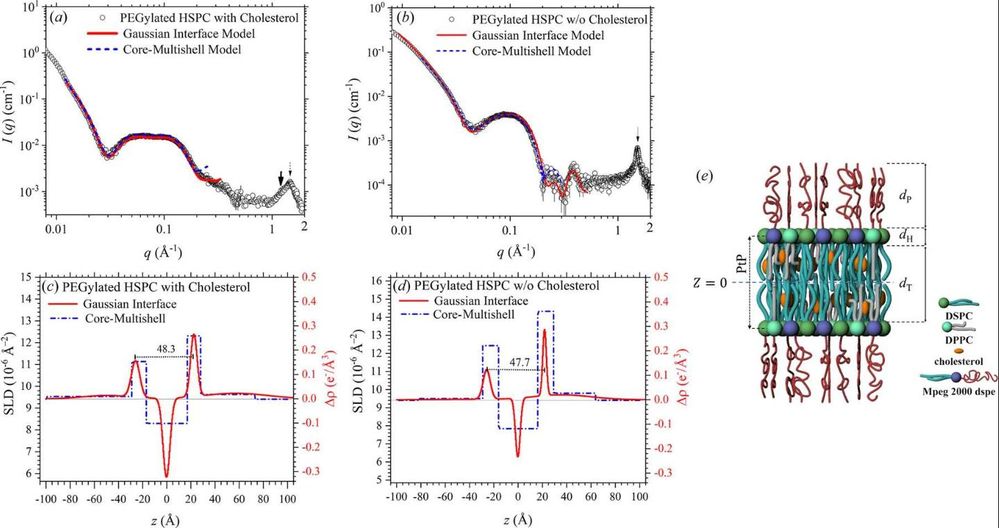
An open-access literature example illustrates how composition-level changes can be translated into measurable structural readouts during liposome characterization. In PEGylated HSPC liposomes, cholesterol was evaluated using AF4-MALS together with simultaneous small- and wide-angle X-ray scattering. The study shows that cholesterol can alter phospholipid chain packing and bilayer architecture, with changes observed in liposome size, bilayer thickness, and head-to-head distance.
The practical message for formulation teams is clear: lipid ratio, cholesterol content, and PEG-lipid design should not be treated as isolated formulation choices. Cholesterol can stiffen or reorganize a membrane, PEGylation can create a hydrated outer layer, and the base phospholipid composition can determine whether these changes improve or compromise the final product profile.
For formulation teams, the practical value of these findings is that composition changes should be interpreted together with structural and functional readouts. When cholesterol, PEG-lipid, and phospholipid ratio are evaluated as an integrated system, liposome characterization data can better support troubleshooting, formulation comparison, and rational optimization decisions.
From Characterization Data to Formulation Optimization
The most useful characterization output is not just a report. It is an evidence-based roadmap for improving the formulation. Creative Biolabs can help translate analytical findings into a practical optimization plan for liposome-based drug delivery systems.
Diagnose Failure Mechanisms
Map poor stability, premature leakage, low encapsulation efficiency, or variable release behavior to likely composition drivers such as lipid ratio imbalance, suboptimal cholesterol incorporation, PEG-lipid desorption, or payload-lipid incompatibility.
Prioritize Formulation Adjustments
Use characterization data to guide targeted adjustment of phospholipid ratio, cholesterol content, PEG-lipid mol%, surface charge, and drug-to-lipid ratio instead of relying on broad trial-and-error screening.
Build a Development-Ready Data Package
Generate a structured data package that supports internal review, partner communication, formulation selection, analytical method development, and downstream stability or release study planning.
Need to improve a promising but unstable formulation?
Use characterization results to redesign lipid ratio, cholesterol level, and PEG-lipid content with a rational optimization path.
Explore Liposome Formulation Optimization ServiceNeed evidence for storage or stress performance?
Stability monitoring helps determine whether structure and composition remain consistent under real project conditions.
View Liposome Stability Monitoring ServiceHow to Prepare Samples for Composition-Aware Liposome Characterization
To obtain interpretable results, provide the target lipid composition, preparation method, expected payload location, storage condition, buffer system, and any known performance issue. When available, include comparator batches or failed batches. This context allows analytical scientists to connect observed particle behavior with the formulation variables most likely to control performance.
Have size, PDI, or encapsulation data but still cannot explain formulation behavior?
Creative Biolabs can help interpret liposome characterization results at the composition and structure level to identify likely causes of leakage, low loading, instability, or inconsistent release.
Request a Liposome Characterization ConsultationFrequently Asked Questions
It helps explain why a formulation behaves the way it does. Size, PDI, zeta potential, and encapsulation efficiency are useful, but lipid ratio, cholesterol content, and PEG-lipid design often determine bilayer organization, stability, leakage, loading, and release behavior.
Cholesterol can increase membrane order, reduce permeability, and improve storage stability, but the effect depends on phospholipid composition, payload chemistry, and cholesterol-to-lipid ratio. Too little or too much cholesterol may contribute to leakage, reduced loading, or altered release.
PEG-lipid affects colloidal stability, aggregation resistance, surface hydration, protein interaction, and biological exposure. Characterization should consider PEG-lipid mol%, PEG chain length, lipid anchor, dilution stability, and how steric shielding affects cell interaction or delivery performance.
Yes. By comparing lipid ratio, cholesterol content, payload association, release kinetics, membrane structure, and stress stability, characterization can help determine whether leakage is associated with membrane permeability, phase behavior, payload-lipid mismatch, or insufficient bilayer stabilization.
Structure and composition analysis is useful when a liposome formulation shows low loading, unstable release, storage instability, aggregation, unexpected biological behavior, or inconsistent batch performance. It is also useful when comparing lead candidates before further development.
Useful information includes the target lipid composition, cholesterol level, PEG-lipid type and molar percentage, payload type, preparation method, buffer system, storage condition, known performance issue, and any comparator or failed batches. This context helps connect analytical results with formulation variables that may control stability, loading, release, or delivery performance.
By evaluating composition, particle properties, encapsulation efficiency, release profile, stress stability, and functional performance together, liposome characterization can identify which candidate has the strongest structure-function relationship and which formulation variables require further optimization.
References
- Hsu, T-W., et al. "Revealing cholesterol effects on PEGylated HSPC liposomes using AF4-MALS and simultaneous small-and wide-angle X-ray scattering." Applied Crystallography 56.4 (2023): 988-993. https://doi.org/10.1107/S1600576723005393
- Under Open Access license CC BY 4.0, without modification.
Online Inquiry
This site is protected by reCAPTCHA and the Google Privacy Policy and Terms of Service apply.