
Formulation Strategies Beyond PEGylation for Long Circulating Liposome Development
Practical formulation approaches to extend liposome blood residence time, reduce immune clearance, and build more flexible delivery systems for small molecules, biologics, nucleic acids, vaccines, and targeted therapeutics.
Why Long Circulation Requires More Than a Single Stealth Excipient
Long circulating liposome development aims to keep vesicles intact in the bloodstream long enough to reach the intended tissue, while limiting rapid opsonization, complement activation, and mononuclear phagocyte system clearance. For formulation scientists and R&D teams, the practical challenge is not simply to add a hydrophilic polymer. It is to coordinate lipid composition, surface hydration, particle size, charge, membrane rigidity, cargo retention, and biological identity after exposure to serum proteins.
PEGylation has served as a widely used strategy for extending circulation by forming a steric barrier around liposomes. However, PEG-based systems can be constrained by anti-PEG immune responses, accelerated blood clearance after repeated dosing, reduced cellular uptake, and application-specific limits in vaccines, nucleic acid delivery, or targeted therapeutics. A stronger formulation plan therefore asks which non-PEG or complementary tools can maintain a protective hydration layer while preserving cell interaction and release behavior.
This resource outlines formulation levers that support long circulating liposome development beyond conventional PEGylation. Researchers comparing polymer-lipid architectures, surface charge modulation, cholesterol tuning, and stability analytics can use it as a decision framework for early feasibility studies and candidate optimization.
The PEGylation Gap in Modern Liposome Programs
PEG remains valuable, and many teams still evaluate PEGylated lipids when building sterically stabilized vesicles. The key is to avoid treating PEG as the only route to longer circulation.
Repeated-Dose Immunology
Anti-PEG antibodies and complement activation can alter clearance kinetics. This is especially relevant when a therapy requires multiple administrations, dose escalation, or chronic exposure.
The Uptake Trade-Off
Dense polymer shielding can delay protein adsorption but may also reduce receptor contact, membrane fusion, or cellular internalization. Long circulation must be balanced with target engagement.
Payload-Specific Flexibility
Small molecules, proteins, RNAs, and vaccine antigens impose different requirements on bilayer stability, release rate, and immune visibility. Alternative surface chemistries allow more design latitude.
Polymer and Surface-Engineering Strategies Beyond Conventional PEG
The polymer/liposome assembly literature highlights several ways to engineer a protective interface beyond simple PEGylation. Surface adsorption can introduce a hydrated polymer corona without changing the core bilayer chemistry. Polymer caging or layer-by-layer coating can improve colloidal robustness and control protein access. Covalent polymer-lipid anchoring can create a more durable surface layer, while amphiphilic polymer incorporation can integrate stabilizing chains directly into the lipid bilayer.
These strategies can help tune the hydration layer, reduce nonspecific protein adsorption, and reduce MPS/RES uptake. They can also provide extra functionality, such as ligand presentation, charge reversal, pH sensitivity, or enzyme-responsive shedding. For teams that need custom polymer selection, Creative Biolabs provides polymer-modified liposome development to align material chemistry with circulation, targeting, and release objectives.
Practical Interpretation for Formulators
A non-PEG strategy should be selected by mechanism. If the problem is rapid aggregation, strengthen colloidal stabilization. If the problem is macrophage uptake, tune surface hydration and charge. If the problem is poor target cell interaction, use a detachable or spatially controlled coating rather than a permanent dense brush.
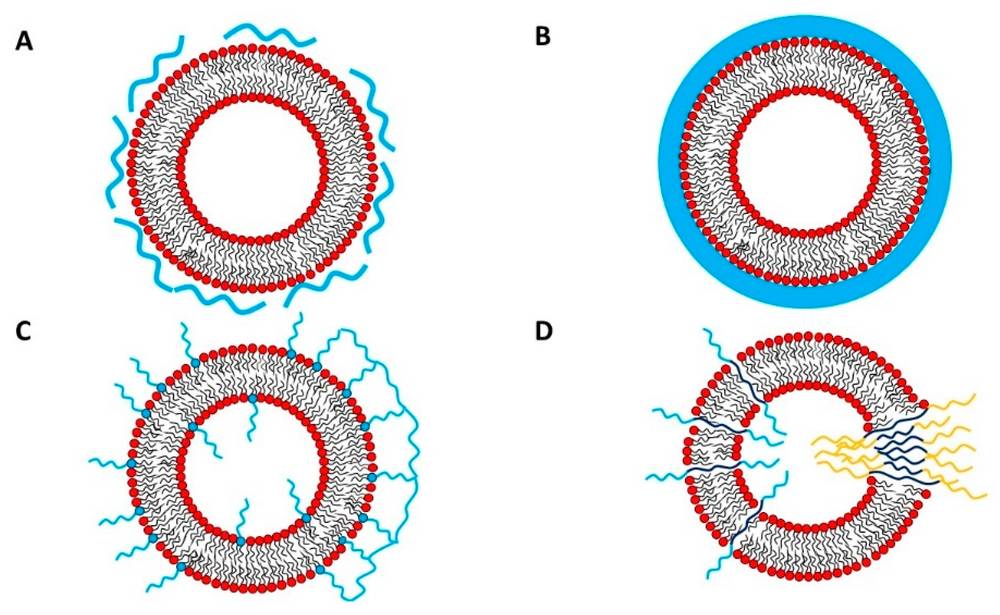
Formulation Strategy Matrix for Long Circulating Liposomes
Robust long circulating liposome development usually combines several formulation levers. The table below summarizes common design routes and the technical questions each route should answer before advancing to animal studies.
| Formulation Lever | Circulation Rationale | Best-Fit Use Cases | Watch Points |
|---|---|---|---|
| Alternative hydrophilic polymers | Create a hydrated anti-fouling interface that reduces protein adsorption and macrophage recognition. | Repeated dosing, PEG-sensitive programs, biologics, and nucleic acid formulations. | Polymer molecular weight, anchoring stability, complement activation, and batch consistency. |
| Polymer caging or coatings | Increase colloidal stability and provide a controllable barrier around the vesicle. | Fragile cargos, serum-stability screening, and stimuli-responsive release concepts. | Overcoating can suppress uptake; coating thickness must be measured by DLS, zeta potential, and microscopy. |
| Charge and lipid-ratio tuning | Reduce nonspecific electrostatic binding and control the protein corona formed in plasma. | Small molecule liposomes, immune-oncology payloads, vaccines, and targeted vesicles. | Charge neutrality may improve circulation but reduce endosomal escape or membrane association. |
| Cholesterol and membrane rigidity control | Improve bilayer packing and reduce premature leakage during systemic exposure. | Hydrophobic drugs, labile biologics, and formulations requiring slow release. | Excess rigidity may alter release kinetics, fusion behavior, or manufacturability. |
| Ligand-compatible stealth layers | Combine prolonged exposure with receptor engagement at the desired tissue or cell type. | Targeted therapeutics, tumor delivery, immune-cell delivery, and ligand-guided vaccines. | Ligand density, orientation, steric masking, and serum stability must be optimized together. |
Decision Logic for Candidate Selection
Start by defining the biological failure mode observed in in vitro, ex vivo, or in vivo studies. If the liposome aggregates in serum, prioritize colloidal and membrane stabilization. If the particle remains stable but disappears rapidly from blood, investigate opsonin adsorption, complement activation, and macrophage uptake. If circulation improves but efficacy falls, the formulation may need a sheddable coating, ligand presentation, or a release-trigger strategy.
The most informative screening campaign links composition to measurable outcomes: hydrodynamic diameter, PDI, zeta potential, encapsulation efficiency, leakage in serum, hemocompatibility, complement markers, macrophage uptake, plasma half-life, tissue exposure, and pharmacodynamic response.
Formulation Insight
Long circulation is an emergent property. It depends on the synthetic identity of the vesicle and the biological identity created after serum exposure.
Analytical Validation Connects Stealth Design to PK Performance
A promising surface modification should be validated across formulation stability, biological compatibility, and pharmacokinetic behavior. Stability testing confirms whether the liposome maintains size distribution, encapsulation, and release profile after storage and after contact with serum proteins. Biological assays clarify whether the surface chemistry reduces unwanted complement activation, hemolysis, and phagocytic uptake.
For translational decisions, circulation data should be connected to biodistribution and pharmacodynamic readouts. Creative Biolabs supports integrated evaluation through PK-PD analysis, helping teams understand whether an improved plasma profile translates into better exposure at the intended site.
Recommended Evidence Package
Physicochemical comparability
DLS, PDI, zeta potential, morphology, encapsulation efficiency, osmolality, and pH.
Serum and storage stability
Leakage, aggregation, polymer shedding, and cargo integrity under accelerated and real-time conditions.
Immune interaction profiling
Protein corona assessment, complement markers, cytokine screening, and macrophage uptake assays.
PK and biodistribution confirmation
Blood exposure, tissue distribution, payload release, and pharmacodynamic activity in relevant models.
Frequently Asked Questions
It means designing liposomes that can remain stable in blood and avoid rapid immune clearance by using formulation strategies in addition to, or instead of, PEG. Examples include alternative hydrophilic polymers, polymer caging, covalent polymer-lipid anchoring, charge tuning, cholesterol-mediated membrane stabilization, and ligand-compatible stealth layers.
Polymer-modified liposomes are useful when a program needs stronger colloidal stability, lower protein adsorption, reduced phagocytic uptake, or a tunable surface for targeting and stimuli-responsive release. They are also worth exploring when PEG-related immune concerns, uptake suppression, or repeated-dose effects complicate the development path.
Not always. PEG may still be appropriate for many research formulations. The best choice depends on the payload, dosing schedule, target tissue, immune-risk profile, and desired uptake or release mechanism. In some programs, a reduced PEG density combined with another polymer or a detachable coating may offer a better balance than complete replacement.
Useful endpoints include stable particle size and PDI in serum, low premature leakage, reduced protein adsorption, acceptable complement and hemolysis profiles, lower macrophage uptake, extended plasma exposure, and improved tissue exposure or pharmacodynamic activity in relevant in vivo models.
Creative Biolabs can support formulation design, polymer modification, stability monitoring, characterization, and PK-PD evaluation for research-stage liposome programs. The workflow can be customized around the payload, target tissue, dosing route, and desired balance between circulation, uptake, and release.
References
- De Leo, Vincenzo, et al. "Recent advancements in polymer/liposome assembly for drug delivery: from surface modifications to hybrid vesicles." Polymers 13.7 (2021): 1027. https://doi.org/10.3390/polym13071027
- Under Open Access license CC BY 4.0, without modification.
Online Inquiry
This site is protected by reCAPTCHA and the Google Privacy Policy and Terms of Service apply.