
How to Control Trigger Selectivity and Background Leakage
in ATP-Responsive Liposome Development
Practical formulation strategies for ATP-responsive liposome development, with a focus on maximizing ATP-triggered release while minimizing background leakage under storage, circulation, and low-ATP conditions.
Navigating the Paradox of Responsive Drug Delivery
Adenosine triphosphate (ATP) is increasingly explored as an endogenous molecular trigger for responsive drug delivery systems. The rationale for ATP-responsive liposome development is based on a steep ATP gradient: intracellular ATP is typically present in the millimolar range, while extracellular and circulation-associated ATP levels are much lower under non-trigger conditions. In tumor-associated or metabolically active environments, ATP availability may increase, creating an opportunity to design liposomes that remain stable in low-ATP settings but release their payload after exposure to ATP-rich target conditions.
The central challenge is not simply making a liposome respond to ATP. It is creating a sufficiently wide trigger window: low baseline leakage during storage, serum exposure, and circulation-mimicking incubation, together with rapid and reproducible payload release when the formulation encounters the intended ATP concentration range.
Background leakage can reduce the delivered dose, change pharmacokinetic behavior, and increase off-target exposure before the carrier reaches the desired biological compartment. Controlling leakage therefore requires coordinated optimization of lipid packing, cholesterol content, responsive element density, payload retention, buffer conditions, and release-assay design.
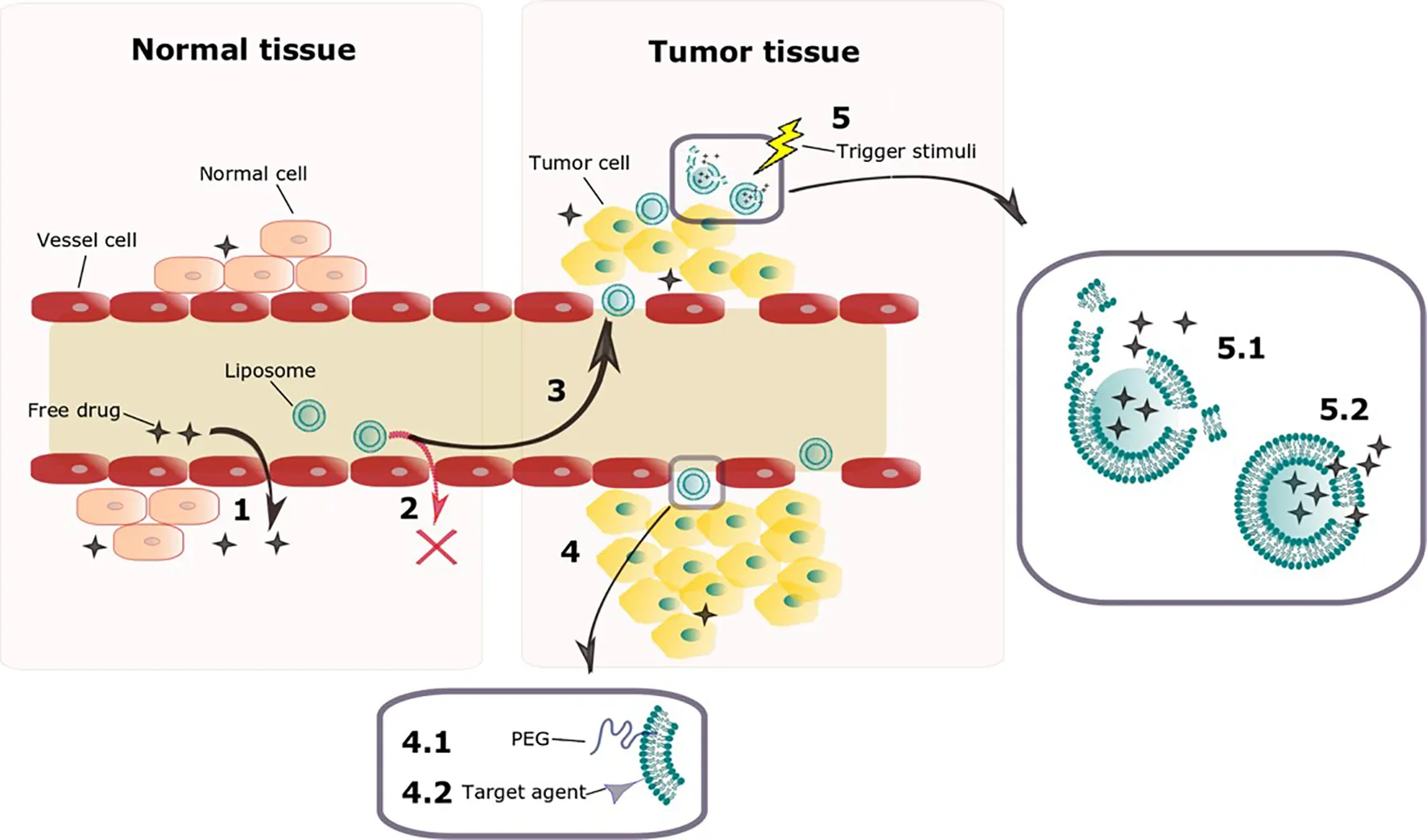
Fig.1 Schematic illustration of liposome-based drug delivery and stimulus-triggered release design. The same design principle can be adapted to ATP-responsive liposome systems by engineering a release window between low-ATP and ATP-rich conditions. 1,2
Mechanisms of ATP-Triggered Payload Release
ATP-responsive liposome development can follow different molecular design routes, and the leakage-control strategy should match the selected mechanism. In aptamer-assisted systems, ATP binding may alter the structure of an oligonucleotide motif, open a molecular gate, or release an intercalated payload. In lipid-switch systems, ATP binding can change the conformation or charge-presentation of a membrane-embedded responsive lipid, disturbing membrane packing and increasing permeability.
Regardless of the mechanism, the formulation goal is the same: the liposome should remain intact under low-ATP and serum-containing conditions, but show a measurable increase in release rate after exposure to the target ATP concentration. This difference between non-trigger leakage and ATP-triggered release should be treated as the primary design window for formulation optimization.
Defining the ATP Trigger Window
A useful ATP-responsive formulation should be evaluated by its trigger window rather than by triggered release alone. This window compares payload release under non-trigger conditions with release under ATP-rich target conditions. A narrow window indicates that the formulation either leaks too much before activation or responds too weakly after ATP exposure.
| Parameter | What It Measures | Why It Matters |
|---|---|---|
| Background Leakage | Payload release in buffer, serum, or low-ATP media | Indicates storage and circulation stability |
| ATP-Triggered Release | Payload release after exposure to defined ATP concentrations | Shows whether the trigger is strong enough for the intended application |
| Selectivity Index | Ratio of ATP-triggered release to non-trigger leakage | Helps compare formulations during screening |
Formulation Strategies to Suppress Background Leakage
Tuning Lipid Phase Transition
Background leakage is strongly influenced by bilayer permeability and lipid packing. High phase-transition-temperature lipids such as DSPC, HSPC, or DPPC can improve membrane rigidity at physiological temperature and reduce passive diffusion of encapsulated hydrophilic payloads. However, excessive rigidity may also reduce ATP-triggered permeability changes, so lipid composition should be screened together with the responsive element rather than optimized independently.
Cholesterol Modulation
Cholesterol can improve membrane packing and reduce permeability by filling gaps between phospholipid acyl chains. In ATP-responsive liposome development, the optimal cholesterol ratio should be identified experimentally because too little cholesterol may increase leakage, while too much cholesterol may suppress the membrane reorganization required for ATP-triggered release. A practical screening matrix during liposome formulation optimization should compare leakage and triggered release across several lipid-to-cholesterol ratios.
Responsive Element Density and Spacer Design
The density of ATP-binding aptamers, lipid switches, or supramolecular recognition motifs directly affects both selectivity and leakage. A low density may produce weak triggered release, while excessive surface or membrane loading can disturb bilayer packing and increase baseline leakage. Spacer length, anchoring chemistry, and PEG-lipid density should therefore be optimized to maintain ATP accessibility without creating membrane defects.
Payload and Buffer Compatibility
Leakage behavior depends on payload size, charge, hydrophilicity, and encapsulation method. Small hydrophilic dyes may leak more readily than larger biomolecules, while charged payloads may interact with the lipid bilayer or responsive motif. Buffer pH, ionic strength, osmolarity, divalent cations, and serum proteins should be controlled during release testing because they can affect both membrane stability and ATP-binding behavior.
Cross-linked and Polymer-Stabilized Bilayers
Cross-linkable lipids, polymer-lipid hybrids, or stabilizing surface coatings can improve structural integrity during storage and serum exposure. These approaches are especially useful for payloads that diffuse rapidly through loosely packed membranes. The key is to design stabilizing interactions that remain intact under non-trigger conditions but become sufficiently weakened, displaced, or reorganized after ATP-trigger engagement.
Advanced Approaches for Target Selectivity
Selectivity depends on how well the formulation distinguishes low-ATP non-trigger conditions from ATP-rich target environments. Instead of relying on a single ATP concentration cutoff, developers should evaluate release across a concentration gradient and compare ATP responses with structurally related nucleotides and phosphorylated metabolites.
| Objective | Engineering Strategy | Mechanism of Action | Formulation Consideration |
|---|---|---|---|
| Prevent Premature Leakage | High-Tm Lipids & Optimal Cholesterol | Improves lipid packing and reduces permeability-associated defects. | May lower trigger sensitivity if bilayer becomes too rigid. |
| Enhance ATP Affinity | Aptamer Sequence Truncation | Removes competitive secondary structures to favor ATP binding. | Requires stringent screening of oligonucleotide modifications. |
| Amplify Release Signal | Signal Amplification Cascades | Initial ATP binding triggers secondary enzymatic or chemical breakdown. | Increases system complexity and manufacturing difficulty. |
| Dual-Trigger Specificity | ATP + pH / Redox Responsiveness | Release is enhanced when ATP responsiveness overlaps with acidic, reductive, or enzyme-rich target conditions. | Can improve trigger specificity, but requires careful assay design to avoid overcomplicated formulations. |
To prevent false-positive triggering, multi-stimuli responsive designs are gaining traction. By combining ATP-responsiveness with a second biological trigger—such as the acidic pH of the endosome or the high glutathione (GSH) levels in the cytosol—researchers create a boolean "AND" logic gate. In these advanced architectures, high ATP alone cannot trigger the release; both conditions must be met simultaneously, effectively abolishing the risk of background leakage during circulation.
Trigger selectivity should also be tested against competing metabolites. In addition to ATP concentration gradients, release assays should include ADP, AMP, GTP, UTP, pyrophosphate, phosphate, and serum-containing controls when relevant. This helps determine whether the formulation responds specifically to ATP or more broadly to phosphate-containing molecules, which is critical for reducing false-positive release.
Validating Carrier Integrity and Release Profiles
Formulation design should be supported by release, stability, and structural characterization assays. For ATP-responsive liposomes, validation should compare the same formulation under storage, serum-containing, low-ATP, ATP-rich, and competing-metabolite conditions. The goal is to quantify both baseline leakage and ATP-triggered release kinetics, rather than reporting only endpoint release.
Fluorescence dequenching assays using self-quenching dyes such as calcein can provide a convenient readout for membrane permeability changes. For therapeutic payloads, orthogonal analytical methods such as HPLC, LC-MS, UV absorbance, or bioactivity assays may be needed to confirm actual payload release and integrity.
Particle size, polydispersity index, zeta potential, encapsulation efficiency, and morphology should be measured before and after ATP exposure. Changes observed by DLS, cryo-TEM, or other characterization methods can provide supporting evidence of ATP-associated membrane reorganization, but they should be interpreted together with release data.
Access Basic Characterization ServicesExample Validation Parameters
- Baseline Leakage: Measure payload release in storage buffer, physiological buffer, and serum-containing media over project-relevant time points.
- ATP-Triggered Release: Compare release profiles across low, intermediate, and high ATP concentrations to define the trigger window.
- Metabolite Selectivity: Test ATP against ADP, AMP, GTP, UTP, pyrophosphate, and phosphate-containing controls when relevant.
- Structural Integrity: Track size, PDI, zeta potential, encapsulation efficiency, and morphology before and after trigger exposure.
Frequently Asked Questions
ATP-responsive liposomes are designed to discriminate between low-ATP non-trigger conditions and ATP-rich target environments through a combination of ATP-binding affinity, responsive element density, membrane stability, and formulation architecture. In practice, developers should evaluate release across an ATP concentration gradient rather than relying on a single cutoff value. A useful formulation shows low baseline leakage in storage, serum, and low-ATP media, but a measurable increase in release under the intended ATP-rich condition.
Background leakage is primarily caused by insufficient thermodynamic stability of the lipid bilayer at physiological temperature (37°C) or interactions with serum proteins (like lipoproteins) that act as lipid sinks. If the phase transition temperature (Tm) of the primary lipids is too close to body temperature, the membrane exists in a fluid or highly dynamic phase, allowing small hydrophilic payloads to diffuse out. Additionally, the incorporation of bulky aptamer sequences can create phase boundary defects in the membrane, serving as escape routes for the payload.
While incorporating cholesterol is a highly effective strategy to enhance membrane packing and reduce passive permeability, it cannot entirely eliminate leakage without consequences. Overloading a liposome with cholesterol can make the bilayer excessively rigid. In ATP-responsive systems, this rigidity can impede the necessary structural conformational shift of the ATP aptamer, thereby reducing the trigger sensitivity and preventing effective in vivo payload release when the liposome reaches the target site.
Release kinetics are typically evaluated using a fluorescence dequenching assay. Liposomes are loaded with a self-quenching concentration of a fluorescent dye (e.g., calcein). They are then incubated in buffers mimicking physiological conditions (with and without serum) to measure baseline leakage. Subsequently, they are exposed to target concentrations of ATP (e.g., 5 mM). As the liposome destabilizes and releases the dye into the surrounding buffer, the dye is diluted, its fluorescence dequenches, and the signal intensity is measured over time using a fluorometer to plot an exact release kinetic curve.
Dual-responsive design can improve specificity by requiring ATP responsiveness to overlap with another biological condition, such as acidic endosomal pH or a reductive intracellular environment. This approach can reduce false-positive release compared with single-trigger systems, but it also increases formulation complexity. Developers should confirm that each trigger contributes to the release profile and that the combined design does not compromise storage stability, manufacturability, or reproducibility.
References
- Franco, Marina Santiago, et al. "Triggered drug release from liposomes: exploiting the outer and inner tumor environment." Frontiers in Oncology 11 (2021): 623760. https://doi.org/10.3389/fonc.2021.623760
- Under Open Access license CC BY 4.0, without modification.
Online Inquiry
This site is protected by reCAPTCHA and the Google Privacy Policy and Terms of Service apply.