
Resource Guide for Liposome Stability Evaluation
Liposome Stability Evaluation Guide for Storage and Stress Testing
A practical study design template for accelerated, freeze-thaw, photostability, and long-term storage studies of liposome-based drug delivery systems.
Why Liposome Stability Evaluation Needs a Liposome-Specific Framework
Liposome stability evaluation is more than placing a formulation on a shelf and measuring appearance. A liposomal product is a dynamic colloidal system in which lipid composition, aqueous phase, entrapped payload, surface charge, osmolarity, and container closure can all affect the same final quality attributes. For formulation scientists, drug delivery researchers, CMC teams, and analytical development groups, the core question is whether the liposome maintains its intended identity under real storage and stress conditions.
A practical stability plan should connect each storage condition to a defined risk: particle aggregation, vesicle fusion, size drift, lipid oxidation or hydrolysis, payload leakage, loss of encapsulation efficiency, pH shift, turbidity, precipitation, or changes that may affect in vitro, ex vivo, or in vivo performance. The same design also helps distinguish a formulation problem from a packaging, handling, or analytical method problem.
This guide provides a study design template for accelerated, freeze-thaw, light exposure, and long-term storage studies. It is intended for research-use formulation programs that need defensible, data-driven evidence for formulation robustness, storage condition selection, and preclinical-to-IND preparation.
Core Stability Questions
- 01Does the liposome keep a consistent particle size and PDI during storage?
- 02Does surface charge remain within a range that supports colloidal stability?
- 03Does the payload remain encapsulated without unacceptable leakage?
- 04Are lipids protected from oxidation, hydrolysis, and phase-transition stress?
- 05Can the formulation tolerate shipping, light exposure, and repeated handling?
Study Design Template for Liposome Stability Evaluation
A useful template begins with the intended storage condition, the most likely degradation pathway, and the analytical readouts that will detect failure early. The conditions below are not a universal regulatory protocol; they are a structured starting point that can be adjusted according to lipid phase behavior, payload sensitivity, dosage form, concentration, buffer system, and container closure.
| Study Type | Typical Purpose | Example Conditions | Suggested Time Points | Critical Readouts |
|---|---|---|---|---|
| Accelerated storage | Reveal short-term physical and chemical instability trends. | 25°C, 30°C, or 40°C; controlled humidity when relevant. | 0, 1, 2, 4, 8, and 12 weeks. | Size, PDI, zeta potential, drug leakage, pH, lipid degradation. |
| Freeze-thaw challenge | Assess handling, shipping, and accidental freezing risk. | Three to five cycles between frozen and refrigerated or room temperature states. | Before stress, after each cycle, and final recovery point. | Aggregation, vesicle disruption, encapsulation efficiency, appearance. |
| Photostability | Evaluate sensitivity of lipids, payload, and excipients to light. | Protected control versus defined visible and UV exposure. | 0, mid-exposure, end-exposure, and post-exposure hold. | Assay, impurities, color change, lipid oxidation markers. |
| Long-term storage | Support recommended storage and retest interval decisions. | 2-8°C, -20°C, -80°C, or product-specific controlled conditions. | 0, 1, 3, 6, 9, 12 months; extend as needed. | Full physicochemical panel, sterility-related appearance checks, potency-related assay. |
Define the Risk Hypothesis
For each condition, state what failure mode is being challenged. For example, heat may accelerate lipid oxidation, while freezing may trigger ice-induced vesicle fusion.
Set Acceptance Logic
Define alert limits for particle size, PDI, zeta potential, encapsulation efficiency, leakage, assay, and impurity trends before data are generated.
Connect Data to Decisions
Use the study to decide whether to optimize lipids, adjust buffer, add cryoprotectants, protect from light, or refine manufacturing controls.
How to Structure Accelerated, Freeze-Thaw, Light, and Long-Term Studies
A balanced liposome stability evaluation program should include both mild storage conditions and stress conditions that are intentionally harsher than routine use. Accelerated studies help rank formulation candidates quickly, but they should not be interpreted in isolation. Long-term data under the intended storage condition remain essential for confirming whether early trends are meaningful.
Freeze-thaw studies are particularly important for liposomes because ice formation, solute concentration, pH microshifts, and lipid phase separation can alter membrane integrity. If a product is expected to be shipped cold, stored frozen, or handled in multiple laboratories, freeze-thaw data can reveal robustness gaps before scale-up.
Explore Formulation Stability MonitoringAccelerated Storage Design
Use elevated temperature to expose trends in particle growth, leakage, hydrolysis, and oxidative degradation. Include a refrigerated control so heat-related effects can be separated from ordinary time-dependent drift.
Freeze-Thaw Design
Track size and PDI after each cycle rather than only at the end. Stepwise data can show whether instability begins after the first freeze or accumulates progressively.
Photostability Design
Compare exposed samples with dark controls in the same container type. Light-sensitive payloads may require amber vials, foil wrapping, or revised labeling instructions.
Long-Term Storage Design
Long-term storage should use the intended clinical or research storage condition whenever possible, with a complete analytical panel at key milestones.
Practical Tip for CMC Teams
Keep retained samples from the same batch across all storage arms. This reduces batch-to-batch noise and makes it easier to attribute changes to storage stress rather than manufacturing variability.
Essential Analytical Readouts for Liposome Stability
Stability evaluation should combine orthogonal physical, chemical, and functional readouts. Particle size and PDI show colloidal behavior, while zeta potential provides insight into electrostatic repulsion and surface changes. Encapsulation efficiency and leakage assays connect physical integrity to payload retention. Lipid assay, impurity profiling, pH, osmolality, and appearance complete the interpretation.
Particle Size and PDI
Monitor mean size, distribution width, and emerging populations. An increase in PDI may appear before visible aggregation.
Zeta Potential
Track surface charge changes that may indicate lipid rearrangement, adsorption, hydrolysis, or buffer incompatibility.
Encapsulation and Leakage
Compare total and free payload. Leakage trends are often the most direct evidence of membrane integrity loss.
Lipid Degradation
Evaluate oxidation, hydrolysis, and impurity formation using appropriate chromatographic or mass-based methods.
Recommended Evaluation Matrix
| Endpoint | Why It Matters | Typical Method Category |
|---|---|---|
| Size / PDI | Detects aggregation, fusion, and size drift. | Dynamic light scattering or nanoparticle tracking. |
| Zeta potential | Indicates colloidal stability and surface charge behavior. | Electrophoretic light scattering. |
| Encapsulation efficiency | Shows whether the payload remains associated with vesicles. | Separation plus assay of free and total payload. |
| Drug leakage | Provides time-dependent membrane integrity evidence. | Dialysis, filtration, chromatography, fluorescence, or payload-specific assay. |
| Lipid impurities | Supports chemical stability and degradation pathway mapping. | HPLC, UPLC, LC-MS, or related methods. |
For early formulation ranking, researchers can combine this matrix with lipid-based basic characterization service to establish a baseline before stress testing. For programs where degradation or leakage may affect biological interpretation, formulation safety evaluation can be integrated downstream to connect physicochemical changes with research-use safety readouts.
Literature-Informed Stability Monitoring: What the Figure Shows
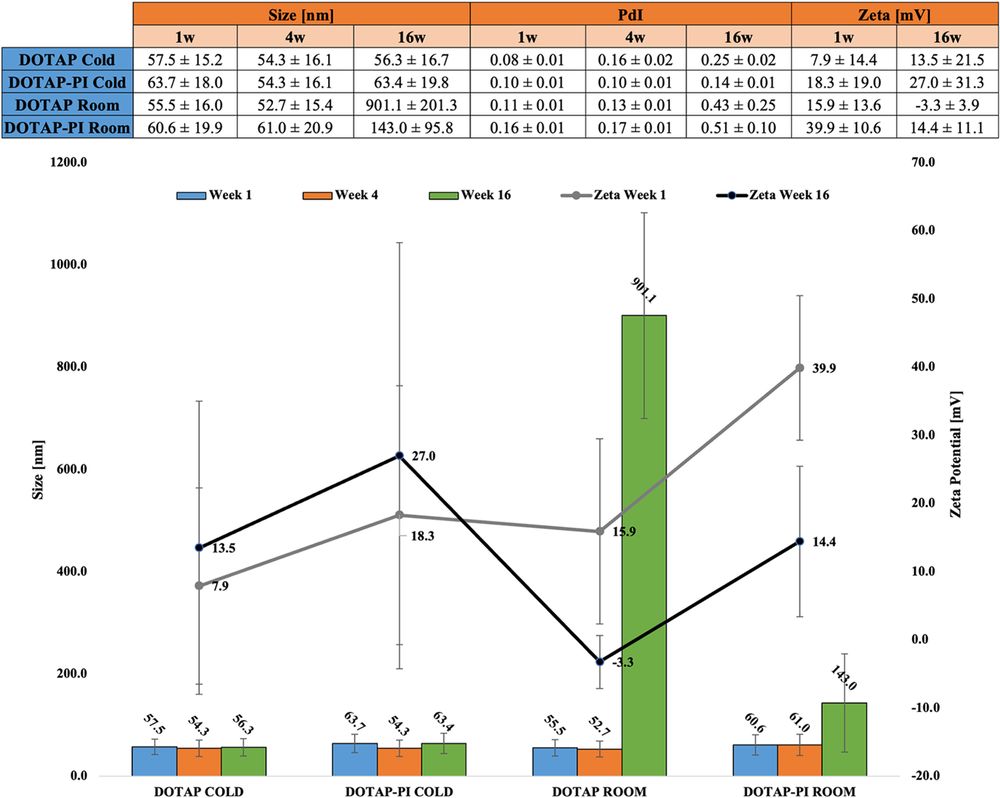
The open-access work by Cazzolla et al. describes cationic liposome nanoparticles prepared by thin-film dispersed hydration and extrusion, with reported physicochemical tracking over storage. The figure below illustrates how liposome stability can be monitored over time by following particle size, polydispersity index, and zeta potential under different storage conditions.
The data emphasize a common stability principle: storage temperature can strongly influence liposome behavior. Refrigerated storage helps maintain more consistent physicochemical properties over 16 weeks, whereas less suitable conditions may accelerate size drift, aggregation risk, and loss of colloidal stability. For liposome stability evaluation, these readouts are essential because they can identify formulation failure before visual changes become obvious.
A literature-informed design does not simply copy time points from a publication. Instead, it uses published evidence to justify why size, PDI, zeta potential, encapsulation efficiency, drug leakage, and lipid degradation should be measured together. The result is a more defensible stability package for formulation selection and storage-condition optimization.
From Stability Results to Formulation Decisions
Stability data become useful when they guide specific actions. A formulation that shows rising PDI during accelerated storage may require lipid composition adjustment, tighter process control, or changes in ionic strength. A formulation that fails freeze-thaw testing may need cryoprotectant screening or revised shipping instructions. A formulation that shows light-triggered leakage may need a light-protective container and a revised handling plan.
Baseline Characterization
Confirm initial size, PDI, zeta potential, encapsulation, assay, and appearance.
Stress Challenge
Run accelerated, freeze-thaw, light, and long-term arms using matched samples.
Trend Interpretation
Separate meaningful instability from analytical variation using predefined alert criteria.
Optimization Loop
Modify lipids, buffer, process, packaging, or handling based on the failure mode.
Need help translating stability findings into a robust formulation and production plan?
Learn About Liposome ManufacturingFrequently Asked Questions
Liposome stability evaluation is the systematic assessment of whether a liposomal formulation maintains its physicochemical identity, payload retention, and performance-relevant properties during storage or stress. Typical readouts include particle size, PDI, zeta potential, encapsulation efficiency, drug leakage, lipid degradation, pH, osmolality, appearance, and assay.
Common early-stage time points include baseline, 1 week, 2 weeks, 4 weeks, 8 weeks, and 12 weeks for accelerated studies, with 1, 3, 6, 9, and 12 months for longer storage studies. The final plan should be adjusted for payload sensitivity, lipid chemistry, storage temperature, and project stage.
Freeze-thaw stress can disrupt liposome membranes through ice formation, concentration of solutes, osmotic shifts, and lipid phase changes. These effects may cause aggregation, vesicle fusion, and payload leakage, making freeze-thaw testing important for shipping and handling risk assessment.
Rising particle size, increasing PDI, zeta potential drift, reduced encapsulation efficiency, increased free drug, visible turbidity, pH shift, and lipid oxidation or hydrolysis markers can all indicate instability. Interpreting these readouts together is more reliable than using any single endpoint alone.
Stability data identify the dominant failure mode. Size drift may point to lipid composition or process issues, leakage may suggest membrane permeability or payload-buffer incompatibility, and light sensitivity may require protective packaging. These findings help prioritize formulation, process, and storage-condition changes.
References
- Cazzolla, Alessandro, et al. "Synthesis of cationic liposome nanoparticles using a thin film dispersed hydration and extrusion method." Plos one 19.4 (2024): e0300467. https://doi.org/10.1371/journal.pone.0300467
- Under Open Access license CC BY 4.0, without modification.
Online Inquiry
This site is protected by reCAPTCHA and the Google Privacy Policy and Terms of Service apply.