
Liposome Formulation Safety Evaluation: From Hemolysis to Residual Solvent Testing
An integrated testing strategy for liposome, LNP, and lipid-based delivery formulations that connects hemolysis, cell compatibility, endotoxin control, and residual solvent analysis before in vitro, ex vivo, or in vivo studies.
Why Lipid-Based Formulations Need a Connected Safety Readout
A promising liposome or lipid nanoparticle can fail for reasons that are not visible in a single potency or release assay. Carrier lipids, manufacturing residues, trace microbial components, aggregation state, and drug payload can all influence blood compatibility, cellular response, and early inflammatory signals. For formulation scientists, the practical question is not only whether a formulation works, but whether the formulation itself introduces avoidable risk before downstream biological testing.
A complete formulation safety evaluation liposome package should therefore bring hemolysis, cytocompatibility, endotoxin testing, and residual solvent analysis into one coordinated workflow. When these readouts are interpreted together, researchers can separate carrier-related toxicity from payload-related activity, identify unsafe excipient ratios, and make evidence-based decisions about reformulation, scale-up, or preclinical readiness.
Creative Biolabs supports lipid-based drug delivery programs with integrated analytical and biological testing. For projects that still need particle-size profiling, encapsulation efficiency, morphology, zeta potential, or stability data before safety testing, our formulation analysis and characterization services can be aligned with safety endpoints to create a traceable formulation record.
Typical Safety Questions Before Advancement
- 01Does the lipid carrier disrupt red blood cell membranes under clinically relevant exposure conditions?
- 02Is reduced cell viability caused by the drug, the lipid composition, the solvent residue, or the final nanoparticle?
- 03Could endotoxin or microbial contamination confound cytokine, complement, or immune-cell assays?
- 04Are organic solvent residues controlled after thin-film hydration, ethanol injection, microfluidics, or solvent-exchange processing?
A Tiered Workflow for Liposome Safety Evaluation
A useful safety workflow starts with what can change interpretation: physicochemical identity, contamination status, biological compatibility, and manufacturing residues. Literature on liposome-based nanomaterials has described a stepwise approach in which liposomes are characterized for physical-chemical properties and screened for bacterial contamination before being evaluated for toxicity in human cells and inflammatory response.
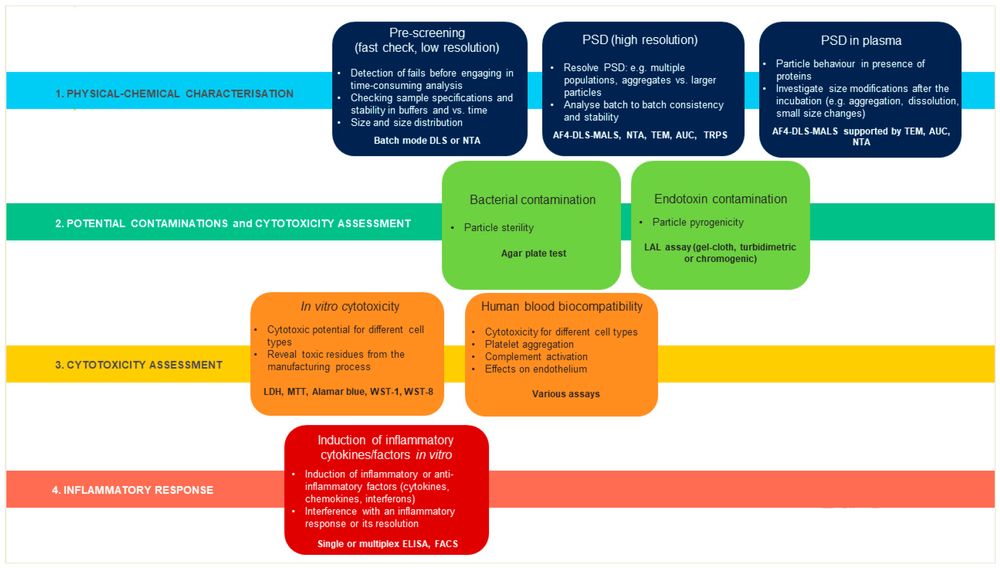
Fig. 1 Each liposome was characterized for its physical-chemical properties and for potential contamination by bacteria and bacterial toxins, and eventually examined for toxicity on human cells and capacity to induce an inflammatory response. PSD, particle size distribution.1,2
Characterize First
Confirm size distribution, PDI, zeta potential, concentration, morphology, and stability so safety data can be linked to a defined formulation state.
Control Contaminants
Screen for endotoxin and microbial risk early to reduce false-positive inflammatory or cytotoxicity signals.
Test Biological Compatibility
Assess hemolysis and cellular compatibility across relevant concentrations, exposure times, and controls.
Review Manufacturing Residues
Quantify residual solvents and process-related impurities that may drive toxicity or regulatory concern.
Core Assays in a Complete Safety Package
Each endpoint answers a different question, but their combined value is highest when samples, controls, and formulation lots are coordinated. A single lot can be profiled across orthogonal assays, while comparator lots help reveal whether toxicity tracks with lipid composition, drug loading, residual solvent, or storage condition.
| Evaluation Module | Primary Question | Useful Outputs | Decision Value |
|---|---|---|---|
| Hemolysis Testing | Does the formulation damage erythrocyte membranes? | Percent hemolysis, dose-response curve, positive and negative control comparison. | Supports blood-contact compatibility screening and formulation ranking. |
| Cytocompatibility | Is the lipid carrier or payload reducing cell viability? | Viability, membrane integrity, metabolic activity, morphology observations. | Guides dose selection for in vitro efficacy and mechanism studies. |
| Endotoxin and Microbial Risk | Could bacterial toxins confound immune or toxicity assays? | Endotoxin level, method suitability notes, interference controls. | Improves confidence in cytokine, complement, and immune-cell readouts. |
| Residual Solvent Testing | Are process solvents adequately removed from the final formulation? | Solvent identity, concentration, batch comparison, process trend. | Supports process optimization and manufacturing readiness. |
Hemolysis: Blood Compatibility as an Early Gate
Hemolysis testing is especially important for intravenously administered or blood-contacting lipid-based formulations. Cationic lipids, high surfactant content, free drug, and unstable particle populations can all disrupt erythrocyte membranes. A well-designed assay includes untreated cells, vehicle controls, positive lysis controls, and concentration points that bracket expected biological exposure.
The goal is not simply to produce a pass or fail label. A dose-dependent hemolysis profile can reveal whether a formulation needs lipid-ratio adjustment, buffer optimization, purification, or further process control before in vivo dosing is considered.
Cytocompatibility: Separating Carrier and Payload Effects
Cell compatibility studies should be selected around the intended route, tissue, or mechanism of action. For many liposome and LNP programs, multiple readouts are preferable because lipid nanoparticles may interfere with colorimetric assays, fluorescence signals, or metabolic indicators. Orthogonal endpoints help avoid over-interpreting a single assay artifact.
When blank carrier, free payload, and loaded formulation are tested side by side, teams can understand whether the observed effect is driven by lipid composition, drug activity, particle uptake, or residual process components.
Interpreting Endotoxin and Residual Solvent Data Together
Endotoxin contamination is a common reason why immune-cell data become difficult to interpret. Even when a liposome formulation appears physically stable and non-cytotoxic, low levels of bacterial toxin may alter cytokine release, complement activation, or inflammatory signaling. Method suitability is critical because lipids, surfactants, chelators, and buffers can interfere with endotoxin assays. Spike recovery, dilution strategy, and sample pretreatment should be documented for transparent interpretation.
Residual solvent testing addresses a different but equally practical risk. Liposome production may use ethanol, chloroform, methanol, acetone, isopropanol, or other solvents depending on the process. Incomplete solvent removal can affect membrane fluidity, cell tolerance, protein binding, and apparent drug activity. For programs moving from discovery preparation to larger batch production, residual solvent data can help optimize evaporation, diafiltration, tangential flow filtration, or buffer exchange conditions.
Safety data become more actionable when paired with process knowledge. Teams planning larger batches can connect solvent-removal performance, sterility strategy, and lot-to-lot comparability with liposome manufacturing capabilities to reduce risk before scale-up.
A Practical Interpretation Matrix
Build a Formulation-Specific Safety Package Before Preclinical Decisions
No single assay can define liposome safety. The most informative package connects formulation identity, biological response, contamination control, and manufacturing residue analysis. This is especially important when comparing lipid ratios, PEG-lipid density, cholesterol content, helper lipid selection, payload loading, or storage conditions.
Creative Biolabs can help design a study map that fits early discovery screening, lead formulation selection, or preclinical-enabling preparation. If your formulation still requires optimization before safety profiling, our liposomal formulation development service can support lipid selection, payload loading, process design, and analytical comparison.
Frequently Asked Questions
A complete package typically includes physicochemical characterization, hemolysis testing, cytocompatibility assays, endotoxin or microbial contamination assessment, and residual solvent testing. For higher-confidence interpretation, blank carrier, free payload, and loaded formulation should be compared under matched conditions.
Hemolysis focuses on red blood cell membrane damage, while cytocompatibility evaluates how nucleated cells tolerate the carrier, payload, or final particle. Testing both helps identify whether a formulation is risky for blood-contact exposure, cell-based studies, or later in vivo planning.
Yes. Endotoxin can trigger inflammatory signaling and cytokine release, which may be mistaken for a lipid-carrier effect. Method suitability, spike recovery, and interference checks are important because lipid excipients and formulation buffers may affect endotoxin assay performance.
Residual solvent testing is recommended when organic solvents are used in lipid film formation, ethanol injection, solvent exchange, microfluidic processing, or purification steps. It is especially useful before scale-up, repeat-dose studies, or sensitive cell-based assays.
Integrated data can show whether a safety signal tracks with particle size, lipid ratio, payload loading, solvent residue, endotoxin contamination, or storage instability. This allows teams to modify the formulation or process before committing resources to larger biological or preclinical studies.
References
- Della Camera, Giacomo, et al. "A step-by-step approach to improve clinical translation of liposome-based nanomaterials, a focus on innate immune and inflammatory responses." International Journal of Molecular Sciences 22.2 (2021): 820. https://doi.org/10.3390/ijms22020820
- Under Open Access license CC BY 4.0, without modification.
Online Inquiry
This site is protected by reCAPTCHA and the Google Privacy Policy and Terms of Service apply.