
Engineering Long-Circulating pH-Responsive Liposomes for Stealthy and Triggered Drug Delivery
A long circulating pH-responsive liposome is engineered to remain stable and “stealthy” in blood circulation while enabling payload release or membrane activation in acidic tumor or endosomal environments.
The PEG Dilemma: When Stealth Limits Triggered Delivery
The development of lipid-based drug delivery systems has become increasingly important in the therapeutic landscape, particularly in oncology and RNA therapeutics. A foundational requirement for any systemically administered liposome is the ability to circulate in the bloodstream long enough to reach the target tissue. Traditionally, this is achieved by coating the liposomal surface with hydrophilic polymers, predominantly polyethylene glycol (PEG). This "stealth" layer effectively shields the nanoparticle from opsonization and subsequent phagocytosis by the mononuclear phagocyte system (MPS), significantly enhancing the formulation's pharmacokinetic profile.
However, pharmaceutical researchers face a significant translational barrier known as the "PEG dilemma." While robust PEGylation provides excellent systemic stability, it simultaneously acts as a steric barrier at the target site. This dense polymer cloud inhibits critical lipid-membrane interactions, fundamentally impairing cellular uptake and reducing or limiting the efficiency of endosomal escape. Consequently, the encapsulated payload—whether it is a small molecule chemotherapeutic, an siRNA, or a large biologic—often remains trapped within the endosomal pathway or is expelled from the cell.
For this reason, the design objective is not simply to maximize PEG coverage, but to engineer a reversible stealth layer that remains protective during circulation and becomes less inhibitory after the liposome reaches acidic tumor or intracellular compartments.
Engineering Systemic Stealth and Stability
Ensuring that a liposome can endure the sheer forces and biochemical challenges of the bloodstream requires precise lipid engineering. The core lipid bilayer is typically composed of high-transition temperature phospholipids (e.g., DSPC or HSPC) and cholesterol to provide mechanical rigidity and prevent premature payload leakage during circulation.
While standard PEG-lipids (such as DSPE-PEG2000) are widely utilized, advanced stealth engineering often explores alternative polymers or specialized PEG derivatives to minimize immunogenic responses, such as the accelerated blood clearance (ABC) phenomenon. Polymers like polyoxazolines (POZ) or specific zwitterionic modifications are being investigated as robust alternatives to traditional PEG. Researchers looking to refine the circulatory half-life and biodistribution profiles of their delivery vehicles often rely on comprehensive polymer-modified liposome development strategies to fine-tune the steric stabilization layer without compromising the structural integrity of the core vesicle.
The ultimate goal of this stealth engineering is to exploit the Enhanced Permeability and Retention (EPR) effect efficiently. By extending the circulation time, the liposomes have a higher probability of extravasating through leaky tumor vasculature and accumulating within the tumor interstitium. However, reaching the tumor is only the first step; the formulation must then actively respond to the microenvironment.
Mechanisms of Microenvironment-Triggered Activation
The ingenuity of the long-circulating pH-responsive platform lies in its exploitation of physiological pH gradients. The blood and normal tissues maintain a neutral pH of approximately 7.4. In contrast, the tumor microenvironment (TME) is mildly acidic (pH 6.5-6.8) due to the Warburg effect, and intracellular endo/lysosomal compartments present a much steeper acidic gradient (pH 6.0 down to 4.5).
Several distinct molecular mechanisms can be engineered into the lipid bilayer to harness these pH drops:
- Acid-Cleavable PEG-Lipids: Formulations can incorporate PEG chains tethered to the lipid anchor via acid-labile bonds, such as hydrazone, orthoester, or vinyl ether linkages. Upon encountering the acidic TME, these bonds hydrolyze, shedding the PEG layer. This "de-shielding" exposes an underlying cationic or fusogenic surface, restoring cellular interaction and promoting uptake. From an engineering perspective, the linker must be stable enough to avoid premature PEG shedding in blood, yet labile enough to respond within the desired acidic activation window.
- Titratable/Ionizable Lipids: Incorporating lipids containing tertiary amines allows the liposome to remain neutral at physiological pH but become protonated and positively charged in the acidic endosome. This cationic shift induces strong electrostatic interactions with the anionic endosomal membrane, leading to membrane destabilization and payload escape. The apparent pKa of the ionizable component should be tuned to support low nonspecific charge at physiological pH while enabling sufficient protonation in acidic endosomal compartments.
- Polymorphic Phase Transitions: Utilizing lipids like DOPE (dioleoylphosphatidylethanolamine) combined with weakly acidic titratable amphiphiles (like CHEMS). At pH 7.4, CHEMS stabilizes DOPE into a lamellar bilayer. As the pH drops, CHEMS becomes protonated, losing its stabilizing effect, and forcing DOPE to revert to its preferred inverted hexagonal (HII) phase. This phase transition physically disrupts the liposome and the surrounding endosomal membrane, executing accelerated release or membrane destabilization. The DOPE/CHEMS ratio, cholesterol content, and total membrane composition should be screened carefully because excessive destabilization may increase leakage during storage or circulation.
Design Parameters for Balancing Stealth and pH-Triggered Activation
1. PEG Density and PEG-Lipid Anchoring
PEG density, PEG chain length, and lipid anchor stability should be optimized rather than maximized. A dense PEG corona can improve colloidal stability and reduce opsonization, but excessive steric shielding may reduce target-cell interaction and suppress endosomal escape.
2. pH-Trigger Threshold
An effective pH-responsive design should define its activation window clearly. Stability at pH 7.4 is required for systemic circulation, while partial activation at pH 6.5–6.8 may support tumor microenvironment responsiveness and stronger activation at pH 5.0–5.5 may promote intracellular release after endocytosis.
3. Lipid Composition and Membrane Stability
The lipid matrix determines whether the vesicle remains intact during circulation or becomes destabilized under acidic conditions. High-transition-temperature phospholipids and cholesterol can improve membrane rigidity, while helper lipids such as DOPE or titratable components such as CHEMS can introduce pH-dependent membrane destabilization.
4. Payload-Specific Optimization
Payload properties also influence formulation design. Small-molecule chemotherapeutics often require controlled leakage prevention and tumor-site release, while RNA payloads require serum protection, efficient cellular uptake, and rapid endosomal escape before lysosomal degradation.
Case Study: cRGD-Modified pH-Sensitive Liposomes for Sorafenib Delivery
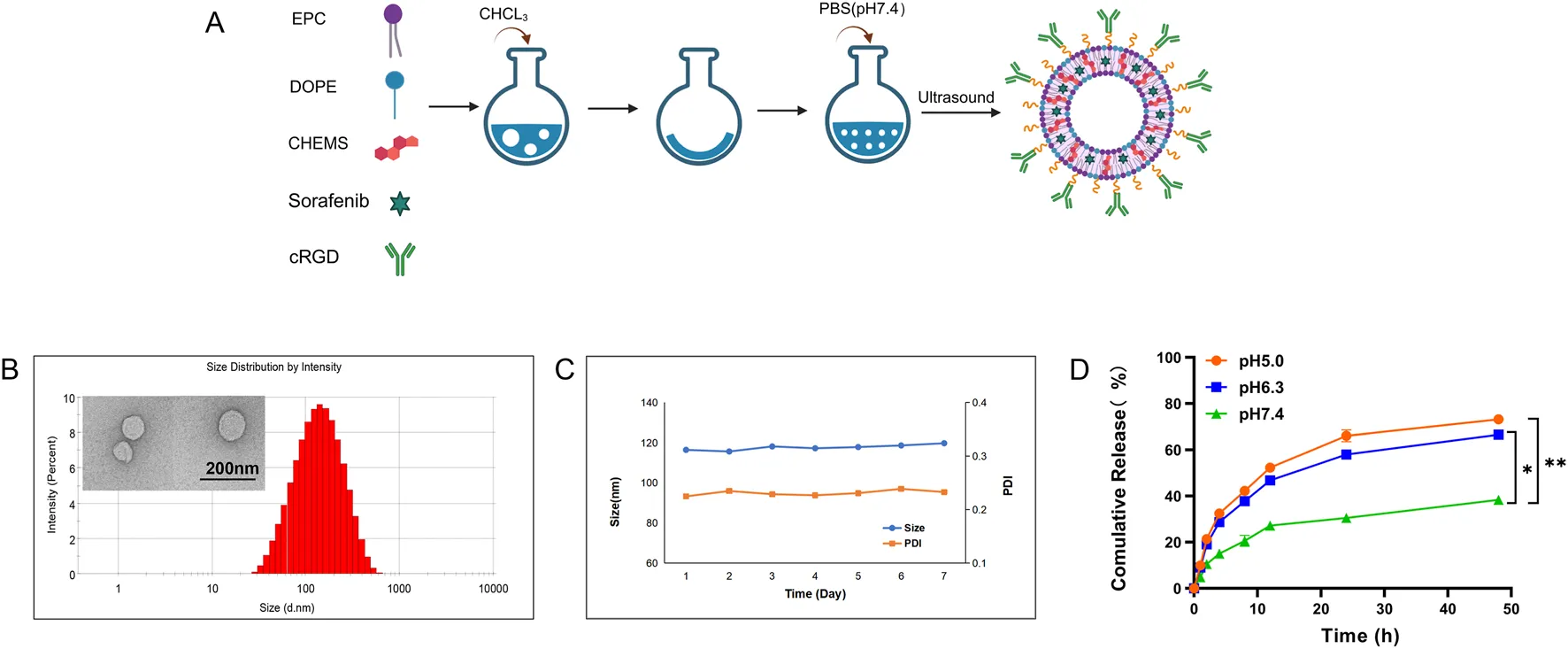
Recent literature illustrates the potential value of combining active targeting with pH-triggered mechanisms to maximize the therapeutic index. The figure illustrates the engineering rationale of a long-circulating pH-responsive liposome platform. The formulation integrates PEGylated/functionalized lipid components for systemic stability and tumor-oriented delivery, while pH-sensitive components enable controlled, site-associated payload release under acidic conditions.
As a representative example, a cRGD-modified pH-sensitive liposomal sorafenib formulation demonstrated a nanoscale particle size of approximately 117 nm, narrow size distribution, negative surface charge, high encapsulation efficiency, and pH-dependent release behavior. The formulation released a greater proportion of sorafenib under acidic pH than under physiological pH, supporting the concept of maintaining comparative stability during circulation while enhancing release under acidic tumor- or endosome-relevant conditions.
| Parameter | Representative Readout |
|---|---|
| Particle size | ~117 nm |
| PDI | ~0.22 |
| Zeta potential | Negative surface charge |
| Encapsulation efficiency | >80% |
| Release behavior | Higher release at acidic pH than pH 7.4 |
| Functional rationale | Long circulation + targeting + pH-triggered release |
Formulation Characterization and Clinical Translation
The transition from conceptual design to a viable therapeutic candidate requires rigorous quality control and analytical validation. Evaluating the morphological integrity and size distribution via Dynamic Light Scattering (DLS) and cryo-TEM is critical, but tracking the formulation's response under varying pH environments is what defines success. Researchers heavily rely on precise formulation stability monitoring to ensure that the liposomes retain their payload in serum while demonstrating distinct, quantifiable release kinetics under acidic conditions.
A robust validation pathway typically encompasses the following dimensions:
- Colloidal stability: particle size, PDI, zeta potential, aggregation tendency, and storage stability.
- Serum stability: payload retention and particle integrity in serum-containing media at physiological pH.
- pH-dependent release: comparative release kinetics at pH 7.4, 6.8, 6.5, 5.5, and 5.0.
- Cellular uptake: uptake efficiency in target cells, with or without active targeting ligands.
- Endosomal escape: cytosolic payload delivery, endosomal disruption, or functional RNA/protein activity after internalization.
- In vivo performance: circulation half-life, biodistribution, tumor accumulation, therapeutic efficacy, and tolerability.
| Property | Conventional Liposomes | PEGylated (Stealth) Liposomes | Long-Circulating pH-Responsive Liposomes |
|---|---|---|---|
| Systemic Circulation Time | Short | Long | Long |
| Immune Clearance (RES) | High | Low | Reduced, depending on surface chemistry and repeat dosing profile |
| Tumor/Site Accumulation | Low | High (Passive EPR) | Potentially enhanced through long circulation, EPR, targeting, and pH-triggered activation |
| Cellular Uptake & Escape | Variable; often limited without fusogenic or targeting features | Low (PEG Dilemma) | High (pH Triggered) |
| Target Microenvironment Specificity | Low | Low | Enhanced when pH trigger and targeting are well tuned |
Overcoming translational bottlenecks demands a holistic understanding of lipid chemistry, manufacturing scalability, and rigorous in vivo pharmacokinetic modeling. Balancing "stealth" and "activation" within a single, highly stable vesicular structure remains a priority in modern nanomedicine.
Frequently Asked Questions
Traditional PEGylated liposomes excel at avoiding immune clearance and extending blood circulation, but their dense polymer coating creates a "PEG dilemma"—hindering the liposome from fusing with target cell membranes and releasing its drug. A pH-responsive design solves this by maintaining the protective PEG layer in the neutral pH of the bloodstream, but actively shedding the PEG or undergoing structural changes once exposed to the acidic environment of tumors or intracellular endosomes. The goal is not maximum stability, but conditional stability, ensuring both stealth delivery and highly efficient payload release.
This is typically achieved through three main strategies: incorporating acid-labile bonds (such as hydrazone) between the lipid anchor and the PEG chain that cleave at low pH, where linker stability is paramount; using ionizable lipids that change charge from neutral to cationic in acidic conditions to disrupt endosomes, demanding precise tuning of the lipid pKa; or using lipid combinations (like DOPE and CHEMS) that undergo a profound structural phase transition upon acidification, which requires careful optimization of the DOPE/CHEMS ratio to prevent premature leakage.
The activation window should be selected according to the intended biological trigger. A formulation intended to respond in the tumor microenvironment may be tuned toward mild acidity (pH 6.5–6.8), while an endosomal escape-focused formulation may require stronger activation at lower pH (pH 5.0–5.5). In both cases, release at pH 7.4 should remain sufficiently controlled to reduce premature leakage during systemic circulation.
During early screening, formulation scientists must prioritize multi-dimensional validation. The most critical assays include Dynamic Light Scattering (DLS) for particle size and PDI, zeta potential analysis, precise quantification of encapsulation efficiency, long-term serum stability, robust pH-dependent release kinetics across physiological and acidic gradients, as well as in vitro cell uptake and endosomal escape tracking.
Yes, they are highly suitable. The systemic delivery of RNA (like siRNA or mRNA) requires strict protection from serum nucleases and the ability to escape the endosome before lysosomal degradation occurs. A pH-responsive mechanism, particularly one utilizing ionizable lipids, is critical for RNA therapies because it facilitates rapid endosomal membrane disruption immediately after cellular uptake, promoting cytosolic availability of the RNA payload before lysosomal degradation.
References
- Yang, Xu, et al. "Dual-Functional cRGD/pH-Sensitive Liposomes Loaded with Sorafenib: A Novel Therapeutic Approach for Hepatocellular Carcinoma." Frontiers in Nanotechnology 8: 1760783. https://doi.org/10.3389/fnano.2026.1760783
- Under Open Access license CC BY 4.0, without modification.
Online Inquiry
This site is protected by reCAPTCHA and the Google Privacy Policy and Terms of Service apply.