
Functional Liposome Validation Workflow for Uptake, Localization, Release, and Stability
A decision-oriented resource for functionalized, targeted, imaging, and stimuli-responsive liposomes that must connect cellular uptake, intracellular localization, payload release, and formulation stability into one defensible validation story.
Validation Questions Answered
- 01Does the formulation enter the intended target cells?
- 02Does it traffic to productive intracellular or tissue compartments?
- 03Does the payload release under the intended trigger or time window?
- 04Does stability support storage, serum exposure, and downstream activity?
Why Functional Liposome Validation Requires a Closed-Loop Workflow
Functional liposome validation is not simply a collection of uptake, imaging, release, and stability assays. For functionalized liposomes, targeted liposomes, imaging liposomes, and stimuli-responsive liposomes, the central question is whether these datasets connect into a defensible delivery story. A candidate may show strong cellular uptake but remain trapped in lysosomes, localize to the expected tissue but release payload too slowly, or demonstrate promising release kinetics in buffer while losing payload in serum or during storage.
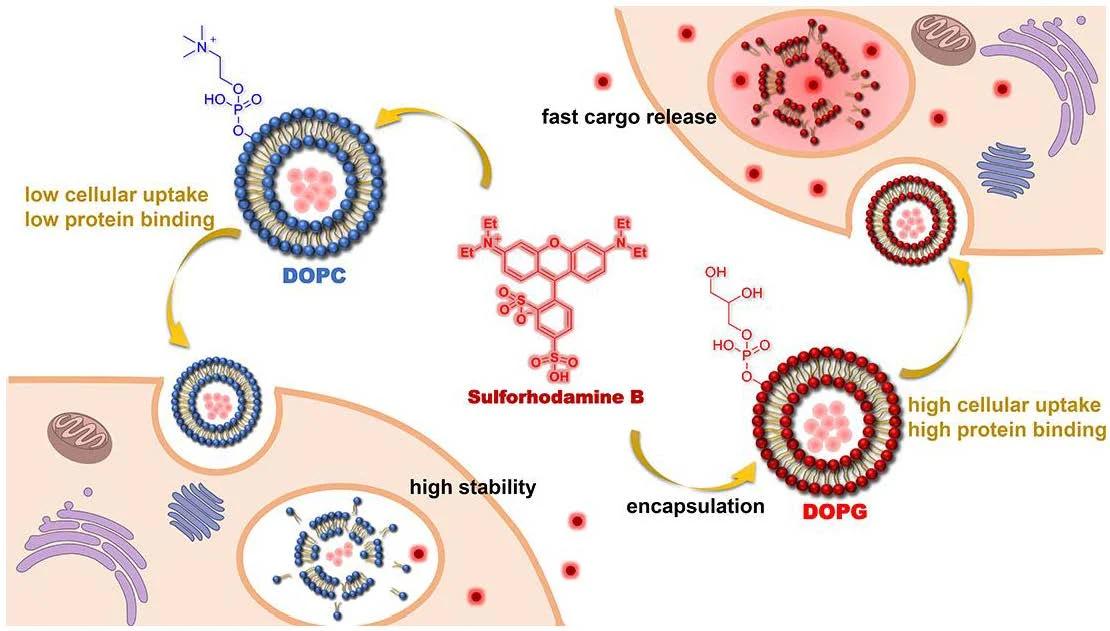
A closed-loop validation workflow helps researchers identify where delivery fails, compare lead formulations, and move from formulation design toward preclinical decision-making. Recent liposome validation studies highlight the importance of evaluating extracellular stability and intracellular release together. For customized functional liposomes, this principle can be extended into an integrated workflow that links what happens before cell entry with what happens after internalization.
In practice, the workflow should define formulation intent first, then test uptake, localization, release, and stability as connected performance endpoints. If one endpoint fails, the data should feed back into lipid composition, PEG density, ligand density, charge, release trigger, or storage-condition optimization rather than being reported as an isolated result.
The Functional Liposome Validation Loop
A practical functional liposome validation workflow begins with formulation intent and ends with formulation optimization. Each step asks a different question, but the output from one step should guide the next experimental decision.
Define Intent
Set the target cell, payload, trigger, administration route, and acceptance criteria before assay design.
Confirm Uptake
Quantify internalization, target-cell selectivity, dose response, and receptor contribution.
Verify Localization
Determine whether the carrier and payload reach productive compartments rather than dead-end trafficking sites.
Measure Release
Connect payload liberation with time, trigger specificity, and cell-associated functional activity.
Feed Back Stability
Use storage, serum, plasma, and stress data to refine lipid composition and handling conditions.
Assay Endpoints for Functional Liposome Validation
The strongest validation packages combine orthogonal assays. Quantitative assays rank candidates, imaging assays explain mechanism, and stability assays clarify whether delivery failure begins before or after biological exposure.
Uptake: proving entry before interpreting activity
Uptake is the first gate in functional liposome validation. Useful readouts include percent positive cells, median fluorescence intensity, internalized-to-surface-bound ratio, uptake inhibition after ligand competition, and uptake in target versus non-target cells. Flow cytometry, plate-based fluorescence, and microscopy-based quantification can be combined to distinguish simple binding from true internalization.
For ligand-modified formulations, receptor-blocking controls and matched cell panels help confirm whether uptake reflects the intended targeting mechanism. For teams developing receptor-directed systems, Targeted Liposome Development Service can support formulation design before uptake validation begins.
Localization: confirming productive trafficking
Localization studies answer where the liposome and payload go after entry. Confocal microscopy, live-cell imaging, and organelle-marker colocalization can evaluate endosome and lysosome overlap, nuclear or cytosolic availability, and carrier-payload signal separation. Useful decision metrics include Pearson's correlation coefficient, time-course trafficking, and the fraction of signal associated with productive compartments.
Localization is especially important for imaging liposomes and stimuli-responsive liposomes because signal may not equal release. A carrier may reach the right cell but remain in the wrong compartment, creating weak activity despite high uptake.
Release: connecting internalization to payload availability
Payload release should be tested in buffer, biological medium, and relevant cell-associated conditions. Depending on the payload and trigger, release readouts may include fluorescence dequenching, dialysis or separation-based quantification, LC-based payload recovery, and cell-based activity after exposure. The goal is to distinguish controlled release from premature leakage.
View ;in vitro Release Kinetics AnalysisStability: explaining reproducibility and biological performance
Stability monitoring should include particle size change, PDI drift, encapsulation retention, leakage percentage, zeta potential shift, and serum or plasma incubation stability. Storage temperature, freeze-thaw exposure, dilution, and biological-fluid aging can reveal why an otherwise promising formulation performs inconsistently.
Integrated Formulation Stability Monitoring Service helps connect physical stability with downstream uptake and release outcomes for customized lipid-based delivery systems.
Troubleshooting Functional Liposome Delivery Failure
A closed-loop validation strategy turns unexpected assay results into next-step decisions. The table below illustrates how uptake, localization, release, and stability data can be interpreted together.
| Observation | Possible Failure Mode | Recommended Validation Next Step |
|---|---|---|
| High uptake, weak activity | Endosomal or lysosomal trapping, or poor payload release | Add colocalization imaging and intracellular release assays |
| Good localization, low payload effect | Delayed release or payload degradation | Compare trigger-specific release and cell-based activity |
| Strong release in buffer, weak serum performance | Premature leakage or protein-corona-driven instability | Add serum aging, SEC, DLS, and encapsulation-retention testing |
| Good in vitro result, inconsistent in vivo signal | Biodistribution or biological stability issue | Add ex vivo imaging and biological-fluid stability testing |
How Creative Biolabs Supports Functional Liposome Validation
Creative Biolabs supports researchers who need to translate functional liposome design into ranked, decision-ready validation evidence. The deliverable is not only an assay report; it is an integrated interpretation of whether the formulation entered cells, reached the right compartment, released payload, and remained stable enough to support reproducible performance.
Outputs can include formulation ranking, assay-method recommendations, failure-mode interpretation, and troubleshooting suggestions for the next design cycle.
Uptake assay design
Cell-panel selection, dose/time design, ligand competition, and target versus non-target uptake comparison.
Imaging and localization
Carrier and payload tracking, organelle-marker overlap, trafficking time course, and productive-compartment analysis.
Release and activity linkage
Release kinetics, trigger specificity, intracellular availability, and cell-associated functional readouts.
Stability-informed optimization
Storage, serum, plasma, and stress-condition testing integrated with formulation-ranking recommendations.
Functional Liposome Validation: From Isolated Assay Data to Lead-Formulation Decisions
The value of functional liposome validation lies in connecting evidence. Uptake confirms exposure, localization explains intracellular fate, release verifies payload availability, and stability determines whether performance can be reproduced after storage and biological challenge. When these endpoints are reviewed together, formulation scientists can decide whether to advance a lead, redesign a trigger, adjust ligand density, rebalance membrane composition, or improve storage conditions.
This integrated logic is useful for early feasibility studies, lead optimization, imaging-liposome characterization, stimuli-responsive formulation design, and preclinical package planning. It also improves communication between formulation, biology, and pharmacology teams because every endpoint maps to a clear delivery question.
Frequently Asked Questions
Begin with formulation intent: target cell type, payload, release trigger, administration route, and expected decision criteria. Then select orthogonal assays for uptake, localization, release, and stability. The workflow should be designed so that each result informs the next formulation decision rather than creating disconnected assay outputs.
High uptake can reflect surface binding, nonproductive endocytosis, lysosomal trapping, or insufficient payload release. Localization imaging and intracellular release assays help distinguish whether the formulation enters cells productively or accumulates in compartments that prevent payload action.
Key endpoints include particle size, PDI, zeta potential, encapsulation retention, leakage percentage, serum or plasma incubation stability, and stress-condition response. These data explain whether poor biological performance arises from instability before delivery or from ineffective intracellular release after uptake.
Lead selection becomes stronger when uptake, localization, release, and stability are interpreted together. A formulation with moderate uptake but strong productive release and stability may be a better candidate than one with high uptake but lysosomal trapping or rapid serum leakage.
Yes, the logic is consistent, but assay details differ. Targeted liposomes require selectivity and competition controls, imaging liposomes require signal localization and signal-retention checks, and stimuli-responsive liposomes require trigger-specific release and stability testing under relevant biological conditions.
References
- Yang, Keni, Karolina Tran, and Anna Salvati. "Tuning liposome stability in biological environments and intracellular drug release kinetics." Biomolecules 13.1 (2023): 59. https://doi.org/10.3390/biom13010059
- Under Open Access license CC BY 4.0, without modification.
- Gandek, T., van der Koog, L., and Nagelkerke, A. "A Comparison of Cellular Uptake Mechanisms, Delivery Efficacy, and Intracellular Fate between Liposomes and Extracellular Vesicles." Advanced Healthcare Materials 12.25 (2023): 2300319. https://doi.org/10.1002/adhm.202300319
- AlSawaftah, Nour, William G. Pitt, and Ghaleb A. Husseini. "Dual-Targeting and Stimuli-Triggered Liposomal Drug Delivery in Cancer Treatment." ACS Pharmacology & Translational Science 4.3 (2021): 1028-1049. https://doi.org/10.1021/acsptsci.1c00066
- Sainaga Jyothi, V. G. S., et al. "Stability characterization for pharmaceutical liposome product development with focus on regulatory considerations: An update." International Journal of Pharmaceutics 624 (2022): 122022. https://doi.org/10.1016/j.ijpharm.2022.122022
Online Inquiry
This site is protected by reCAPTCHA and the Google Privacy Policy and Terms of Service apply.