
Optimizing Membrane Stability and Drug Compatibility
with PG Anionic Liposomes
Advanced engineering strategies to resolve membrane instability during storage, improve payload encapsulation, and overcome inefficient drug release in pharmaceutical formulation.
Strategic Advantages of PG Anionic Liposomes in Drug Delivery
The development of sophisticated drug delivery systems is a cornerstone of modern pharmacotherapeutics. Among the various nanocarrier platforms, liposomes have proven to be exceptionally versatile. However, pharmaceutical researchers, biotech companies, and formulation engineers consistently face critical bottlenecks when utilizing traditional neutral liposomes: pronounced membrane instability during extended storage, sub-optimal drug compatibility (particularly with highly hydrophilic or charged active pharmaceutical ingredients), and erratic or inefficient drug release profiles in vivo.
To overcome these systemic challenges, the strategic incorporation of negatively charged lipids—specifically Phosphatidylglycerol (PG)—has emerged as a highly effective engineering solution. A PG anionic liposome is formulated by integrating PG lipids into the lipid bilayer matrix alongside neutral phospholipids (such as PC) and cholesterol. This architectural modification imparts a net negative charge to the vesicular surface, transforming the physicochemical properties of the nanoparticle.
By introducing a PG anionic liposome into a formulation pipeline, developers can leverage thermodynamic stability and electrostatic principles to dramatically enhance the performance metrics of their drug delivery vehicles. This leads to extended shelf-life, precise payload retention, and improved clinical safety profiles, addressing the exact pain points that hinder the translational success of novel therapeutics.
Mechanisms of Membrane Stabilization
One of the primary causes of liposomal degradation during transport and storage is physical instability, manifesting as aggregation, flocculation, or fusion (Ostwald ripening). These phenomena lead to payload leakage and variations in particle size distribution, rendering the formulation clinically unviable.
The inclusion of phosphatidylglycerol fundamentally alters the suspension dynamics through the principles of Derjaguin-Landau-Verwey-Overbeek (DLVO) theory. The PG anionic liposome presents a robust negative surface charge (measurable via negative zeta potential). This generates a strong electrostatic double layer around each vesicle. As particles approach each other, electrostatic repulsion overcomes van der Waals attractive forces, establishing a potent energy barrier against aggregation.
Furthermore, the specific hydration profile of the PG headgroup contributes to membrane rigidification and stability without compromising flexibility. This is critical for preventing phase transitions during thermal fluctuations associated with global supply chain logistics. To ensure the optimal ratio of these structural components in your bespoke formulations, researchers frequently rely on rigorous Structure and Composition Analysis to validate the integrity and uniformity of the lipid bilayer before advancing to in vivo trials.
Key Stability Benefits
- ✓ Electrostatic Repulsion: Prevents vesicle collision and subsequent fusion during long-term aqueous storage.
- ✓ Hydration Layer Integrity: The glycerol headgroup forms stable hydrogen bonds with interfacial water.
- ✓ Lyophilization Resistance: Enhanced structural resilience during freeze-drying and reconstitution processes.
Optimizing Payload Compatibility and Encapsulation
Achieving high encapsulation efficiency (EE) and superior drug retention is a significant hurdle, particularly for amphiphilic or weakly basic therapeutic agents.
A PG anionic liposome offers a unique internal and inter-facial environment that actively promotes drug compatibility. For cationic or weakly basic drugs, the negatively charged PG headgroups can facilitate electrostatic interactions (ion-pairing) at the lipid-water interface. This interaction not only drives higher initial drug loading during active loading processes (such as the ammonium sulfate gradient method) but also creates an internal "anchoring" effect that minimizes premature drug leakage during systemic circulation.
By fine-tuning the molar ratio of PG within the liposome matrix, formulators can directly modulate the release kinetics of the API. This ensures that the drug is retained tightly within the carrier while traversing the bloodstream, and is only released upon reaching the target microenvironment (such as the acidic interior of an endolysosome following cellular uptake). Developing these highly specific, customized systems requires deep technical expertise, which is why biotech companies frequently collaborate with specialized Anionic Liposome Development Service providers to accelerate their R&D pipelines from bench to clinic.
Pharmacokinetics and Biodistribution Dynamics
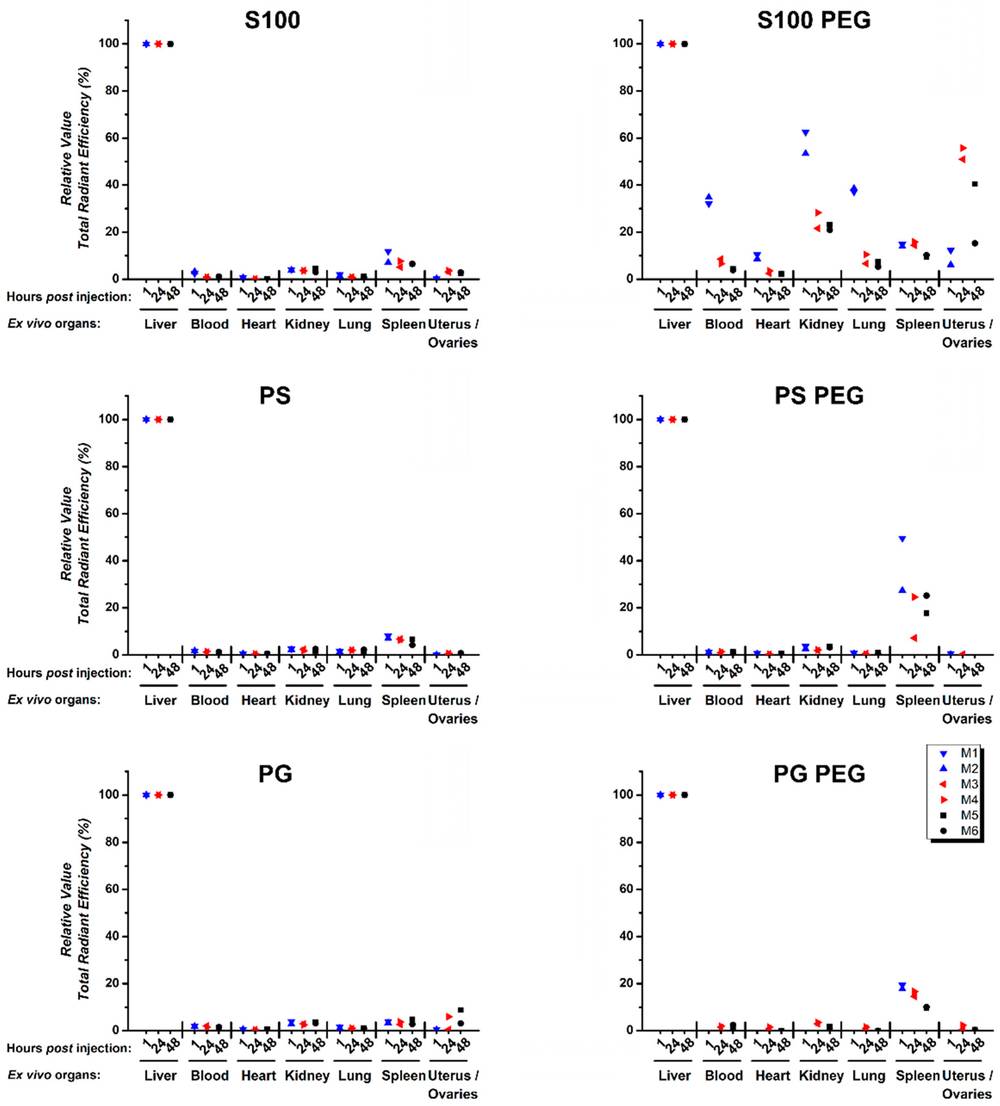
The translation of liposomal stability from an in vitro setting to an in vivo biological system is complex. Upon intravenous administration, liposomes interact with serum proteins (forming a protein corona) and the mononuclear phagocyte system (MPS). The surface chemistry of a PG anionic liposome dictates these interactions.
The provided figure demonstrates a rigorous analysis of biodistribution. The figure shows the ex vivo fluorescence intensity patterns of DiR-labeled liposomes in mouse organs, reflecting how anionic PG-enriched liposomes distribute in vivo compared with PEGylated counterparts. This highlights how lipid composition and surface modification influence circulation stability and biodistribution — key factors when optimizing membrane stability and payload compatibility.
While PEGylation (steric stabilization) is traditionally used to evade MPS clearance, incorporating PG lipids offers nuanced biodistribution profiles. Unmodified, highly charged anionic liposomes are often rapidly cleared by the liver and spleen (as seen in rapid clearance models). However, purposefully engineered PG ratios, sometimes in conjunction with stealth polymers, can be utilized to specifically target macrophages or alter the accumulation kinetics in targeted organ tissues, making them invaluable for specific anti-inflammatory or immunomodulatory applications.
Formulation Strategy: PG vs. PS Anionic Liposomes
When selecting an anionic lipid, researchers primarily choose between Phosphatidylglycerol (PG) and Phosphatidylserine (PS). While both impart a negative charge, their biological implications differ significantly, necessitating careful selection based on therapeutic goals.
| Characteristic | PG Anionic Liposomes | PS Anionic Liposomes |
|---|---|---|
| Biological Presence | Major component of pulmonary surfactant. | Found primarily in inner leaflet of plasma membranes. |
| Macrophage Interaction | Lower basal macrophage affinity; tunable for systemic delivery. | Strong "eat-me" signal; highly specific for targeted macrophage uptake. |
| Primary Applications | Pulmonary delivery, systemic stealth formulations, generic drug encapsulation. | Immunotherapy, resolving inflammation, targeted delivery to RES. |
| Membrane Rigidity | Provides flexible yet highly stable bilayer architecture. | Can increase rigidity depending on acyl chain saturation. |
For projects specifically requiring macrophage targeting via Phosphatidylserine:
Explore PS Anionic Liposome Development ServiceBiocompatibility and Preclinical Safety Evaluation
A definitive advantage of the PG anionic liposome lies in its extraordinary biocompatibility. Phosphatidylglycerol is a naturally occurring lipid, highly abundant in human pulmonary surfactant. Consequently, liposomes formulated with PG exhibit minimal cytotoxicity and excellent tolerability, making them ideal candidates for both inhalation therapies and intravenous administration. Despite this inherent safety, rigorous preclinical testing is mandatory to evaluate formulation-specific interactions, compliment activation, and potential immunogenic responses.
View Formulation Safety Evaluation SolutionsFrequently Asked Questions
A PG anionic liposome possesses a net negative surface charge derived from the phosphatidylglycerol headgroups. This negative zeta potential creates strong electrostatic repulsion between individual liposome vesicles in the aqueous suspension. This repulsive force effectively counteracts van der Waals attractions, preventing vesicle aggregation, fusion, and Ostwald ripening, thereby significantly extending the formulation's physical stability and shelf-life during storage.
PG lipids facilitate improved drug compatibility through electrostatic ion-pairing. Weakly basic or cationic active pharmaceutical ingredients (APIs) interact strongly with the negatively charged PG headgroups at the internal aqueous-lipid interface. This electrostatic anchoring enhances the initial encapsulation efficiency during active loading procedures and significantly limits premature drug leakage during systemic circulation.
Yes, they are highly suitable. Phosphatidylglycerol is a primary, naturally occurring component of human pulmonary lung surfactant. Consequently, a PG anionic liposome exhibits excellent biocompatibility and low pulmonary toxicity, making it an ideal carrier matrix for aerosolized delivery of antibiotics, corticosteroids, or gene therapies directly to the respiratory tract.
While both are negatively charged, their biological recognition pathways differ. Phosphatidylserine (PS) acts as a strong biological "eat-me" signal, leading to rapid, highly specific recognition and phagocytosis by tissue macrophages (particularly in the spleen and liver). Phosphatidylglycerol (PG) is generally less immunogenic and does not trigger the same immediate receptor-mediated macrophage uptake, allowing for distinct pharmacokinetic profiles and broader systemic application potential depending on the exact formulation ratio.
Yes, PEGylation is frequently combined with PG lipid integration. While PG provides baseline membrane stability and payload retention, adding PEG-lipids (steric stabilization) masks the negative surface charge from serum opsonins. This dual strategy leverages the internal structural benefits of PG for drug compatibility while utilizing the external PEG corona to evade the reticuloendothelial system (RES) and prolong in vivo circulation half-life.
References
- Klein, Miriam E., et al. "Towards the development of long circulating phosphatidylserine (PS)-and phosphatidylglycerol (PG)-enriched anti-inflammatory liposomes: is PEGylation effective?." Pharmaceutics 13.2 (2021): 282. https://doi.org/10.3390/pharmaceutics13020282
- Under Open Access license CC BY 4.0, without modification.
Online Inquiry
This site is protected by reCAPTCHA and the Google Privacy Policy and Terms of Service apply.