
Dual Validation Strategies for ROS-Responsive Liposome Development
Practical guidance for formulation scientists and preclinical teams on validating storage stability, passive leakage, and ROS-triggered release efficiency before advancing responsive liposome candidates into deeper development.
The Inherent Trade-Off in Stimuli-Responsive Systems
Reactive oxygen species (ROS)-responsive delivery has become an important strategy for disease-associated drug release, particularly in tumor microenvironments, inflamed tissues, fibrotic lesions, and other oxidative stress-related sites. By incorporating ROS-cleavable or ROS-transformable lipid components, liposomes can be engineered to remain relatively stable under non-triggering conditions while releasing payloads more efficiently in oxidative microenvironments.
The central challenge is the stability–responsiveness balance. Researchers need ROS-responsive liposome development strategies that generate nanocarriers capable of tolerating preparation stress, storage, dilution, serum exposure, and circulation-like conditions without unacceptable payload leakage. At the same time, the formulation must show a measurable and mechanism-linked release response when exposed to disease-relevant ROS levels.
A meaningful validation workflow must therefore distinguish true ROS-triggered payload release from false-positive signals caused by passive leakage, lipid peroxidation, osmotic stress, vesicle rupture during handling, fluorescence quenching, or analytical interference. Orthogonal assays should map both pre-trigger integrity and post-trigger release kinetics before the candidate is advanced into in vitro efficacy, cellular uptake, in vivo biodistribution, or outsourced formulation development studies.
Core Dilemmas in Validation
- 01 Pre-Trigger Integrity: ROS-sensitive lipid components must remain chemically and colloidally stable during preparation, storage, dilution, and serum exposure.
- 02 Passive Leakage vs. Triggered Release: Payload release must be compared against matched no-ROS controls to avoid overestimating responsiveness.
- 03 Mechanism Verification: Size change, bilayer disruption, linker cleavage, or morphology shift should support the proposed ROS-triggered release pathway.
- 04 Assay Artifact Control: ROS exposure may affect payload stability, fluorescent probes, dialysis behavior, or analytical readouts, requiring appropriate controls.
Rigorous Baseline Stability Evaluation
Before evaluating oxidative responsiveness, a stringent baseline of the formulation's physical and chemical integrity must be established. Without a robust baseline, downstream kinetic data remains ambiguous.
Colloidal Integrity Monitoring
Dynamic Light Scattering (DLS), electrophoretic light scattering, and zeta potential measurements should be performed immediately after preparation and during storage or incubation in project-relevant media, such as PBS, serum-containing buffer, or cell culture medium. Instead of relying on a single size value, scientists should track changes in particle size, PDI, aggregation tendency, and surface charge before ROS exposure. Any significant size drift in no-ROS controls should be treated as baseline instability rather than triggered release.
Chemical Oxidation Resistance
Chemical stability testing should confirm whether the intended ROS-sensitive motif is the dominant reactive site. Unsaturated phospholipids, oxidizable linkers, PEG-lipid components, and the payload itself may undergo non-specific degradation. LC-MS, HPLC, or other composition analysis methods can help identify lipid oxidation products, linker cleavage, payload degradation, or excipient-related changes before the formulation is challenged with ROS.
Background Leakage Assessment
Passive payload leakage should be quantified under matched no-ROS conditions across storage, dilution, and physiological incubation windows. This background release curve becomes the reference for interpreting ROS-triggered IVR data. A formulation with high passive leakage may still show apparent release under ROS, but the response may not be sufficiently selective for targeted delivery.
Validating True ROS-Triggered Release Efficiency
Simulated Oxidative Environments
Concentration-Dependent Kinetics
Once baseline stability is confirmed, researchers must evaluate how efficiently the liposome dismantles in response to oxidative stress. A central requirement for ROS-responsive liposome development is to prove that the release mechanism is directly correlated with the local concentration of ROS, such as hydrogen peroxide (H₂O₂), superoxide, or hydroxyl radicals.
ROS-triggered IVR assays should use model-appropriate oxidant gradients rather than a universal H₂O₂ concentration range. Depending on the disease model, linker chemistry, payload stability, and assay format, researchers may compare no-ROS controls with low, intermediate, and high oxidative conditions. The key requirement is to demonstrate a reproducible concentration- and time-dependent release profile that clearly exceeds passive leakage under matched non-triggered conditions.
For example, a representative thioketal-containing ROS-responsive liposome study evaluated release under 1 μM, 10 μM, and 100 μM H₂O₂ and observed progressively higher payload release over time. This type of gradient-based IVR design is more informative than relying on a single high oxidant concentration, because it helps determine whether release is genuinely ROS-dependent or simply caused by harsh oxidative stress.
Mechanistic Verification
Morphological and Structural Transitions
It is equally important to document how the trigger works. Does ROS exposure increase membrane permeability, cleave a protective linker, disrupt the PEG shell, induce vesicle swelling, or cause partial bilayer fragmentation? High-resolution imaging and structural analysis provide orthogonal mechanistic evidence that complements release kinetics.
Transmission Electron Microscopy (TEM), cryo-TEM, AFM, particle size analysis, and composition analysis can be used before and after ROS exposure to evaluate morphological and structural transitions. Pairing functional release assays with structure and composition analysis helps confirm whether the observed release is consistent with the intended ROS-responsive mechanism.
Avoiding False Positives in ROS-Triggered Release Assays
A strong ROS-responsive liposome development program should include controls that rule out false-positive release signals. Oxidants may degrade the payload directly, alter fluorescent probes, change dialysis membrane behavior, or destabilize non-responsive liposomes. Without these controls, a high release percentage may reflect assay interference rather than engineered responsiveness.
Recommended controls include no-ROS release controls, non-responsive liposome controls with the same payload, payload-only controls exposed to ROS, aged formulation samples, and ROS-scavenger conditions when compatible with the assay. These controls help determine whether the observed release is caused by the intended ROS-sensitive lipid architecture.
| Control | Purpose |
|---|---|
| No-ROS control | Quantifies passive leakage under matched incubation conditions. |
| Non-responsive liposome control | Determines whether ROS causes nonspecific vesicle disruption. |
| Payload-only ROS exposure | Identifies payload degradation or analytical signal interference. |
| Aged formulation sample | Tests whether storage weakens stability or responsiveness. |
| ROS-scavenger condition | Supports ROS-dependence when compatible with the assay system. |
Literature Case Study in Dual Validation
Advanced ROS-responsive liposome development depends on tightly integrated analytical assays. Analyzing peer-reviewed successes provides a strategic roadmap for formulation design and comprehensive structural validation.
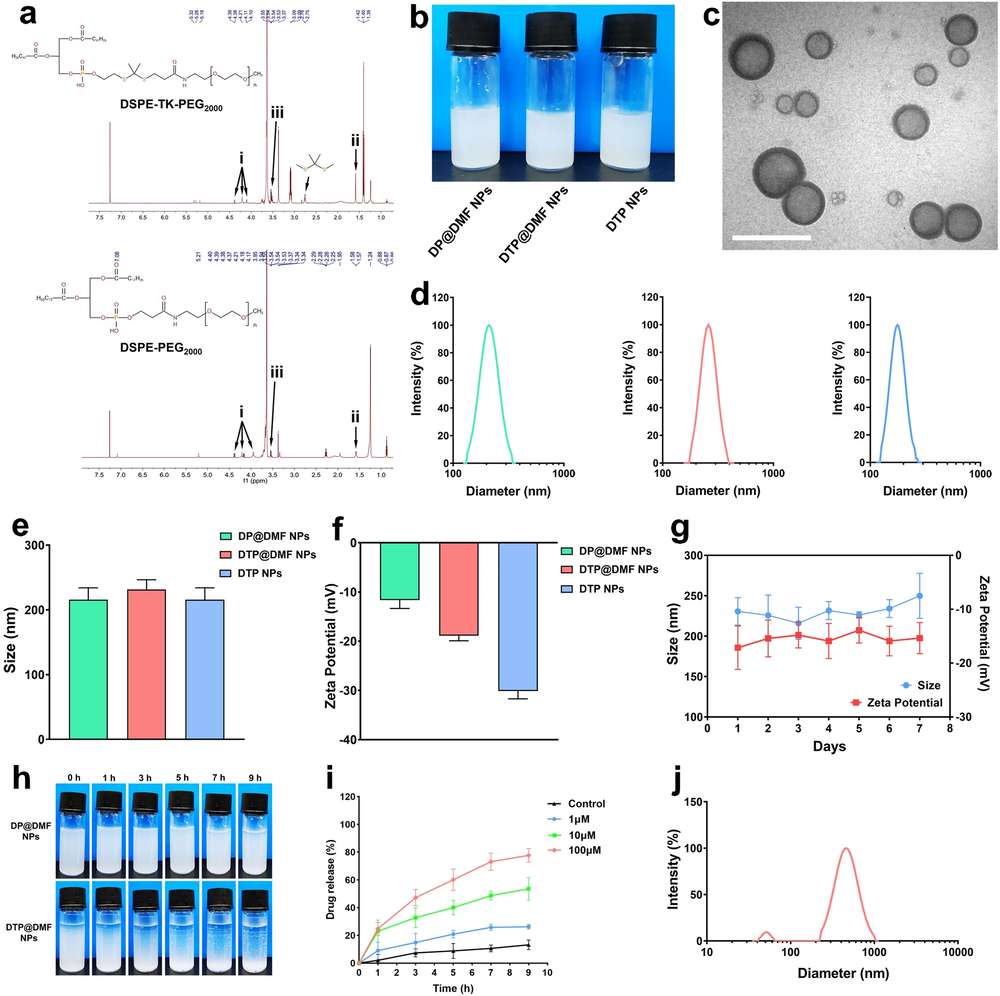
A representative study of DSPE-TK-PEG@DMF ROS-responsive liposomes demonstrates how stability and trigger efficiency can be evaluated together. The formulation was characterized by TEM, particle size distribution, zeta potential, encapsulation efficiency, and drug loading capacity. Stability was also evaluated after freeze-drying and rehydration, which is relevant for storage and practical development considerations.
Trigger efficiency was then tested using H₂O₂ gradients. The study compared release behavior in the absence and presence of H₂O₂ and showed concentration-dependent DMF release under oxidative conditions. After incubation with 100 μM H₂O₂, particle size homogeneity was disrupted and TEM images showed broken nanoparticles and debris, providing structural evidence that supported the release data. Although this case focuses on pulmonary fibrosis, the same dual-validation logic is directly applicable to oncology and inflammation programs where ROS-triggered release must be separated from passive leakage or nonspecific instability.
Strategic Validation Framework
| Validation Domain | Key Parameters Evaluated | Analytical Techniques | Success Criteria |
|---|---|---|---|
| Baseline Stability | Size, PDI, Zeta Potential | DLS, ELS | Project-defined acceptable drift with no aggregation trend in no-ROS controls. |
| Passive Drug Leakage | Dialysis, HPLC/UV-Vis | Low and reproducible background release relative to ROS-triggered release. | |
| Trigger Efficiency | Concentration/Time Kinetics | IVR Assays in H₂O₂ Gradients | Clear concentration- and time-dependent release above matched no-ROS controls. |
| Morphological Destabilization | TEM, AFM | Post-trigger structural change consistent with the proposed release mechanism. |
Mastering this dual validation is a critical step before initiating advanced cell-based studies, animal models, biodistribution analysis, or outsourced formulation optimization. By combining stability profiling, IVR kinetics, structural characterization, and artifact controls, researchers can make better decisions on whether a ROS-responsive liposome candidate is ready for deeper preclinical development.
Request a ROS-Responsive Liposome Validation PlanFrequently Asked Questions
The most reliable approach is to run matched IVR assays with a no-ROS control, one or more ROS-treated groups, and ideally a non-responsive liposome control. Passive leakage is defined by the release observed under identical incubation conditions without ROS. A genuine triggered response is supported when ROS-treated samples show reproducible, concentration- and time-dependent release that clearly exceeds the no-ROS baseline and is consistent with structural or chemical evidence of liposome destabilization.
Preventing premature oxidation requires control of both formulation composition and storage conditions. Depending on the lipid chemistry, researchers may reduce light exposure, limit oxygen exposure, use inert gas protection, optimize buffer composition, and evaluate lyophilization with suitable cryoprotectants. Stability should then be confirmed by measuring particle size, PDI, zeta potential, payload retention, and chemical degradation before downstream in vitro or in vivo studies.
Morphological analysis provides structural evidence that supports the proposed release mechanism. TEM, cryo-TEM, AFM, or complementary particle analysis can show whether ROS exposure is associated with swelling, aggregation, membrane disruption, fragmentation, or other structural transitions. These data are most useful when interpreted alongside IVR kinetics and payload quantification.
No, DLS alone is insufficient. While DLS effectively tracks changes in macroscopic particle size and aggregation (PDI) over time, it cannot measure chemical lipid peroxidation or quantify encapsulated drug retention. True stability validation requires combining physical metrics (DLS) with chemical assays (HPLC to track drug leakage and lipid integrity) to form a comprehensive safety profile.
The ROS-sensitive chemistry determines which trigger conditions and controls should be prioritized. Thioketal-containing lipids are commonly evaluated under oxidative conditions that can cleave or transform the TK linkage, while phenylboronic ester-containing systems are often assessed with H₂O₂-focused assays. However, the validation strategy should not rely only on one oxidant condition. It should include matched no-ROS controls, model-relevant ROS gradients, payload stability checks, and structural analysis after exposure.
References
- Liu, Junzhao, et al. "ROS-responsive liposomes as an inhaled drug delivery nanoplatform for idiopathic pulmonary fibrosis treatment via Nrf2 signaling." Journal of Nanobiotechnology 20.1 (2022): 213. https://doi.org/10.1186/s12951-022-01435-4
- Under Open Access license CC BY 4.0, without modification.
Online Inquiry
This site is protected by reCAPTCHA and the Google Privacy Policy and Terms of Service apply.