
Overview of Stimuli-Responsive Liposomes:
Design, Mechanisms, and Applications
Overcoming the limitations of traditional delivery systems with next-generation smart nanocarriers tailored for precise, trigger-activated therapeutic release.
Navigating the Paradigm Shift in Drug Delivery
The pharmaceutical landscape has been revolutionized by lipid-based nanoparticles, yet traditional liposome technologies frequently encounter profound clinical limitations. The core challenge resides in achieving high targeting precision combined with controlled, site-specific drug release. Conventional liposomes often suffer from premature cargo leakage in systemic circulation, off-target accumulation, and inadequate intracellular delivery, leading to suboptimal therapeutic efficacy and elevated systemic toxicity.
To address these critical pain points, biomedical engineering has pivoted toward stimuli-responsive liposome development. These "smart" nanocarriers are meticulously engineered to remain stable during blood circulation but rapidly destabilize and release their payload in response to specific pathological or external cues. This targeted approach leverages the inherent complexity of biological responses, capitalizing on unique physiological gradients found in diseased tissues.
Whether the target is the acidic microenvironment of solid tumors, the reactive oxygen species (ROS) enriched sites of inflammation, or externally applied spatiotemporal triggers like light and ultrasound, customizing the lipid bilayer is paramount. By integrating specific stimuli-responsive lipids, polymers, or peptides, researchers can dictate the exact location and timing of drug release, significantly improving therapeutic indices across a spectrum of diseases.
Resolving Clinical Bottlenecks
- Mitigating Off-Target Effects: Locking therapeutic cargo within the liposome until a localized trigger is detected.
- Enhancing Intracellular Delivery: Facilitating endosomal escape through pH-dependent membrane fusion.
- Improving Payload Bioavailability: Ensuring maximum drug concentration exactly where it is pharmacologically active.
Design Principles and Release Mechanisms
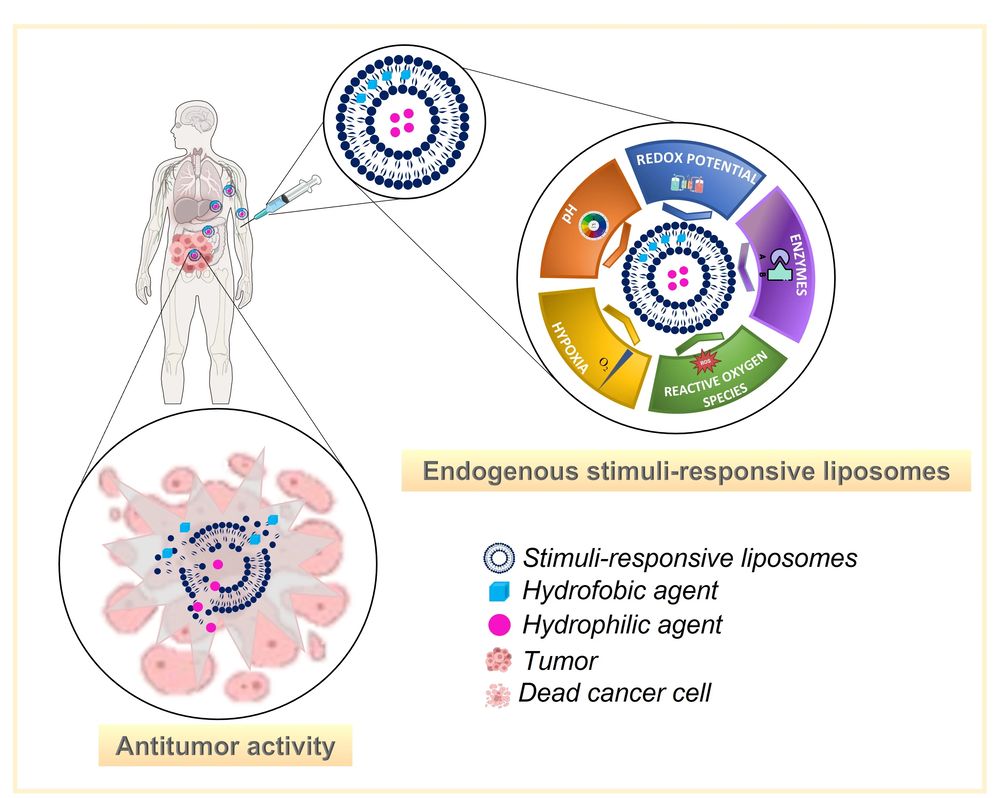
The architectural strategy behind stimuli-responsive liposomes involves engineering the lipid bilayer to undergo a phase transition, structural destabilization, or cleavage upon exposure to specific stimuli. This figure illustrates the design principles and mechanisms of endogenous stimuli-responsive liposomes, highlighting how internal triggers such as acidic pH, reactive oxygen species, and enzymatic activity can be exploited for site-specific drug release — a foundation for developing pH/ROS/ATP/light/ultrasound responsive lipid-based delivery systems.
For instance, the inclusion of lipids with specific head groups or acyl chains that react to variations in proton concentration can induce a hexagonal phase transition, promoting membrane fusion. Alternatively, chemical linkers designed to cleave under reducing conditions or in the presence of highly concentrated intracellular enzymes (like matrix metalloproteinases) provide a highly specific biological switch for cargo unloading.
Translating these complex mechanisms from theoretical chemistry to robust in vivo performance requires specialized expertise in lipid synthesis and formulation science. Researchers looking to streamline this process can leverage comprehensive Stimuli-Responsive Liposome Development Services to optimize structural integrity and responsiveness.
Harnessing Endogenous Biological Triggers
Endogenous stimuli exploit the inherent physiological differences between healthy and pathological tissues. By designing liposomes to recognize these microenvironmental signatures, researchers achieve profound localization of therapeutics without the need for external equipment.
pH-Responsive Liposomes
The tumor microenvironment (TME) is characteristically acidic (pH 6.5-6.8) due to the Warburg effect, while endo/lysosomal compartments drop even lower (pH 4.5-5.5). Formulations utilizing ionizable lipids or pH-sensitive polymers (like PEG-hydrazone derivatives) undergo protonation in these environments. This leads to bilayer disruption or endosomal escape, a critical factor that can be customized through specialized pH-Responsive Liposome Development Services to ensure rapid cytosolic delivery of RNA or cytotoxic drugs.
Redox and ROS-Responsive Systems
Inflammatory diseases and cancers exhibit significantly elevated levels of reactive oxygen species (ROS) and altered redox potentials (e.g., high intracellular glutathione). Liposomes engineered with disulfide bonds, thioketal linkers, or selenium-containing lipids undergo rapid cleavage or hydrophilic-hydrophobic shifts when exposed to these environments. This triggers a sudden release of the encapsulated payload precisely within the hyper-metabolic cells.
ATP and Enzyme Triggers
Intracellular ATP levels are significantly higher than extracellular environments. Aptamer-functionalized liposomes can undergo conformational changes upon ATP binding to release drugs. Similarly, overexpressed enzymes in the TME, such as matrix metalloproteinases (MMPs) or phospholipase A2 (PLA2), can be utilized to actively degrade specific lipid components or cleave protective PEG coronas, re-activating the liposome's cellular uptake mechanisms right at the disease site.
Mastering Spatiotemporal Control with Exogenous Stimuli
Exogenous stimuli offer an unprecedented level of control, allowing clinicians to dictate the exact moment and location of drug release using external devices. This approach drastically minimizes systemic toxicity, as the liposomes remain highly stable and inert until the precise application of the external field.
Light-Responsive Liposomes: Utilizing near-infrared (NIR) or ultraviolet (UV) light can trigger photochemical reactions—such as photoisomerization, photocleavage, or photothermal heating—within the lipid bilayer. For instance, incorporating plasmonic nanoparticles or photosensitizers allows for localized hyperthermia and membrane permeabilization, facilitated by targeted Light-Responsive Liposome Development pipelines.
Ultrasound-Responsive Liposomes: High-intensity focused ultrasound (HIFU) or low-frequency ultrasound can induce thermal and mechanical effects (cavitation) that disrupt liposomal membranes. Sonodynamic therapy combined with specific lipid formulations enhances deep-tissue penetration and localized delivery, providing non-invasive, deep-tissue targeting.
Discover Ultrasound-Responsive Liposome Development| Stimulus Type | Trigger Mechanism | Primary Application |
|---|---|---|
| pH (Endogenous) | Protonation, membrane fusion, endosomal escape | Solid tumors, intracellular RNA delivery |
| ROS/Redox (Endogenous) | Disulfide/thioketal cleavage, structural destabilization | Inflammation, cancer, neurodegeneration |
| Light (Exogenous) | Photoisomerization, photothermal heating | Superficial tumors, ocular therapies |
| Ultrasound (Exogenous) | Cavitation, acoustic sheer stress, hyperthermia | Deep tissue tumors, sonodynamic therapy |
| Enzymes (Endogenous) | Lipid degradation, PEG-deshielding | Targeted metastasis, tissue remodeling |
Translational Applications and Future Perspectives
The progression from fundamental concept to clinical reality requires rigorous validation. Bridging the gap between in vitro screening and in vivo efficacy dictates the future of stimuli-responsive nanomedicine.
Oncology and Precision Medicine
Targeting the unique metabolic profiles of tumors enables the safe delivery of highly toxic chemotherapeutics or delicate nucleic acids. Multi-stimuli responsive systems (e.g., pH/redox dual-responsive) are emerging to further tighten the specificity, ensuring payload release only occurs when multiple TME conditions are met simultaneously.
Inflammatory and Autoimmune Diseases
By utilizing ROS-responsive triggers, anti-inflammatory compounds can be localized directly to sites of active macrophage infiltration and oxidative stress, dramatically reducing the systemic immunosuppression often associated with rheumatoid arthritis and inflammatory bowel disease therapies.
Advancing Ex Vivo and In Vivo Validation
Moving forward, the field is heavily reliant on advanced ex vivo models and sophisticated in vivo imaging to track stimulus-activation in real-time. Ensuring the synthetic lipids do not induce unwanted immunogenicity while maintaining trigger sensitivity remains the primary frontier for formulation scientists.
Frequently Asked Questions
The primary advantage lies in their ability to exert spatial and temporal control over drug release. Conventional liposomes often suffer from premature drug leakage in the bloodstream or poor intracellular release at the target site. Stimuli-responsive liposomes remain stable systemically but rapidly destabilize to release their cargo only when exposed to a specific trigger (like acidic pH or light), significantly reducing off-target toxicity and improving therapeutic efficacy.
pH-responsive liposomes often incorporate ionizable lipids or specific polymers that change their ionization state in acidic environments (pH 4.5-5.5) typical of endosomes. This protonation alters the lipid shape, inducing a phase transition from a stable bilayer to an inverted hexagonal phase, which promotes fusion with the endosomal membrane. This effectively ruptures the endosome, allowing the encapsulated drugs or RNA to escape directly into the cytoplasm before degradation occurs.
Endogenous stimuli refer to biological cues naturally present within the body, particularly those that differ significantly between healthy and diseased tissues. Key examples include decreased pH (acidosis) in tumor microenvironments, elevated reactive oxygen species (ROS) in inflammatory sites, overexpressed specific enzymes (like MMPs), and varying concentrations of ATP or glutathione (redox gradients).
Yes. Dual- or multi-stimuli responsive liposomes represent the cutting edge of targeted delivery. By combining different functional lipids or polymers, researchers can engineer systems that, for example, only release cargo when both an acidic pH and a high redox potential are encountered, or when an endogenous trigger is combined with an exogenous trigger like ultrasound. This multi-layered "AND-gate" logic maximizes targeting precision.
The primary challenge lies in balancing formulation stability with acoustic sensitivity. The liposomes must be robust enough to circulate without leaking, yet responsive enough to undergo cavitation or thermal destabilization upon exposure to clinical ultrasound frequencies. Additionally, optimizing tissue penetration depth and accurately standardizing the ultrasound parameters in vivo are critical steps for successful clinical translation.
References
- Torres, Jazmín, et al. "Innovations in cancer therapy: endogenous stimuli-responsive liposomes as advanced nanocarriers." Pharmaceutics 17.2 (2025): 245. https://doi.org/10.3390/pharmaceutics17020245
- Under Open Access license CC BY 4.0, without modification.
Online Inquiry
This site is protected by reCAPTCHA and the Google Privacy Policy and Terms of Service apply.