Liposome Physical Stability Evaluation Service
Background Our Services Workflow Why Choose Us Related Services
Liposomal drug delivery systems represent the gold standard in nanomedicine research, offering unparalleled biocompatibility and the unique ability to encapsulate both hydrophilic and lipophilic compounds. However, transitioning a liposomal formulation from laboratory design to reproducible, scalable preparation requires overcoming a fundamental thermodynamic challenge: colloidal and physical instability.
At Creative Biolabs, we offer industry-leading, high-precision Liposome Physical Stability Evaluation Services designed to characterize, monitor, and optimize your lipid-based drug delivery carriers. Leveraging our state-of-the-art analytical suite and over two decades of biotechnology expertise, our scientists provide deep, actionable biophysical insights that mitigate research risks, ensure batch-to-batch reproducibility, and accelerate scientific discovery.
The Critical Importance of Liposome Physical Stability
Liposomes are dynamic, self-assembled vesicular structures. From the moment of preparation, they are subject to various physical degradation pathways driven by thermodynamic instability.
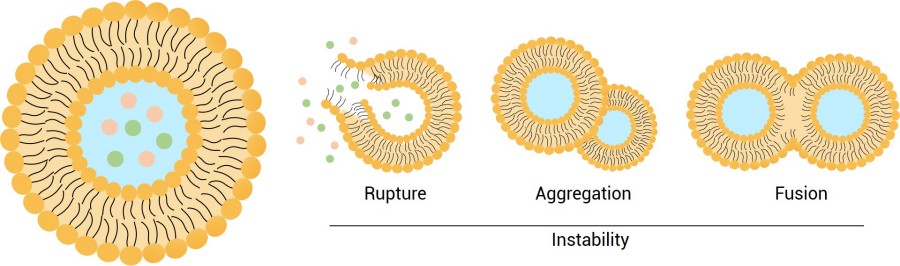 Fig. 1 The instability phenomenon of liposomes.
Understanding and controlling these pathways is critical to securing reproducible research outcomes and reliable experimental data:
-
Aggregation and Flocculation: Governed by DLVO theory—the balance between attractive van der Waals forces and repulsive electrostatic/steric forces. Uncontrolled aggregation alters the cellular uptake and biodistribution profile of the nanomedicine in research models.
-
Coalescence and Fusion: The thermodynamic merging of distinct lipid bilayers into larger, polydisperse vesicles, drastically reducing the effective surface-area-to-volume ratio.
-
Cargo Leakage Kinetics: Alterations in membrane permeability due to phase transitions, lipid oxidation, or mechanical stress can lead to premature cargo release, causing baseline toxicity and loss of target efficacy in experimental assays.
-
Phase Separation: Phase transition anomalies within the lipid bilayer that disrupt membrane uniformity, especially in complex multi-lipid or PEGylated research formulations.
Partner with Creative Biolabs' world-class biophysical characterization team to protect your experimental cargo.
Request a Quote
Our Comprehensive Evaluation Platform
Creative Biolabs' analytical platform is designed to provide a multi-dimensional profile of your liposomal formulations under various physiological and storage conditions. We offer a robust suite of physical characterization assays tailored to your specific research molecules and lipid compositions.
1. Colloidal Dynamics & Sizing Profiling
Accurate particle size distribution is the most critical quality attribute of a liposomal carrier. We utilize high-resolution techniques to monitor size evolution over time:
-
Dynamic Light Scattering (DLS): Measures hydrodynamic diameter and Polydispersity Index (PDI) to detect subtle, early-stage aggregation or Ostwald ripening.
-
Nanoparticle Tracking Analysis (NTA): Provides ultra-high-resolution, particle-by-particle size distribution and absolute concentration tracking, ideal for highly polydisperse or heterogeneous research samples.
2. Surface Charge & Electrostatic Stability
-
Zeta Potential (Zeta-Potential) Analysis: By evaluating the electrophoretic mobility of your vesicles, we determine the surface charge of the lipid bilayer. A high absolute zeta potential (typically |Zeta| > 30 mV) indicates strong electrostatic repulsion, a key predictor of long-term colloidal stability in laboratory storage.
3. High-Resolution Morphological Characterization
Visual confirmation of bilayer integrity and vesicle shape is essential to confirm stability.
-
Cryogenic Transmission Electron Microscopy (Cryo-TEM): Images liposomes in their native, vitrified state, eliminating artifacts. Cryo-TEM allows us to inspect lipid bilayer thickness, detect lamellarity changes (uni-, oligo-, or multi-lamellar transitions), and visually identify vesicle fusion, rupture, or drug crystallization inside the core.
4. Thermodynamic & Phase Transition Analysis
The physical state of the lipid bilayer (liquid-crystalline vs. gel phase) dictates membrane permeability and mechanical strength.
-
Differential Scanning Calorimetry (DSC): Determines the exact phase transition temperature and enthalpy changes of your formulation. This analysis is crucial for validating the stabilizing effects of cholesterol and sterols within the bilayer structure.
5. Membrane Integrity & Drug Leakage Kinetics
We quantitatively evaluate the retention capability of your liposomes over defined temperature, pH, and physiological media gradients.
-
Self-Quenching Assays: Uses encapsulated self-quenching fluorophores (such as calcein or carboxyfluorescein) to track real-time membrane leakage kinetics under simulated experimental conditions or serum exposure.
Workflow
Why Choose Creative Biolabs?
Developing lipid-based drug delivery systems is an intricate, non-linear journey. Creative Biolabs serves not merely as a contract service provider, but as a strategic co-developer for your research projects.
-
Deep Scientific Expertise: Our lead biophysicists possess decades of specialized experience in lipid biochemistry, physical chemistry, and nanomedicine characterization.
-
State-of-the-Art Instrumentation: Access a fully integrated, modern laboratory equipped with high-end analytical instruments (Malvern Zetasizer, Cryo-TEM).
-
Turnkey Analytics: From sample preparation and protocol development to comprehensive statistical analysis and interpretation, we provide end-to-end, ready-to-present documentation for grant applications and manuscripts.
-
Customer-Centric Collaboration: Receive interactive, transparent technical support, with custom data interpretation and actionable recommendations on how to modify your lipid ratios or surface modifications (e.g., optimal PEGylation density) to overcome identified instability pathways in your formulations.
Don't let formulation instability slow down your research. Trust Creative Biolabs to deliver the high-resolution, robust biophysical characterization data you need to drive your project forward confidently.
Related Services

For Research Use Only. Not For Clinical Use