
Antibody Conjugated ASO
Antibody-conjugated ASOs enable receptor-mediated delivery to defined cell populations that may be poorly reached by free ASOs, extending RNA-targeted therapy beyond liver-directed applications to muscle, the central nervous system, tumors, immune cells, and rare-disease models. Their effectiveness depends on accessible and internalizing cell-surface targets, productive intracellular trafficking, endosomal release, and ASO potency, so antibody binding alone does not guarantee functional gene regulation.
Introduction
Antibody-conjugated ASOs are targeted oligonucleotide therapeutics that combine the selective binding of antibodies with the sequence-specific RNA modulation of antisense oligonucleotides. Creative Biolabs supports this workflow through its antibody-conjugated ASO development service, covering carrier selection, conjugation optimization, analytical characterization, and biological evaluation.
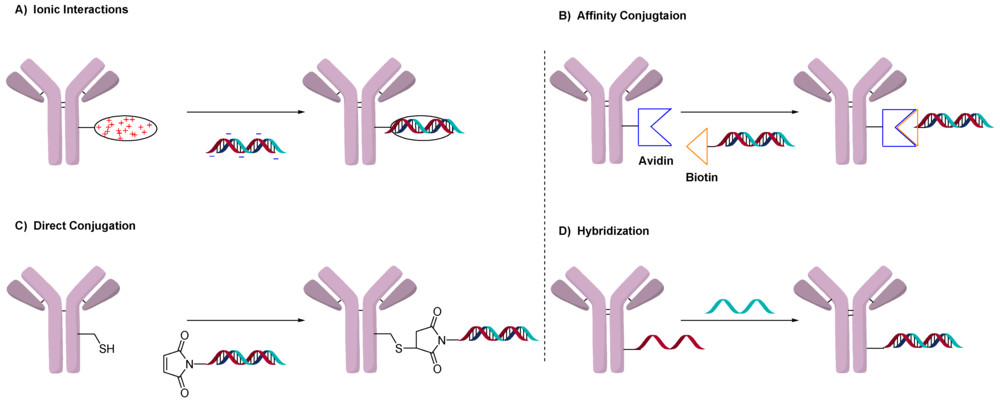 Figure 1. General methods to conjugate oligonucleotides by (A) electrostatic interactions, (B) affinity between biotin and avidin, (C) directly to antibody and (D) using double-strand hybridization.
The Antibody-ASO Delivery Concept
The antibody determines where the construct can bind
A monoclonal antibody, fragment, or engineered binding protein recognizes an extracellular epitope. Its affinity, epitope location, valency, Fc properties, and tissue penetration shape the first distribution layer. The target antigen must be accessible from the dosing compartment and sufficiently enriched in the desired cell population relative to safety-relevant tissues. Binding alone can produce retention without internalization. For delivery, the receptor-antibody complex must enter the cell at a useful rate and route enough of the conjugate toward compartments from which the ASO can become active.
The ASO remains a mechanism-specific payload
The ASO sequence, backbone, and sugar chemistry still control RNA recognition, nuclease resistance, protein interactions, and mechanism. RNase H gapmers, splice-switching oligonucleotides, and steric blockers do not share identical intracellular requirements. A receptor can increase uptake yet reduce activity if trafficking sends the construct to destructive lysosomal pathways or if a conjugation remnant interferes with the ASO. The parent ASO should therefore be optimized and characterized independently, then compared with the antibody conjugate at matched ASO molar doses. Antibody-oligonucleotide conjugation is meaningful only when both carrier and payload functions remain measurable.
| Component | Primary Role | Design Variables | Failure Signal |
|---|---|---|---|
| Antibody or binding fragment | Cell-surface recognition and tissue exposure | Affinity, epitope, valency, Fc, format | Strong binding with weak internalization or off-tissue uptake |
| Receptor | Endocytic entry and intracellular routing | Density, turnover, recycling, disease and species expression | Uptake without productive RNA modulation |
| Linker and attachment handle | Connect carrier and payload; optionally release ASO | Site, stability, cleavability, spacer length | Plasma deconjugation or intracellular persistence |
| ASO payload | Sequence-specific RNA modulation | Sequence, mechanism, backbone, sugar chemistry | Loss of hybridization, activity, or specificity |
Selecting a Receptor That Can Deliver Cargo
A useful receptor is accessible and internalizing
Selection begins with surface protein rather than transcript abundance. The receptor should be exposed to circulating antibody, present at a meaningful density, and internalize after engagement without rapid shedding. Epitope matters because different antibody clones against the same receptor can produce different clustering, internalization, recycling, or degradation. A target that is abundant on tissue-resident cells may still be inaccessible behind an endothelial barrier. Expression in liver, endothelium, immune cells, or other normal tissues can also dominate systemic clearance or create unintended pharmacology.
Species and disease biology must remain aligned
Cross-reactivity is often limited, so a human-targeting antibody may require a surrogate antibody in animal studies. The surrogate should match epitope, affinity range, internalization, Fc behavior, and conjugate architecture closely enough to answer the same delivery question. Disease can change receptor expression, membrane localization, or tissue permeability. Patient heterogeneity is especially relevant in tumors and degenerative disorders. Receptor selection should therefore include healthy and diseased human tissue data, protein-level confirmation, and a plan for translating pharmacology across species rather than relying on one receptor-positive cell line.
| Receptor Criterion | Evidence Needed | Why It Matters | Red Flag |
|---|---|---|---|
| Surface accessibility | Protein-level and tissue-localization data | Determines whether systemic antibody can encounter the epitope | High RNA expression but intracellular protein localization |
| Internalization and recycling | Pulse-chase or trafficking assay | Controls uptake rate and cargo routing | Binding without internalization or rapid surface return |
| Target-cell selectivity | Cross-tissue and single-cell expression context | Defines exposure margin over normal tissues | High expression in clearance organs or critical cells |
| Species relevance | Cross-reactivity and functional uptake comparison | Supports interpretable in vivo pharmacology | Surrogate receptor biology differs from the human system |
| Disease stability | Measurement across stages and patient samples | Predicts whether the delivery gate persists clinically | Loss or heterogeneity in advanced disease |
Antibody Format and Oligonucleotide Loading
Full antibodies provide exposure and Fc biology
An immunoglobulin G (IgG) can offer long circulation and bivalent binding, but its size can limit tissue penetration and its Fc region can interact with Fc receptors, complement, and recycling pathways. Fc engineering may reduce effector activity or alter half-life, yet those changes also affect distribution. An antibody that internalizes efficiently in vitro may be cleared rapidly in vivo if it binds abundant peripheral antigen. Full-antibody constructs therefore require simultaneous evaluation of antigen-mediated disposition, Fc behavior, receptor occupancy, and the ASO-equivalent dose.
Fragments and bispecific formats change transport behavior
Fab, single-chain variable fragment (scFv), or other compact formats can improve penetration and reduce Fc-mediated effects, but often clear more rapidly. Bispecific architectures can combine tissue-barrier engagement with target-cell recognition or use one arm as a transport shuttle. Added valency can increase avidity while also changing receptor clustering and intracellular sorting. Format should follow the tissue barrier and receptor mechanism rather than a preference for the smallest or longest-lived molecule. Equivalent comparisons should control binding sites, ASO loading, and molar exposure.
Oligonucleotide-to-antibody ratio is a pharmacological variable
The oligonucleotide-to-antibody ratio (OAR) describes average ASO loading, but an average can conceal a distribution of species. Higher loading increases payload per binding event while adding negative charge, hydrodynamic size, and potential aggregation. It can reduce antigen affinity, alter Fc-receptor interactions, or accelerate clearance. Low loading may preserve antibody behavior but deliver insufficient ASO. Site-specific chemistry narrows the OAR distribution and enables positional control. Candidate panels should compare defined loading states with matched antigen affinity, internalization, stability, and RNA activity.
- Use IgG when prolonged exposure and established Fc engineering are valuable and tissue penetration is adequate.
- Use fragments when compactness, rapid tissue entry, or reduced Fc biology outweigh shorter systemic residence.
- Use bispecific formats only when the second binding function has a defined transport or cell-selection role.
- Treat OAR and conjugation position as design variables, not merely release specifications.
Conjugation Chemistry and Linker Logic
Random attachment broadens product heterogeneity
Lysine or reduced-cysteine chemistry can provide accessible coupling routes, but multiple reactive sites create positional and loading distributions. The resulting species may differ in antigen binding, aggregation, clearance, and payload release. Site-specific strategies use engineered cysteines, enzymatic tags, glycan remodeling, or bioorthogonal handles to place the ASO at a defined region. Positional control is especially important for a large, charged payload that can perturb antibody surfaces. Analytical methods should report not only average loading but also unconjugated antibody, free ASO, high-load species, aggregates, and attachment-site occupancy.
Stable and cleavable linkers answer different questions
A stable linker maintains antibody attachment through circulation and internalization. It is suitable only if the intact conjugate or its processed remnant allows the ASO to become pharmacologically active. Cleavable disulfide, enzyme-sensitive, or acid-responsive linkers seek to release ASO after uptake, but the biological trigger must be present in the relevant compartment. Premature cleavage generates free ASO before targeting; slow cleavage produces high cellular antibody signal without active payload. Linker comparisons should measure plasma stability, intracellular metabolites, intact tissue conjugate, and RNA modulation over time.
| Chemistry Strategy | Product Control | Main Advantage | Primary Risk |
|---|---|---|---|
| Lysine coupling | Broad positional and loading distribution | Simple access to native antibody residues | Heterogeneity and possible binding-site modification |
| Cysteine coupling | Moderate control depending on disulfide handling | Established thiol-selective reactions | Antibody destabilization or reoxidation complexity |
| Engineered site-specific handle | Defined position and narrower OAR | Improved structure-activity interpretation | Additional antibody engineering and process steps |
| Enzymatic or glycan-directed attachment | Region-selective conjugation | Can place payload away from antigen-binding sites | Enzyme, glycan, and scale-up variability |
| Cleavable linker system | Defined construct plus processed intracellular species | Potential release of less hindered ASO | Plasma instability or incomplete intracellular cleavage |
The Intracellular Trafficking Problem
Receptor binding starts a multistep delivery process. The strongest evidence follows the antibody, intact conjugate, released ASO, and RNA response across time rather than inferring payload delivery from one fluorescent image.
- The conjugate distributes through plasma and tissues, where Fc interactions, antigen binding, and nonspecific charge effects influence exposure.
- The antibody encounters an accessible receptor and binds without losing affinity because of ASO loading or linker placement.
- The receptor-conjugate complex internalizes through clathrin-dependent or another receptor-specific pathway.
- Endosomal sorting determines whether the construct recycles, traffics toward lysosomes, transfers across a barrier, or reaches a compartment compatible with release.
- Linker cleavage, antibody proteolysis, or another processing event generates an ASO-containing species capable of leaving the vesicular pathway.
- A small productive fraction reaches cytosolic or nuclear RNA and produces a sequence-dependent molecular effect.
An Evidence Ladder for Targeted Activity
Molecular and cellular evidence establishes causality
The first tier confirms antibody affinity, ASO hybridization, OAR distribution, purity, aggregate level, and linker stability. The second tier measures binding and internalization in receptor-high, receptor-low, and receptor-null cells. Competition, knockout, or blocking studies test receptor dependence. The third tier measures intact intracellular conjugate, released ASO, subcellular localization, target RNA, protein, and a downstream phenotype. A targeted ASO screening plan should compare parent ASO, unconjugated antibody plus ASO, sequence-control conjugate, nonbinding antibody conjugate, and linker or loading variants at matched component doses.
In vivo evidence must resolve target cells and active species
Whole-organ antibody or ASO concentration cannot identify the cell population or active molecular species. An in vivo antisense study can combine plasma pharmacokinetics, intact-conjugate assays, tissue fractionation, cell sorting, imaging, RNA modulation, and safety endpoints. Receptor occupancy and antigen-mediated clearance should be examined across dose. A species-matched surrogate should demonstrate comparable binding and internalization. Recovery time points help distinguish durable pharmacology from persistent inactive antibody or ASO material. Advancement should require an exposure-activity relationship in the intended cell type and an interpretable margin over controls.
- Binding gate: antibody affinity and receptor occupancy remain acceptable after ASO loading.
- Uptake gate: internalization is receptor-dependent and occurs in the intended cell population.
- Release gate: the active ASO species is identified rather than assumed from total fluorescence.
- Activity gate: RNA modulation is sequence-dependent and linked to an orthogonal protein or splice endpoint.
- Safety gate: Fc, receptor, linker, ASO, and aggregate-related effects are separated with matched controls.
Tissue Strategies and Model Fit
Antibody conjugation is most useful when a validated surface receptor provides access to a cell population that free ASO reaches poorly. Tissue claims should remain narrower than the receptor and model evidence.
- Skeletal and cardiac muscle: transferrin-receptor pathways can support uptake, but receptor abundance, iron biology, and cross-species epitope behavior require control.
- Central nervous system: barrier-shuttle concepts must demonstrate transcytosis and parenchymal cell exposure, not retention in brain endothelium.
- Solid tumors: antigen heterogeneity, stromal barriers, internalization rate, and normal-tissue expression can separate antibody binding from ASO activity.
- Immune cells: Fc-receptor interactions and activation state may dominate uptake, so Fc-silent and nonbinding controls are particularly important.
- Rare-disease models: receptor biology, target transcript, and ASO sequence should be aligned in the same species or justified through a surrogate system.
Developability and Safety Boundaries
The complete conjugate has biologic and oligonucleotide risks
Antibody immunogenicity, Fc effector activity, receptor agonism or antagonism, cytokine release, complement activation, and target-mediated toxicity can coexist with ASO sequence and chemistry effects. High-load or aggregated species may change clearance and immune recognition. Free antibody, free ASO, linker impurities, and unconjugated intermediates can each contribute distinct findings. Safety interpretation therefore requires component controls and analytical monitoring of the dosed material. A reduced ASO dose does not automatically translate into a lower biological risk if receptor engagement creates new pharmacology.
Manufacturing control must preserve both functions
Process changes can shift OAR, attachment distribution, aggregation, antigen affinity, linker stability, and ASO integrity. Size-exclusion chromatography, charge or hydrophobic interaction methods, capillary electrophoresis, mass spectrometry, intact and subunit analysis, and binding assays provide complementary views. Stability studies should track deconjugation, fragmentation, oxidation, aggregation, and ASO shortening in the intended formulation. The release specification must be linked to functional evidence: a narrow OAR is useful only if the antibody still binds and internalizes and the ASO still modulates RNA.
Published Data
Case 1: Anti-TfR Antibody-ASO Conjugate Enables Systemic CNS Delivery in Spinal Muscular Atrophy
This study demonstrates that antibody-oligonucleotide conjugates (AOCs) can cross the blood-brain barrier (BBB) to treat central nervous system (CNS) disorders like spinal muscular atrophy (SMA). Researchers conjugated a phosphorodiamidate morpholino oligomer (PMO) ASO to 8D3₁₃₀, a monoclonal antibody targeting the transferrin receptor (TfR). Upon systemic intravenous administration, the 8D3₁₃₀-ASO conjugate effectively utilized receptor-mediated transcytosis to cross the BBB, markedly enhancing ASO bioavailability throughout brain and spinal cord tissues. In adult human SMN2 transgenic mice, the conjugate achieved therapeutic levels of SMN2 exon-7 splicing correction across the CNS. Crucially, systemic treatment in severe SMA mice significantly rescued motor function and extended survival compared to naked ASO. This study provides compelling proof-of-concept that anti-TfR AOCs can overcome the BBB barrier, establishing a transformative strategy for non-invasive systemic nucleic acid therapy in neurodegenerative and neuromuscular diseases.
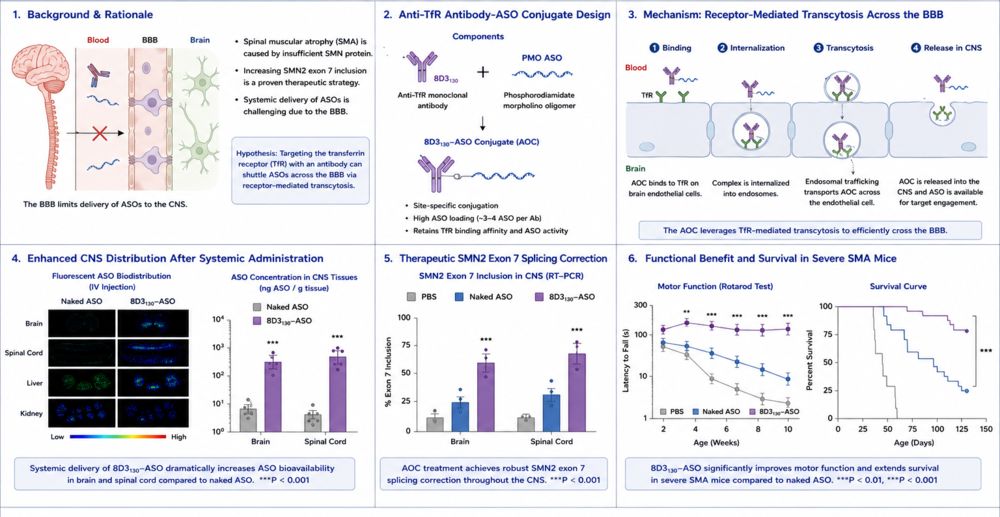 Figure 2. Anti-TfR-ASO conjugate enables blood-brain barrier penetration for SMA therapy.
Frequently Asked Questions
Q: What is an antibody-conjugated ASO?
A: It is a construct in which an antisense oligonucleotide is chemically linked to an antibody or antibody-derived binding format so that receptor recognition can alter tissue or cell delivery.
Q: Does strong antibody affinity guarantee effective ASO delivery?
A: No. The receptor must be accessible, internalize the conjugate, and route enough ASO toward productive release. Very strong binding can also alter recycling or tissue penetration.
Q: What is the oligonucleotide-to-antibody ratio?
A: The oligonucleotide-to-antibody ratio describes average ASO loading per antibody. Its distribution, attachment position, and effect on affinity and aggregation are as important as the average value.
Q: Is a cleavable linker required for antibody-ASO activity?
A: Not in every design. Cleavage is useful when the intact construct blocks productive ASO activity, but the linker must remain stable in plasma and release payload in the intended intracellular compartment.
Q: Which antibody format is best for ASO delivery?
A: There is no universal format. IgG, fragments, and bispecific constructs differ in half-life, penetration, Fc biology, valency, and trafficking. Selection should follow the receptor and tissue barrier.
Q: How is receptor-dependent RNA activity demonstrated?
A: Use receptor-high and receptor-null models, competition or blocking, nonbinding antibody controls, sequence controls, and matched parent ASO, then measure target RNA and an orthogonal functional endpoint.
Overview of What Creative Biolabs Can Provide
Creative Biolabs can support antibody-ASO research across antibody and receptor selection, ASO preparation, site-specific conjugation, linker and loading optimization, analytical characterization, and biological validation. The modules below correspond to the carrier, payload, chemistry, and evidence decisions described on this page.
| Research Need | Related Creative Biolabs Support | How It Connects to the Current Resource Topic |
|---|---|---|
| Develop an antibody-conjugated ASO | Antibody-Conjugated Antisense Oligonucleotide (ASO) Development Service | Integrates antibody format, linker, attachment, OAR, purification, characterization, and functional testing. |
| Compare alternative ASO conjugates | Antisense Oligonucleotide (ASO) Conjugate Development Services | Places antibody delivery alongside peptide, lipid, GalNAc, polymer, aptamer, and small-molecule formats. |
| Perform oligonucleotide-antibody conjugation | Oligonucleotide-antibody Conjugation | Supports controlled coupling and purification of an oligonucleotide with an antibody-derived carrier. |
| Design and prepare the ASO payload | Antisense Oligonucleotide (ASO) Design and Synthesis Service | Establishes mechanism, target site, sequence, and chemistry before carrier-dependent delivery is evaluated. |
| Install a defined conjugation handle | Custom Oligonucleotide Modification Service | Introduces terminal or internal functionality for linker and attachment-site comparisons. |
| Screen receptor-dependent activity in vitro | Antisense Oligonucleotide (ASO) In Vitro Screening Service | Tests binding, uptake, RNA modulation, cell-model fit, and mechanism-specific controls. |
| Evaluate targeted pharmacology in vivo | In Vivo Study Service for Antisense Therapeutics | Links intact exposure, cell-resolved distribution, RNA response, and tolerability in an appropriate model. |
To discuss a receptor, antibody format, linker, or loading strategy for your ASO target, contact us today to connect with our scientific team.
References
- Dugal-Tessier J, Thirumalairajan S, Jain N. Antibody-oligonucleotide conjugates: a twist to antibody-drug conjugates. Journal of clinical medicine, 2021, 10(4): 838. https://doi.org/10.3390/jcm10040838 Distributed under Open Access license CC BY 4.0, with modification.
- Hammond S M, Abendroth F, Goli L, et al. Antibody-oligonucleotide conjugate achieves CNS delivery in animal models for spinal muscular atrophy. JCI insight, 2022, 7(24): e154142. 10.1172/jci.insight.154142
