
Small Molecule Conjugated ASO
Small-molecule-conjugated ASOs improve tissue targeting, cellular uptake, and intracellular delivery while maintaining a compact, chemically defined structure and reproducible synthesis. Their effectiveness still depends on receptor accessibility, endosomal escape, target engagement, and ASO potency.
Introduction
Small-molecule conjugated antisense oligonucleotides are chemically defined therapeutic constructs that covalently join targeted small-molecule ligands to antisense oligonucleotides via precise linkers, significantly enhancing cell-specific uptake, bio-distribution, and intracellular endosomal escape.
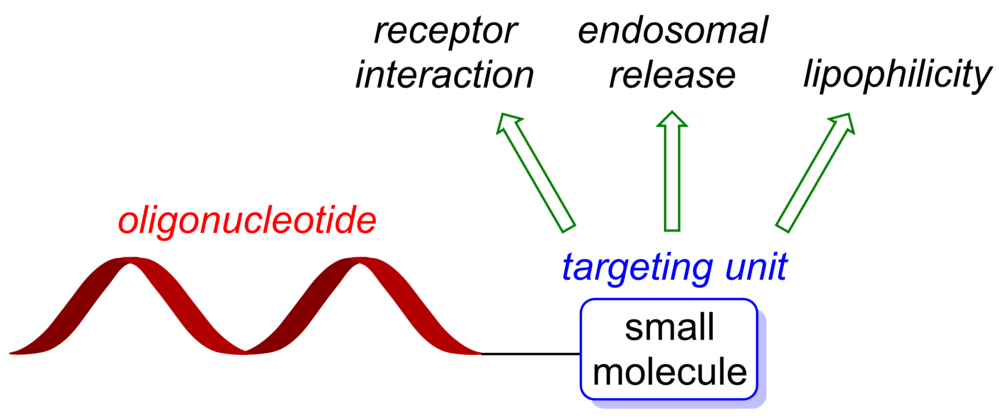 Figure 1. Oligonucleotide targeting by small-molecule conjugation.1
The Receptor-Ligand Hypothesis
Expression Is Only the First Filter
A suitable receptor requires more than high expression. It must be accessible in target cells, located on the cell surface, and able to bind the conjugated ligand. RNA expression provides an initial indication, but functional availability depends on protein abundance, membrane localization, glycosylation, receptor turnover, and disease context.
Early validation should integrate:
- Surface protein and ligand-binding measurements
- Target-positive and receptor-negative models
- Tissue distribution and accessibility after administration
- Potential competition from circulating ligands or metabolites
Off-target receptor expression should also be evaluated to reduce unwanted distribution and safety risks.
Productive Internalization Determines ASO Activity
Receptor binding and cellular uptake do not always result in therapeutic activity. After internalization, the ASO must escape intracellular compartments and reach the cytosol or nucleus to modulate RNA targets.
Therefore, successful delivery should be measured by functional gene silencing rather than uptake signals alone. Key considerations include:
- Receptor-mediated internalization efficiency
- Endosomal trafficking and escape capability
- Receptor recycling or degradation pathways
- Competition from endogenous ligands
- Conservation of receptor biology across preclinical species
A strong receptor-ligand hypothesis should connect binding → uptake → intracellular trafficking → RNA modulation, with each step independently validated through appropriate experiments.
Ligands for Conjugation
| Ligand Concept | Biological Opportunity | Central Risk | Discriminating Experiment |
|---|---|---|---|
| Folate-like receptor ligand | Enrichment in receptor-positive cell populations | Variable receptor expression and normal-tissue uptake | Free-ligand competition across receptor-high and receptor-low cells |
| PSMA-directed ligand | Binding to selected prostate-tumor and neovascular contexts | Heterogeneous expression and nonproductive internalization | Surface protein quantification plus target RNA modulation |
| Integrin-binding motif | Recognition of activated vascular or tumor-associated integrins | Affinity changes after tethering and broad integrin biology | Matched active and binding-deficient ligand conjugates |
| Sigma-receptor ligand | Potential uptake in selected tumor or neural models | Uncertain trafficking and off-target pharmacology | Receptor perturbation with subcellular trafficking analysis |
| Transporter-associated ligand | Access to nutrient-uptake pathways | The conjugate may bind but not undergo productive transport | Transporter knockout and translocation-versus-endocytosis assays |
Chemistry of a Defined ASO Conjugate
Attachment site preserves the ASO mechanism
A ligand can be placed at the 5' end, 3' end, or an internal modified nucleotide. Terminal attachment is generally easier to synthesize and characterize, while internal placement can position the ligand more deliberately but risks disturbing duplex structure. RNase H gapmers must retain a DNA-like central region that supports enzyme recruitment; splice-switching and steric-blocking ASOs require stable target binding without RNase H. Terminal modifications can still affect protein interactions, nuclease processing, and intracellular distribution. The attachment site should be selected together with the ASO chemistry, and the ligand conjugate should be compared with the identical parent sequence rather than with an unrelated benchmark.
Linkers control reach, polarity, stability, and release
Direct coupling gives a compact construct but can bury the ligand near the polyanionic ASO. A hydrophilic spacer may improve receptor access and solubility, whereas a hydrophobic spacer can increase nonspecific protein binding or membrane association. Stable linkers preserve a single conjugate species during circulation. Cleavable disulfide, enzyme-sensitive, or acid-labile designs aim to release ASO after uptake, but their useful window lies between premature plasma cleavage and incomplete intracellular processing. Small-molecule ASO development should compare linker variants using the same ligand, sequence, and cell system so that trafficking effects are not confused with ASO potency differences.
Coupling and purification define product quality
Amide formation, copper-free click reactions, thiol-selective coupling, and other orthogonal chemistries can join a ligand handle to a functionalized ASO. The reaction should minimize side products that are difficult to separate from the desired conjugate. Reverse-phase or ion-exchange chromatography, mass spectrometry, and analytical HPLC or UPLC can establish purity and identity. Residual free ligand, unconjugated ASO, deletion sequences, linker isomers, and oxidized or hydrolyzed species may each alter biological interpretation. The target is not simply high conversion; it is a reproducible conjugate with a traceable attachment site, controlled impurity profile, and retained hybridization behavior.
| Design Element | Options | Question to Resolve | Typical Readout |
|---|---|---|---|
| ASO attachment site | 5', 3', or internal nucleotide | Does placement preserve hybridization and mechanism? | Melting behavior and target-RNA activity |
| Spacer | Short alkyl, PEG-like, polar, rigid, or branched | Is the ligand accessible without excessive nonspecific binding? | Receptor binding, solubility, protein binding |
| Release mode | Stable, reducible, acid-labile, or enzyme-cleavable | Where and when should the ASO separate? | Matrix stability and intracellular metabolite mapping |
| Coupling chemistry | Amide, click, thiol-selective, or other orthogonal reaction | Can one defined product be purified reproducibly? | LC-MS and chromatographic purity |
What Happens after Receptor Binding
A ligand-receptor interaction initiates a chain rather than completing delivery. Mapping that chain avoids the common mistake of treating an uptake increase as proof of pharmacological improvement. The steps below can be examined with pulse-chase experiments, competition, microscopy, subcellular fractionation, receptor perturbation, and time-resolved RNA assays.
- The intact conjugate distributes through plasma and interstitial spaces while interacting with proteins, extracellular matrix, and non-target cells.
- The ligand encounters an accessible receptor or transporter and binds with an affinity that may differ substantially from that of the free ligand.
- The receptor-conjugate complex enters the cell through a defined or mixed endocytic route; ligand density and linker geometry can change this route.
- Acidification and vesicle maturation separate receptor recycling from cargo retention, degradation, or transfer into compartments that support escape.
- Linker cleavage or ASO processing generates the pharmacologically competent molecular species, if release is required.
- A fraction of ASO reaches cytosolic or nuclear RNA and produces RNase H cleavage, splice modulation, or steric blockade that matches the sequence design.
A Tissue-to-Ligand Selection Framework
Ligand selection is best treated as a falsifiable ranking exercise. Start with the target cell and dosing route, then narrow receptors by access, abundance, internalization, disease selectivity, and species relevance. Only after the biological shortlist is defined should chemistry and synthesis convenience guide the decision. This ordering reduces the risk of building a technically elegant conjugate around a receptor that cannot deliver an ASO in vivo.
- Define the target cell population and RNA compartment, including whether the required effect is hepatocyte, tumor-cell, immune-cell, muscle, or central-nervous-system specific.
- Map surface receptors and transporters at protein level in target and safety-relevant tissues, paying attention to disease-associated heterogeneity.
- Prioritize candidates with extracellular accessibility, internalization capacity, and a plausible route to productive endosomal escape.
- Confirm that a conjugatable ligand retains receptor affinity and does not introduce dominant nonspecific pharmacology.
- Build a small matched series varying attachment site or linker while holding sequence and ASO chemistry constant.
- Advance only candidates that show receptor-dependent RNA modulation, not uptake alone, and that retain an interpretable margin over the parent ASO.
Analysis of ASO Conjugate
A tiered assay set can measure surface binding, internalization, subcellular localization, intact intracellular ASO, target RNA, target protein, and a downstream phenotype. The parent ASO should first be optimized through sequence design and synthesis so that ligand performance is not judged with a weak sequence. Receptor-positive primary cells are preferable when established lines lose relevant surface expression. Dose-response and time-course studies reveal whether conjugation changes potency, maximal effect, or duration. Cytotoxicity, cytokine signals, and global transcript effects help separate intended antisense activity from ligand or chemistry-mediated stress.
| Question | Readout | Comparator | Interpretation Boundary |
|---|---|---|---|
| Is the conjugate intact? | LC-MS and chromatography | Fresh reference material | Intact mass does not prove correct positional isomer |
| Does the ligand still bind? | Competition or direct binding assay | Free ligand and binding-deficient analog | Binding does not prove internalization |
| Is uptake receptor-dependent? | Cell-associated and internalized ASO | Knockout, blocking, or excess-ligand control | Total uptake does not prove escape |
| Is RNA modulation sequence-dependent? | Target RNA, splice product, or protein | Mismatch or scrambled ASO | A single time point may miss kinetic differences |
| Does targeting persist in vivo? | Cell-resolved exposure and pharmacodynamics | Parent ASO at matched ASO dose | Bulk tissue concentration may reflect non-target cells |
Advantages, Trade-offs, and Failure Modes
A compact, defined conjugate can simplify some variables
Small-molecule conjugates provide several potential advantages compared with protein- or nanoparticle-based systems, including:
- Defined chemical structure with reproducible synthesis and quality control
- Tunable ligand affinity for optimizing receptor interaction
- Controlled ligand-to-ASO ratio for consistent product characterization
- Smaller molecular size that may support improved tissue penetration
Failure usually occurs between binding and RNA engagement
Common failures include loss of ligand affinity after tethering, receptor saturation, uptake into receptor-positive but irrelevant cells, lysosomal trapping, premature linker cleavage, insufficient release, and new off-target pharmacology from the ligand. Disease-stage heterogeneity may make a receptor attractive in one sample and absent in another. A conjugate can also produce less activity than the parent ASO if the ligand blocks productive protein interactions or redirects the ASO away from its natural uptake route. These outcomes should be treated as diagnostic evidence. Custom oligonucleotide modification and matched linker or attachment-site variants can isolate the chemical cause before a program changes its biological target.
Frequently Asked Questions
Q: What qualifies as a small-molecule-conjugated ASO?
A: It is a chemically defined construct in which a relatively low-molecular-weight ligand is covalently attached to an ASO, usually through a linker, to alter binding, distribution, uptake, trafficking, or another pharmacological property.
Q: Does high receptor expression guarantee improved ASO potency?
A: No. The receptor must be accessible, bind the conjugated ligand, internalize the construct, and route enough ASO toward productive escape. Surface expression alone cannot establish these steps.
Q: Should a small-molecule ligand be attached to the 5' or 3' end?
A: Either terminus may work, depending on ASO mechanism, chemistry, linker, and ligand. Matched terminal variants are often the most direct way to determine whether placement changes hybridization, processing, or activity.
Q: Is a cleavable linker always preferable?
A: No. A cleavable linker helps only if release is required and occurs in the intended intracellular window. Premature cleavage removes the targeting function, while slow cleavage can trap an inactive conjugate.
Q: How is receptor-dependent activity demonstrated?
A: Combine receptor-high and receptor-low models with competition, blocking, knockout, or knockdown experiments, then show that target RNA modulation—not only uptake—changes with receptor function.
Q: What is the minimum useful comparison set?
A: Compare the conjugate with the parent ASO, free ligand plus parent ASO, a sequence-control conjugate, and a receptor or ligand-binding control at matched doses. Add linker variants when release is part of the hypothesis.
Overview of What Creative Biolabs Can Provide
Creative Biolabs can assemble a small-molecule-ASO workflow around receptor selection, ASO preparation, linker and attachment-site design, analytical characterization, and biological validation. The following Gene Therapy service modules correspond to distinct decisions in that workflow.
| Research Need | Related Creative Biolabs Support | How It Connects to the Current Resource Topic |
|---|---|---|
| Design and prepare the parent ASO | Antisense Oligonucleotide (ASO) Design and Synthesis Service | Establishes a mechanism-matched sequence and chemistry before the targeting ligand is evaluated. |
| Develop the ligand-ASO conjugate | Small Molecule-Conjugated Antisense Oligonucleotide (ASO) Development Service | Supports ligand selection, linker design, coupling, purification, characterization, and functional assessment. |
| Compare broader conjugation options | Antisense Oligonucleotide (ASO) Conjugate Development Services | Places a small-molecule strategy alongside peptide, lipid, GalNAc, antibody, polymer, and aptamer alternatives. |
| Install a defined ASO modification or handle | Custom Oligonucleotide Modification Service | Introduces terminal or internal functionality needed for controlled conjugation and linker studies. |
| Synthesize a custom ASO series | Custom Antisense Oligonucleotide Synthesis | Provides matched parent, conjugate-ready, sequence-control, and chemistry variants for comparative studies. |
| Test receptor-dependent activity in vitro | Antisense Oligonucleotide (ASO) In Vitro Screening Service | Measures uptake and RNA modulation across model systems, concentrations, and mechanistic controls. |
| Assess pharmacokinetics and pharmacology in vivo | In Vivo Study Service for Antisense Therapeutics | Connects exposure, tissue or cell distribution, target modulation, and tolerability in an appropriate model. |
For help translating a receptor–ligand hypothesis into a controlled small-molecule–ASO study, contact us today to discuss your target cell, ligand, linker, and validation plan.
Reference
- Hawner M, Ducho C. Cellular targeting of oligonucleotides by conjugation with small molecules. Molecules, 2020, 25(24): 5963. https://doi.org/10.3390/molecules25245963 Distributed under Open Access license CC BY 4.0, with modification.
