
Polymer Conjugated ASO
Polymer-conjugated ASOs can improve circulation, tissue distribution, cellular uptake, intracellular release, and RNA-targeting activity by tuning polymer size, charge, architecture, and attachment chemistry. They are useful for overcoming delivery barriers and extending ASO exposure, but successful design requires balancing improved pharmacokinetics with solubility, aggregation, extracellular retention, endosomal escape, and productive gene regulation.
Introduction
A polymer-conjugated antisense oligonucleotide (ASO) combines a sequence-specific ASO with a covalently attached polymer to modify its physicochemical and biological properties. Creative Biolabs integrates these variables through its polymer-conjugated ASO development service, spanning polymer selection, conjugation, characterization, biological screening, and in vivo evaluation.
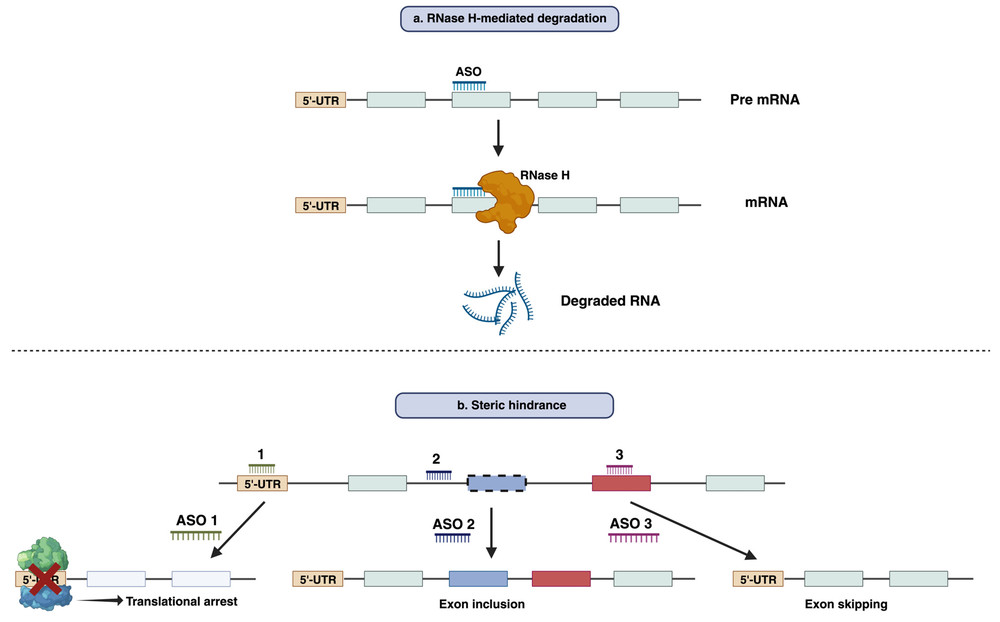 Figure 1. Functional mechanism of antisense oligonucleotide-mediated modulation of gene expression. (a) RNase H mediated degradation of RNA by antisense oligonucleotides. (b) Suppressing the translation or splicing modulation by an antisense oligonucleotide through steric hindrance mechanisms.1
Polymer-ASO Association
| Material State | Polymer–ASO Interaction | Defining Attribute | Key Analytical Need |
|---|---|---|---|
| Covalent polymer–ASO conjugate | Persistent bond at a terminal or internal ASO site | Polymer architecture and attachment stoichiometry | Conjugate identity, free components, molecular-size distribution |
| Electrostatic polyplex | Reversible association between polymer charge and ASO | N/P ratio and complex stability | Free ASO, size, zeta potential, dissociation kinetics |
| Polymeric nanoparticle | ASO is entrapped or associated with a particle matrix | Particle composition and loading process | Encapsulation, leakage, morphology, release |
| Self-assembling polymer conjugate | Covalent amphiphile forms supramolecular structures | Critical assembly behavior and morphology | Molecular and particle states in relevant matrices |
Polymer Variables That Shape the Conjugate
Molecular weight and architecture control hydrodynamic behavior
Increasing polymer molecular weight can reduce renal filtration and extend exposure, but it also enlarges the construct and may reduce tissue penetration. Linear polymers provide a simpler relationship between chain length and size. Branched, star, and bottlebrush architectures can present multiple ASOs or a dense solvated corona at similar nominal mass. Architecture affects viscosity, steric shielding, multivalency, and the local concentration of ASO. Comparisons should use measured molecular-weight distributions and hydrodynamic properties, not supplier labels alone, because two polymers with the same average mass can behave differently.
Charge, hydrophilicity, and degradability change biological identity
Neutral hydrophilic polymers can reduce protein adsorption and shield the ASO, whereas cationic segments may increase membrane association and endosomal disruption at the cost of cytotoxicity and nonspecific binding. Anionic or zwitterionic segments create other solvation and protein-interaction patterns. Biodegradable backbones can reduce long-term persistence, but degradation changes molecular size, charge, and the active-species profile over time. Custom polymer design should therefore match composition to a documented barrier and specify which degradation products, residual monomers, and charge-related effects need to be monitored.
- Average molecular weight influences filtration and circulation, while dispersity determines how broad the exposure distribution may be.
- Linear, branched, star, and bottlebrush topologies change shielding and ASO valency even at similar total mass.
- Neutral hydrophilic chains can improve solvation but may suppress cell binding and endosomal escape.
- Ionizable or cationic segments can improve association and membrane interaction while increasing toxicity and protein binding.
- Backbone degradation can improve clearance only if the fragments and release kinetics remain compatible with ASO activity and safety.
Polymer Design
Polymer conjugates can be organized by the main barrier they are intended to address. The regimes below overlap, but naming the dominant purpose prevents one polymer from being expected to solve incompatible problems simultaneously.
| Design Regime | Architecture Logic | Expected Benefit | Central Trade-off |
|---|---|---|---|
| Hydrophilic shielding | Linear or branched neutral polymer around one ASO | Improved solvation and reduced filtration or protein adsorption | Reduced cellular interaction and slower productive uptake |
| Multivalent scaffold | Star or bottlebrush polymer bearing several ASOs | Higher payload per construct and tunable local density | Steric crowding, heterogeneity, and complex clearance |
| Biodegradable carrier conjugate | Cleavable polymer backbone or linker releases smaller species | Temporary size increase followed by elimination | Uncertain degradation rate and multiple active or inactive products |
| Stimuli-responsive system | pH-, redox-, or enzyme-responsive segments change state | Conditional release or membrane interaction | Premature activation, incomplete response, or material toxicity |
Mapping Architecture to Biological Barriers
A polymer should be selected after the limiting step is measured. Increasing circulation is useful only when short exposure limits activity; increasing uptake is useful only when extracellular delivery is adequate; promoting release is useful only when endosomal sequestration is demonstrated. The following sequence links polymer properties with distinct biological gates.
- Dosing and dilution: the conjugate must remain soluble and chemically stable across concentration, salts, temperature, and administration conditions.
- Plasma transport: polymer size, charge, and corona formation influence filtration, protein adsorption, complement interactions, and clearance.
- Tissue access: hydrodynamic radius and architecture determine movement across endothelium, interstitium, extracellular matrix, and tumor stroma.
- Cell association: exposed charge, targeting ligands, or hydrophobic segments influence binding and endocytosis, while dense shielding can oppose entry.
- Intracellular processing: polymer degradation, linker cleavage, complex dissociation, and membrane interaction determine ASO availability.
- RNA engagement: the released or intact ASO must retain hybridization and the protein interactions required for RNase H, splicing, or steric mechanisms.
Polymer-Conjugated ASO Production
Polymer-conjugated ASO production converts a selected polymer–ASO design into a consistent and scalable product. The workflow focuses on controlling starting materials, conjugation efficiency, purification, and final product quality.
Production Process
-
Material Preparation
ASO identity, purity, concentration, and reactive groups are confirmed. Polymer molecular weight, dispersity, functionality, and residual impurities are also evaluated. -
Conjugation
Material ratio, pH, temperature, reaction time, and mixing conditions are optimized to achieve consistent conjugation and loading. -
Purification and Formulation
Chromatography or filtration removes free ASO, free polymer, and process residues. The purified conjugate is then concentrated and transferred into a suitable formulation buffer. -
Quality Control
Final batches are tested for identity, purity, ASO loading, molecular size, aggregates, stability, and biological activity to support reproducible production and reliable batch quality.
Characterizing a Distributed Molecular Product
Average values can hide pharmacologically different species
Number-average and weight-average molecular weights, dispersity, ASO loading, and hydrodynamic size describe different aspects of the product. An average loading of two ASOs can represent a uniform two-payload construct or a mixture of zero-, one-, two-, and higher-load species. These distributions may differ in clearance, uptake, and activity. Analytical development should quantify the species most likely to affect dose consistency. Defined short PEG chains or sequence-controlled backbones reduce one source of heterogeneity, whereas conventional polymer distributions require explicit acceptance criteria linked to biological data.
Stability changes both chemistry and material state
Storage, freeze–thaw, oxidation, hydrolysis, polymer degradation, linker cleavage, and ASO nuclease processing can all shift the product distribution. A conjugate can retain total ASO concentration while losing its intended polymer architecture. Stability-indicating methods should therefore track intact conjugate, free ASO, free polymer, size distribution, aggregate level, and potency. Matrix studies should include formulation, diluted dose, plasma, cellular extracts, and tissue when feasible. The analytical panel should be chosen before long studies begin so samples can be preserved and interpreted consistently.
| Attribute | Useful Measurement | Why One Method Is Insufficient | Biological Link |
|---|---|---|---|
| Polymer molecular-weight distribution | SEC with appropriate detectors or orthogonal size methods | Hydrodynamic behavior can differ from calibrated standards | Filtration, circulation, penetration |
| ASO loading distribution | Component-specific chromatography, spectroscopy, or mass balance | Average loading conceals individual species | Dose consistency and uptake per construct |
| Free ASO and free polymer | Orthogonal separation with selective detection | One component may be invisible in a single detector | Parent-like exposure and material toxicity |
| Assembly and aggregate state | DLS, microscopy, SEC, turbidity, or centrifugation | Size methods weight populations differently | Clearance, immunological signals, apparent uptake |
| Release and degradation | Time-resolved intact and fragment assays | Total ASO does not identify active species | Intracellular availability and duration |
A Selection Guide for Polymer-ASO Studies
Selection should begin with a barrier and end with a minimal matched series. A broad material screen is difficult to interpret when every candidate changes molecular weight, charge, architecture, and attachment simultaneously.
- For rapid renal clearance, compare a small molecular-weight series at constant architecture and ASO loading, then measure intact exposure and urinary recovery.
- For poor solubility or nonspecific protein adsorption, evaluate neutral or zwitterionic shielding while monitoring whether productive cell entry decreases.
- For insufficient payload per uptake event, compare defined multivalent scaffolds and quantify loading distribution rather than relying on average stoichiometry.
- For endosomal sequestration, test a responsive linker or segment only after uptake is established, and include a nonresponsive matched control.
- For long-term persistence, use degradable architectures with fragment identification, mass balance, and recovery time points.
- For tissue targeting, add a validated ligand only after the base polymer's protein binding, clearance, and cell interactions are understood.
- For every regime, preserve a common parent ASO and use orthogonal assays to distinguish polymer-dependent exposure, cellular delivery, linker processing, and RNA engagement. This matched-control strategy keeps an apparent potency gain from being assigned to the wrong transport step.
Biological Testing and Interpretation Boundaries
Cell studies should separate polymer effects from antisense effects
Compare parent ASO, free polymer, an unconjugated mixture, polymer conjugate, sequence-control conjugate, and release-deficient variants at matched doses. Transfection can establish intrinsic ASO competence but should not be used to claim polymer-mediated uptake. Free-uptake studies should measure cell association, internalization, subcellular localization, intact or released ASO, target RNA, protein, and cellular stress. Charge-related membrane damage or broad transcriptional suppression can imitate activity. Custom oligonucleotide modification can provide defined handles and matched intermediates for attribution.
In vivo studies must follow distributions and degradation products
Plasma and tissue assays should distinguish intact conjugate, released ASO, free polymer, and major fragments. Whole-organ concentration needs cell-resolved follow-up when the target is restricted to a parenchymal or immune population. Dose and time courses can reveal saturation, delayed release, and persistent material. Complement, cytokines, hematology, liver and kidney markers, and histopathology should be selected according to charge, degradability, and architecture. Transcript-level off-target detection and analysis can help separate sequence effects from polymer-mediated stress, but it does not replace chemical and cell-type attribution.
Translation is limited by reproducibility and species context
Polymer protein binding, complement interactions, degradation, and clearance can differ across species. A formulation that appears stealth-like in one plasma matrix may acquire a different corona in another. Manufacturing scale can shift molecular-weight distribution, substitution, residual monomer, and loading. Translation therefore requires a structure–property relationship that survives process and species changes. A candidate should advance only when the intended polymer function, active ASO species, reproducible product attributes, target-cell RNA activity, and a tolerable exposure range are all supported by linked evidence.
Frequently Asked Questions
Q: What is a polymer-conjugated ASO?
A: It is a covalent construct in which a polymer is attached to an antisense oligonucleotide to alter size, solvation, shielding, distribution, uptake, release, or another pharmacological property.
Q: Is polymer conjugation the same as forming a polyplex?
A: No. A conjugate contains a chemical bond between polymer and ASO. A polyplex is a noncovalent complex, usually assembled through electrostatic interactions, and requires different loading and dissociation analyses.
Q: Does PEGylation always improve ASO activity?
A: No. PEG-like shielding can improve solvation and exposure while reducing cell binding or intracellular release. The outcome depends on molecular weight, architecture, attachment, ASO chemistry, and target tissue.
Q: Why is polymer dispersity important?
A: A broad molecular-weight or loading distribution can contain species with different clearance, uptake, and activity. Average molecular weight and average ASO loading may hide these differences.
Q: Must a polymer be biodegradable or cleavable?
A: Not necessarily. Stable conjugates can remain active, but degradable or cleavable designs may be useful when persistent shielding or material accumulation limits performance. Fragments and release kinetics must be characterized.
Q: What controls are needed for polymer–ASO studies?
A: Use parent ASO, free polymer, an unconjugated mixture, sequence-control conjugate, and relevant loading or release variants. Measure productive RNA activity separately from uptake and cytotoxicity.
Published Data
Case 1: Noncationic PEG Brush Polymer-DNA Conjugates for Effective Antisense Gene Regulation
This study presents a noncationic delivery platform for antisense gene regulation using dense polyethylene glycol (PEG) brush polymers. To circumvent the high cytotoxicity and immunogenicity associated with traditional polycationic transfection agents, researchers synthesized brush polymer-DNA conjugates by grafting single-stranded DNA onto a dense PEG backbone. This unique sterically hindered brush structure effectively shields embedded DNA oligonucleotides from nuclease degradation while significantly enhancing cellular uptake without relying on positive charges. In vitro evaluations demonstrated robust target gene silencing accompanied by high cell viability and minimal cytotoxicity due to the bio-benign polymer components. This work establishes a promising paradigm for nucleic acid therapeutics, proving that noncationic PEG brush architectures can simultaneously address long-standing stability, cellular delivery, and safety bottlenecks in antisense oligonucleotide therapies.
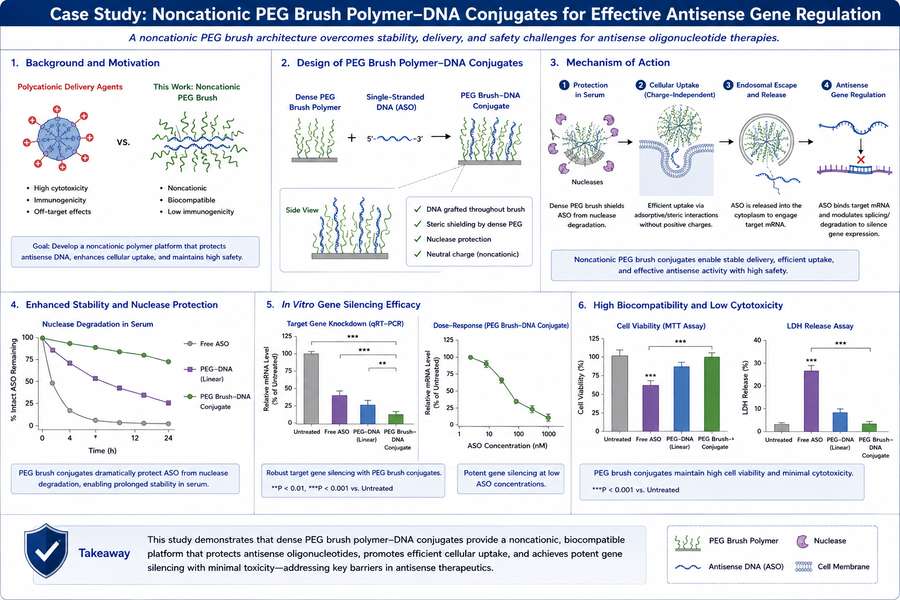 Figure 2. Antisense gene regulation using PEG brush polymer-DNA conjugates.
Overview of What Creative Biolabs Can Provide
Creative Biolabs can support polymer-ASO studies from parent ASO preparation and polymer selection through conjugation, encapsulation comparison, analytical characterization, screening, and in vivo evaluation. The selected Gene Therapy service modules map to the material-state and evidence questions described in this resource.
| Research Need | Related Creative Biolabs Support | How It Connects to the Current Resource Topic |
|---|---|---|
| Develop a covalent polymer–ASO conjugate | Polymer-Conjugated Antisense Oligonucleotide (ASO) Development Service | Integrates polymer architecture, attachment, linker, purification, distribution analysis, and functional testing. |
| Compare broader ASO conjugation formats | Antisense Oligonucleotide (ASO) Conjugate Development Services | Places polymer conjugation alongside lipid, antibody, GalNAc, peptide, aptamer, and small-molecule strategies. |
| Evaluate polymer encapsulation as an alternative | Custom Polymer based Antisense Oligonucleotide (ASO) Encapsulation Service | Addresses noncovalent polymer formulation, ASO loading, particle characterization, and release. |
| Design a custom polymer system | Custom Polymers Service | Supports polymer composition, charge, degradability, and material characterization for nucleic-acid delivery. |
| Prepare matched custom ASOs | Custom Antisense Oligonucleotide Synthesis | Provides parent, sequence-control, functionalized, and chemistry variants for conjugation studies. |
| Screen polymer–ASO activity in vitro | Antisense Oligonucleotide (ASO) In Vitro Screening Service | Measures uptake, release, RNA modulation, cytotoxicity, and mechanism-specific controls. |
| Assess exposure and pharmacology in vivo | In Vivo Study Service for Antisense Therapeutics | Connects conjugate and fragment disposition with target-cell activity and tolerability. |
To discuss polymer architecture, conjugation, release, or comparison studies for your ASO, contact us today to connect with our scientific team.
References
- Haque U S, Yokota T. Enhancing antisense oligonucleotide-based therapeutic delivery with DG9, a versatile cell-penetrating peptide. Cells, 2023, 12(19): 2395. https://doi.org/10.3390/cells12192395 Distributed under Open Access license CC BY 4.0, with modification.
- Lu X, Jia F, Tan X, et al. Effective antisense gene regulation via noncationic, polyethylene glycol brushes. Journal of the American Chemical Society, 2016, 138(29): 9097-9100. https://doi.org/10.1021/jacs.6b05787
