
Aptamer-Conjugated ASO
Aptamer-conjugated antisense oligonucleotides (ASOs) combine aptamer-mediated recognition and cellular uptake with sequence-specific RNA regulation, enabling targeted delivery to receptor-positive tumor cells, immune subsets, vascular targets, and other defined cell populations. Their compact nucleic-acid architecture, controlled stoichiometry, and receptor-dependent internalization may improve productive ASO exposure, target selectivity, and therapeutic performance, although outcomes depend on the aptamer, target tissue, linker, and ASO design.
Introduction
Aptamer-conjugated ASOs are targeted oligonucleotide therapeutics that combine the selective binding properties of aptamers with the sequence-specific RNA modulation of antisense oligonucleotides. Creative Biolabs supports these requirements through its aptamer-conjugated ASO development service, covering aptamer selection, chimera assembly, folding and binding analysis, cellular studies, and in vivo evaluation.
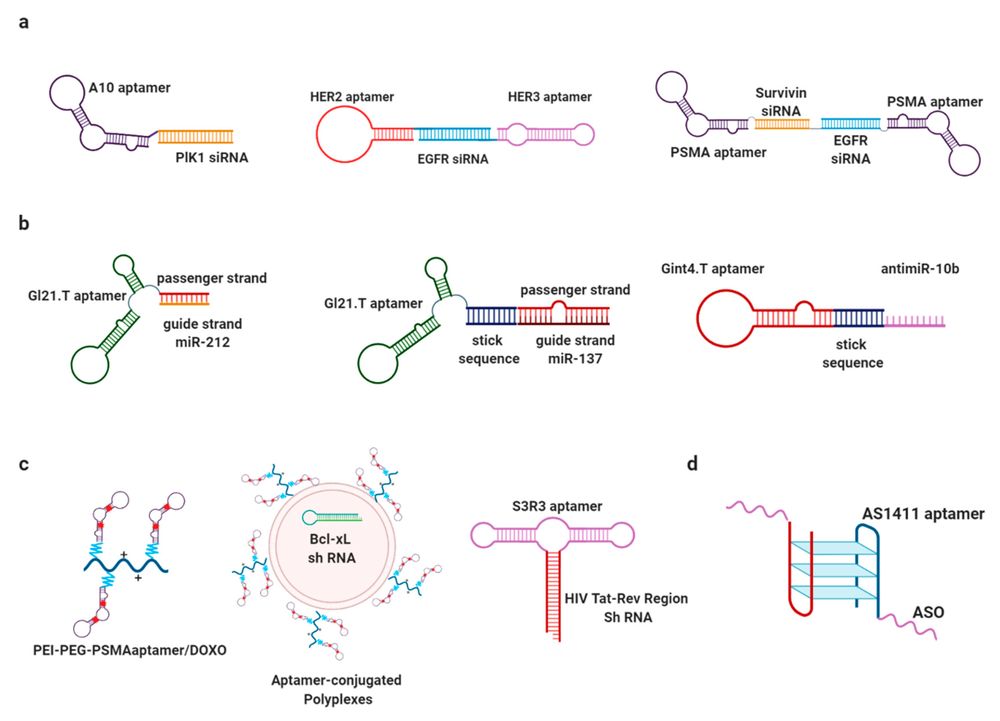 Figure 1. Schematic presentation of principle Aptamer-chimeras. Main examples of the mentioned chimera conjugates (aptamer-siRNA (a), aptamer-miRNA/antimiRNA (b), aptamer-sh (c) and aptamer-ASO (d)) are schematically illustrated.1
Two Oligonucleotide Functions in One Construct
The aptamer is a folded ligand, not merely a sequence tag
Aptamer binding depends on a three-dimensional ensemble stabilized by intramolecular base pairing, loops, bulges, ions, and sometimes noncanonical motifs such as G-quadruplexes. Affinity measured for the free aptamer may change after ASO attachment because the cargo adds charge, length, steric bulk, and alternative base-pairing opportunities. The aptamer target must also be accessible on living cells. Binding to purified protein or fixed cells does not establish recognition of the native receptor in its membrane context. Folding conditions and assay matrices should resemble those used for biological testing.
The ASO remains a mechanism-specific payload
The ASO sequence, backbone, and sugar chemistry determine RNA affinity, nuclease resistance, protein interactions, and mechanism. RNase H gapmers, splice-switching oligonucleotides, and steric blockers require different intracellular destinations and tolerances for attached remnants. Conjugation can change melting behavior or block proteins needed for activity. The parent ASO should therefore be optimized independently and compared at matched ASO molarity. ASO sequence design and synthesis establishes intrinsic payload competence before aptamer targeting and trafficking are asked to improve delivery.
| Component | Required Function | Key Variables | Failure Signal |
|---|---|---|---|
| Aptamer | Native receptor recognition and useful internalization | Sequence, fold, ions, affinity, epitope, receptor turnover | Binding lost after conjugation or no receptor dependence |
| ASO | Sequence-specific RNA modulation | Target site, backbone, sugar pattern, mechanism | Uptake without target RNA or functional response |
| Connector | Maintain spacing or enable release | Length, rigidity, hybridization, cleavage, stability | Premature separation or persistent steric block |
| Whole conjugate | Reach target cells as a defined active system | Size, charge, folding ensemble, protein binding, metabolites | Bulk exposure without target-cell active species |
Selecting an Aptamer and a Deliverable Receptor
Selection must preserve cell-context information
Systematic Evolution of Ligands by Exponential Enrichment (SELEX) can use purified proteins, cells, tissue, or in vivo exposure. Protein SELEX offers defined targets but can enrich ligands for epitopes that are hidden on cells. Cell-SELEX preserves membrane context while requiring counter-selection to remove ligands for abundant irrelevant surfaces. Internalization SELEX adds uptake pressure, and in vivo selection adds barriers at the cost of complex attribution. Custom aptamer screening should define positive and negative targets, species context, matrix, temperature, uptake interval, and intended receptor mechanism before enrichment begins.
A useful receptor does more than bind strongly
- Confirm binding on live target-high, target-low, and receptor-null cells rather than relying only on purified protein affinity.
- Use competition, receptor knockdown or knockout, and nonbinding aptamer controls to establish receptor dependence.
- Measure internalization and post-endocytic routing separately from equilibrium surface binding.
- Evaluate aptamer folding and binding in serum-containing media and relevant ion conditions.
- Map normal-tissue and disease-state receptor expression before interpreting target selectivity.
Architectures for Aptamer–ASO Assembly
Architecture determines stoichiometry, synthesis burden, folding independence, release, and analytical identity. The simplest structure is not always the most biologically productive, and rapid modular assembly is not automatically stable in vivo.
- Continuous linear chimera: Aptamer and ASO are one synthesized strand separated by a spacer. Main advantage: Defined 1:1 composition and no coupling reaction. Central limitation: Length, synthesis yield, and intramolecular misfolding.
- Covalent modular conjugate: Separately prepared aptamer and ASO are joined through handles. Main advantage: Independent component optimization and linker choice. Central limitation: Coupling impurities and possible conformational interference.
- Hybridized sticky-end construct: Complementary extensions assemble the two components. Main advantage: Rapid payload swapping and screening. Central limitation: Dissociation, strand exchange, and extra duplex structure.
- Cleavable pro-conjugate: Connector releases ASO after uptake or processing. Main advantage: Separates targeting from intracellular payload function. Central limitation: Premature cleavage or incomplete release.
- Multivalent scaffold: Multiple aptamers, ASOs, or both are displayed together. Main advantage: Higher avidity or payload per uptake event. Central limitation: Heterogeneity, size, crowding, and complex clearance.
A Receptor-to-RNA Delivery Journey
Aptamer targeting creates a chain of gates that should be measured in order. A failure at a late gate can coexist with excellent binding and whole-cell fluorescence.
- The conjugate adopts the intended aptamer fold and remains chemically intact in formulation, plasma, and extracellular fluid.
- The aptamer encounters accessible native receptor in the target tissue without being consumed by abundant soluble or off-tissue target.
- Receptor binding persists after ASO attachment and leads to internalization rather than static surface retention.
- Endosomal sorting avoids rapid recycling or destructive degradation and produces an ASO-containing species capable of release.
- The intact or processed ASO reaches cytosolic or nuclear RNA while retaining hybridization and mechanism-specific protein interactions.
- Target RNA modulation is receptor dependent, sequence dependent, and followed by an orthogonal protein, splice, or phenotypic effect.
Analysis of a Folded Conjugate
| Attribute | Useful Method | Question Answered | Interpretation Boundary |
|---|---|---|---|
| Whole-conjugate identity | Intact mass plus orthogonal chromatography | Is the intended covalent or assembled product present? | Does not establish correct folding |
| Folding ensemble | Native separation, structure probing, thermal or CD analysis | Are intended and alternative structures populated? | In vitro fold may change on cells or in serum |
| Receptor binding | Kinetic and cell-binding assays | Does the conjugate retain affinity and specificity? | Binding does not prove internalization or RNA delivery |
| Release and metabolites | Time-resolved component-specific assays | Which ASO-containing species forms and when? | Total nucleic acid can conceal active-species changes |
| Functional integrity | Target RNA plus orthogonal endpoint | Does the delivered ASO retain its mechanism? | Activity still requires receptor and sequence controls |
Function of Aptamer-ASO Conjugate
Cell models should test both binding and antisense mechanisms
Compare receptor-high, receptor-low, and receptor-null cells using parent ASO, free aptamer, an unconjugated mixture, aptamer–ASO conjugate, nonbinding aptamer conjugate, and sequence-control ASO conjugate. Competition establishes receptor involvement, while uptake and trafficking assays locate the transport barrier. Intact and released ASO measurements connect localization with chemistry. Target RNA and a mechanism-matched functional endpoint establish antisense action. ASO in vitro screening should avoid transfection when the question is aptamer-mediated delivery, since transfection bypasses receptor uptake.
In vivo studies must resolve receptor biology and cell exposure
Whole-organ concentration cannot identify receptor-positive target cells or the active species. Plasma and tissue assays should distinguish intact conjugate and major fragments; cell sorting, spatial methods, or imaging should localize material and RNA response. Dose ranges can reveal receptor saturation and target-mediated clearance. Species differences in aptamer binding may require a surrogate construct whose affinity, epitope, folding, internalization, and ASO pharmacology are justified. Recovery time points help distinguish durable activity from persistent inactive nucleic acid. Safety readouts should cover innate immunity, complement, liver, kidney, hematology, and receptor-related effects.
Decision rules should integrate both molecular functions
A candidate should advance only when aptamer binding survives conjugation, internalization is receptor dependent, the active ASO species is identified, RNA modulation is sequence dependent, and activity occurs within a tolerable exposure range. High affinity without delivery, high uptake without RNA activity, or RNA activity only after transfection are incomplete evidence. Comparisons with antibody, peptide, small-molecule, or formulation approaches should use the same ASO, molar dose, route, and target-cell endpoint. This prevents selection based on the novelty of aptamer targeting rather than performance against the actual barrier.
Applications of Aptamer–ASO conjugates
Aptamer–ASO conjugates are most compelling when a validated, accessible receptor marks a cell population that free ASO reaches poorly and when the compact nucleic-acid architecture offers an advantage over larger carriers. Applications include receptor-positive tumor cells, immune subsets, vascular targets, and other defined populations, but each remains target and model specific. An aptamer can also contribute antagonistic or agonistic activity, creating a dual-mechanism construct whose effects must be separated from ASO silencing. Translation depends on receptor conservation, disease heterogeneity, nuclease environment, manufacturing reproducibility, and an interpretable relationship between fold, exposure, and activity.
- Reject candidates whose affinity is measured only against purified target and is not reproduced on living cells.
- Do not equate aptamer internalization with endosomal escape or nuclear delivery of a splice-switching payload.
- Monitor innate immune activation and complement because length, structure, sequence motifs, and degradation products can alter recognition.
- Define refolding, storage, dilution, and administration procedures as product attributes when they change the conformational ensemble.
- Plan scalable synthesis and purification around full-length yield, free components, misfolded species, and batch-to-batch binding activity.
- Use potency-normalized and exposure-normalized comparisons so an apparent targeting advantage is not driven only by a stronger parent ASO or a higher effective dose.
Frequently Asked Questions
Q: What is an aptamer-conjugated ASO?
A: It is a dual-function construct in which a structured DNA or RNA aptamer directs binding or uptake and an attached antisense oligonucleotide modulates a separate RNA target.
Q: Is an aptamer simply a smaller antibody?
A: No. Aptamers are nucleic acids whose binding depends on sequence, folding, ions, and matrix conditions. Their pharmacology and analytical requirements differ from proteins.
Q: Does high aptamer affinity guarantee ASO delivery?
A: No. The receptor must be accessible and internalizing, and trafficking must produce an active ASO species in the correct intracellular compartment.
Q: Can the aptamer and ASO be synthesized as one strand?
A: Yes, a continuous chimera can provide defined 1:1 composition, but length, folding interference, synthesis yield, and ASO activity must be evaluated.
Q: Must the ASO be released from the aptamer?
A: Not always. Some intact chimeras can remain active, whereas others require cleavage. Matched stable and cleavable designs can identify the active species.
Q: Which controls are essential for aptamer–ASO studies?
A: Use parent ASO, free aptamer, an unconjugated mixture, nonbinding aptamer conjugate, sequence-control ASO conjugate, receptor competition or knockout, and relevant release controls.
Published Data
Case 1: Comparative Analysis of Aptamer, Vitamin E, and Cholesterol Conjugates for Enhanced Intracellular ASO Delivery
This study presents a direct comparative evaluation of distinct covalent conjugation strategies—specifically aptamers, vitamin E, and cholesterol—designed to improve the intracellular delivery and biological activity of antisense oligonucleotides (ASOs). To overcome poor cellular uptake of naked ASOs, researchers synthesized parallel ASO conjugates and evaluated their internalization kinetics and target knockdown efficiency. The study highlights aptamer-ASO conjugates as highly specific delivery vehicles, focusing on AS1411 (targeting nucleolin) and MUC1 S1.3/S2.2 aptamers (targeting mucin 1). While lipophilic conjugates (vitamin E and cholesterol) enhanced cellular uptake through membrane interaction, aptamer conjugation enabled receptor-mediated endocytosis, directing ASOs selectively to target-expressing cells to silence genes like luciferase and galectin-1. This work delivers key comparative insights, demonstrating that aptamer-guided targeting offers superior specificity and intracellular delivery precision compared to generalized lipophilic modifications for next-generation ASO therapeutics.
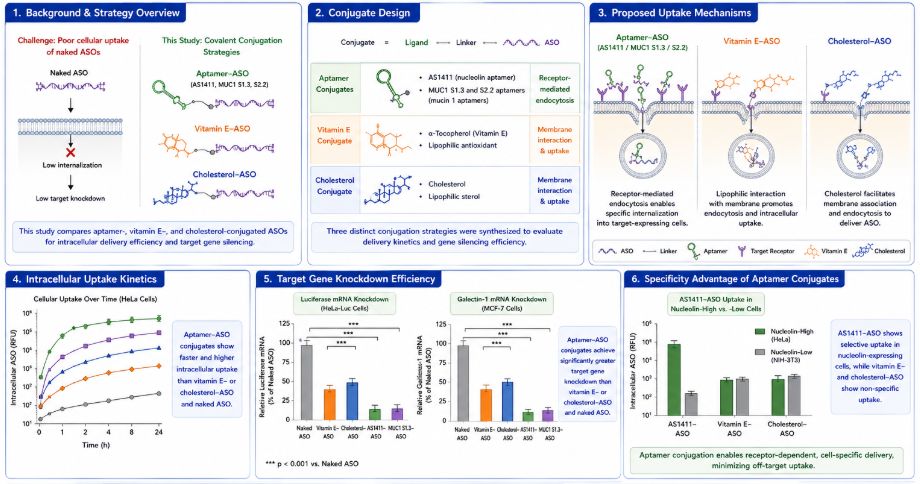 Figure 2. Aptamer, vitamin E, and cholesterol ASO conjugates for enhanced cellular uptake.
Overview of What Creative Biolabs Can Provide
Creative Biolabs can support aptamer–ASO programs from target and aptamer selection through ASO design, chimera assembly, folding and binding analysis, cellular mechanism studies, and in vivo evaluation. The services below map to the dual-function design and evidence requirements described in this resource.
| Research Need | Related Creative Biolabs Support | How It Connects to the Current Resource Topic |
|---|---|---|
| Develop an aptamer-conjugated ASO | Aptamer-Conjugated Antisense Oligonucleotide (ASO) Development Service | Integrates aptamer, ASO, architecture, linker, purification, characterization, and functional validation. |
| Perform defined oligonucleotide–aptamer conjugation | Oligonucleotide-aptamer Conjugation | Supports modular component preparation, coupling, purification, and identity analysis. |
| Discover or optimize a targeting aptamer | Custom Aptamer Screening | Addresses target choice, selection pressure, counter-selection, affinity, specificity, and internalization. |
| Compare broader ASO conjugation formats | Antisense Oligonucleotide (ASO) Conjugate Development Services | Places aptamer delivery alongside peptide, antibody, lipid, GalNAc, polymer, and small-molecule approaches. |
| Design and synthesize the ASO payload | Antisense Oligonucleotide (ASO) Design and Synthesis Service | Establishes target site, sequence, mechanism, and chemistry before delivery optimization. |
| Test receptor-dependent activity in vitro | Antisense Oligonucleotide (ASO) In Vitro Screening Service | Measures binding, uptake, trafficking, intact or released ASO, RNA modulation, and controls. |
| Evaluate exposure and pharmacology in vivo | In Vivo Study Service for Antisense Therapeutics | Connects receptor context and active-species disposition with target-cell RNA response and tolerability. |
To discuss aptamer target, chimera architecture, folding, or validation strategy for your ASO, contact us today to connect with our scientific team.
References
- Nuzzo S, Roscigno G, Affinito A, et al. Potential and challenges of aptamers as specific carriers of therapeutic oligonucleotides for precision medicine in cancer. Cancers, 2019, 11(10): 1521. https://doi.org/10.3390/cancers11101521 Distributed under Open Access license CC BY 4.0, with modification.
- Balachandran A A, Poudel B H, Rahimizadeh K, et al. Enhancing the intracellular delivery of antisense oligonucleotides (ASO): a comparative study of aptamer, vitamin E, and cholesterol ASO conjugates. RSC advances, 2025, 15(51): 43727-43736. https://doi.org/10.1039/d5ra05904f
