
Nanoparticle Conjugated ASO
Introduction
Nanoparticle association can improve Antisense oligonucleotides (ASOs) stability, tissue access, cellular uptake, and intracellular release, but its performance depends on the association mode, particle composition, size, charge, loading, and biological interactions. Development therefore requires coordinated interface design, quality characterization, mechanism-matched controls, and cell-resolved evaluation. Creative Biolabs supports this work through comprehensive ASO delivery services, covering carrier selection, formulation characterization, cellular screening, and preclinical evaluation.
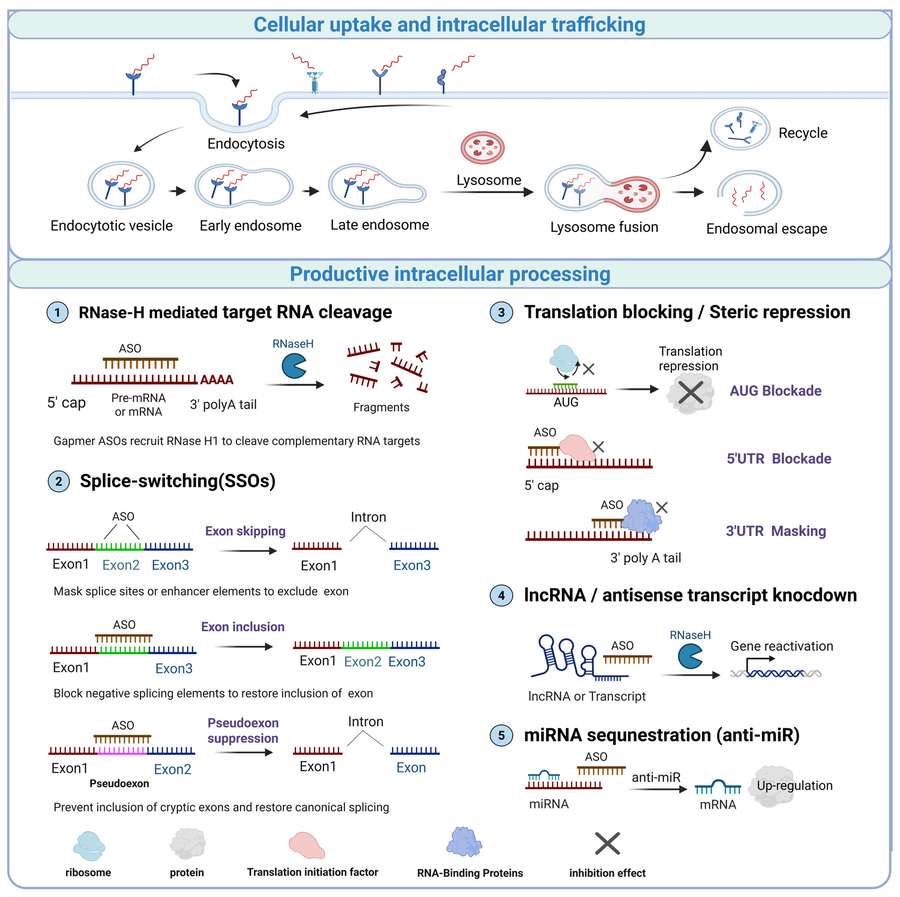 Figure 1. Major mechanism of action of antisense oligonucleotides (ASOs).1
Defining Nanoparticle-ASO Association
Surface attachment creates an exposed ASO interface
In the strictest usage, a nanoparticle-conjugated ASO is attached to a particle surface through a covalent bond, an affinity pair, or a deliberately engineered noncovalent interaction. Surface display can make the ASO accessible for hybridization, enable receptor ligands and ASOs to coexist on the same carrier, or create multivalent arrangements. Exposure is also a liability: nucleases, proteins, complement components, and polyanions can interact with the displayed oligonucleotide. The attachment must remain stable during manufacture and circulation while permitting the ASO to reach its intracellular RNA target.
Encapsulation places the ASO within a particle phase
Encapsulation or complexation embeds the ASO in a lipid, polymer, inorganic, or hybrid matrix rather than fixing it as a defined surface conjugate. The particle can shield charge and nuclease-sensitive regions, but loading may be heterogeneous and the active material must be released after uptake. The distinction matters for analytics: a surface conjugate requires evidence of attachment identity and density, whereas an encapsulated product requires reliable measures of total ASO, free ASO, encapsulated fraction, leakage, and release. LNP-based ASO encapsulation is therefore related to, but not interchangeable with, nanoparticle conjugation. Precise terminology prevents formulation behavior from being mistaken for molecular conjugate behavior.
| Architecture | How the ASO Is Associated | Principal Design Question | Characteristic Analytics |
|---|---|---|---|
| Covalent surface conjugate | Defined chemical linkage to a surface handle | Will the linkage survive exposure yet release or remain compatible with activity? | Conjugation ratio, attachment identity, free ASO, particle size |
| Affinity-bound surface construct | Biotin-avidin, hybridization handle, or another binding pair | Is the interaction stable in biological matrices without blocking uptake? | Binding occupancy, displacement, serum stability, accessibility |
| Electrostatically complexed particle | Anionic ASO associates with a cationic or ionizable phase | Does charge balance support loading without excessive toxicity? | N/P ratio, zeta potential, loading, release |
| Encapsulated formulation | ASO partitions inside a lipid or polymer matrix | Is protection balanced with intracellular availability? | Encapsulation efficiency, leakage, morphology, release kinetics |
Nanoparticle Platforms and Their Design
Lipid and polymer systems tune assembly and release
Lipid nanoparticles commonly combine an ionizable lipid with helper lipids, cholesterol-like components, and a PEG-lipid. Their charge state can support nucleic-acid association during mixing while limiting persistent cationic character after administration. Polymer particles offer a broader range of degradability, charge density, hydrophobicity, and ligand placement. In either class, small changes in composition can alter size, internal organization, protein adsorption, tissue distribution, and intracellular trafficking. A lipid nanoparticle platform or polymer formulation should therefore be optimized around the ASO chemistry and route of administration rather than copied from an unrelated RNA payload.
Inorganic, biomimetic, and nucleic-acid particles add distinct functions
Gold, silica, calcium-based, exosome-like, protein-based, and nucleic-acid nanostructures provide alternative ways to organize an ASO. The value of a custom nanoparticle strategy is not the novelty of the material; it is whether the platform solves a documented biological barrier without introducing a harder manufacturing or safety problem.
- Lipid-rich systems are often selected when scalable self-assembly, membrane interaction, and high nucleic-acid loading are priorities.
- Degradable polymers can be useful when charge density, erosion rate, or sustained release must be tuned independently.
- Inorganic cores support precise surface functionalization but require an explicit clearance and persistence hypothesis.
- Biomimetic or nucleic-acid particles may enable complex recognition patterns, provided identity and heterogeneity can be controlled.
From Administration to Productive RNA Engagement
A particle can increase total tissue exposure without increasing productive ASO exposure. The relevant path is a sequence of conditional gates, and failure at any gate can separate biodistribution from pharmacology. Designing experiments around this sequence helps teams identify whether the limiting variable is colloidal stability, cellular specificity, intracellular processing, or the oligonucleotide itself.
- Maintain integrity after dosing. Dilution, salts, shear, and serum proteins must not trigger unacceptable aggregation, premature ASO loss, or a damaging surface-charge shift.
- Reach the intended tissue compartment. Particle size, shape, rigidity, route, and protein corona influence vascular transit, filtration, and uptake by phagocytic cells.
- Enter the relevant cell type. Passive accumulation is rarely sufficient evidence; receptor-blocking, ligand-free, or cell-resolved studies should test the proposed uptake route.
- Traffic through endosomes. Uptake usually places the construct in vesicles, where maturation, acidification, enzymatic processing, or membrane interaction may expose the ASO.
- Release a pharmacologically competent ASO. The oligonucleotide must separate from the carrier when necessary and retain the hybridization and protein-recruitment properties required by its mechanism.
- Engage RNA in the correct compartment. Target knockdown, splice correction, or steric blockade should be demonstrated with a sequence-matched assay and linked to downstream biology.
Engineering the ASO-Particle Interface
Attachment chemistry determines stability and orientation
Amide, thiol-maleimide, strain-promoted click, disulfide, hydrazone, and hybridization-based strategies provide different balances of selectivity, stability, and release.
Surface density controls accessibility and colloidal behavior
Increasing ASO density can raise payload per particle and support multivalent interactions, but it also changes the surface seen by proteins and cells. Dense oligonucleotide layers may create steric crowding, increase negative charge, restrict hybridization, or alter ligand access.
| Interface Variable | What It Changes | Failure Signal | Useful Control |
|---|---|---|---|
| Linker cleavage rate | Timing and location of ASO liberation | Early free ASO or persistent inactive conjugate | Cleavable versus noncleavable matched pair |
| ASO surface density | Payload, charge, accessibility, protein adsorption | Aggregation or reduced hybridization | Density series at constant particle composition |
| Spacer length | Distance from the particle surface | Steric occlusion or unstable flexible corona | Short, medium, and long spacer variants |
| Targeting-ligand density | Receptor avidity and surface identity | Nonlinear uptake or loss of selectivity | Ligand-free and competition controls |
| Residual free ASO | Apparent activity unrelated to the particle | Activity without particle uptake | Separation assay and free-ASO comparator |
Choosing Surface Attachment or Encapsulation
The choice should follow the delivery hypothesis. Surface attachment is attractive when spatial presentation, receptor interaction, hybridization accessibility, or a defined particle-to-ASO relationship is central. Encapsulation is attractive when shielding, high cargo loading, and release from an internal phase are more important. Hybrid designs can display one ASO population and encapsulate another, but every added state increases analytical burden. A small, explicitly comparative formulation set is usually more informative than an expansive material screen with weak controls.
| Decision Criterion | Surface-Conjugated ASO | Encapsulated or Complexed ASO |
|---|---|---|
| Need for nuclease shielding | Partial; exposed regions may remain accessible | Potentially high if the internal phase remains intact |
| Control of molecular attachment | Can be defined by site and linker | Usually characterized as a loading distribution |
| Payload per particle | Limited by available surface area | Can be higher, depending on internal capacity |
| Release requirement | May be optional or linker-dependent | Usually essential for productive activity |
| Surface biological identity | ASO directly contributes to the corona and charge | Surface can be engineered more independently of cargo |
| Primary analytical challenge | Conjugation density and accessible free ASO | Encapsulation, leakage, and release kinetics |
Evaluation Workflow of Nanoparticle-ASO
- Start with identity, loading, size, charge, morphology, and stability in the intended dosing matrix.
- Then compare free ASO, empty particle, unconjugated mixture, particle-associated ASO, and a sequence control at matched component doses.
- Cellular studies should separate binding, internalization, endosomal trafficking, and RNA effect rather than treating fluorescence as proof of delivery.
- Receptor competition or uptake inhibitors can support a mechanistic claim, while a mechanism-matched ASO screen tests whether sequence ranking is preserved after formulation.
- Measuring both total intracellular ASO and target modulation reveals constructs that enter cells but remain sequestered.
Limitations of Nanoparticle-ASO
Ionizable or cationic components can disrupt membranes, activate complement, or alter inflammatory pathways, while slowly degradable materials may accumulate. Protein adsorption can redirect particles to the mononuclear phagocyte system and change across species or disease states. Repeated dosing may also generate responses to PEG, targeting ligands, or other carrier components. These effects are not predictable from ASO sequence alone. Empty-particle controls and component-matched dose calculations are essential, particularly when an apparent efficacy signal coincides with tissue injury, immune activation, or reduced expression of many unrelated transcripts.
Published Data
Case 1: Efficient ASO Delivery via Bioreducible Lipid Nanoparticles In Vitro and In Vivo
This study demonstrates a bioreducible lipid nanoparticle (LNP) platform designed for targeted antisense oligonucleotide (ASO) delivery to the liver. Researchers engineered key lipid components containing disulfide bonds, creating a redox-responsive trigger system. These LNPs maintain structural integrity in extracellular environments but rapidly disintegrate upon exposure to high intracellular glutathione (GSH) concentrations within the cytoplasm, releasing the encapsulated ASO payload. In cell models, bioreducible LNP-ASO formulations achieved high encapsulation efficiency, superior cellular uptake, and robust target gene silencing compared to non-reducible control LNPs, while maintaining excellent biocompatibility. In vivo, systemic intravenous administration in mice directed LNP accumulation primarily to liver tissue via passive targeting mechanisms. The bioreducible LNP-ASO complex achieved potent liver-specific target mRNA knockdown without inducing systemic or hepatic toxicity. This study establishes a complete validation pipeline for redox-sensitive LNPs, proving that intracellular stimulus-triggered payload release significantly enhances ASO knockdown potency without increasing cytotoxicity.
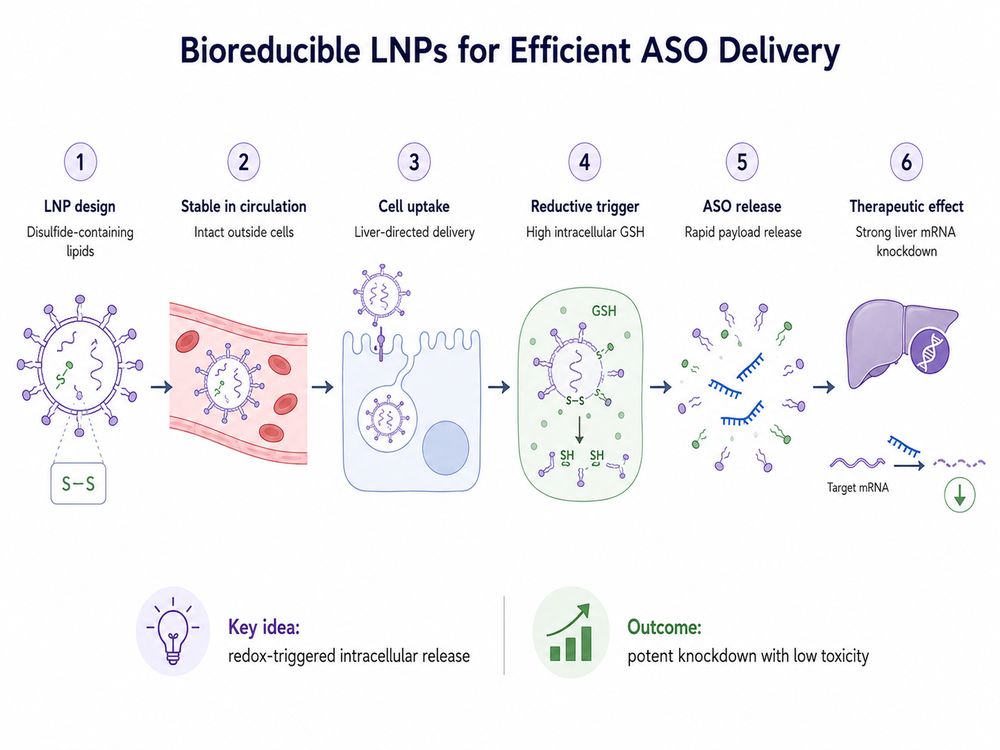 Figure 2. Bioreducible LNPs for ASO delivery in vitro and in vivo. Redox-responsive nanocarriers achieve efficient cellular uptake and endosomal release of ASOs.
Frequently Asked Questions
Q: Is a nanoparticle-conjugated ASO the same as an LNP-encapsulated ASO?
A: No. A nanoparticle-conjugated ASO is attached to a particle, usually at the surface, whereas an encapsulated ASO is retained within a particle phase. Some systems combine both states, so the association mode should be defined experimentally.
Q: Must the ASO be released from the nanoparticle to work?
A: Often, but not always. Release is usually needed when tethering blocks access to RNA or intracellular proteins. A surface-bound construct may remain active if the linkage and geometry permit the required molecular interactions.
Q: Which particle property most strongly predicts ASO activity?
A: No single property is sufficient. Size, charge, loading, stability, cell-type uptake, endosomal processing, and release act together. Productive RNA modulation is the decisive functional readout.
Q: How can productive uptake be distinguished from total uptake?
A: Measure target RNA or splice modulation alongside intracellular ASO, and use cell-resolved assays plus free-ASO, empty-particle, sequence, and receptor-dependence controls. High fluorescence alone does not demonstrate productive delivery.
Q: What controls are essential for nanoparticle-ASO studies?
A: At minimum, include free ASO, empty particle, an unconjugated ASO-particle mixture, the associated construct, and a sequence control at matched doses. Add ligand-free or competition controls when receptor targeting is claimed.
Q: Can a nanoparticle platform developed for siRNA be used unchanged for an ASO?
A: Not reliably. ASOs differ in strand structure, length, charge distribution, chemistry, protein binding, and intracellular mechanism. Composition, loading, release, and potency should be re-optimized for the ASO payload.
Overview of What Creative Biolabs Can Provide
Creative Biolabs can support a nanoparticle-ASO program from oligonucleotide preparation and association-mode selection through formulation characterization, cell-based screening, and in vivo evaluation. The modules below are selected from the Gene Therapy Services branch and map directly to the design questions discussed on this page.
| Research Need | Related Creative Biolabs Support | How It Connects to the Current Resource Topic |
|---|---|---|
| Define the overall ASO delivery strategy | Antisense Oligonucleotide (ASO) Delivery Services | Compares delivery routes and formulation options against the intended tissue, cell type, and ASO mechanism. |
| Develop a covalent ligand or carrier conjugate | Antisense Oligonucleotide (ASO) Conjugate Development Services | Connects ASO attachment-site and linker design with purification, identity, and functional testing. |
| Encapsulate an ASO in a lipid nanoparticle | Custom LNP based Antisense Oligonucleotide (ASO) Encapsulation Service | Addresses formulation, encapsulation efficiency, particle characterization, and ASO release for LNP systems. |
| Encapsulate an ASO in a polymer system | Custom Polymer based Antisense Oligonucleotide (ASO) Encapsulation Service | Supports polymer selection, complex formation, physical characterization, and delivery evaluation. |
| Build a broader nanoparticle formulation | Custom Nanoparticles Service | Provides access to lipid, polymeric, inorganic, or hybrid nanoparticle design and characterization. |
| Screen formulated ASOs in vitro | Antisense Oligonucleotide (ASO) In Vitro Screening Service | Measures sequence- and formulation-dependent activity in a mechanism-matched cellular context. |
| Evaluate distribution and pharmacology in vivo | In Vivo Study Service for Antisense Therapeutics | Links dose and tissue exposure with target modulation, tolerability, and study-specific endpoints. |
Projects can be scoped around target biology, mechanism, model, and decision-enabling readouts. Researchers may contact us today to discuss a fit-for-purpose ASO study plan.
References
- Xu L, Zhang H, Jiang B, et al. Antisense Oligonucleotides: Technological Advances, Clinical Progress, and Expanding Therapeutic Frontiers. Pharmaceutics, 2026, 18(4): 446. https://doi.org/10.3390/pharmaceutics18040446 Distributed under Open Access license CC BY 4.0, with modification.
- Yang L, Ma F, Liu F, et al. Efficient delivery of antisense oligonucleotides using bioreducible lipid nanoparticles in vitro and in vivo. Molecular Therapy Nucleic Acids, 2020, 19: 1357-1367. 10.1016/j.omtn.2020.01.018
