


Hexosylceramide Lipidomics Analysis Service
Batch-Ready HexCer Profiling for Sphingolipid Pathway Studies
Creative Biolabs provides research-use hexosylceramide (HexCer) lipidomics analysis for comparative sphingolipid studies, biomarker exploration, and pathway-oriented lipid profiling. Built on our glycosphingolipids analysis platform, this service focuses on scalable LC-MS/MS measurement, transparent annotation levels, and optional method designs for distinguishing glucosylceramide (GlcCer) and galactosylceramide (GalCer) when the project requires isomer-aware interpretation.
Service Focus
- Measure HexCer species as part of broader sphingolipid metabolism studies, with clear reporting of class-level, species-level, and isomer-resolved confidence when applicable.
- Support comparative studies across cells, tissues, plasma or serum, cerebrospinal fluid for research use, and other qualified biological matrices.
- Provide data tables and quality-control summaries that can be interpreted alongside ceramide, lactosylceramide, ganglioside, or other glycosphingolipid results.
HexCer Lipidomics for Comparative Sphingolipid Studies
Hexosylceramides are monohexosylceramides in which a single hexose head group is linked to a ceramide backbone. In lipidomics datasets, HexCer may be reported as a measured lipid class or as individual molecular species defined by long-chain base and N-acyl chain composition.
This service is designed for researchers who need reproducible HexCer measurements across biological groups, time courses, perturbation studies, or pathway-focused sphingolipid panels. Depending on project goals, Creative Biolabs can support relative profiling, standard-based quantification where suitable standards are available, batch-aware study design, and optional GlcCer/GalCer differentiation when matrix quality, chromatographic separation, and reference materials support isomer-aware interpretation.
Why HexCer Data Need Careful Analytical Boundaries
HexCer interpretation is not limited by signal detection alone. GlcCer and GalCer are isobaric glycosphingolipids, many species share similar fragments, and matrix effects can influence quantitative accuracy.
GlcCer/GalCer Isomerism
GlcCer and GalCer have the same nominal composition but different hexose configuration, so precursor mass alone cannot distinguish them.
Species Diversity
Different sphingoid bases, fatty acyl chain lengths, hydroxylation states, and unsaturation patterns can produce large, partially overlapping HexCer profiles.
Separation Limits
Reversed-phase LC often separates species by hydrophobicity but may not fully resolve GlcCer and GalCer isomers without an optimized or orthogonal method.
Matrix Effects
Cells, tissues, biofluids, and extracts can differ in extraction efficiency and ion suppression, making internal standards, QC samples, and batch design important.
Method Selection
We select LC-MS/MS, HILIC or other suitable separation options according to the target panel, matrix, and required confidence level.
MS/MS Evidence
Product ions, retention behavior, accurate mass when available, and reference standards are used to strengthen annotation where the project scope supports it.
Quantitative Design
Relative profiling, isotope/internal-standard-assisted quantification, or standard-based quantification can be discussed based on available materials.
Confidence-Level Reporting
Results separate class-level HexCer signals from species-level annotations and from GlcCer/GalCer-resolved assignments when they are supported by the data.
Our HexCer Lipidomics Capabilities
Creative Biolabs designs HexCer analysis workflows around the biological question, sample matrix, target list, and expected reporting depth. Our service can be configured for broad comparative profiling or focused quantification of predefined HexCer species.
Recommended Workflow for HexCer Lipidomics Analysis
A robust HexCer project begins with clear definition of the desired readout. Broad profiling, targeted quantification, and isomer-aware analysis require different levels of method optimization, reference materials, and reporting confidence.
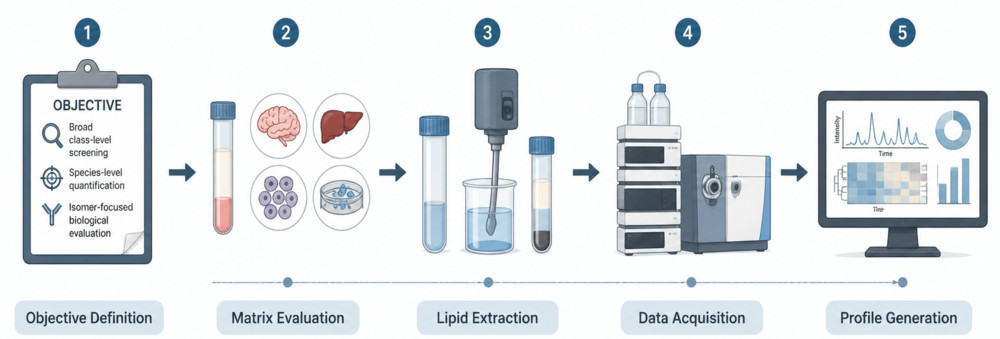
Fig.1 HexCer lipidomics workflow from study design to confidence-level reporting.
Study Design
Review sample matrix, groups, replicate number, target species, and whether GlcCer/GalCer separation is required.
Feasibility Review
Assess sample amount, extraction needs, expected abundance, available standards, and suitable LC-MS/MS strategy.
Extraction and QC
Apply lipid extraction, internal-standard addition where appropriate, pooled QC planning, and batch controls to support comparable data.
LC-MS/MS Acquisition
Acquire targeted or semi-targeted HexCer data using a method aligned with class-level, species-level, or isomer-aware objectives.
Reporting
Deliver abundance tables, method notes, QC summaries, annotation levels, and interpretation-ready files for pathway comparison.
Sample Types and Project Information
Creative Biolabs can evaluate research samples such as cultured cells, tissues, plasma or serum, cerebrospinal fluid for research use, microbial samples, lipid extracts, and other customized matrices. Sample suitability depends on amount, storage history, matrix complexity, and the requested confidence level.

Helpful Submission Details
- Sample type, species, tissue or cell source, preparation method, storage temperature, and freeze-thaw history.
- Study design, group comparison, replicate number, and whether the project requires relative profiling or standard-based quantification.
- Known target HexCer species, expected concentration range, and any previously generated lipidomics data.
- Whether GlcCer/GalCer distinction is essential, desirable, or not required for the research question.
- Available standards, internal standards, pooled QC material, or reference samples that can improve quantification and annotation confidence.
Deliverables and Data Outputs
Final deliverables are organized so researchers can understand both the quantitative result and the level of structural confidence behind each assignment. This is particularly important when HexCer signals may represent unresolved GlcCer/GalCer isomers.
Typical Deliverables
- Detected HexCer species list with retention time, precursor ion, product ion information, and annotation level.
- Relative abundance tables or standard-based concentration tables, depending on the agreed analytical strategy.
- QC summary covering pooled QC performance, internal-standard response where applicable, batch behavior, and data acceptance notes.
- Clear flags for class-level HexCer measurements, species-level assignments, and GlcCer/GalCer-resolved results when supported.
- Concise technical report suitable for downstream biological interpretation and follow-up study planning.

Plan a HexCer Lipidomics Project
Share your sample type, study design, expected HexCer targets, quantification needs, and whether GlcCer/GalCer distinction is required. Creative Biolabs can recommend a research-use workflow that balances throughput, annotation confidence, and practical sample requirements.
Published Data Supporting HexCer LC-MS/MS Profiling
Published sphingolipidomics studies support the use of LC-MS/MS workflows for simultaneous profiling of HexCer and related sphingolipids across biological matrices.
A validated single-column LC-MS/MS measurement system using normal-phase separation with positive ionization was reported for simultaneous sphingolipid analysis in human serum, cerebrospinal fluid, urine, and cell lysates. The study demonstrates the feasibility of measuring multiple sphingolipid classes, including HexCer species, in a workflow relevant to comparative lipidomics studies.
- The referenced work supports LC-MS/MS as a practical platform for multi-class sphingolipid profiling across different research matrices.
- The study reports simultaneous measurement of sphingolipids without changing mobile solvents, which is relevant to throughput-oriented assay design.
- Precision, calibration behavior, and matrix applicability are evaluated in the publication, reinforcing the need for validation and QC in service projects.
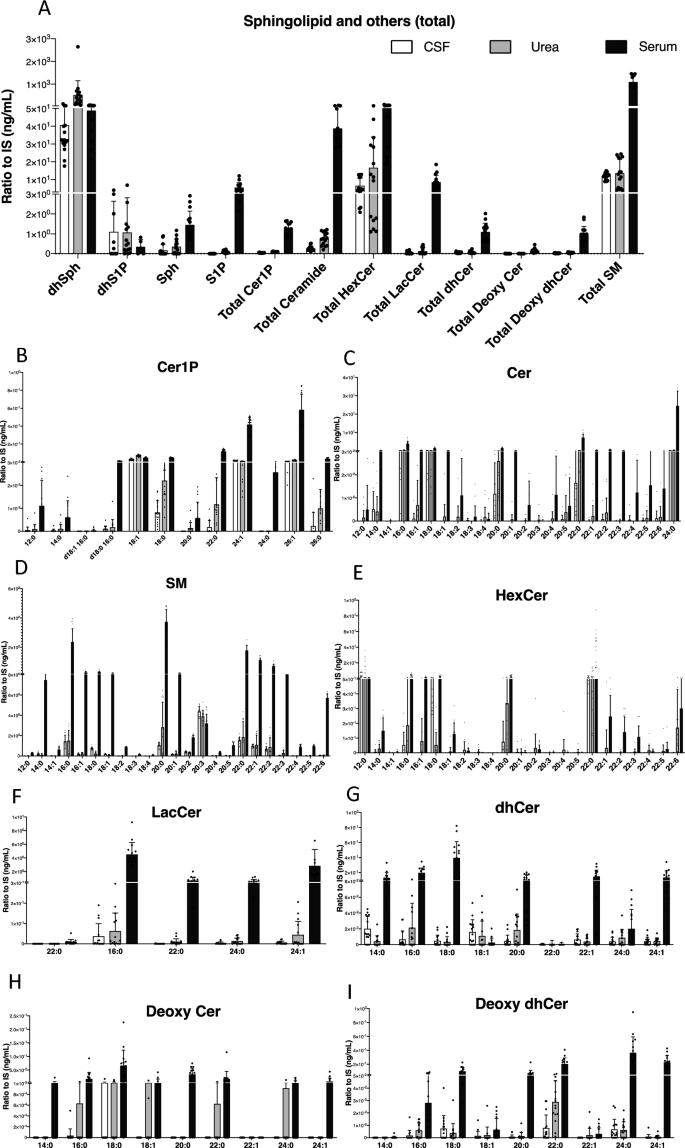
Fig.2 Representative sphingolipid measurements including HexCer-related readouts across human serum, CSF, and urine samples.1
Customer Review
Recommended Products
These representative anti-glycan product categories may support related glycan research, assay development, antigen preparation, or follow-up studies after HexCer and glycolipid analysis.
Carbohydrate Antigen Products
A research-use collection of carbohydrate antigens, including oligosaccharides, nucleosides, monosaccharides, neoglycolipids, and glycans, suitable for glycan-focused antibody generation, binding studies, and assay development.
Learn MoreMonoclonal Antibody Products
Designed for precise glycoepitope recognition, these monoclonal antibody products support high-specificity glycan profiling, binding evaluation, and advanced screening workflows.
Learn MorePolyclonal Antibody Products
These polyclonal antibody products offer broad epitope recognition, strong signal generation, and flexible use in glycoantigen detection, immunoassays, and other applications that benefit from high sensitivity.
Learn More